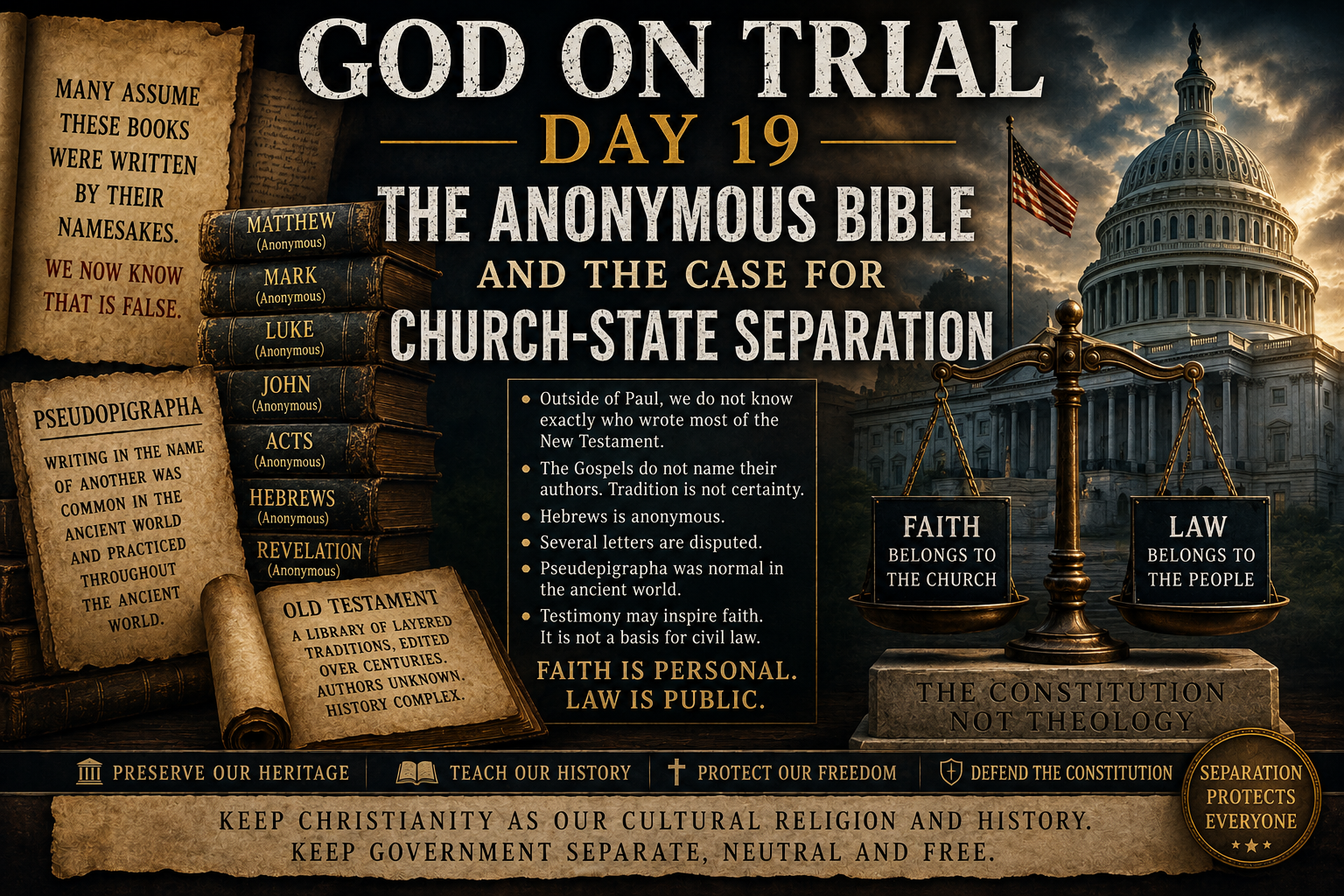
Many Christians grow up assuming something that is rarely examined carefully: that the books of the New Testament were written by the men whose names appear at the top of the page. Matthew wrote Matthew. Mark wrote Mark. Luke wrote Luke. John wrote John. Peter wrote Peter. James wrote James. Paul wrote everything with Paul's name attached to it. That is the Sunday school version. It is not the historical version. The harder truth is that much of the New Testament comes to us through anonymous, disputed or traditionally attributed writings. Outside of the seven letters most scholars accept as genuinely Pauline, which I covered in detail on Day 18, we do not know with certainty who wrote many of the documents that later became Christian scripture. The Gospels do not identify their authors inside the text. Hebrews is anonymous. Several letters attributed to Paul are disputed. Other letters bearing apostolic names are contested by scholars. Revelation names a John, but not clearly John the apostle. Even the Old Testament is a vast library of layered traditions, edited texts, oral histories, priestly material, legal codes, poetry, prophecy and national memory shaped across centuries. None of that makes the Bible worthless. It makes the Bible human. And that distinction matters because a human religious library, however sacred to believers, is not the same thing as a verified public record suitable for governing a secular republic. This is where the separation of church and state becomes not merely a political preference, but a constitutional necessity.
The Problem With "The Bible Says"
In American politics, the phrase "the Bible says" is often used as if it settles the matter. The Bible says marriage is this. The Bible says sex is that. The Bible says gender is this. The Bible says life begins here. The Bible says morality requires this law. But that phrase hides a mountain of historical complexity. Which Bible. Which manuscript tradition. Which translation. Which canon. Which author. Which century. Which context. Which genre. Which redaction layer. Which community preserved it. Which theological fight shaped it. Which later church authority attached a name to it. Which disputed letter is being treated as if it came directly from an apostle. That is not nitpicking. That is the difference between private faith and public law.
A believer has every right to say this text is sacred to me. That is religious liberty. But the state has no right to say this text is sacred to you, therefore it is binding on everyone. That is religious establishment. When lawmakers cite Christian scripture as the foundation for civil restrictions on marriage, reproductive rights, education, speech, science curriculum or personal liberty, they are not merely quoting an old book. They are asking millions of citizens to live under theological claims rooted in writings whose authorship, transmission and interpretation are far more complicated than most pew-level Christianity ever admits.
The Gospels Are Not Signed Eyewitness Reports
The four Gospels are the heart of Christian storytelling. They shape how Christians imagine Jesus, his teachings, his miracles, his death and his resurrection. But the Gospels are not signed eyewitness affidavits. The texts we call Matthew, Mark, Luke and John do not open by saying "I, Matthew, wrote this," or "I, John, the disciple, witnessed these things and now record them." The names are traditional titles attached by the early church, generally a generation or more after the texts themselves were composed. Some Christians may accept those traditions as reliable. That is their right. But tradition is not the same thing as certainty, and it is certainly not the same thing as public evidence.
The Gospels were written in Greek, decades after Jesus, by highly literate authors drawing on earlier oral and written traditions. They were not written as modern biographies. They are theological narratives, shaped by communities trying to explain who Jesus was, what his death meant and how his followers should understand their place in the world after his crucifixion. Again, that does not make them meaningless. It makes them exactly what they are: religious literature, historical memory, theological argument and community testimony. Those categories matter, because testimony may inspire faith, but testimony is not the same thing as law.
Pseudepigrapha Was Part of the Ancient World
Modern readers often assume that if a text bears someone's name, that person wrote it. Ancient literary culture was more complicated than that assumption allows. Pseudepigrapha, writing in the name of a revered figure, was widely practiced in the ancient world. Jewish, Christian, Greek and Roman traditions all contain texts attributed to famous teachers, prophets, apostles or heroes who almost certainly did not personally write them. Sometimes this was done to honor a school of thought. Sometimes it was done to place later teaching under an older authority. Sometimes it was literary convention. Sometimes it was deception. Sometimes the line between homage, tradition and forgery was blurry, and ancient readers themselves debated which side of that line a given text fell on.
That may sound shocking to modern readers, but it was not rare. The ancient world did not have copyright law, footnotes, publishing houses, peer review or modern standards of authorship. Texts circulated by copying. Communities preserved them. Scribes edited them. Traditions grew around them. Names became attached. Authority accumulated over time. That is how religious libraries form. The problem is not that ancient people wrote this way. The problem is that modern politicians pretend they did not.
If a sermon treats a disputed text as sacred, that is religion. If a legislature treats that same disputed text as binding civil authority, that is a constitutional problem.
Paul Is the Strongest Case, and Even Paul Raises Problems
Paul is the strongest case in the New Testament because we do have a core set of letters that the overwhelming scholarly consensus accepts as genuinely his: Romans, 1 and 2 Corinthians, Galatians, Philippians, 1 Thessalonians and Philemon. That matters. Paul is not simply a mythic name floating above anonymous tradition. We have real letters from a real first-century religious thinker wrestling with theology, community conflict, law, faith, resurrection, sin, grace and the meaning of Jesus. But even Paul raises serious church-state problems.
First, Paul was not one of the original disciples during Jesus's ministry. His authority rests on a claimed revelation, a personal encounter with the risen Christ on the road to Damascus that I examined in detail on Day 18, including the contradictions across its three retellings in Acts and the documented medical literature on temporal lobe epilepsy that offers a far simpler natural explanation. That experience may be profound religious testimony, but it is not publicly verifiable evidence. Second, several letters traditionally attributed to Paul are disputed or considered pseudonymous by many scholars, meaning some teachings later treated as Pauline may reflect later church communities writing in Paul's name rather than Paul himself. Third, some of the most politically weaponized Christian ideas in American life do not come from Jesus's direct speech at all. They come from later theological interpretation, much of it Pauline or post-Pauline in origin. None of that means Christians cannot believe those doctrines. They can. It means the government cannot force everyone else to live under them.
Of the thirteen letters traditionally attributed to Paul, only seven enjoy near-universal scholarly acceptance as genuinely his. Six more, including all three Pastoral Epistles, are disputed by a substantial body of critical scholarship, which holds they were written by later followers using Paul's name and reputation to lend authority to their own theological positions decades after his death. That pattern repeats across nearly every layer of the New Testament. The Gospels carry traditional titles attached after composition, not author signatures. Hebrews is and always has been anonymous. Revelation names a John whom scholars cannot confidently identify as the apostle. When the foundational texts of a tradition are this uncertain about their own origins, building binding civil law on top of them compounds uncertainty with coercion.
The Old Testament Has the Same Problem, at Greater Scale
The authorship problem does not begin with the New Testament. The Old Testament is even more complex. It contains law, legend, poetry, prophecy, royal history, wisdom literature, origin stories, national trauma, temple theology and post-exilic identity formation. Many books are traditionally associated with figures such as Moses, David, Solomon, Isaiah or Daniel, but critical scholarship has long recognized layers of composition, editing, compilation and redaction beneath those traditional attributions.
The Torah did not arrive as a signed legal document. The Psalms are not all simply written by David in the way a modern person writes a book. Isaiah contains material that scholars often divide across multiple historical periods centuries apart. Daniel reflects historical and literary questions far more complicated than the average church lesson admits. None of this makes the Old Testament unimportant. It makes it ancient. It makes it layered. It makes it part of the human struggle to understand suffering, law, identity, exile, power, morality, kingship and covenant. That is precisely why it belongs in serious study, as literature, as history, as philosophy, as theology and as cultural memory. But it is not a clean constitutional code for a modern republic.
Why Christianity Must Be Preserved, Not Imposed
This is the part secular critics often get wrong. The answer is not to erase Christianity from American culture. That would be foolish and historically illiterate. Christianity is part of the architecture of the West. It shaped our art, language, literature, music, holidays, moral imagination, universities, reform movements, abolitionist arguments, civil rights rhetoric and ideas of human dignity. You cannot understand America without understanding Christianity. You cannot understand Western law, literature, architecture, painting or political struggle without understanding it either. Christianity should be taught. It should be studied. It should be preserved. Its symbols, stories and moral vocabulary are woven deeply into our cultural inheritance.
But preserving Christianity as history is not the same thing as enforcing Christianity as law. That distinction is everything. A museum preserves. A church proclaims. A university studies. A citizen believes. A government protects the right to believe or not believe. But the state must not preach. That is not hostility to Christianity. It is protection for Christianity and every other belief system simultaneously. Once the government is allowed to enforce religion, religion becomes a political weapon. And once religion becomes a political weapon, the faith itself is corrupted by the power it borrows.
The Establishment Clause Protects Believers Too
Many Christians hear separation of church and state as an attack on religion. It is not. It is one of the greatest protections religion has ever had. The First Amendment does not say religion is bad. It says the government cannot establish one. That protects the atheist from the Christian, the Christian from the Muslim, the Baptist from the Catholic, the Jew from the Protestant majority, the Hindu from the evangelical legislature and the sincere believer from a state-sponsored version of faith that may not match his own convictions at all.
The founders understood something modern religious nationalists often forget: once the state gets to define true religion, the state gets to control religion. That should terrify Christians more than anyone else. If government can enforce your theology today, a different government can enforce someone else's theology tomorrow. If the majority can turn its scripture into law today, another majority can do the same later, against the very tradition that benefited first. The only stable principle is liberty of conscience under a secular state. Secular government is not godless tyranny. It is the neutral ground that allows religious diversity to exist without civil war.
If government can enforce your theology today, a different government can enforce someone else's theology tomorrow. The founders built secular government as the only stable ground precisely because they understood that the next majority might not share your faith.
Anonymous Scripture Should Not Govern Known Citizens
Here is the basic civic problem. We know the citizens who are governed by American law. We know their names. We know they exist. They are Christians, Jews, Muslims, Hindus, Buddhists, atheists, agnostics, deists, pagans and people who do not care about religion at all. They are real people with real bodies, real marriages, real children, real medical decisions, real classrooms and real rights. But when law is justified by ancient scripture, we often do not know the author with certainty. We do not know the community history with certainty. We do not know the textual development with certainty. We do not know the original context with certainty. We do not know how much later interpretation has been poured into the text with certainty either.
That does not mean scripture has no meaning. It means scripture is not a sufficient basis for coercive law. A free republic cannot govern known citizens by anonymous or disputed religious texts. It can allow those texts to guide private conscience. It can allow churches to preach them, families to teach them, scholars to study them and artists to reinterpret them endlessly. But it cannot turn them into binding law for everyone, including the citizens who never accepted the text's authority in the first place. That is the line.
Faith Can Live Without State Power
If Christianity is true, it does not need government force. If it is morally persuasive, it can persuade on its own merits. If it is spiritually transformative, it can transform hearts without legislation. If it is culturally valuable, it can be preserved through education, art, family, tradition and voluntary worship. The moment Christianity needs the state to force compliance, it has already admitted a failure of persuasion. The church does not become stronger when it captures the government. It becomes lazier, harsher and more corrupt. It stops making arguments and starts writing mandates. It stops witnessing and starts ruling. It stops inviting and starts punishing. That is not faith. That is power wearing religious clothing, and the clothing does not change what is underneath it.
My Bottom Line
The Bible is one of the most influential collections of writings in human history. It shaped civilizations. It formed moral imaginations. It gave language to grief, hope, guilt, love, judgment, redemption and human longing. Christianity is central to American and Western history, and any serious education should include it. But the Bible is also an ancient, layered, human-transmitted library filled with anonymous writings, disputed authorship, pseudonymous traditions, editorial development, theological conflict and centuries of interpretation. Outside of the strongest Pauline letters, we do not know with certainty who wrote much of the New Testament. The Old Testament is even more complex. That reality should humble every attempt to turn Christianity into civil law.
A citizen may live by scripture. A church may preach scripture. A scholar may study scripture. A culture may preserve scripture. But a secular republic must not govern by scripture, especially when the authorship, history and interpretation of that scripture are far more uncertain than the political slogans built on top of it. Christianity belongs in America's memory. It belongs in our libraries, museums, churches, classrooms, art and historical consciousness. It does not belong as the operating system of the state.
Anonymous sacred texts, however beautiful or influential, cannot be allowed to overrule known citizens with constitutional rights. That is not an attack on faith. It is the only arrangement that lets every faith, and every absence of faith, survive in the same republic together.
Why This Matters
This matters because the authorship questions raised across this series are not academic trivia disconnected from real consequences. Every time a legislature cites scripture to justify a civil restriction, it is borrowing the authority of a text whose origins are far less settled than the confidence of the citation suggests. A republic that takes its own founding principles seriously has to be willing to ask the texts cited in its statehouses the same questions a graduate seminar would ask without hesitation. Who actually wrote this. When. Why. For whom. Under what pressures. With what later editing. Those questions do not destroy faith. They restore the proper boundary between what a person is free to believe and what a government is permitted to enforce. That boundary is the entire argument of this series, and it does not get less important the further into the text you go. If anything, the deeper you go, the more obviously load-bearing that boundary becomes.
References
- Ehrman, B. (2011). Forged: Writing in the name of God. HarperOne.
- Ehrman, B. (1999). Jesus: Apocalyptic prophet of the new millennium. Oxford University Press.
- Authorship of the Pauline epistles. Wikipedia. Undisputed and disputed letter classifications per critical scholarly consensus.
- Brown, R. E. (1997). An introduction to the New Testament. Doubleday.
- Friedman, R. E. (1987). Who wrote the Bible? Summit Books.
- Collins, J. J. (2014). Introduction to the Hebrew Bible. Fortress Press.
- Madison, J. (1785). Memorial and Remonstrance Against Religious Assessments.
- Jefferson, T. (1802). Letter to the Danbury Baptist Association.
Disclaimer: The views expressed in this post are the personal opinions of the author and are offered for educational, commentary and public discourse purposes only. They do not represent the positions of any institution, employer, organization or affiliated entity. Nothing in this post constitutes legal, financial, medical or professional advice of any kind. This post engages critically with the historical authorship and transmission of specific religious texts and does not make claims about the sincerity of any individual believer's personal faith. References to historical scholarship and textual criticism are based on publicly available sources cited above. Commentary on religious, historical and constitutional subjects reflects the author's independent analysis and is protected expression of opinion. Readers are encouraged to consult primary sources and form their own conclusions.