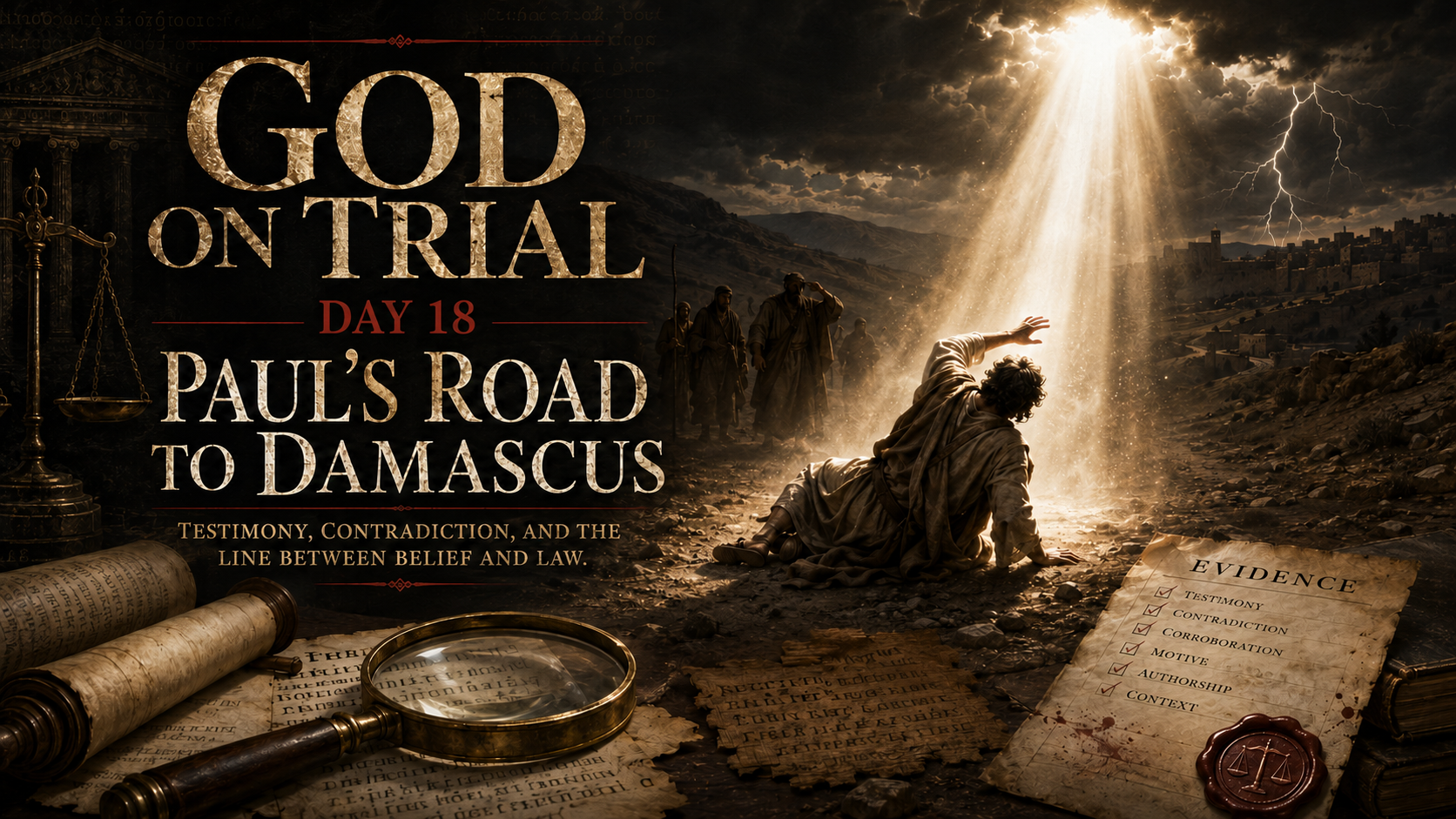
Christianity exists in its current theological form because of one event that nobody but a single man ever claimed to witness clearly, that the New Testament itself describes three contradictory ways, and that has a documented medical explanation requiring no supernatural component whatsoever. That event is Paul's conversion on the road to Damascus. Before this moment, Paul, then called Saul, was a zealous persecutor of the early Jesus movement, present at the stoning of Stephen and actively hunting down Christians for arrest. After this moment, he became the most important theologian in Christian history, the author of seven letters that critical scholarship accepts as genuinely his and the namesake of six more that later followers wrote in his name after his death, together accounting for roughly half the books of the New Testament. He is also, by most historians' accounting, the single individual most responsible for transforming a small Jewish messianic sect into the religion that would eventually conquer an empire. Nearly every distinctive Christian doctrine, from salvation through faith rather than works to the cosmic significance of the crucifixion, traces back to Paul's letters rather than to anything Jesus is recorded as having said. Which makes the reliability of what actually happened on that road a question with civilizational consequences. It deserves the same scrutiny we would apply to any other extraordinary claim of a supernatural encounter, and that scrutiny does not hold up well.
The Myth: A Blinding Light and a Voice From Heaven
The version of this story embedded in popular Christian memory comes almost entirely from the Book of Acts, written by an author traditionally identified as Luke, a follower of Paul who was not present at the event and was writing decades after it supposedly occurred. In Acts 9, Saul is traveling to Damascus with letters from the high priest authorizing him to arrest followers of "the Way." A light from heaven suddenly flashes around him. He falls to the ground. A voice says, "Saul, Saul, why do you persecute me?" Saul asks who is speaking and the voice identifies itself as Jesus. Saul is struck blind, led into Damascus by his companions, and three days later a disciple named Ananias restores his sight, at which point something like scales fall from his eyes and he is immediately baptized.
This is dramatic, cinematic and has been painted by some of the greatest artists in Western history, including Caravaggio. It is also, on close inspection, a story that the New Testament cannot keep straight even within its own pages, and one that Paul himself never describes in anything resembling this level of detail in any of his own surviving letters.
Acts presents this event three separate times within its own text, in chapters 9, 22 and 26, and the details shift each time. In Acts 9, Saul's companions hear nothing but see the light. In Acts 22, Paul tells the crowd that his companions saw the light but did not hear the voice that spoke to him. In Acts 26, the account changes again. Whether Saul fell to the ground varies across the retellings as well. These are not minor stylistic variations. They are the same author, within the same book, describing the same event in mutually inconsistent ways, which is precisely the kind of internal contradiction that would sink any other historical document's credibility as a precise eyewitness record.
The unreliability problem extends beyond the conversion story itself. Critical New Testament scholarship has long divided the thirteen letters bearing Paul's name into two categories: seven undisputed letters that the overwhelming scholarly consensus accepts as genuinely his, and six disputed letters, including the three Pastoral Epistles, that a substantial body of critical scholars believe were written by later followers decades after Paul's death, using his name and reputation to lend authority to their own theological positions. This is not a fringe theory. It is the mainstream position taught in most university religious studies departments, supported by differences in vocabulary, writing style and theological content that the undisputed letters do not share. If a large portion of the New Testament writing attributed to Christianity's most important theologian was not actually written by him, that should recalibrate how much confidence anyone places in the chain of testimony running from a contested desert road experience to the doctrines built on top of it.
What Paul Himself Actually Says
Here is the detail that should stop every reader cold. Paul wrote several genuine letters that survive in the New Testament, including Galatians and 1 Corinthians, and in none of them does he mention a road, a blinding light visible to companions, falling from a horse, three days of blindness or a man named Ananias. In Galatians 1:15-16, Paul's own first-person description of the event that changed his life is remarkably sparse: God, he says, "was pleased to reveal his Son to me." In 1 Corinthians 15:8, Paul lists himself as the last person to whom the resurrected Jesus appeared, placing his experience in the same category as the other resurrection appearances he lists, without elaborating on physical specifics. That is the entirety of what the man who actually had the experience tells us about it in his own words.
Every dramatic element of the popular Damascus road story, the light blinding the eyes, the audible voice, the fall, the three days of darkness, the scales falling away, comes from Luke's account in Acts, written by someone who was not there, decades after the fact, working from secondhand testimony at best. Bart Ehrman, a leading New Testament historian, has noted that Paul's own descriptions are maddeningly terse compared to Luke's vivid narrative, and that historians attempting to reconstruct what actually happened are working with a primary source that gives them almost nothing to work with. When the central architect of Christian theology describes the most important event of his life in two sentences, and a later writer who was not present fills in three chapters of vivid sensory detail, any honest evaluation has to treat the vivid version as a literary and theological composition rather than a transcript.
The man who actually had the experience gave us two sentences. The man who was not there gave us three chapters of blinding light, falling bodies and an audible divine voice. One of those is a testimony. The other is a story being told about a testimony, decades later, for a specific theological purpose.
The Reality: What Medicine Actually Knows About This Pattern
Step back from theology entirely and ask a different question. What do we know, from documented clinical neurology, about people who experience sudden visual disturbances, hear voices, lose consciousness or collapse and then undergo a complete personality and belief transformation? The answer is that this pattern is extensively documented in modern medical literature, and it has a name: temporal lobe epilepsy.
In 1987, neurologist D. Landsborough published a paper in the peer-reviewed Journal of Neurology, Neurosurgery and Psychiatry titled simply "St Paul and Temporal Lobe Epilepsy." Landsborough argued that Paul's recurring "thorn in the flesh," the chronic affliction Paul references in 2 Corinthians 12 alongside his description of being "caught up to paradise" and experiencing other visions, is consistent with complex partial seizures originating in the temporal lobe. Temporal lobe epilepsy is documented to produce auditory hallucinations, including hearing voices that seem to come from an external divine source, visual disturbances including flashes of bright light, a profound sense of religious or mystical significance attached to the seizure experience, and in some cases temporary loss of consciousness or collapse. Patients with this condition frequently describe their seizures using explicitly religious language: a sensed presence, a feeling of cosmic connection, an encounter with the divine. This is not speculation about ancient texts dressed up as science. It is a documented clinical phenomenon studied across decades of modern epilepsy patients who have no connection to Christianity or to Paul whatsoever.
Clinical literature on temporal lobe epilepsy documents auditory hallucinations of voices, visual auras including bright light, a profound and often overwhelming sense of religious significance, sensations of depersonalization and connection to a transcendent presence, and in some patients a permanent personality shift toward heightened religiousness, a documented condition researchers call hyperreligiosity. Some patients also experience hypergraphia, a compulsive drive to write extensively, often on religious or philosophical themes. Paul became one of history's most prolific religious writers immediately following his episode. None of this requires assuming Paul was lying or acting in bad faith. A genuine neurological event can feel, to the person experiencing it, exactly like contact with the divine, while still being fully explainable through documented brain physiology.
The Honest Scientific Caveat
Intellectual honesty requires noting that the temporal lobe epilepsy hypothesis is not universally accepted among scholars who study this question, and a fair treatment of the topic should say so directly. Critics of the Landsborough hypothesis, including a formal response published in the same journal by Brorson and Brewer, have pointed out that the specific combination of symptoms attributed to Paul, an ecstatic aura, a generalized seizure and three full days of postictal blindness, is an extraordinarily rare combination even among documented epilepsy patients, which makes a single, tidy neurological diagnosis harder to establish with confidence centuries after the fact, using a text that was not written as a medical record.
That caveat does not rescue the supernatural explanation. It simply means the explanation might be migraine with aura rather than epilepsy specifically, or a psychogenic non-epileptic event triggered by the well-documented psychological stress of having just participated in the killing of Stephen, a man whose final words Paul would have heard and whose death he had personally enabled. What the caveat absolutely does not do is provide any evidentiary support for the alternative explanation, which is that a deceased religious teacher's spirit spoke audibly from the sky and selected a violent persecutor to become his chief spokesman. Uncertainty about which naturalistic explanation fits best is not the same thing as evidence for a supernatural one. Historians and physicians arguing about whether it was epilepsy, migraine or acute stress response are still operating entirely within the domain of natural explanation. That domain is the philosophy and history department's territory, and arguably the neurology department's. It has never been the science department's job to adjudicate divine revelation, and it has even less business being the foundation of American civil law.
Why This Belongs in Philosophy, Not Reality
This is precisely the distinction this series exists to draw. A philosophy department can and should examine Paul's conversion as a profound case study in religious experience, conviction, the psychology of radical belief change and the sociology of how new religious movements form around a charismatic founder's personal testimony. That is legitimate, valuable academic inquiry into human meaning-making, and it belongs exactly where it is taught: in religious studies, philosophy and the history of ideas. What does not belong anywhere near a science classroom, a biology curriculum or, more urgently, the law of the United States, is the unexamined claim that this event was a literal, verifiable encounter with a resurrected deity, treated as historical fact on the same epistemic footing as a documented battle or a census record.
Yet that is precisely how Pauline theology has been treated in American civic life for much of this country's history. Doctrines that trace directly back to Paul's letters, justification by faith, the nature of sin, the structure of Christian sexual ethics, have been cited as the basis for laws governing marriage, reproduction, education and public morality, as though the chain of reasoning from "a man said a voice spoke to him on a road" to "therefore this should be enforceable civil law" were self-evidently sound. It is not. The framers who built the First Amendment's establishment clause understood exactly this danger: that a sincerely held religious conviction, however powerful to the person who holds it, cannot be the basis for government action binding on citizens who do not share that conviction and have no obligation to accept testimony about a private revelation as a fact about the natural world.
A man's account of a voice on a road, told three contradictory ways by someone who was not there, is not a basis for civil law in a pluralistic republic. It is a profound human testimony worth studying. Those two things are not the same, and conflating them is precisely the error the establishment clause was written to prevent.
The Constitutional Stakes
The reason this matters beyond ancient history is that the doctrines built on Paul's testimony continue to shape American legislation directly. When lawmakers cite scriptural authority rooted in Pauline epistles to justify restrictions on reproductive rights, marriage equality or curriculum content in public schools, they are asking citizens who do not accept the underlying revelation, and citizens who do accept a different revelation entirely, to live under law derived from one man's account of an unverifiable private experience nearly two thousand years ago. James Madison warned explicitly against exactly this dynamic. Religious conviction, however sincere, cannot be allowed to dictate civil law in a republic built on the consent of a religiously diverse population, because doing so necessarily subordinates every citizen who was not present for, does not believe in, or actively rejects the revelation in question.
None of this requires anyone to stop believing Paul had a genuine, transformative, meaningful experience on that road. People have profound experiences constantly, through grief, through psychedelics, through meditation, through illness and through epilepsy, and those experiences can permanently and legitimately reshape a person's entire understanding of their life's purpose. What it does require is a clear, unbending line between a private testimony of personal transformation and a public claim suitable for governing other people's bodies, marriages, classrooms and civil rights. Paul's letters are a remarkable historical and literary document. They are not, and should never be treated as, a scientific record of a verified supernatural event, and they are even less suited to serve as the constitutional foundation of a secular republic that was deliberately built to outlast any single religious tradition's claim to civic authority.
My Bottom Line
The road to Damascus produced one of the most consequential religious transformations in human history. It did not produce reliable historical evidence of a literal divine encounter, and the text's own internal contradictions, combined with Paul's own conspicuously sparse first-person account, should be enough to settle that on textual grounds alone. The medical literature offers a far more parsimonious explanation requiring no violation of the laws of physics, no audible voice from a deceased man, and no special pleading: a documented neurological event, consistent with known clinical patterns, experienced by a man under enormous psychological stress, who then spent the rest of his life interpreting that experience through the only conceptual framework available to a first-century Pharisee. That interpretation produced extraordinary literature and shaped the moral imagination of billions of people. It still belongs in the philosophy and history department, studied as testimony and as a case study in conviction. It has no business being cited as scientific or historical fact, and it has even less business serving as the philosophical foundation for laws that govern Americans who never asked to be bound by a stranger's account of a voice on a desert road two thousand years ago.
A blinding light that three different tellings of the same book cannot agree on is not evidence. It is testimony, and testimony belongs in the humanities, not in the statute books of a secular republic.
Why This Matters
God on Trial exists because the distinction between studying a belief and governing by it has collapsed too often in American civic life, and Paul's conversion is one of the clearest possible test cases for restoring that distinction. Nearly every major Christian doctrine that has been invoked in American legislative debate over the past century traces back, directly or indirectly, to the theological framework Paul constructed after this single contested event. If the event itself cannot survive basic historical and medical scrutiny as a literal, verified occurrence, the doctrines built on top of it deserve to be evaluated as exactly what they are: a coherent, historically significant philosophical and literary tradition, worthy of serious academic study, and entirely unsuited to serve as the operating system for the laws of a secular constitutional republic built to protect the conscience of believer and skeptic alike.
References
- Acts 9:1-19; Acts 22:6-11; Acts 26:9-20. New Testament.
- Galatians 1:15-16. New Testament.
- 1 Corinthians 15:8-11. New Testament.
- 2 Corinthians 12:1-10. New Testament.
- Landsborough, D. (1987). St Paul and temporal lobe epilepsy. Journal of Neurology, Neurosurgery, and Psychiatry, 50 (6), 659-664.
- Brorson, J. R. & Brewer, K. (1988). St Paul and temporal lobe epilepsy [response]. Journal of Neurology, Neurosurgery, and Psychiatry, 51 (6).
- Devinsky, O. & Lai, G. (2008). Spirituality and religion in epilepsy. Epilepsy & Behavior, 12 (4), 636-643.
- Ehrman, B. (2025). The road to Damascus: The true story of Paul's conversion. bartehrman.com.
- Ehrman, B. (2011). Forged: Writing in the name of God. HarperOne.
- Authorship of the Pauline epistles. Wikipedia. Undisputed and disputed letter classifications per critical scholarly consensus.
- Madison, J. (1785). Memorial and Remonstrance Against Religious Assessments.
Disclaimer: The views expressed in this post are the personal opinions of the author and are offered for educational, commentary and public discourse purposes only. They do not represent the positions of any institution, employer, organization or affiliated entity. Nothing in this post constitutes legal, financial, medical or professional advice of any kind. This post engages critically with specific theological doctrines, historical texts and clinical hypotheses, and does not make claims about the sincerity of any individual believer's personal faith. References to historical events, medical literature and theological doctrines are based on publicly available sources cited above. Commentary on religious, historical and constitutional subjects reflects the author's independent analysis and is protected expression of opinion. Readers are encouraged to consult primary sources and form their own conclusions.