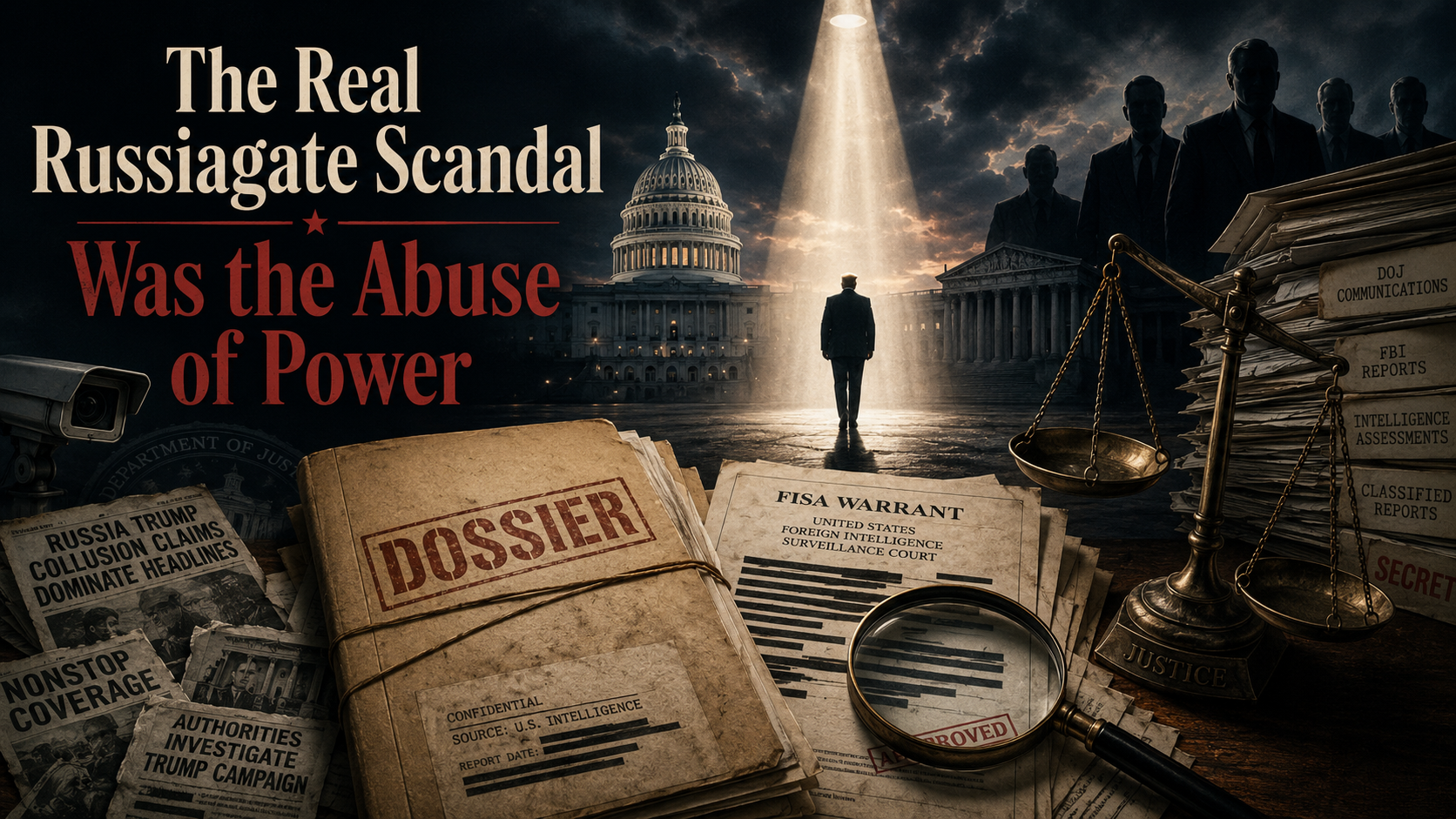
For years, the country was told that the central scandal of the 2016 election was Donald Trump and Russia. The accusation was repeated so often that millions of Americans came to believe it as settled fact: Trump had colluded with Russia, stolen the election and was somehow compromised by Vladimir Putin. But after years of investigations, leaks, cable-news hysteria, congressional hearings, a special counsel report and endless speculation, the core allegation was not proven. The Mueller investigation did not establish that the Trump campaign conspired or coordinated with the Russian government's election-interference operation. Russia interfered in the election. That part is real. But the leap from Russia interfered to Trump criminally conspired with Russia was never proven, and that distinction matters more than the political class has ever been willing to admit.
Who Actually Held the Power
Because if Trump did not control the FBI, the DOJ, the CIA, the NSA, the FISA process or the Obama White House in 2016, then the more serious question becomes obvious: who actually had power at the time, and how was that power used? Trump was a candidate. He was not president. He did not have federal law enforcement at his disposal. He could not open surveillance investigations. He could not approve FISA warrants. He could not brief intelligence agencies. He could not push opposition research through government channels. The people with institutional power were on the other side. That does not automatically prove a criminal conspiracy by Barack Obama or Hillary Clinton. But it absolutely raises a serious abuse-of-power question that should have been investigated with the same intensity, curiosity and outrage that was aimed at Trump. Instead, much of the political class acted as if the only possible abuse was Trump's existence.
The Steele Dossier and the FISA Process
The Steele dossier is where the issue becomes especially troubling. The dossier was opposition research tied to the Clinton campaign through lawyers and Fusion GPS. It was politically funded. It contained serious claims. Many of those claims were unverified, unreliable or wrong. Yet dossier-related material was used in the FBI's surveillance process involving Carter Page. That should alarm every American regardless of party. The government should never be casual about surveilling a U.S. citizen connected to a presidential campaign. The standard should be extremely high. The evidence should be clean. The process should be careful. The court should be told the full truth, especially about political sourcing and weaknesses in the evidence. That did not happen.
The DOJ Inspector General found serious failures in the Carter Page FISA applications. Inspector General Michael Horowitz testified that the Crossfire Hurricane team failed to comply with FBI policies and fell short of what should be expected from a premier law enforcement agency using such an intrusive surveillance tool. That is not a minor paperwork problem. That is a civil-liberties problem. It is a constitutional problem. It is a trust problem, and trust problems of that scale do not get resolved by being quietly filed away once the political news cycle moves on.
What Durham Actually Found
Durham later criticized the FBI's handling of the Trump-Russia allegations, concluding that the bureau moved too quickly and failed to apply the level of caution such a politically explosive matter demanded. His report also discussed intelligence suggesting a possible Clinton campaign effort to tie Trump to Russia politically, while the broader public record still has not proven a criminal Obama-Hillary conspiracy to fabricate the entire investigation. That is the line serious people should be willing to walk. Do not overstate what is proven. But do not minimize what happened either. There was a real Russian interference operation. There were real contacts around Trump's orbit that investigators had reason to look at. But there was also a real pattern of institutional failure, selective skepticism, FISA abuse, politically funded opposition research and media amplification that badly damaged a presidential candidate and then a sitting president.
The Media's Disgraceful Role
The media's role in this story was disgraceful. Too many outlets treated suspicion as proof. They treated leaks as gospel. They treated anonymous claims as near-certain truth. Night after night, the country was fed the idea that Trump was a Russian asset or that the walls were closing in. When the central conspiracy claim failed to materialize, there was no equal reckoning. No real apology. No serious self-examination. That double standard is why public trust collapsed, and it did not collapse because people stopped caring about facts. It collapsed because people watched the facts get bent for years and then watched nobody answer for it.
The mechanism was not one big lie. It was the accumulation of dozens of smaller editorial choices that, stacked together over two years, produced an atmosphere of near-certainty the underlying evidence never supported. The vocabulary did the work first. Cable hosts and prominent commentators reached for the word treason repeatedly, long before any legal process had gotten anywhere close to that threshold. A former CIA analyst told a national television audience flatly: "He's guilty. It's not a question." Clinton's own former campaign manager raised the possibility that Trump aides could be prosecuted for treason. A New Yorker writer described the Trump campaign and Russia as having possibly "knowingly colluded in a clearly illegal and perhaps treasonous manner." These were not fringe voices. They were mainstream commentators on mainstream platforms, and using the word treason casually, night after night, before any evidence supported it, is itself a form of pre-judgment dressed as analysis.
Unverified material got treated as confirmed along the way. The Washington Post's own media critic documented that CNN, MSNBC and other outlets touted the Steele dossier with flimsy corroboration, and that one prominent host became a clearinghouse for dossier-related claims, stating on air that all the supporting details were checking out, even the really outrageous ones. That is a journalist telling an audience that opposition research funded by a political campaign was being independently verified, when it was not. Coverage volume itself helped create the impression of certainty. One analysis found that Russia was the topic of more than half of a prominent host's segments during this period, and critics noted that placing the Russia story at the head of nearly every broadcast fostered the impression that other major stories affecting people's lives were comparatively unimportant.
Multiple outlets ran stories during this period that were later retracted or discredited entirely, including claims that a Vermont power grid had been hacked by Russians and that a Trump server was secretly communicating with a Russian bank. Each individual retraction received far less attention than the original claim. The net effect over two years was a public memory full of damning headlines and comparatively few corrections, which is its own kind of distortion even when no single story was intentionally fabricated.
None of this required a single fabricated fact to produce the public's eventual sense of near-certainty. It required treating speculation as confirmation, treating volume as proof, treating retractions as footnotes and treating the absence of skepticism toward politically convenient sourcing as professionalism. That is the precise mechanism by which suspicion became, in the public mind, something close to a verdict.
If the same facts were reversed, the reaction would still be echoing today. A Republican-funded dossier used in surveillance against a Democratic nominee, federal agencies making major errors in the warrant process and years of media treason talk before the central claim collapsed would not have faded quietly. And it should not have faded quietly here either.
The Question That Actually Matters
The issue is not whether someone likes Trump. The issue is whether federal power can be pointed at a political opponent based on weak evidence, political research and institutional bias. If that can happen once, it can happen again, regardless of which party holds power the next time it does. The real scandal of Russiagate is not simply that Trump was accused. Politicians accuse each other every day. The real scandal is that parts of the federal investigative machinery, the opposition party and the press created a cloud of suspicion that lingered for years without proving the central charge. That is not how a healthy republic is supposed to work.
My Bottom Line
A fair conclusion is this. Russia interfered in 2016. Trump was not proven to have criminally conspired with Russia. The Clinton-funded dossier helped poison the atmosphere. The FBI mishandled the FISA process. The media inflated suspicion into near-certainty. And the people who actually held government power in 2016 were never scrutinized with the same intensity as the man they were investigating. That is the part history should not let slide, because the asymmetry itself is the lesson. A republic that investigates the candidate without power more aggressively than the institutions that actually had power has gotten the accountability question backward.
In America, the most dangerous political abuse is not a loud candidate saying reckless things. It is quiet institutional power being used behind closed doors, then protected by people who insist it was all for the public good.
Why This Matters
This matters because the precedent set by Russiagate does not disappear just because the political moment has moved on. If federal investigative agencies can be pointed at a political campaign based on politically funded opposition research and weak evidentiary standards, and if the people responsible for that face no meaningful accountability once the central claim fails to hold up, then the next administration of either party inherits a playbook rather than a warning. A republic that wants to prevent the next abuse of power has to be willing to name the last one honestly, including when the institutions involved are the ones the political class generally trusts. Selective scrutiny is not accountability. It is just abuse of power wearing a different uniform.
References
- Mueller, R. (2019). Report on the investigation into Russian interference in the 2016 presidential election. U.S. Department of Justice.
- Horowitz, M. (2019). Review of four FISA applications and other aspects of the FBI's Crossfire Hurricane investigation. DOJ Office of Inspector General.
- Durham, J. (2023). Report on matters related to intelligence activities and investigations arising out of the 2016 presidential campaigns. U.S. Department of Justice Special Counsel.
- U.S. Senate Select Committee on Intelligence. (2020). Report on Russian active measures campaigns and interference in the 2016 U.S. election, Volume 5.
- Wemple, E. (2019). Rachel Maddow rooted for the Steele dossier to be true. Then it fell apart. The Washington Post.
- Capital Research Center. (2020). The cast of the Trump-Russia collusion hoax. capitalresearch.org.
- Fairness and Accuracy in Reporting. (2017). "Let's get back to Russia": Media's interest in narrowing the Trump story. fair.org.
Disclaimer: The views expressed in this post are the personal opinions of the author and are offered for educational, commentary and public discourse purposes only. They do not represent the positions of any institution, employer, organization or affiliated entity. Nothing in this post constitutes legal, financial, medical or professional advice of any kind. References to public figures, government reports and investigations are based on publicly available sources cited above and are intended to support analysis, not to state facts about any individual's criminal conduct beyond what the cited sources document. Commentary on political subjects reflects the author's independent analysis and is protected expression of opinion. Readers are encouraged to consult primary sources and form their own conclusions.