I am an atheist, so I am not writing this from the position that religion deserves special cultural privilege. I do not need a baseball game, a workplace or a corporation to promote Christianity, Judaism, Islam, Hinduism, atheism or anything else. I am perfectly fine with a professional setting having rules, uniforms, standards, branding controls and boundaries. But being an atheist does not mean being blind to fairness. The legal and ethical question here is not whether I agree with someone's religious beliefs. The question is whether a corporation can suppress religious expression while allowing other personal, political, cultural or ideological expression. That is where this issue gets more complicated than the usual internet shouting match, and it deserves a more careful answer than either side of that shouting match usually gives it.
What a Private Corporation Can Legitimately Do
A private corporation, including Major League Baseball or any individual team, is not the government. That means the First Amendment usually does not apply the same way it would if a city, school board, police department or other government actor were punishing speech. MLB has brand standards. Teams have uniform rules. Employers can regulate what employees wear, say and display while working. A player does not have an unlimited right to turn his uniform into a personal billboard, and that part of the analysis is straightforward.
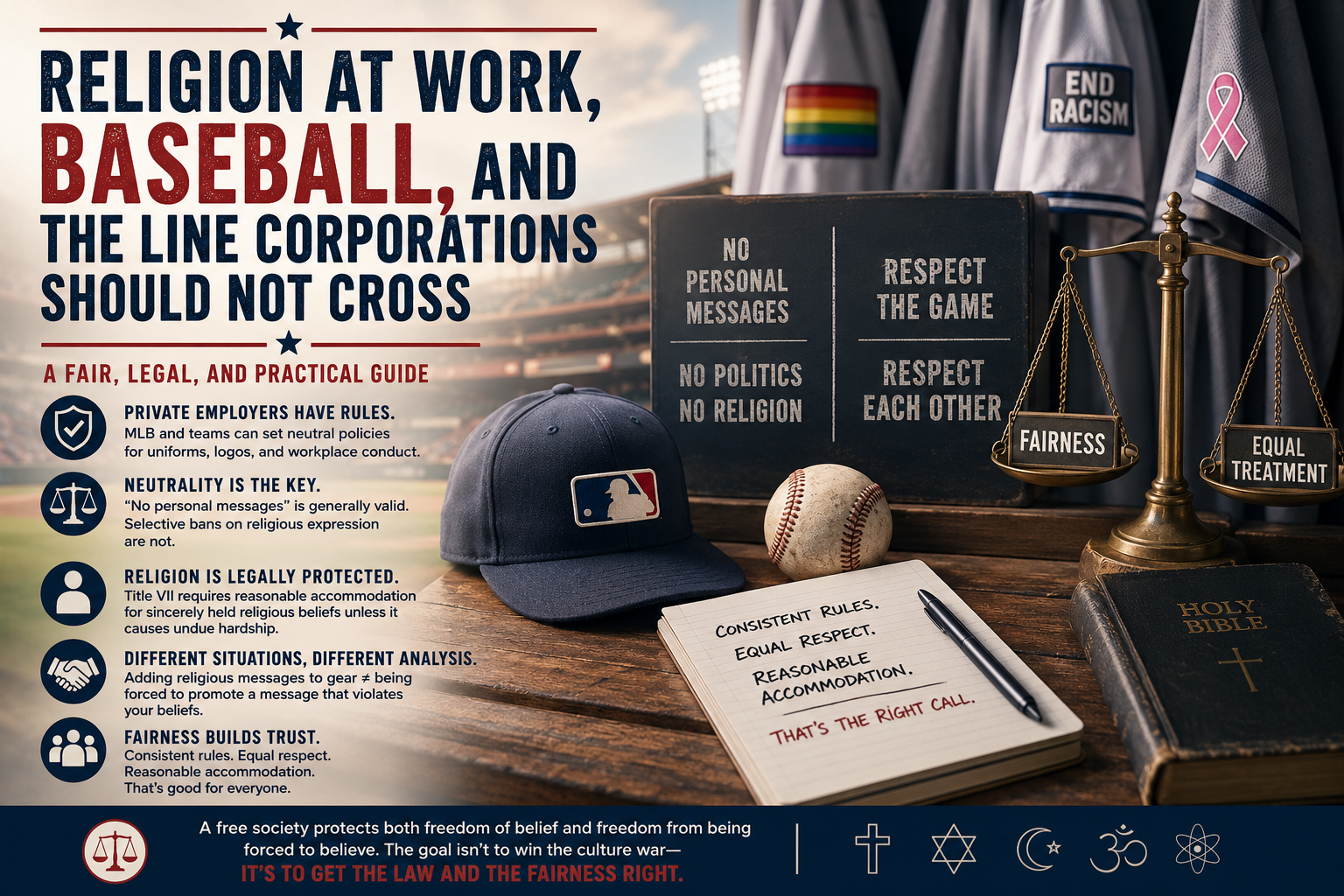
If MLB says no personal messages on hats, jerseys, helmets, eye black, cleats or other official equipment, that is generally a legitimate workplace and brand rule. The league has a real interest in uniformity, sponsorships, broadcast presentation, merchandise standards and avoiding every game becoming a message war. A Bible verse, a political slogan, a personal tribute, a charity slogan and an activist message can all be banned under the same neutral policy. But the key word is neutral. If the rule is no personal messages, it should mean no personal messages. It should not mean no religious messages while other preferred messages are welcomed, celebrated, marketed and sold. That is where a corporation starts moving from neutral workplace management into selective ideological gatekeeping.
What the Law Actually Requires
Religion is a protected category under federal employment law. Title VII of the Civil Rights Act prohibits religious discrimination in employment. It also requires employers to reasonably accommodate an employee's sincerely held religious belief or practice unless doing so would create an undue hardship for the employer. After the Supreme Court's decision in Groff v. DeJoy , that hardship must be more than a minor inconvenience. The employer has to demonstrate a real, substantial burden in the context of its business, not merely a preference for uniformity or a desire to avoid controversy.
That does not mean every religious request must be granted. It does not mean a player can ignore uniform rules whenever he invokes religion. It does not mean a workplace must become a pulpit. But it does mean employers should take religious objections seriously and apply their rules consistently rather than treating religious accommodation requests as uniquely suspect compared to every other category of accommodation the law recognizes.
The first case is an employee adding a religious message to official work gear, such as writing a Bible verse on a hat or adding religious wording to a uniform. MLB has a strong argument here. The uniform belongs to the team and league brand, not the individual player, and if everyone gets to modify it, the uniform stops being uniform. The second case is an employee refusing to participate in a message the employer is actively promoting, such as a themed night with a special cap or patch tied to a social or political cause. That is different. The player is not demanding to promote his own religion. He may simply be asking not to be forced to promote a message he believes violates his conscience. A company has more authority to say "do not add your message to our uniform" than it does to say "you must wear our message even if it violates your religious belief." The first controls employee expression. The second risks compelling employee participation in the employer's expression.
The Question Every Corporation Should Ask Itself
From a fairness standpoint, corporations should ask a simple question: are we enforcing a real neutral rule, or are we picking winners and losers in the culture war? If a league bans all personal messages, that is clean and defensible. If it allows Mother's Day messages, military tributes, cancer awareness gear, Pride symbols, racial justice statements, environmental causes and other approved messaging, then turns around and treats religious expression as uniquely inappropriate, that is not neutrality. That is selective approval dressed up as brand consistency.
People can disagree about whether religion belongs in sports. I personally do not need it there. But I also do not need corporations pretending they are neutral while constantly promoting their own approved moral and political messaging. Modern corporations are not shy about taking public positions. They celebrate causes, sponsor social campaigns, redesign logos, issue statements and run theme nights built around specific values. Once a corporation has done all of that, it becomes much harder to credibly claim that religious expression alone is out of bounds because it is divisive. Almost everything is divisive now. Singling out religion for that label while exempting every other cause the company has chosen to platform is not principle. It is preference.
A corporation does not get to call itself neutral while running theme nights for every fashionable cause and then declaring religious expression uniquely inappropriate because it might offend someone. Offense is not the standard being applied consistently here, and everyone watching can tell.
This Does Not Mean Workplaces Must Become Churches
None of this means MLB or any employer must allow chaos. A professional workplace can still draw reasonable boundaries. It can say official uniforms cannot be altered. It can say employees may not harass customers or coworkers. It can say speech that disrupts operations is not permitted. It can say political and religious debates do not belong in the middle of job duties. What it should not do is create a double standard where secular moral causes are treated as enlightened and religious moral claims are treated as embarrassing or backward. That is not fairness. That is corporate viewpoint preference operating under the cover of brand management.
Why an Atheist Should Care About This
As an atheist, I do not want religion running government. I do not want Christianity, or any religion, imposed through law, and I believe strongly in the separation of church and state. But separation of church and state is not the same thing as treating religious people as second-class employees in private workplaces. Religious liberty is not only valuable for people whose beliefs I share. Rights matter most precisely when they protect people I disagree with, because that is the actual test of whether a principle is genuine or merely convenient.
The same rule should apply in reverse, and this is worth stating plainly. Religious employees should not be allowed to use the workplace to harass others, attack gay coworkers, demean nonbelievers or refuse to perform the basic job duties they were hired to do. Religious accommodation is not a license to mistreat people. It is a legal requirement to make reasonable room for conscience where doing so does not substantially burden the employer's business. That balance is not always easy to draw in specific cases, but the underlying principle is simple: corporations should be consistent in both directions.
What Consistency Actually Looks Like
If the rule is no personal messages, enforce no personal messages, full stop, for everyone. If the company allows approved messages for certain causes, it should not pretend that only religious messages are improper additions to that list. If an employee wants to add personal religious expression to official gear, the employer may have a genuinely strong reason to say no, the same reason it would have for any other personal modification to standardized equipment. If an employee wants to opt out of promoting a specific message that violates a sincerely held religious belief, the employer should look hard for a reasonable accommodation before reaching for punishment. None of this is a pro-religion argument. It is a pro-fairness argument, and the distinction matters because the alternative, an employer that treats its own preferred causes as default and everything else as a problem to be managed, is not actually neutral no matter how it describes itself.
My Bottom Line
A free society does not require every workplace to become a church. It also does not require every religious employee to check his conscience at the door while corporations promote every other fashionable cause without a second thought. The better standard is viewpoint consistency, equal treatment and reasonable accommodation applied the same way regardless of which belief system is asking for room to exist. MLB and other corporations are allowed to manage their brands. They are not wise to manage them with a double standard, and legally, if they do, they may eventually discover that religious liberty is not just a slogan for believers. It is part of the employment law framework that protects everyone's conscience, including people like me who do not believe at all.
Rights matter most when they protect people you disagree with. A corporation that only respects conscience when the cause is fashionable has not discovered fairness. It has discovered marketing.
Why This Matters
It matters because the workplace is where most Americans spend the majority of their waking lives, and the standards corporations apply there shape what people believe is normal and acceptable far beyond any single industry. When a corporation treats religious conscience as uniquely suspect while celebrating every other category of belief and identity, it teaches employees and the public that some forms of conviction deserve protection and others deserve management. That lesson does not stay contained to baseball uniforms. It shapes how people think about pluralism generally, and a society that wants genuine pluralism needs its largest and most visible institutions to apply the same rule to every belief system, including the ones currently out of fashion.
References
- Civil Rights Act of 1964, Title VII, 42 U.S.C. § 2000e. Prohibition of religious discrimination in employment.
- Groff v. DeJoy, 600 U.S. 447 (2023). Supreme Court ruling on religious accommodation and undue hardship standard.
- U.S. Equal Employment Opportunity Commission. Religious discrimination guidance. eeoc.gov.
- Major League Baseball. Uniform regulations and official equipment standards. mlb.com.
Disclaimer: The views expressed in this post are the personal opinions of the author and are offered for educational, commentary and public discourse purposes only. They do not represent the positions of any institution, employer, organization or affiliated entity. Nothing in this post constitutes legal, financial, medical or professional advice of any kind. References to legal standards, court decisions and league policies are based on publicly available sources cited above. Commentary on legal and cultural subjects reflects the author's independent analysis and is protected expression of opinion. Readers are encouraged to consult primary sources and form their own conclusions.