
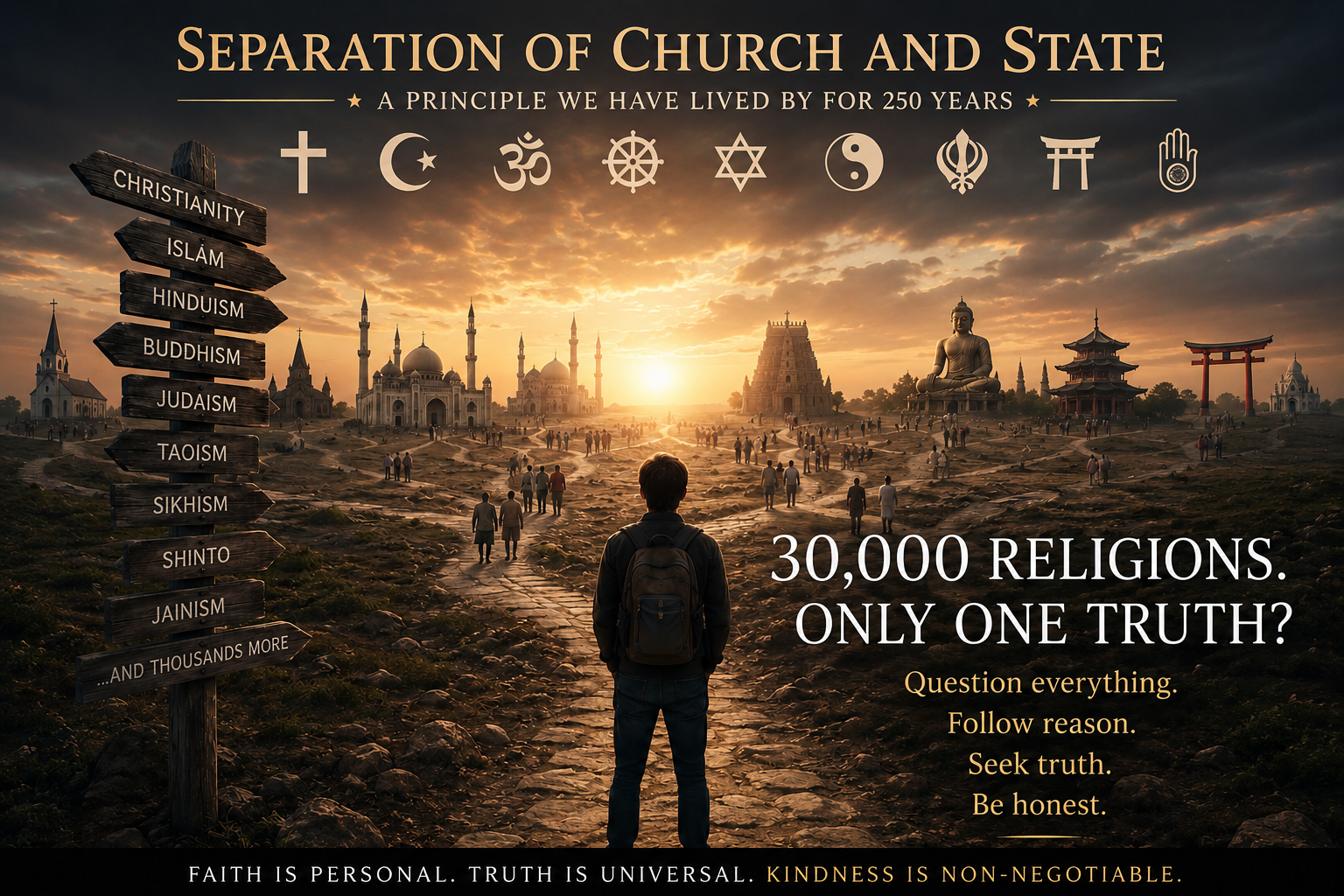
Scholars who study religion estimate that between 4,200 and 10,000 distinct religions are currently practiced on earth. If you count every distinct denomination, sect, splinter group and tribal tradition separately, the number climbs toward 30,000. Every one of them has adherents who believe, with varying degrees of conviction, that their version of the divine is the correct one. Every one of them has a theology, a set of sacred texts, a moral code and a community that reinforces the belief that this, here, is what God actually wants from human beings. Most of them cannot be right. The mathematics alone are damning. If there is one true religion among the thousands, then the overwhelming probability is that any given believer was born into the wrong one and has spent their life confident of something that is false. This is the elephant in the room that religious apologists have been navigating around for centuries. It does not get discussed in Sunday sermons. It does not appear prominently in theological training. It is the question that, if asked directly and honestly, makes the entire enterprise of religious certainty look like something other than faith. It looks like a psychological condition.
The Numbers Nobody Wants to Talk About
Let us be precise about what we are discussing. The World Christian Encyclopedia, one of the most cited academic references on global religion, identifies approximately 10,000 distinct religions currently practiced worldwide. If you include all Christian denominations separately, the number of distinct Christian traditions alone exceeds 45,000 by some scholarly counts. The 30,000 figure cited across multiple comparative religion texts represents a middle estimate that encompasses major world religions, their denominations, regional variants, syncretic traditions, indigenous spiritual systems and active new religious movements. The exact count varies by methodology but the order of magnitude is consistent. We are talking about tens of thousands of distinct religious traditions each making claims about the nature of reality, the character of the divine and the moral obligations of human beings.
Of those tens of thousands, many make mutually exclusive claims. Islam holds that Jesus was a prophet but not divine. Christianity holds that Jesus was God incarnate. Judaism holds that Jesus was neither. These three positions cannot all be correct. Hinduism's understanding of the divine as a multiplicity of manifestations of one ultimate reality cannot be simultaneously true with the strict monotheism of Islam. The Buddhist position that the question of God's existence is largely irrelevant to enlightenment cannot be reconciled with the evangelical Christian position that belief in a specific God through a specific savior is the precondition for eternal life. These are not minor differences in emphasis. They are contradictions at the level of fundamental ontology. When religious believers say they respect all faiths, they are almost always not saying they believe all faiths are equally true. They are saying they believe in tolerance while privately maintaining that their own version is correct and the others are not.
If there are 30,000 distinct religious traditions and only one is correct, the prior probability that any given person was born into the correct one is approximately 0.003 percent. If religious truth is distributed randomly across the human population, then the overwhelming majority of people who have ever lived and died in sincere religious certainty were sincerely and completely wrong. The confident Christian in Alabama, the devout Muslim in Tehran, the practicing Hindu in Mumbai and the traditional Buddhist in Tokyo cannot all be correct about the fundamental nature of the divine. One of them might be. Most of them are not. Religious certainty in the face of these numbers is not faith. It requires something else to explain it.
Where Religious Certainty Actually Comes From
The most important and least discussed fact about religious belief is that it is almost entirely determined by geography and family of origin. A child born in Saudi Arabia to Muslim parents will almost certainly become Muslim. A child born in rural Mississippi to Baptist parents will almost certainly become Baptist. A child born in Israel to Orthodox Jewish parents will almost certainly become Orthodox Jewish. A child born in rural India to Hindu parents will almost certainly become Hindu. This is not a knock on any of these traditions. It is an empirical observation about how religious belief actually propagates through human populations. It does not propagate primarily through evidence, rational argument or independent spiritual investigation. It propagates through socialization, family structure, community belonging and the immense psychological power of the beliefs a child absorbs before they can evaluate them critically.
The philosopher George Santayana noted that each religion is true in its own way, meaning that each religion expresses genuine human needs, fears, hopes and social realities. What it does not mean is that each religion is factually correct about the nature of God. The subjective truth of religious experience and the objective truth of religious doctrine are two entirely different things. A Muslim mystic may have a genuine and profound spiritual experience. That experience does not prove the truth of Islam's specific theological claims over Hinduism's specific theological claims. A Christian in the grip of conversion may feel genuinely transformed. That feeling does not establish that the Nicene Creed is a factual description of divine reality rather than a fifth-century political document. The felt reality of religious experience is real. The leap from felt reality to universal doctrinal truth is enormous and almost never examined honestly by the people who make it.
The Psychological Architecture of Certainty
What psychological machinery does it take to look at a world containing 30,000 competing religious traditions and conclude with confidence that yours is the correct one? This is worth examining carefully because it reveals something about the human mind rather than anything about the divine. The machinery includes at minimum three interlocking mechanisms: confirmation bias, motivated reasoning and what psychologists call in-group favoritism.
Confirmation bias means that people preferentially notice and remember evidence that supports what they already believe and discount or ignore evidence that contradicts it. A religious believer who prays and then recovers from illness will attribute the recovery to prayer. The same believer who prays and does not recover will attribute the outcome to God's will, a lesson being taught or a plan not yet visible. Both outcomes confirm the belief. No outcome can disconfirm it. That is not a robust epistemic framework. That is a closed system that protects itself from challenge by design.
Motivated reasoning is the tendency to reason toward conclusions we want to reach rather than conclusions the evidence supports. People who want their religion to be true will evaluate arguments for it more favorably than arguments against it, will find theological responses to hard questions more satisfying than they would if the same responses were applied to a competing religion they did not want to believe and will experience doubt as a threat to be overcome rather than information to be evaluated. The motivation to believe is doing enormous work that the reasoning process is given credit for.
In-group favoritism means that human beings are biologically predisposed to favor the beliefs, customs and people of the groups they belong to and to be skeptical of outgroups. Religion is among the most powerful in-group identifiers in human history. The belief that your religious community holds the truth is inseparable from the belief that your community is the right one to belong to, that your parents and grandparents were wise rather than deceived, that your moral code is correct rather than arbitrary and that your identity is grounded in something real. Questioning the theology means questioning all of that at once. The psychological cost of honest doubt is enormous. Most people do not pay it.
Religious certainty is not primarily the product of spiritual investigation. It is the product of birth, geography, family, community and the enormous psychological cost of genuine doubt. A person who was born in Tehran and raised in Mecca would almost certainly be Muslim today. That is not evidence of Islam's truth. It is evidence of how religious certainty actually works.
The Elephant in the Room: Why This Matters for Public Life
The certainty problem is not merely a private philosophical puzzle. It is the reason religion must be kept strictly in its lane in public life. When a religious tradition claims the right to govern the behavior of others, to write law based on its theology, to impose its sexual ethics on non-believers, to control what children learn in schools, to deny medical care on doctrinal grounds or to structure civil law around its particular reading of the divine will, it is making a political claim on the basis of theological certainty. And that theological certainty, as we have now established, is almost certainly wrong in the sense that 29,999 out of 30,000 versions of it cannot simultaneously be correct.
This is the argument that religious apologists never successfully answer. They can argue about which religion is correct. They can marshal evidence, cite scripture, point to personal transformation and make philosophical arguments for theism. What they cannot do is explain why the civil law of a pluralistic society should reflect one religion's theology when the people subject to that law belong to dozens of other religious traditions, each equally confident of its own truth, and when a large portion of the population belongs to no religious tradition at all. The Muslim who is subject to a Christian-derived abortion law and the atheist who is subject to a religiously motivated drug prohibition and the secular Jew who is subject to evangelical sexual ethics are all being governed by someone else's theological certainty. And that theological certainty, as a matter of statistical fact, is almost certainly wrong.
The Philosophy of Religious Certainty
Epistemology is the branch of philosophy concerned with how we know what we know. It asks about the nature of knowledge, belief and justification. When philosophers apply epistemological standards to religious belief, the results are uncomfortable for believers because the standards that would justify certainty in other domains do not appear to be met in the religious domain. We are certain that the earth orbits the sun because we have independent evidence from multiple observational traditions, mathematical models that predict outcomes correctly, physical experiments consistent with the theory and no serious competing explanation. The certainty is grounded in a method that could in principle produce different results if the evidence were different.
Religious certainty is not grounded in anything like that method. It is grounded in scriptural authority, personal experience, tradition, community reinforcement and the intuition that the universe requires explanation. None of those grounds is sufficient to produce certainty about specific theological claims. Scripture is a human document with a human history, written in human languages, edited by human committees, translated through human interpretive traditions and read through lenses shaped by the culture and period of the reader. Personal experience is real but not self-interpreting. A feeling of divine presence does not establish which divine is present, or whether the experience reflects contact with a transcendent reality or a neurological state. Tradition is not evidence. The fact that billions of people have believed something across many centuries does not make it true. Many billions of people believed the sun orbited the earth across many centuries. They were wrong.
What Genuine Humility Would Require
A genuinely humble religious epistemology would acknowledge that its claims about the divine are held on faith rather than on evidence sufficient to justify certainty, that other religious traditions are held with equal sincerity and equal conviction and that the person holding these beliefs would almost certainly hold different ones if they had been born elsewhere. That does not mean religious belief is false. It means that the certainty with which religious beliefs are held is almost never epistemically justified by the actual evidence available to the believer.
Genuine humility would also require acknowledging that using theological certainty as the basis for imposing obligations on others is a form of coercion that cannot be justified in a pluralistic society. The person who says I will not eat pork because my religion forbids it is exercising personal religious freedom. The person who says pork should be illegal because my religion forbids it is using their unjustified theological certainty to govern the behavior of people who do not share it. The first is a legitimate expression of faith. The second is a category error that democracies have been fighting to correct for three centuries. Many of them have not finished the fight because the religions doing the governing are also the religions defining the debate.
The Specific Insanity of Exclusive Truth Claims
The most philosophically aggressive religious traditions do not merely claim that they have found a path to God. They claim that theirs is the only path, that all other paths lead away from God rather than toward him, that billions of sincerely devout human beings across centuries of religious practice have been fundamentally wrong about the nature of reality and that the correct view happens to be the one held by the person making the claim. This is the position of traditional Christianity, traditional Islam and Orthodox Judaism in their most unqualified forms. It is an extraordinary claim. It deserves extraordinary scrutiny.
Consider what an exclusive truth claim requires you to believe. It requires believing that the billions of Hindus who have lived and died in sincere devotion across four thousand years of practice were not approaching the divine at all. It requires believing that the hundreds of millions of Buddhists who have achieved states of profound peace, compassion and wisdom through their practice have been on the wrong path. It requires believing that the indigenous spiritual traditions of every people on every continent that predated your religion were not merely different but completely mistaken about the fundamental nature of existence. It requires believing that God either did not notice these billions of people pursuing him by the wrong method, or noticed and allowed most of his creation to wander in error, or actively misled them, or created them knowing they would seek him through the wrong path. None of those possibilities reflects well on the God being defended.
Ask any person who holds their religion to be exclusively true: if you had been born in a different country, to different parents, in a different century, what religion do you think you would hold with equal certainty? Almost no one answers that they would have conducted an independent global religious investigation and arrived at the same conclusion through dispassionate inquiry. Almost everyone, if honest, acknowledges they would believe what the people around them believed. That acknowledgment, if fully absorbed, is the end of religious certainty as an epistemic position. It does not end religious practice or religious meaning. But it ends the claim that certainty is justified.
Why Religion Must Stay in Its Lane
The case for keeping religion in its lane is not primarily a case against religion. It is a case against unjustified certainty governing people who do not share it. Religious communities are legitimate. Religious practice is a profound human good for billions of people. The spiritual, communal, psychological and ethical contributions of religious traditions to human civilization are real and deserve acknowledgment. The argument here is not that religion should disappear. The argument is that the political authority claimed by religious institutions and believers on the basis of their theological certainty is not justified by anything that would satisfy the epistemic standards we apply elsewhere.
When a religious majority uses its political power to impose its sexual ethics on a sexual minority, it is imposing unjustified theological certainty on people who do not share it. When a religious tradition uses its cultural authority to shape what children learn about the origins of life, it is replacing demonstrable science with unjustified theological certainty. When a religious institution claims the right to exempt itself from civil laws protecting workers, children or vulnerable people, it is claiming that its theological authority supersedes the secular authority that governs everyone else. In each case, the claim rests on theological certainty that the arithmetic of 30,000 religions alone should give us serious reason to question.
My Bottom Line
The certainty problem is the elephant in every room where religion and public life intersect. There are roughly 30,000 religious traditions on earth, each holding claims about the nature of God, the obligations of humanity and the path to salvation or enlightenment. Most of them cannot be right. The statistical probability that any given believer was raised in the correct one is negligibly small. The mechanisms by which religious certainty is produced, geography, family, socialization, confirmation bias and the enormous psychological cost of doubt, are not mechanisms that tend to produce accurate beliefs about the nature of reality. They are mechanisms that tend to produce inherited beliefs reinforced by community. The philosophical case for treating any particular religious tradition's certainty as sufficient grounds for governing others is simply not available. It is not a matter of hostility to religion. It is a matter of arithmetic, psychology and basic epistemology.
The right of every human being to pursue their own understanding of the divine, to practice their own faith, to find meaning in their own tradition and to live according to their own theological convictions is one worth defending absolutely. What is not worth defending is the extension of that private certainty into public law, public education and the civil rights of people who do not share it. If you want to know why the founders of the American republic were so insistent on the separation of church and state, the certainty problem is the answer. They had watched what happens when theological certainty governs civil life. They built the wall specifically to prevent it from happening again. We owe it to the republic to keep that wall standing.
Every religion thinks it is the one true religion. That cannot all be true. The psychology required to maintain absolute certainty against those odds is not a spiritual virtue. It is a warning sign. And it is precisely why theological certainty should never be allowed to govern people who do not share it.
Why This Matters
This matters because the certainty problem is not going away. New religious movements form constantly. Old ones splinter. Sects multiply. Each new division produces a new community of people certain that they, now, have gotten it right in ways the parent tradition missed. The total number of competing certainties grows while the evidence base for any of them remains exactly what it has always been: tradition, scripture, personal experience and community reinforcement. A society that allows any of those competing certainties to govern it has chosen to be ruled by something other than reason and evidence. The founders understood this. Enlightenment philosophers argued it. The history of theocracy demonstrates it. The elephant in the room does not disappear when you refuse to name it. It just gets bigger.
References
- Barrett, D. B., Kurian, G. T. & Johnson, T. M. (2001). World Christian encyclopedia: A comparative survey of churches and religions in the modern world. Oxford University Press. [Identifies approximately 10,000 distinct religions worldwide]
- Prothero, S. (2010). God is not one: The eight rival religions that run the world. HarperOne.
- Smith, H. (1991). The world's religions. HarperOne.
- Stark, R. & Finke, R. (2000). Acts of faith: Explaining the human side of religion. University of California Press.
- Plantinga, A. (2000). Warranted Christian belief. Oxford University Press.
- Flew, A. (2007). There is a God: How the world's most notorious atheist changed his mind. HarperOne.
- Kahneman, D. (2011). Thinking, fast and slow. Farrar, Straus and Giroux. [On confirmation bias and motivated reasoning]
- Norenzayan, A. (2013). Big gods: How religion transformed cooperation and conflict. Princeton University Press.
- Shermer, M. (2000). How we believe: Science, skepticism and the search for God. W.H. Freeman.
- James, W. (1902). The varieties of religious experience. Longmans, Green and Co.
Disclaimer: The views expressed in this post are the personal opinions of the author and are offered for educational, commentary and public discourse purposes only. They do not represent the positions of any institution, employer, organization or affiliated entity. Nothing in this post constitutes legal, financial, medical or professional advice of any kind. This post engages critically with specific theological doctrines and institutional religious ideas and does not make claims about individual believers or the sincerity of individual faith. References to historical events, theological doctrines and published scholarship are based on publicly available sources cited above. Commentary on religious and philosophical subjects reflects the author's independent analysis and is protected expression of opinion. Readers are encouraged to consult primary sources and form their own conclusions.