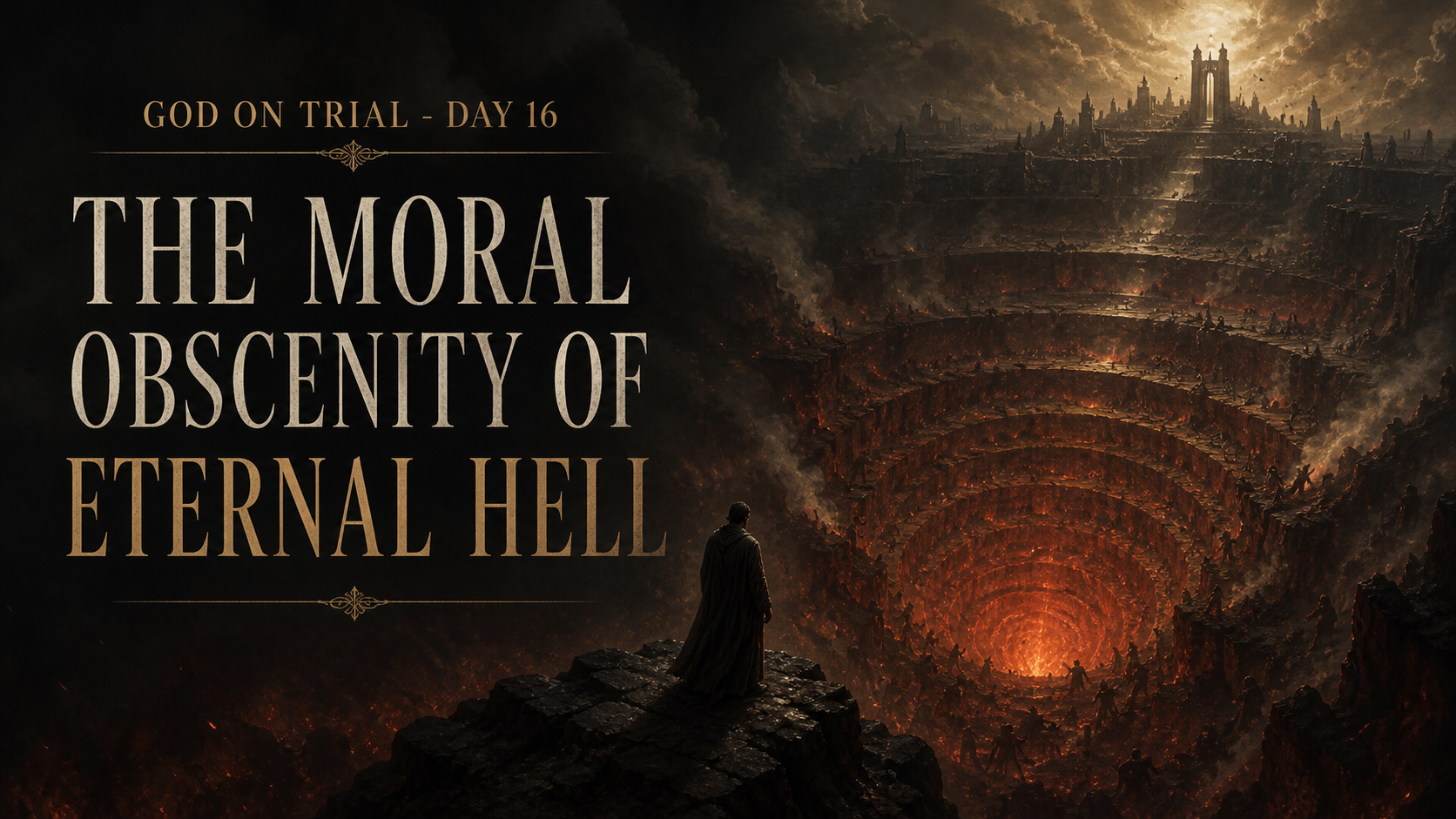
Christianity asks us to believe that a loving God created human beings, placed them into a world of confusion, suffering, biology, culture, trauma, fear, ignorance and unequal opportunity, then threatened them with eternal torment for getting the answer wrong. That is not justice. That is not love. That is not moral order. It is power wrapped in theology. Hell is often defended as the necessary counterpart to heaven — good must be rewarded, evil must be punished, choices must have consequences and the moral universe must mean something. That sounds reasonable until you examine what the doctrine actually claims. Christianity does not merely teach that wickedness has consequences. It teaches, in many of its traditional forms, that finite human beings can deserve infinite punishment. A person can live seventy years, think the wrong thoughts, reject the wrong creed, belong to the wrong religion, doubt the wrong claim or fail to accept the correct savior, then face torment without end. No parole. No correction. No rehabilitation. No completion. Just punishment as permanence. That is where the doctrine collapses morally. Hell does not solve the problem of evil. It multiplies it. It takes the suffering already visible in this world and adds an eternal torture chamber underneath it, then asks us to call the architect of that system good.
The Proportionality Problem
Every civilized concept of justice depends on proportionality. The punishment should fit the crime. We do not execute shoplifters. We do not imprison children for life because they lied. We do not torture criminals indefinitely because we understand, at some basic moral level, that punishment without proportion is not justice - it is cruelty. Christian hell destroys proportionality completely. Even granting, for the sake of argument, that human beings sin, fail, harm others and fall short morally, the leap from finite wrongdoing to eternal torment is impossible to defend. No finite act can rationally merit infinite punishment. A lifetime of error, even serious error, cannot justify never-ending conscious suffering. The math does not work. The moral structure does not work. The emotional appeal does not work. A person may be guilty. A person may deserve accountability. But eternal punishment is not accountability. It is vengeance with no limiting principle.
And that matters because Christians do not typically present hell as a metaphor for moral seriousness. They present it as a real possibility. They warn children about it. They preach it from pulpits. They build entire conversion strategies around it. Believe, or burn. Accept Christ, or suffer forever. Join the saved, or be cast out. That is not moral persuasion. That is cosmic coercion. The distinction is important because it reveals what the doctrine is actually doing: it is not describing the natural consequences of moral choices. It is threatening finite beings with infinite suffering to compel compliance. A faith that must threaten children with eternal fire to recruit them is not offering good news. It is offering terror with a theological wrapper.
The Problem of Divine Responsibility
A common Christian defense argues that God does not send people to hell - people choose hell by rejecting God. That answer sounds clever until examined. If God created the system, God is responsible for the system. If God created human beings knowing in advance that many would end in eternal torment, God is responsible for the outcome. If God had the power to design a different system - one with correction, restoration, finite punishment or universal reconciliation - then choosing eternal punishment is a divine decision, not a human one. You cannot build the prison, write the law, define the offense, control the evidence, know the verdict before birth and then claim the condemned inmate chose the sentence. That is not free will. That is theological blame-shifting.
The Christian God, as traditionally described, is not a limited judge working under constraints someone else set. He is the supposed author of reality itself. He could have made a world where moral growth continues after death. He could have made a world where punishment is corrective rather than endless. He could have made a world where ignorance is healed instead of damned. He could have made a world where finite creatures are never exposed to infinite ruin. If hell exists, God chose hell. That is the point defenders keep trying to move past. It does not move.
A decent human judge considers age, capacity, intent, mental state, coercion, prior abuse, evidence, remorse and proportionality. Christian hell ignores all of that. It reduces the complexity of human life to saved or damned. If divine justice appears indistinguishable from infinite cruelty, the honest response is not worship. It is refusal.
The Child in the Pew
Hell is not merely an abstract doctrine debated by theologians. It is preached to children, and that alone should make decent people pause. Millions of children have been told that they are born sinful, watched by God, vulnerable to demons, destined for judgment and at risk of eternal torment if they do not believe correctly - before they can think critically, before they understand metaphor, before they can distinguish inherited religious fear from moral truth. A child who believes in hell does not process it as a philosophical category. A child processes it as terror. What if I die tonight? What if I had a bad thought? What if I did not really mean the prayer? What if my friend is going to hell? What if my mother is not saved? That is not spiritual formation. That is fear conditioning.
The fact that many adults later soften the doctrine does not erase the damage done by teaching it plainly in childhood. A child does not hear "eternal separation from God" as a refined theological concept. A child hears fire, darkness, screams and no way out. The adult calls it doctrine. The child experiences it as a threat. A moral God would not need to frighten children into loving him. A parent who told a child that love me or I will hurt you forever was not expressing love. They were expressing control. The theological version of that relationship deserves the same moral verdict.
Modern Christians often retreat from the old imagery. They say hell is not really fire. It is separation from God. It is the soul choosing isolation. It is self-exclusion from divine love. This softer language is designed to make hell sound less barbaric. It fails. Eternal separation from God, if God is the source of all goodness, joy, peace and life, is still eternal misery. Whether the condemned are burning, frozen, isolated or spiritually desolate, the doctrine still claims that conscious beings may suffer forever under a system created and sustained by God. The modern version also creates its own problem: if hell is separation from God and God is omnipresent, what does separation even mean? If God sustains all existence, then even hell must exist by God's will. If the damned continue to exist, God continues to hold them in being. Their suffering is not happening outside his power. It is happening inside it. That means God is not merely permitting hell. God is maintaining hell. A loving God could end it at any moment. He does not. That is the moral problem that philosophical language cannot dissolve.
The Belief Test Problem
Hell becomes even more morally incoherent when tied to belief rather than conduct. Christianity has often taught that rejecting Christ, failing to accept the Gospel or dying outside the faith can place a person under eternal condemnation. This creates a grotesque moral equation. A kind Hindu grandmother, a skeptical scientist, a Muslim child, a Buddhist monk, an isolated tribesman, a traumatized ex-Christian and a decent atheist may all be at risk because they did not accept the correct theological claim. Meanwhile, a murderer who sincerely repents before death may receive paradise. Christians will answer that salvation is by grace, not merit. That is exactly the problem. A system that can damn decent unbelievers and save repentant monsters is not morally superior to human justice. It is morally incoherent.
Belief is not entirely voluntary. People believe based on evidence, upbringing, temperament, education, trauma, culture and experience. A person raised in Iran is more likely to be Muslim. A person raised in India is more likely to be Hindu. A person raised in Alabama is more likely to be Christian. A person raised in a secular academic household is more likely to doubt religion altogether. If God judges belief while distributing evidence unevenly across history and geography, then God is judging people under conditions he created and controls. The responsibility returns to the designer every time the argument tries to relocate it to the individual.
Justice or Revenge?
There is a meaningful distinction between justice and revenge. Justice aims to correct moral imbalance. It protects the innocent, restrains the dangerous, names wrongdoing and imposes consequences within moral limits. Revenge is different. Revenge enjoys the suffering. It wants the offender diminished, humiliated and hurt without asking what the punishment accomplishes. Hell looks far more like revenge than justice. What purpose does eternal torment serve after the first million years? What moral lesson is being learned after the first billion? What restoration is possible when the sentence never ends? What justice is achieved by conscious suffering that continues forever with no mechanism for repair? If the answer is that God's holiness requires it, then holiness has been redefined as cruelty. If the answer is that sin against an infinite God requires infinite punishment, then God's ego has become the measure of justice. If the answer is that humans had their chance and lost it, then grace has limits far smaller than the church advertises. The doctrine of hell does not reveal divine justice. It reveals a human appetite for final vengeance projected upward onto the sky and labeled as righteousness.
My Bottom Line
Hell is Christianity's moral confession. It tells us what the system ultimately believes about power, obedience, fear and punishment. Beneath the language of love sits the threat. Beneath the promise of salvation sits the furnace. Beneath the invitation sits the ultimatum: love me, or suffer forever. No decent parent would say that to a child. No decent government would build that prison. No decent judge would issue that sentence. Yet Christianity asks us to believe that the creator of the universe does all three and remains perfectly good. If God exists and is good, hell should not exist. If hell exists, then God is not good in any sense that deserves the word. The doctrine cannot be rescued by metaphor, softened language or philosophical gymnastics. Eternal punishment for finite beings is morally obscene and the only way to make it tolerable is to stop looking at it directly. That is exactly what modern Christianity often does. It lowers the volume, changes the vocabulary and moves the doctrine to the background. The threat remains. The machinery remains. The terror remains for every child taught it plainly before they can evaluate it. A God who creates and maintains hell is not a God of justice. He is a God of domination. And domination, no matter how many hymns are sung around it, is not love.
Rejecting hell is not rejecting moral seriousness. It is the opposite. It is insisting that justice must remain proportional, humane and accountable — and refusing to exempt infinite cruelty from moral judgment simply because theology calls it holy. If morality means anything at all, eternal torture cannot be good.
References
- Augustine. (426/1998). The City of God. Penguin Classics.
- Dostoevsky, F. (1880/1990). The Brothers Karamazov. Vintage Classics.
- Ehrman, B. D. (2020). Heaven and Hell: A History of the Afterlife. Simon & Schuster.
- Hick, J. (1966). Evil and the God of Love. Harper & Row.
- Lewis, C. S. (1940). The Problem of Pain. HarperOne.
- New Testament. Matthew 25:31-46; Mark 9:43-48; Luke 16:19-31; Revelation 20:11-15.
- Origen. (ca. 225/1973). On First Principles. Harper & Row.
- Russell, B. (1927). Why I Am Not a Christian. Watts & Co.
- Talbott, T. (1999). The Inescapable Love of God. Universal Publishers.
- Walls, J. L. (1992). Hell: The Logic of Damnation. University of Notre Dame Press.
Disclaimer: The views expressed in this post are the personal opinions of the author and are offered for educational, commentary and public discourse purposes only. They do not represent the positions of any institution, employer, organization or affiliated entity. Nothing in this post constitutes legal, financial, medical or professional advice of any kind. References to historical events, theological doctrines, published scholarship and literary works are based on publicly available sources cited above. This post engages critically with specific doctrinal claims and institutional religious ideas and does not make claims about individual believers or the sincerity of individual faith. Commentary on religious and philosophical subjects reflects the author's independent analysis and is protected expression of opinion. Readers are encouraged to consult primary sources and form their own conclusions.