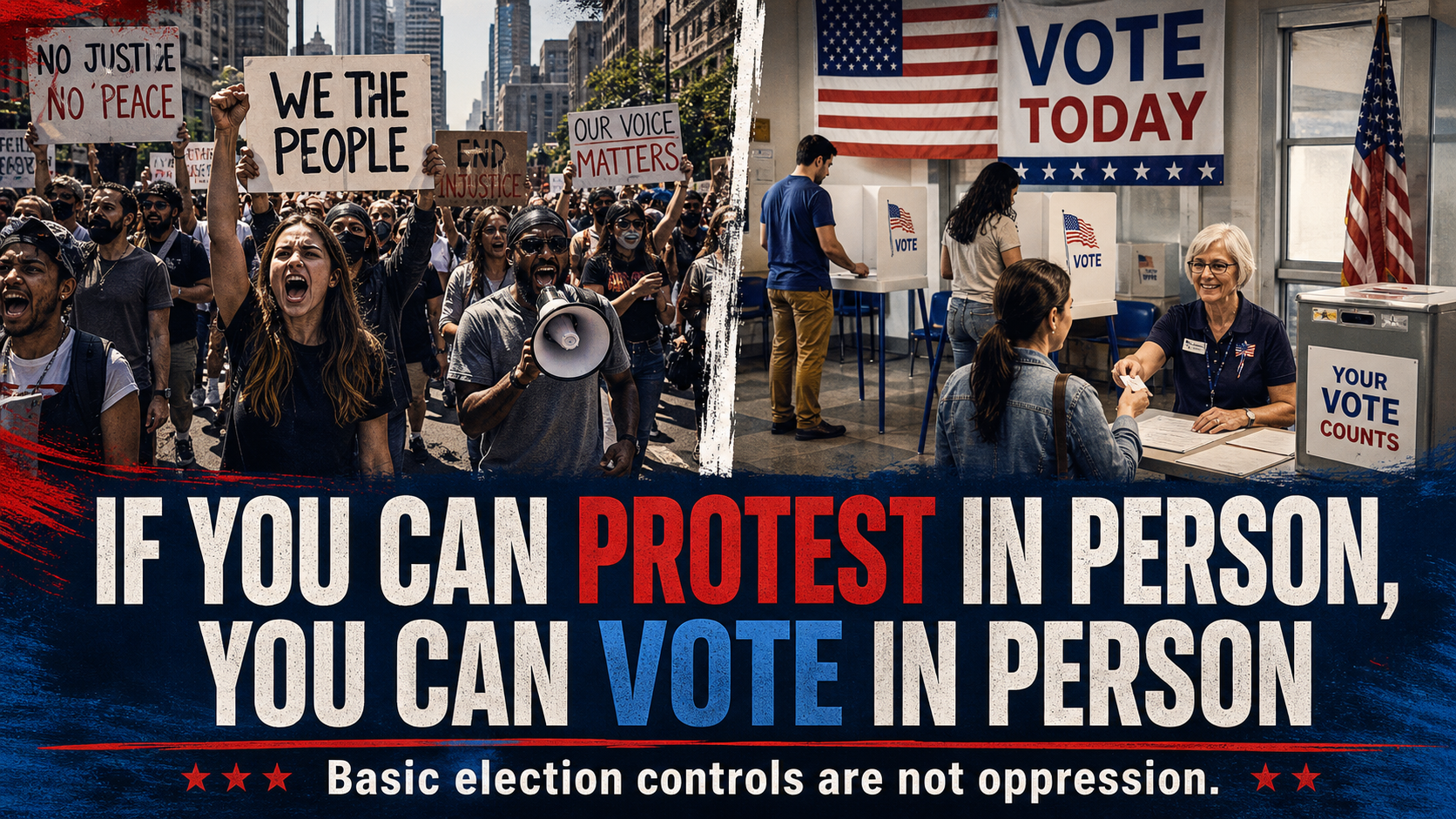
A meme making the rounds says: if you can show up by the millions to protest against a president, why do you need mail-in ballots to elect one? The left hates it for the same reason it works - it points straight at the contradiction. When people want to protest, march, organize, block streets, carry signs and fill public spaces, suddenly transportation exists. Time exists. Coordination exists. Energy exists. The same people who can navigate a city to find a protest rally become helpless when asked to show up at a polling place, verify who they are and cast a ballot under ordinary election controls. For generations, in-person voting was the standard. You went to the polling place. You checked in. You voted. There were exceptions for military service, illness, disability, travel and legitimate absentee needs. Nobody serious objects to those. A system should accommodate people who genuinely cannot vote in person. But somewhere along the way the exception became the desired standard and the standard became suspicious. That is backwards. And the political movement responsible for that reversal should have to answer for it plainly rather than hiding behind a parade of sympathetic edge cases and civil rights vocabulary.
The Position Reveals Itself by What It Opposes
Democrats do not have to stand at a podium and say they want weaker election controls. Nobody expects them to. Politics does not work that way. The position reveals itself by what the party consistently opposes. Voter ID is suppression. Proof of citizenship is discriminatory. Cleaning voter rolls is purging. Limits on ballot harvesting are silencing voters. In-person voting as the normal standard is a burden. Election Day deadlines are disenfranchisement. At some point the pattern matters more than the marketing language. A party does not have to admit it wants looser election rules when every argument it makes pushes the system in that direction - less verification, weaker controls, longer chains of custody, more ballots floating outside controlled polling places, more opportunities for confusion, abuse or activity that cannot be independently observed and verified.
That is not paranoia. That is basic process control. In construction, if a homeowner tells you that inspections are oppressive, permits are unfair, engineering reviews are biased and code compliance is too burdensome, you know exactly what he wants. He wants the job done without guardrails. The same analysis applies to elections. The direction of every Democratic election-security argument is toward less control, less verification and less accountability. That direction is not accidental. Consistent direction is called policy.
A party does not have to admit it wants looser election rules when every argument it makes pushes the system in that direction. The direction is consistent. Consistent direction is called policy.
Voting Rights Do Not Mean Voting Without Rules
The left has become very good at confusing access with the absence of control. These are different things. Voting should be accessible. Legal voters should be able to vote. Polling places should be available and reasonably located. Disabled voters should be accommodated. Elderly voters should have options. Military voters overseas should be protected. People with legitimate absentee needs should have a clean, verifiable way to participate. All of that is true and none of it is the argument. The argument is whether the default system should be controlled, verified and centered on in-person voting, or whether it should be stretched into a loose administrative maze of mail ballots, drop boxes, third-party handling, signature disputes, curing periods and extended deadlines that make chain of custody harder to maintain and public confidence harder to earn.
The more a ballot travels the more control matters. That is not right-wing hysteria. The U.S. Election Assistance Commission publishes chain-of-custody guidance specifically because election materials require tracking, security and documentation - mailed ballots, voter registration rolls, poll lists, return envelopes and signature matching materials. The National Conference of State Legislatures tracks how states verify absentee and mail ballots through signature verification, witness requirements, notarization and ID requirements precisely because mail voting creates risks that in-person voting does not. Mail voting may be legal. It may be well-run in some states. It may be necessary for some voters. It is not the same thing as walking into a polling place, presenting identification and casting a ballot under direct supervision. Anyone who says otherwise is either uninformed or being deliberately misleading.
The modern Democratic strategy for opposing election controls is not to argue against them directly. That would be too difficult because most ordinary Americans understand why ID, eligibility checks and basic verification exist. So instead, every rule gets attached to a sympathetic victim. Require voter ID and suddenly the argument is about a poor grandmother who cannot get documents. Require proof of citizenship and suddenly it is about married women whose names changed. Clean voter rolls and suddenly someone was accidentally removed. Limit ballot harvesting and suddenly elderly voters in nursing homes are being silenced. There may be real edge cases in all of these scenarios. Government systems are imperfect and people lose documents. Names change and records get messy. That is why reasonable exceptions, provisional ballots and correction procedures exist. Edge cases do not invalidate the rule. A voter who lost her ID may need a provisional process. That does not mean voter ID is racist. A disabled voter may need absentee access. That does not mean mass mail voting should become the default for everyone. The scam is to take a fixable administrative issue, inflate it into a moral crisis and then use that crisis to attack the underlying rule. That is not compassion. That is manipulation with better vocabulary.
Mail Voting Defenders Prove the Point Without Meaning To
Defenders of mail voting often say fraud is rare. The Brennan Center argues that election officials use verification, tracking, deadlines, chain of custody and identity controls to secure the system against widespread fraud and tampering. Good. Then stop fighting the controls. That is the obvious answer. If mail voting is secure because safeguards exist, then those safeguards are not voter suppression. They are the reason the system can be defended at all. The argument that mail voting is safe and the argument that every proposed safeguard is a civil rights violation cannot both be true. Pick one. The Carter-Baker Commission made this point explicitly in 2005: absentee ballots were the largest source of potential voter fraud, and even small amounts of fraud can determine outcomes in close elections. That does not mean every mail ballot is fraudulent. Of course not. It means the concern is not a fever dream invented for political convenience. It was documented by a bipartisan commission before the current argument existed.
People Show Up When They Care
The protest meme works because Americans are tired of being managed around obvious things. People show up when they care. They show up for protests, concerts, sports events, rallies, DMV appointments, court dates and Black Friday sales. They coordinate, they travel, they organize, they find childcare, they take time off work. But when voting comes up, suddenly appearing in person becomes an impossible hardship for millions of functioning adults who just spent the weekend coordinating a march across a major city. That observation does not mean nobody needs absentee voting. Some genuinely do. It does not mean every mail ballot is suspicious. Most are not. It does not mean every Democrat is trying to cheat. That is not the point. The point is that a political movement that consistently attacks every rule making cheating harder should not act surprised when people question its motives. A locked door is not anti-visitor. A password is not anti-customer. A building inspection is not anti-homeowner. A voter ID requirement is not anti-voter. Controls exist because valuable things need protection. The vote is valuable. The people defending it deserve controls that reflect its value.
My Bottom Line
The issue is not that Democrats openly oppose election integrity. The issue is that they wrap opposition to basic controls in the language of fairness, access and civil rights and then express bewilderment when people notice the direction of every argument they make. The result is consistent regardless of the rhetoric: less verification, weaker controls, longer chains of custody and more ballots entering the system under conditions that are harder for the public to observe and trust. In-person voting should be the norm. Absentee voting should remain available for people who genuinely need it. Voter ID should be standard. Citizenship should be verified. Voter rolls should be clean. Ballots should be tracked. Deadlines should mean something. Chain of custody should be documented. None of that is radical. It is the minimum standard for a serious country that wants its elections to produce results the public can trust regardless of outcome. Election legitimacy is not built on slogans. It is built on systems that people can understand, verify and trust. A democracy that cannot verify its voters cannot expect the public to accept its results. That should not be controversial. It should be obvious.
If millions can show up to protest, millions can show up to vote. And if one side keeps insisting that showing up, proving identity and verifying eligibility are oppressive, the public has every right to ask what exactly they are trying to protect - because it is not the integrity of the election.
References
- Brennan Center for Justice. (2024). Mail voting accuracy and security safeguards. brennancenter.org.
- Carter-Baker Commission. (2005). Building Confidence in U.S. Elections. Report of the Commission on Federal Election Reform, American University.
- U.S. Election Assistance Commission. (2021). Chain of Custody Best Practices for Election Officials. eac.gov.
- National Conference of State Legislatures. (2025). How States Verify Voted Absentee/Mail Ballots. ncsl.org.
- U.S. Election Assistance Commission. (2021). Best Practices for Election Officials. eac.gov.
Disclaimer: The views expressed in this post are the personal opinions of the author and are offered for educational, commentary and public discourse purposes only. They do not represent the positions of any institution, employer, organization or affiliated entity. Nothing in this post constitutes legal, financial, medical or professional advice of any kind. References to commissions, government agencies and published research are based on publicly available sources cited above. Commentary on election policy and political parties reflects the author's independent analysis and is protected expression of opinion. Readers are encouraged to consult primary sources and form their own conclusions.