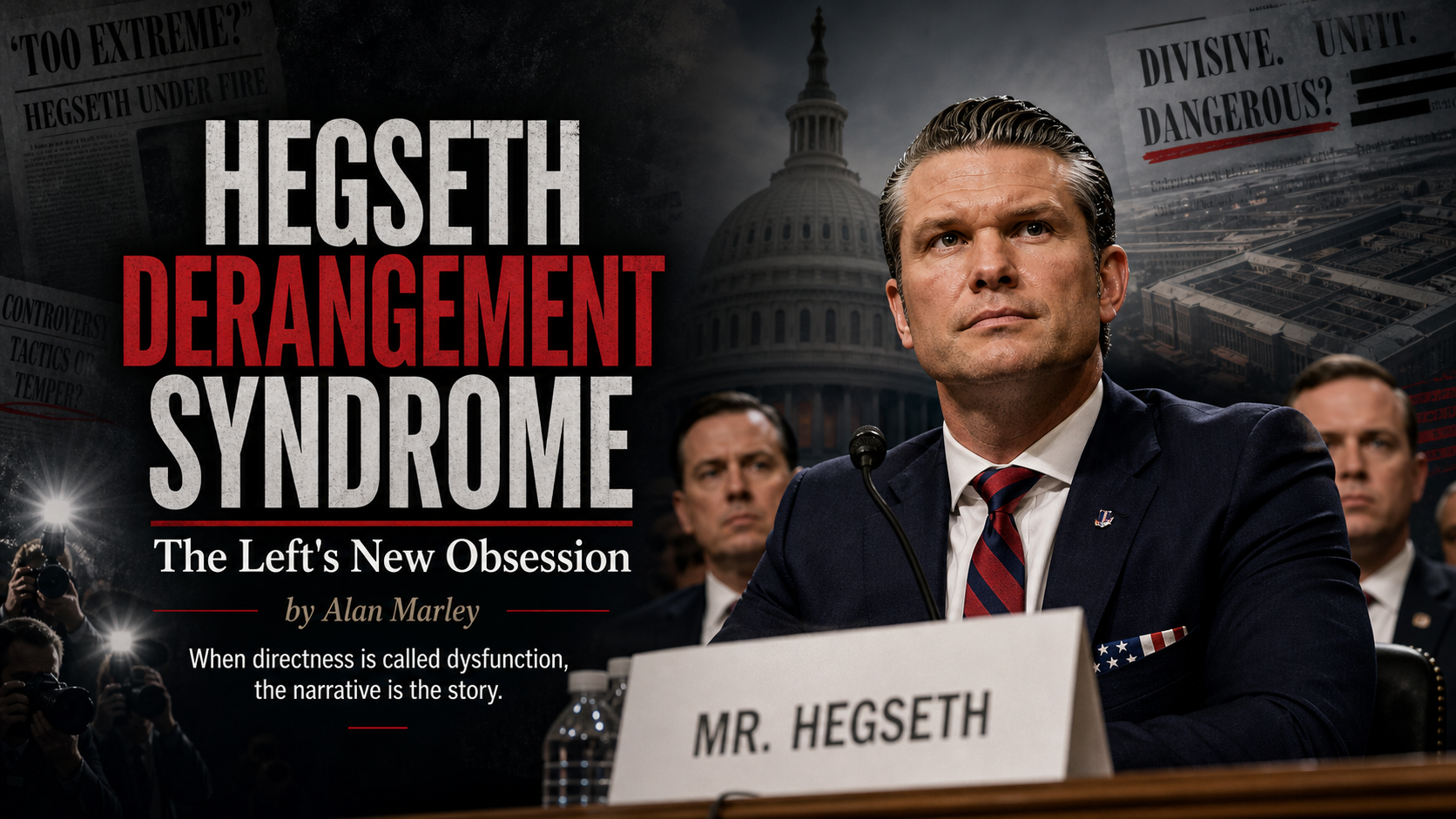
I have been watching American politics for more than fifty years. I have seen defense secretaries come and go - credentialed bureaucrats, retired generals, corporate executives and political operators who knew how to manage the press while managing very little else. Pete Hegseth is something different, and the reaction to him tells you more about the people reacting than it does about the man. This week Hegseth sat through two consecutive congressional hearings - nearly six hours before the House Armed Services Committee on Tuesday and another full session before the Senate Armed Services Committee on Wednesday - fielding questions on the Iran war, the proposed $1.5 trillion fiscal year 2027 defense budget, the War Powers Act deadline, the dismissal of military leaders and everything else Democrats could stuff into six hours of microphone time. The media narrative was that he was struggling, squirming and unable to answer basic questions. The actual record of what happened tells a different story. Hegseth walked into those hearings, called congressional Democrats reckless, feckless and defeatist to their faces and defended the administration's Iran strategy under sustained hostile questioning without retreating, apologizing or doing any of the things the press was hoping to capture. That is not struggling. That is what it looks like when someone who actually believes what he is saying shows up to defend it.
What Actually Happened in the Hearings
The framing from outlets like The Independent, The New Republic and the broader left-leaning press was that Hegseth was on the ropes - battered by tough questions about Iran, unable to account for discrepancies between the administration's version of events and statements from troops in the field, evasive about the War Powers Act deadline. Let us go through that. On the War Powers Act: the 1973 resolution requires the president to seek congressional authorization after sixty days of hostilities. The sixty-day clock from the February 28 strikes was set to expire May 1. Hegseth's position was that the ceasefire beginning April 7 paused the clock - a legally arguable position that a senior administration official subsequently reinforced by stating that for purposes of the War Powers Act the hostilities that began February 28 have terminated. Democrats called this evasion. It is actually a substantive legal argument about what constitutes ongoing hostilities. The War Powers Act does not clearly define whether a ceasefire with a maintained naval blockade constitutes continuation of hostilities. Hegseth did not refuse to engage. He gave the administration's position and referred the constitutional interpretation to the White House as the appropriate authority. That is correct institutional behavior, not evasion.
On the question of troops' accounts versus the administration's account of events in Iran: The New Republic ran a headline claiming Hegseth accused troops of lying when faced with facts. That characterization is not what happened. When Democratic senators pressed him on discrepancies between official accounts and statements attributed to servicemembers, Hegseth maintained the Department of Defense's account and questioned the sourcing of the contrary claims. That is what a Defense Secretary is supposed to do in a hearing room. The opposing framing - that any discrepancy between the official account and an unnamed source's version constitutes Hegseth calling troops liars - is the kind of spin that earns a headline rather than illuminates what occurred.
Hegseth called congressional Democrats reckless, feckless and defeatist to their faces in an open hearing and defended the administration's Iran strategy for nearly six combined hours. The media called that struggling. I call it the first Defense Secretary in a long time who says what he means and means what he says.
The War Powers Act and the Democrats Who Discovered It Last Month
The Democratic focus on the War Powers Act in these hearings deserves its own examination because the selective application of constitutional principle is one of the most consistent features of modern progressive politics. The War Powers Resolution was passed in 1973 over Nixon's veto precisely because Congress felt executive branch military adventurism needed a check. It is a real law with real provisions and the sixty-day authorization requirement is a legitimate constitutional question worth taking seriously. The problem is that Democratic outrage about executive military authority has historically appeared and disappeared in direct proportion to which party controls the White House. Barack Obama conducted military operations in Libya in 2011 that never received congressional authorization and that lasted well beyond sixty days. The Democratic response was mostly silence. The current Democratic concern about Hegseth and the War Powers Act arrived approximately two months after the Iran strikes began, timed perfectly to coincide with the sixty-day deadline, and is being driven in the Senate by Rand Paul - a libertarian Republican - with Democratic votes attached as useful pressure rather than principled constitutional commitment.
That does not make the constitutional question invalid. Rand Paul's concern about war powers is genuine and consistent regardless of which party is in the White House. But the sudden Democratic urgency about the sixty-day clock is a political calculation dressed in constitutional clothing, and Hegseth was right to name it. The biggest adversary we face at this point are the reckless, feckless and defeatist words of congressional Democrats and some Republicans is not a diplomatic statement. It is an accurate description of what it looks like when political opponents use an ongoing military operation as a vehicle for domestic point-scoring while American forces are still positioned in the theater.
The media narrative about Hegseth is almost entirely focused on what he has supposedly done wrong. It rarely engages with what he has accomplished. On personnel: he fired the Chief of Naval Operations, the Air Force's number two, and a string of generals he judged insufficiently focused on warfighting - and he did it without institutional collapse. Replacement officers are in their seats and functioning. General Dan Caine, the new Joint Chiefs Chairman, sat beside Hegseth for both days of congressional testimony and presented a coherent defense of the Iran operation, stating Iran is weaker and less capable than it has been in decades. On readiness: Hegseth ordered an 8 percent annual Pentagon budget cut to redirect funds toward the Iron Dome proposal and genuine readiness priorities, then submitted a $1.5 trillion fiscal year 2027 budget request focused on nuclear modernization, Indo-Pacific posture and shipbuilding. On culture: he eliminated DEI offices across the Department, ended identity months, restored fitness and height-weight standards and told senior officers in September 2025 that there would be no more climate change worship, no more gender delusions and no more politically correct rules of engagement. On the $93 billion spending story that Kimmel, Colbert, Schumer and Newsom amplified in March: Snopes fact-checked it and found it was September 2025 end-of-fiscal-year use-it-or-lose-it spending that predated Hegseth's directives and follows the same pattern every administration produces at fiscal year end. The media ran with it anyway. On accountability: he has now testified under oath for two consecutive days in open congressional hearings - something predecessors regularly avoided.
Hegseth Derangement Syndrome Is the Real Story
The pattern of Hegseth coverage has followed the same arc as Trump Derangement Syndrome with a compressed timeline. Every statement he makes is characterized as a gaffe. Every confrontation is characterized as a failure. Every moment of directness is characterized as incompetence. Every personnel decision is characterized as purge or chaos. The Signal chat controversy - in which Hegseth was criticized for discussing operational details in a group message that included a journalist - was covered as a firing offense for weeks. Hegseth survived it. The firings of senior military officers were covered as the destruction of institutional expertise. The replacement officers have assumed their roles without visible institutional crisis. The Iran hearing coverage describes a man struggling when the actual transcript shows a man who sat through six hours of hostile questioning, maintained his positions and called the opposition what they were to their faces.
I have watched fifty years of American defense secretaries navigate congressional hearings. Most of them performed carefully, spoke in measured bureaucratic language designed to commit to nothing and offend no one and left the room having said very little. What the press describes as struggling in Hegseth is what directness looks like when the media has spent months expecting and hoping for retreat. When someone refuses to retreat, the coverage does not update to reflect that. It intensifies the struggling narrative because the alternative is acknowledging that the man knows what he is doing and is doing it deliberately.
The Iran War and Hegseth's Actual Record
Let us be clear about the strategic context in which these hearings are occurring. The United States struck Iranian nuclear facilities on February 28. A ceasefire took effect April 7. A naval blockade of the Strait of Hormuz continues. Pentagon officials briefed Trump on options for renewed strikes if the ceasefire collapses. The IRGC has warned that new American attacks will be met with long and painful strikes on U.S. assets in the region. This is a live military situation with significant strategic stakes and the situation is being managed by a Defense Secretary who has now testified under oath twice in two days, answered every question he was legally and institutionally authorized to answer and defended the administration's strategy coherently. The CFR's analysis acknowledges that whether the war was worth it will depend heavily on whether the ceasefire holds and leads to a longer-term resolution. That is a legitimate analytical question. It is not a question that the current congressional Democratic performance is helping to answer. It is, however, a question that Hegseth is in the room trying to address while Democrats perform outrage about a sixty-day clock they rediscovered three days before it expired.
My Bottom Line
Pete Hegseth is doing a good job. Let me be specific about what that means because the left's coverage never is. He restructured Pentagon leadership by removing officers he judged distracted from warfighting and replaced them without institutional breakdown. He eliminated DEI offices, identity months and the gender ideology that had penetrated military culture and personnel policy. He has Iran's nuclear facilities bombed and the regime, in the assessment of his own Joint Chiefs Chairman, weaker and less capable than it has been in decades. He testified under oath before two congressional committees in two consecutive days, stayed for nearly six combined hours, held his positions and called his critics what they are. He submitted a $1.5 trillion defense budget prioritizing nuclear modernization and Indo-Pacific readiness over the social programming that consumed Pentagon attention for years. He oversaw Operation Rough Rider against Houthi targets in Yemen and managed the Iran campaign from its February 28 launch through the April ceasefire and the current blockade. The $93 billion spending story that the left amplified as evidence of incompetence was end-of-fiscal-year contractual spending that Snopes confirmed predated his directives entirely. That is the record. The struggling narrative requires you not to look at it.
I say that as someone who has watched enough Defense Secretaries to know what competence looks like under fire and what struggling looks like when the cameras are on. The left's coverage of Hegseth has the same structural signature as Trump Derangement Syndrome: a conclusion fixed before the evidence is examined, escalating framing regardless of what actually occurs and the consistent characterization of directness as dysfunction. Hegseth Derangement Syndrome is a real condition and it is producing the same analytical failures as its parent disorder. Americans who watched those hearings and saw a man hold his ground for six hours under sustained hostile questioning are not going to be persuaded that what they watched was a secretary struggling. They have eyes.
When the media says a man is struggling and the tape shows him calling his critics defeatist to their faces and holding his position for six hours under oath, the question is not whether the man is struggling. The question is what the media is trying to accomplish with the word.
References
- Washington Post. (2026, April 29). Hegseth clashes with Democrats over Iran war, dismissal of military leaders. washingtonpost.com.
- Washington Post. (2026, April 30). Hegseth argues Iran ceasefire pauses deadline for Congress's approval. washingtonpost.com.
- Christian Science Monitor. (2026, April 30). Congress presses Hegseth on Iran war justification, spending, and conduct. csmonitor.com.
- Council on Foreign Relations. (2026, May 1). Hegseth responds to deadline for Congress to authorize war. cfr.org.
- Fox News. (2026, April 30). Hegseth, Caine testify on Pentagon spending, Iran war as Hormuz blockade shakes oil markets. foxnews.com.
- War Powers Resolution of 1973. 50 U.S.C. Chapter 33. (Sixty-day authorization requirement and presidential notification provisions.)
Disclaimer: The views expressed in this post are the personal opinions of the author and are offered for educational, commentary and public discourse purposes only. They do not represent the positions of any institution, employer, organization or affiliated entity. Nothing in this post constitutes legal, financial, military or professional advice of any kind. References to congressional hearings, news coverage and published sources are based on publicly available materials cited above. Commentary on political figures and government officials reflects the author's independent analysis and is protected expression of opinion. Readers are encouraged to consult primary sources and form their own conclusions.