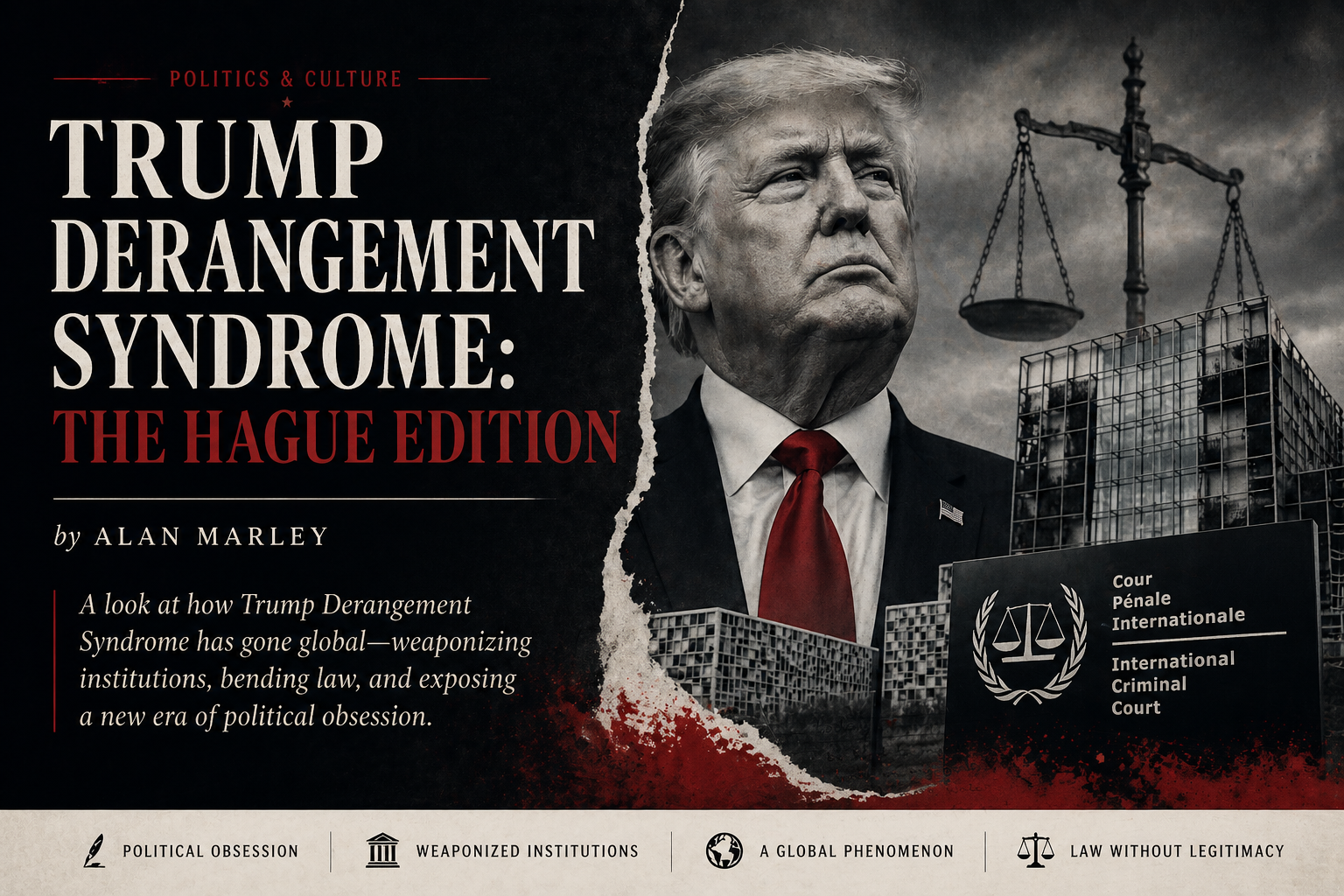
The New Republic published a piece in March 2026 titled "There Will Be No Post-Presidential Peace for Donald Trump." The subheading reads: "The president and his allies will face impeachments, lawsuits, and maybe even The Hague." The author, Matt Ford, calls for what he describes as a broader all-of-society effort to tear the roots of Trumpism out of the nation's political system, using every tool available including the enforcement of international law by American allies. He compares Trump point by point to King George III. He calls the administration fascist and describes Washington as an orgy of corruption beyond even the most cynical observer's imagination. He wants impeachments, civil lawsuits, professional sanctions and potentially trial before the International Criminal Court. This is not a news article. It is a revenge fantasy published in a magazine format, dressed in the language of accountability and justice. And it is the clearest recent specimen of what Trump Derangement Syndrome looks like when it has been running for a decade with no resolution and has reached the international war crimes tribunal stage of its natural progression.
What TDS Looks Like at Terminal Velocity
Trump Derangement Syndrome was always a condition defined by the gap between the specific claim and the catastrophic framing surrounding it. The specific claims in Ford's article are a mix of genuine policy criticisms - the tariffs were struck down by the Supreme Court, there are real concerns about executive power expansion, ICE operations have raised legitimate civil liberties questions - and assertions so sweeping they cannot be assessed because they are not really arguments. They are conclusions. Trump has pushed the country toward fascism and oligarchy. The administration's conduct resembles the charges in the Declaration of Independence against the last American king. These are not analytical claims with evidence attached. They are emotional escalations that establish the conclusion and then invite the reader to nod along rather than evaluate.
The George III comparison is worth examining specifically because Ford uses it as the organizational spine of the entire piece. He matches specific Declaration charges to specific Trump actions, and some of the parallels are superficially clever. But George III presided over the literal military occupation of colonial cities, the quartering of troops in private homes and the systematic destruction of representative government across a continent. Trump issued controversial tariffs that were subsequently struck down by the Supreme Court he himself helped shape, in a legal process that functioned exactly as designed. Calling these things equivalent is not historical analysis. It is historical cosplay that flatters the writer's politics without illuminating the present.
The all-of-society effort to tear the roots of Trumpism out of the political system is not a call for accountability. It is a call for purge. Those are different projects. Accountability requires a standard. A purge requires only an enemy list.
The Hague Fantasy and What It Reveals
The International Criminal Court was established to prosecute genocide, war crimes, crimes against humanity and the crime of aggression. Its jurisdiction is primarily over acts committed in countries that have ratified the Rome Statute or where the UN Security Council refers a situation. The United States has not ratified the Rome Statute. The ICC has no jurisdiction over the American president for domestic policy decisions, however vigorously Ford or anyone else disagrees with those decisions. Suggesting that Trump or his allies could face ICC prosecution for immigration enforcement, tariff policy or the closure of the Kennedy Center for the Performing Arts is not a legal argument. It is a fever dream stated in legal-adjacent language to make it sound more serious than it is. The ICC prosecutes Sudanese officials for Darfur. It does not prosecute American presidents for governing in ways that progressive magazines dislike.
What the Hague mention reveals is the diagnostic core of the piece: the authors have worked through every available domestic mechanism - the prosecutions that were dropped or dismissed, the two impeachments that did not remove him, the civil suits that have not produced the desired outcome - and have arrived at a place where nothing short of international war crimes prosecution satisfies the emotional requirement. That escalation is not a legal position. It is a psychological one. It tells you that the object is not accountability for specific documented violations of specific laws. The object is the permanent destruction of Trump as a political figure through any mechanism that can be located or invented. When someone's list of remedies grows to include international war crimes tribunals for domestic policy disputes, the problem is no longer with the target of the list.
Ford's call for a broader all-of-society effort to tear the roots of Trumpism out of the political system deserves to be read carefully because the language is revealing in ways the author does not appear to notice. Accountability is a legal and institutional concept. It applies to specific people for specific documented violations of specific laws or constitutional provisions. It has standards, evidence requirements and procedural protections. The all-of-society effort Ford is calling for is not that. It is a political project aimed at an ideology and the people associated with it - not prosecution of documented crimes but elimination of a political tendency from the national conversation. That is not accountability. That is what accountability language looks like when it is being used to describe something else. A democracy that is serious about accountability applies it universally across administrations and parties. A political movement that calls for tearing out the roots of the other side's political presence is not making a legal argument. It is making a power argument, and dressing it in accountability rhetoric does not change what it is.
The Pattern Is the Diagnosis
The New Republic has been predicting Trump's inevitable destruction since the escalator descent in 2015. The Russia collusion narrative was going to end him. The first impeachment was going to end him. COVID was going to end him. The second impeachment was going to end him. The Manhattan prosecutions were going to end him. The classified documents case was going to end him. The Georgia RICO case was going to end him. January 6 was going to end him. The 2024 election was, according to the magazine's own contributors, the last democratic election in American history if Trump won. He won. The democracy did not end. The elections have continued to be scheduled. The courts continue to function, including by striking down the tariffs Ford finds so outrageous. The constitutional architecture has not collapsed. And The New Republic has responded to all of this not by reassessing its analytical framework but by adding the Hague to the list of mechanisms that are going to finally, finally end him.
This is the defining feature of Trump Derangement Syndrome at its advanced stage: the refusal to update the prediction model regardless of how many predictions fail. A genuine analyst who predicted destruction ten times and watched the subject survive and win again would ask what the predictions were getting wrong. They would interrogate the framework rather than escalate the stakes. What Ford and The New Republic do instead is raise the temperature of the language, expand the list of mechanisms and maintain the certainty of the outcome while the evidence for that certainty becomes thinner with each cycle. That is not analysis. It is faith. And like all faith traditions, it has become more fervent rather than less in proportion to the number of times reality has failed to cooperate.
What Legitimate Accountability Actually Requires
There are real accountability arguments to be made about the Trump administration and they do not require comparisons to George III, calls for international war crimes proceedings or language about tearing out ideological roots. The tariff authority question is a genuine constitutional separation of powers issue that the Supreme Court addressed directly. The expansion of executive power through the unitary executive theory raises real questions about congressional authority that serious legal scholars across the ideological spectrum have written about carefully. ICE operations raise genuine Fourth and Fifth Amendment questions that are being litigated in actual courts with actual evidence standards. These are arguments that can be made with specific claims, specific legal authority and specific evidence. They are arguments that persuade people who are not already convinced rather than performing outrage for people who are. They are also arguments that survive the basic consistency test: applied to this administration using the same standards that were or would be applied to any administration, rather than as instruments in a decade-long project of political elimination.
The reason Ford does not make those arguments is that they require acknowledging that the legal and constitutional system is functioning - that the courts are ruling, that some administration actions are being upheld and others struck down, that the democratic process continues to operate. Acknowledging that the system is working is incompatible with the narrative that American democracy is on the brink of collapse. So the system has to be delegitimized too. The Supreme Court conservative justices essentially made up the presidential immunity doctrine because Trump asked them to. The article dismisses the court this way, without engaging with the legal arguments Roberts actually made, because if the court is a legitimate institution then its rulings are part of the accountability system rather than an obstacle to it. The narrative requires every institution that does not produce the desired outcome to be characterized as captured, corrupted or complicit.
My Bottom Line
Trump Derangement Syndrome is not a dismissal of legitimate policy criticism. There are many legitimate criticisms of this administration and of Trump specifically, and they deserve honest engagement. TDS is a specific pathology: the inability to evaluate the subject through any framework other than total destruction, the escalation of catastrophic framing regardless of how many catastrophes fail to materialize, the substitution of emotional intensity for analytical rigor and the gradual expansion of acceptable remedies until the list includes things that would never be proposed for any other administration or any other political figure. The New Republic piece is a clinical specimen of that pathology. It calls for an all-of-society effort to tear out roots. It invokes the Hague. It compares a sitting American president to the British monarch who triggered the Revolutionary War. And it does all of this not in the context of specific documented crimes with specific evidence but in the context of policy disagreements that went the wrong direction for the author's preferences. That is not accountability journalism. It is a decade of accumulated grievance dressed up as a legal framework. Americans are not stupid. They can see the difference.
You do not get to the Hague from tariff disputes. You do not get to all-of-society purges from policy disagreements. The escalation of the language is not proportional to the escalation of the conduct. It is proportional to the escalation of the rage. When you cannot tell the difference between those two things, you have lost the argument and replaced it with something else.
References
- Ford, M. (2026, March 19). There will be no post-presidential peace for Donald Trump. The New Republic. newrepublic.com.
- International Criminal Court. (n.d.). About the Court: Jurisdiction and admissibility. icc-cpi.int.
- Rome Statute of the International Criminal Court. (1998). United Nations Treaty Collection. (Note: The United States has not ratified the Rome Statute.)
- Trump v. United States, 603 U.S. ___ (2024). (Presidential immunity ruling.)
- U.S. Supreme Court. (2026, February). Ruling on Trump tariff authority under Cold War-era sanctions law. supremecourt.gov.
Disclaimer: The views expressed in this post are the personal opinions of the author and are offered for educational, commentary and public discourse purposes only. They do not represent the positions of any institution, employer, organization or affiliated entity. Nothing in this post constitutes legal, financial, medical or professional advice of any kind. References to published articles, court decisions and legal institutions are based on publicly available sources cited above. Commentary on political media and public figures reflects the author's independent analysis and is protected expression of opinion. Readers are encouraged to consult primary sources and form their own conclusions.