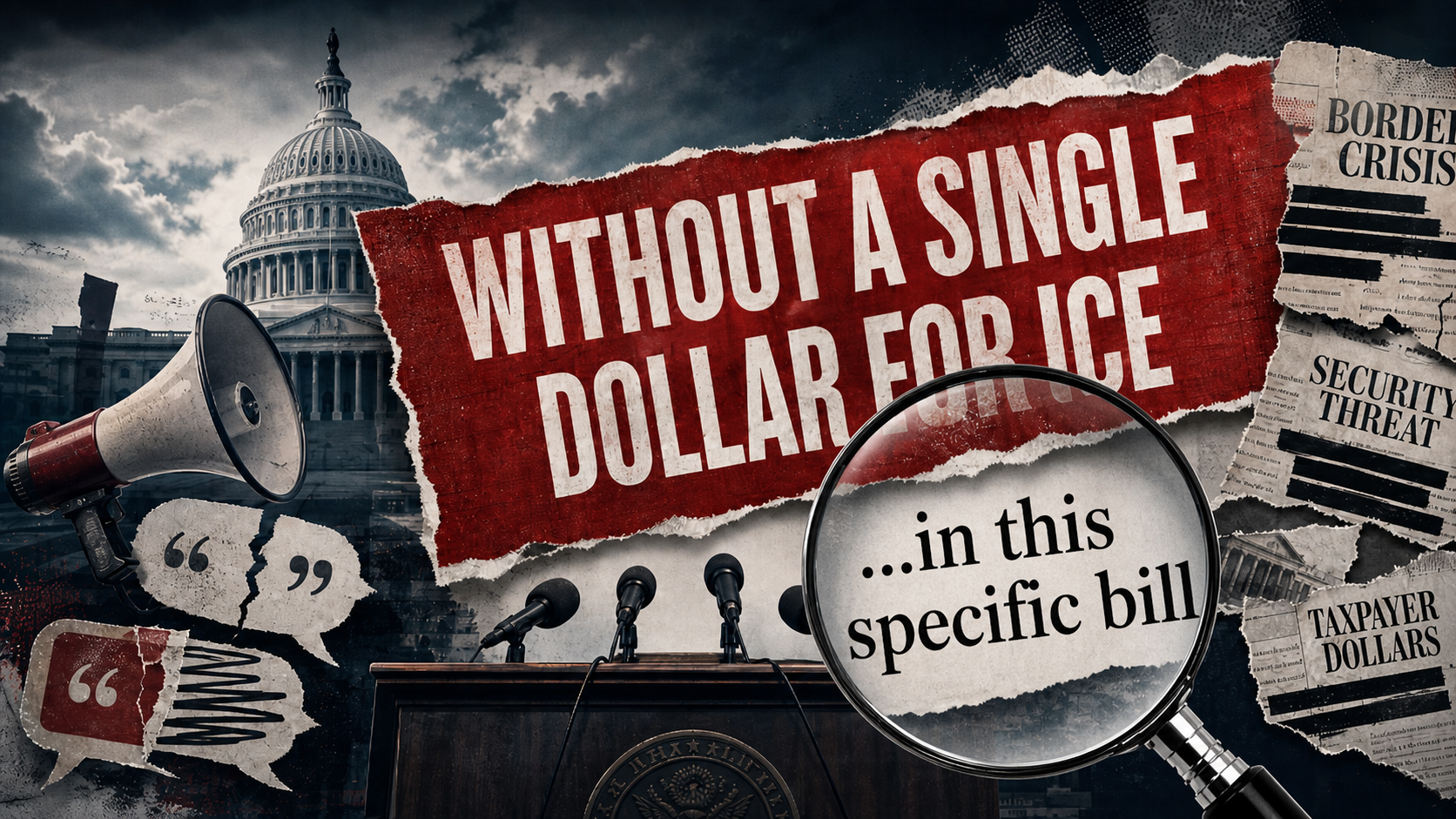
Political messaging works best when it sounds true enough to survive a quick glance but leaves out enough context to mislead anyone who does not look closer. That is exactly what happened with the claim that House Democrats forced passage of legislation reopening the Department of Homeland Security without a single dollar for ICE. That line is engineered to make people believe ICE got nothing - no money, no funding, no ability to operate, stranded on the side of the road while Democrats celebrated defunding the deportation machine. But that is not what happened. Reuters reported that ICE and Border Patrol funding were being moved to a separate legislative track, with Republicans pursuing roughly $70 billion through reconciliation. The Guardian confirmed the bill funded most of DHS while leaving the immigration enforcement funding dispute for a different vehicle. "ICE did not receive the disputed additional money in this specific DHS reopening bill" is not the same statement as "ICE has no funding." But politics does not reward precision. It rewards slogans. And this slogan was built specifically to exploit the gap between those two statements.
Technically True Is Often the Worst Kind of Lie
The most durable political deceptions are not built from fabrications. They are built from partial truths with the load-bearing context removed. "Without a single dollar for ICE" may be technically defensible if the speaker means in this particular bill. But that qualifier is doing all the work and is systematically absent from the messaging. The audience receives a broader impression: ICE was defeated, shut out, defunded. That impression is false. The funding fight was moved to a different track, not resolved in Democrats' favor. ICE continues to operate. The deportation infrastructure the left claims to have kneecapped remains intact and functioning.
Political communicators understand this mechanism precisely. They know most people will not read the bill. They know most people will not track the separate reconciliation pathway. They know most people will absorb the headline, register the emotional message and move on. The slogan is not designed for people who will look closer. It is designed for the vast majority who will not. That is not communication. It is a confidence game run on inattention. Saying "Democrats helped pass a bill reopening most of DHS while excluding the disputed new ICE funding, with Republicans pursuing that money separately" would be accurate. It would also not generate applause, raise money or trend on social media. So we get the slogan instead.
The honest statement would have been simple: Democrats helped pass a bill reopening most of DHS without including new ICE funding, while Republicans pursue immigration enforcement money separately. That is accurate. It would not generate applause. So we get the slogan.
The "Hostage" Language Tells You Who Wrote the Script
The messaging also describes Republicans having held DHS hostage for 75 days. That framing deserves the same scrutiny. Was there a funding fight? Yes. Did the dispute affect TSA, FEMA, Secret Service, Coast Guard and other DHS operations? Reports confirm it did. Was that a real cost to real government functions? Absolutely. None of that is in dispute. What is in dispute is the word "hostage," which is not a descriptive term. It is a moral verdict delivered before the facts are examined. It tells the reader who the villain is before the story begins. It transforms a legislative standoff - a tool both parties use routinely when they believe the policy stakes justify it - into a kidnapping scene. That framing is designed to produce an emotional response, not an accurate understanding of what occurred.
The asymmetry is the tell. The same message that calls Republican holdouts "hostage-taking" celebrates Democratic holdouts as courage and refusing to bend the knee. When one side digs in it is heroic resistance. When the other side digs in it is terrorism against the government. That is not political analysis. That is team branding dressed in the language of neutral description. Both parties hold out on legislation when they calculate the leverage is worth the disruption. Attaching moral vocabulary to one side's version of a universal legislative tactic is dishonest regardless of which party does it.
The actual sequence of events is straightforward and considerably less exciting than the messaging. There was a dispute over DHS funding. Most DHS operations needed to reopen. ICE and Border Patrol funding were the specific sticking points. A bill passed that reopened most DHS operations while leaving immigration enforcement money out of that particular package. Republicans were pursuing ICE and Border Patrol funding separately through the reconciliation process, seeking roughly $70 billion. That is the story. Not "ICE was defunded." Not "Democrats killed the deportation machine." Not "without a single dollar for ICE" as if ICE was somehow excised from the federal government by a single appropriations bill. The slogan turns a procedural funding split - a common outcome when two chambers and two parties cannot agree on a complete package - into a dramatic political triumph. That is why it is misleading. The drama is not in the facts. It is in the framing of the facts.
Why This Pattern Corrodes Public Trust
The damage from this kind of messaging extends beyond any individual claim. When the public repeatedly encounters political language that sounds true, absorbs it, and then later discovers the essential context that was missing, a lesson gets taught. The lesson is not that this specific politician was wrong about this specific bill. The lesson is that political language cannot be taken at face value, that the apparent meaning of a statement and the actual meaning diverge systematically and that the effort required to find the truth is too high relative to the reward. That lesson - once learned - is very hard to unlearn. People who conclude that all political language is equally dishonest stop distinguishing between propaganda and description. They become either apathetic or cynical, and the cynics often prefer whoever performs the deception most entertainingly rather than whoever offers the most accurate account.
The public is not stupid. People understand spin. They understand that politicians frame their wins favorably. There is a line between putting your best foot forward and deliberately constructing a false impression in the audience's mind. "Without a single dollar for ICE" crosses that line not because it contains a falsehood but because it is constructed to ensure the audience reaches a conclusion that the speaker knows is wrong. That is the definition of manipulation: not lying outright but engineering a false belief through selective presentation. It is worse than a clean lie in some ways because it is harder to refute. You cannot simply point to a false statement. You have to reconstruct the full context - which most people will not do - to show why the impression created is inaccurate.
My Bottom Line
The statement is deceitful because it relies on the audience misunderstanding what happened. It takes a narrow fact - ICE did not receive the disputed additional money in that specific DHS reopening bill - and stretches it into a broad political claim engineered to sound like ICE got nothing. The additional context that would correct that impression - that the funding fight was moved to a separate track, that Republicans were pursuing it through reconciliation, that ICE continues to operate on existing appropriations - is systematically absent from the messaging because including it would collapse the narrative. Political language is supposed to clarify public issues, not obscure them. When politicians use slogans that depend on omission to produce their intended effect, they are not informing voters. They are training voters to react emotionally before they understand the facts. That is not leadership. It is propaganda with better production values. And the people absorbing these slogans on both sides of the political divide deserve better than to be managed rather than informed.
Americans are not stupid. They can see when a political claim is built to produce an impression the speaker knows is false. The ones who cannot see it yet will figure it out eventually. And when they do, they stop trusting the people who built the claim - which is the one outcome every political communicator should be trying to avoid.
References
- Reuters. (2026, April 27). US House Republicans to modify Senate-passed DHS funding bill, courting delay.
- The Guardian. (2026, April 30). Trump signs bipartisan bill ending longest-ever shutdown of DHS.
- LMT Online. (2026, May 1). Cuellar supports House vote to end DHS shutdown after 76 days.
Disclaimer: The views expressed in this post are the personal opinions of the author and are offered for educational, commentary and public discourse purposes only. They do not represent the positions of any institution, employer, organization or affiliated entity. Nothing in this post constitutes legal, financial, medical or professional advice of any kind. References to news reporting and legislative actions are based on publicly available sources cited above. Commentary on political messaging and public figures reflects the author's independent analysis and is protected expression of opinion. Readers are encouraged to consult primary sources and form their own conclusions.