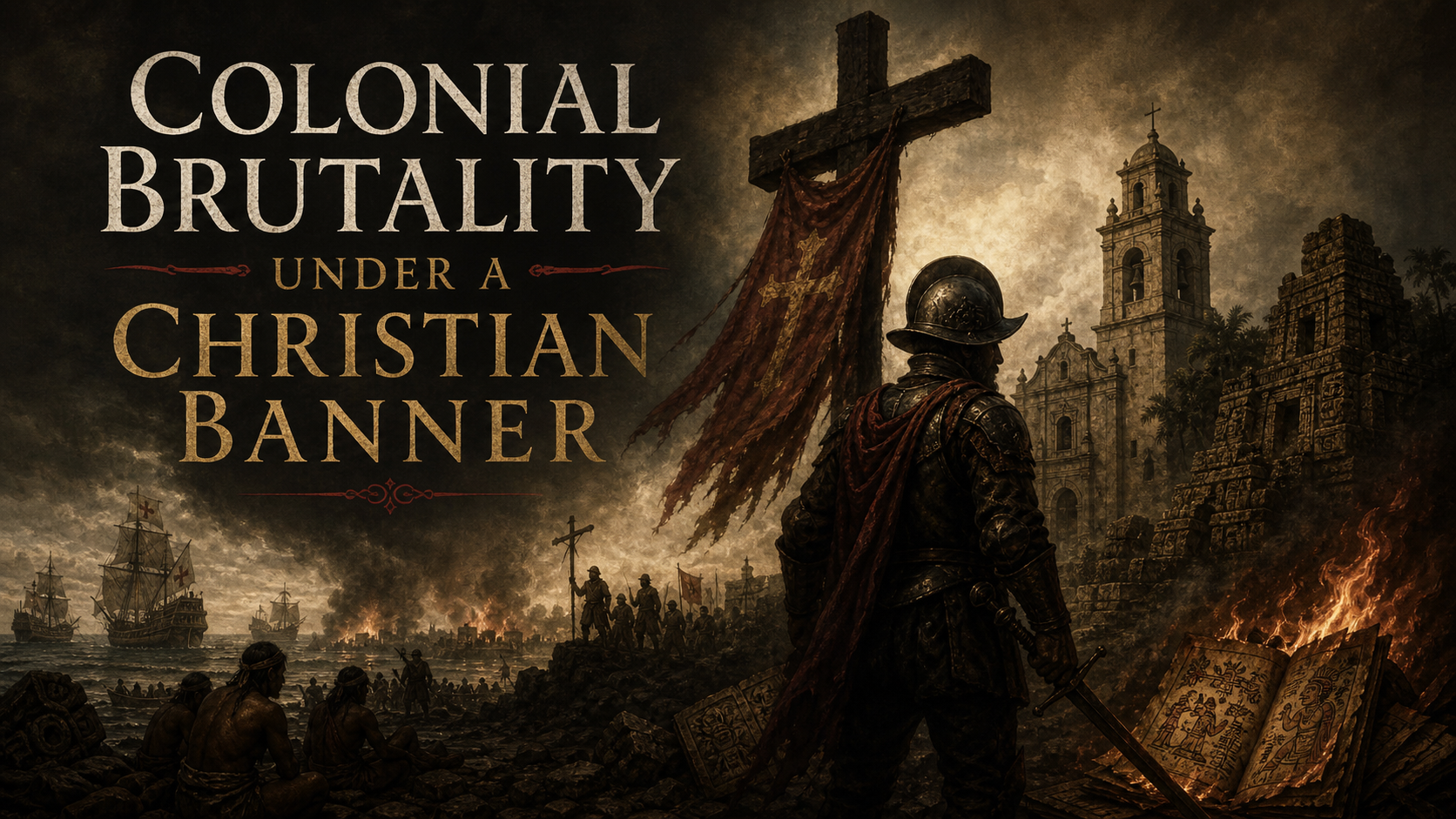
The European conquest of the Americas, Africa and Asia was the largest forced transformation of human societies in recorded history. It destroyed civilizations, killed populations in numbers that still stagger the imagination and replaced functioning cultures with colonial systems built on extraction, coercion and racial hierarchy. That history is well documented. What is less consistently examined is the degree to which the institutional Christian church did not merely accompany that conquest but authorized it, justified it, participated in it and collected from it. The cross did not follow the sword as an afterthought. In the documents that launched European colonialism - the papal bulls of the fifteenth century, the theological frameworks that legitimized conquest and the mission systems that managed surviving populations - the sword and the cross were the same instrument held in different hands. Understanding colonial brutality requires understanding that it was not carried out despite Christianity but in significant measure through it, with theological frameworks that made atrocity not just permissible but obligatory.
The Papal Architecture of Conquest
European colonialism did not begin as an improvised adventure. It began with papal authorization. The bull Dum Diversas in 1452, issued by Pope Nicholas V, granted the Portuguese king authority to conquer, reduce to perpetual slavery and seize the lands and property of Saracens, pagans and other enemies of Christ along the African coast. Romanus Pontifex in 1455 reinforced this, explicitly sanctioning the enslavement of African peoples and the seizure of their territories in the name of Christian expansion. In 1493, following Columbus's first voyage, Pope Alexander VI issued the bull Inter Caetera , granting Spain dominion over newly discovered lands in the Americas not already held by a Christian prince, with the explicit mission of converting indigenous peoples to the Catholic faith. These were not fringe documents. They were the legal and theological foundation of the colonial project. The Doctrine of Discovery that derived from them shaped international law for centuries and remains embedded in U.S. Supreme Court precedent to this day.
The Requerimiento, described in Part 5, was the practical implementation of this framework in the Americas. Before an attack, Spanish forces were legally required to read a document to indigenous communities - often in Spanish they did not understand, sometimes from ships out of earshot - informing them that they must acknowledge the authority of the pope and the Spanish crown or face lawful conquest. Bartolomé de las Casas, a Spanish Dominican friar and one of the most important eyewitnesses to early colonial atrocity, described the document as something the reader did not know whether to laugh at or weep over. It was not a good-faith offer. It was a theological mechanism for converting mass murder into a lawful act. The church had provided the paperwork. The swords provided the enforcement.
The Destruction of the Americas
The scale of what happened to the indigenous populations of the Americas following European contact is difficult to hold in the mind as a single fact. Estimates from historians and demographers including Henry Dobyns, William Denevan and more recently scholars like David Henige and Charles Mann suggest that the pre-contact population of the Americas numbered somewhere between 50 and 100 million people. By the end of the sixteenth century, across the Caribbean, Mesoamerica and the Andes, population decline in the worst-affected areas reached 90 percent or more. The causes were multiple - European disease to which indigenous people had no acquired immunity, direct military violence, forced labor and the destruction of food systems and social structures. But the violence was deliberate where disease was not, and the institutional church's role in legitimizing and organizing what happened was not peripheral.
Hernán Cortés carried a chaplain with him into Mexico. The conquest of the Aztec Empire, completed by 1521, was preceded and followed by systematic destruction of indigenous religious sites, temples and manuscripts. The burning of the Aztec codices - a deliberate erasure of an entire literary and historical record - was carried out under the authority of Bishop Juan de Zumárraga and later Bishop Diego de Landa in the Yucatan, where an auto-da-fé in 1562 destroyed thousands of Maya manuscripts at Maní. Landa himself later expressed regret, but the books were ashes. The destruction was not incidental. Converting a population meant eliminating the intellectual infrastructure that sustained their previous identity. Burning libraries is a very specific kind of violence.
Cortés had a chaplain. Columbus had a chaplain. Every expedition of conquest sailed with theological authority on board. The cross did not arrive after the killing to comfort the survivors. It arrived with the killers to authorize the killing.
Las Casas and the Witness Nobody Wanted to Hear
Bartolomé de las Casas is one of the most important figures in understanding what the conquest meant because he both participated in it and spent the rest of his life documenting and condemning it. Las Casas arrived in Hispaniola in 1502, received an encomienda - a grant of indigenous labor - and participated in colonial administration for years before an experience of religious conviction led him to renounce his encomienda and begin writing the testimony that would eventually become A Short Account of the Destruction of the Indies , completed around 1542 and published in 1552. The account is not comfortable reading. Las Casas describes mass killings, mutilations designed to terrorize populations into submission, the killing of infants, the burning of leaders alive and the systematic destruction of communities across the Caribbean, Mexico and Central America. He estimates the deaths in the millions across the territories he witnessed or received testimony about.
Historians have debated specific figures in Las Casas's account, and some of his estimates were almost certainly inflated by the limitations of his sources. But the basic factual record of colonial atrocity he documented is corroborated across multiple independent accounts and archaeological evidence. What Las Casas provides that no other source quite matches is the insider witness - a man who was part of the system, who knew its participants personally and who could describe not just what was done but how it was justified. The justifications were Christian. The perpetrators believed they were carrying out work sanctioned by God, the pope and the Spanish crown in service of souls that needed saving whether they wanted to be saved or not. Las Casas spent decades petitioning the Spanish court, writing, debating and arguing for legal protections for indigenous people. The New Laws of 1542 partially reflected his influence. They were largely unenforced. The colonial system was too profitable and too entrenched to be reformed by legislation that threatened its foundations.
The most formal theological reckoning with colonial violence in the sixteenth century was the Valladolid debate, convened by the Spanish crown to examine whether the wars of conquest against indigenous Americans were just. Las Casas argued against Juan Ginés de Sepúlveda, who drew on Aristotle's concept of natural slavery to argue that indigenous people were natural inferiors suited to serve superior civilizations and that the wars of conquest were lawful. Las Casas argued that indigenous peoples were fully rational beings, that conversion required consent and that the violence of conquest was unlawful regardless of its missionary framing. The debate produced no definitive ruling and changed colonial practice almost not at all. What it illustrates is that the theological framework for conquest was contested from within Christianity - that not everyone who carried a cross believed the sword was its rightful companion. The tragedy is that the people who won the argument in the field were not the ones making the better argument at the lectern.
The Mission System: Salvation as Forced Labor
Where direct military conquest destroyed populations, the mission system organized the survivors. Across Spanish America, Portuguese Brazil, French North America and eventually the California coast, Christian missions became the primary institutional mechanism for managing indigenous populations that had survived the initial shock of conquest. The mission model is typically described in Catholic historiography as a project of education, protection and spiritual care. That description is accurate for some of what missions provided. It is also a selective reading of a system that functioned, at its operational core, as controlled labor organization under religious supervision.
The California mission system, established under Franciscan leadership beginning in 1769 and running through Mexican secularization in the 1830s, is one of the most documented examples. Missions were built with indigenous labor. Indigenous people were brought in - sometimes voluntarily, increasingly through coercion as the system expanded - and once incorporated could not freely leave. Those who fled were pursued and returned. Mission populations declined catastrophically from disease, malnutrition, disrupted social structures and the grinding conditions of forced agricultural and construction labor. Demographic studies by scholars including Sherburne Cook estimated that the indigenous population of the California coastal region declined by roughly 90 percent between 1769 and 1832 - a catastrophe occurring entirely under mission administration. Junípero Serra, the Franciscan friar who founded the California mission chain and was canonized by Pope Francis in 2015, remains a figure of genuine historical controversy for these reasons. His canonization generated protests from Native American communities whose ancestors died under the system he built.
Africa and the Slave Trade's Christian Architecture
The transatlantic slave trade, which will be addressed more fully in Part 9, had Christian authorization built into its legal foundation from the beginning. The papal bulls of 1452 and 1455 had already authorized the enslavement of African peoples. Portuguese slave trading along the African coast predated Columbus's voyages. By the time the trade reached its peak in the seventeenth and eighteenth centuries, it was transporting between ten and twelve million enslaved Africans across the Atlantic - a forced migration unprecedented in human history - with the sanction of the same church that claimed to represent the moral conscience of Western civilization. Christian nations competed for dominance in the trade. Christian merchants financed the ships. Christian plantation owners purchased the labor. Christian clergy on both sides of the Atlantic offered theological arguments for why this was consistent with scripture, natural law and the will of God. The few voices of condemnation - Las Casas briefly among them, though he later reversed his suggestion that African slavery might substitute for indigenous American labor - were marginal for most of the trade's active centuries. The institution was not challenged at its roots by institutional Christianity until abolitionists in the late eighteenth and early nineteenth centuries began making the case that it could not be reconciled with Christian ethics at all.
Asia: The Portuguese Estado da India
The Portuguese Estado da India, established following Vasco da Gama's voyage to India in 1498, became one of the most violent of the early colonial enterprises in Asia - and one of the most explicitly theological. Afonso de Albuquerque, the architect of Portuguese power in the Indian Ocean, pursued a strategy combining commercial monopoly with religious violence. His campaigns included systematic destruction of Muslim shipping, massacres of Muslim populations in captured cities and the burning of mosques. At the capture of Goa in 1510, Portuguese forces killed roughly 6,000 people, primarily Muslims, within days. The expulsion and killing of non-Christian populations was framed as holy war - an extension of the reconquista mentality into Asia. The Goa Inquisition, established in 1560 and described in Part 5, then managed the religious conformity of surviving populations under Portuguese control for over two centuries, targeting Hindu converts, crypto-Jews and anyone whose practice deviated from Catholic orthodoxy. Goa became the most comprehensively Christianized territory in Portuguese Asia precisely because the combination of military violence and inquisitional enforcement had been most thorough there.
The Pattern That Connects Them
From the Caribbean to California to the coast of India, the structure of Christian colonial violence follows a pattern consistent enough to warrant naming. First, papal or ecclesiastical authorization legitimized the enterprise theologically before it began. Second, conquest was carried out with explicit religious framing - conversion of souls as the stated purpose, justified the killing of bodies as its necessary precondition. Third, surviving populations were managed through institutional religious structures - missions, inquisitions, baptismal registries - that controlled labor, identity and cultural memory simultaneously. Fourth, indigenous religious and intellectual heritage was systematically destroyed as incompatible with Christian civilization. Fifth, any individual within the church who raised objections - Las Casas being the most prominent example - was heard, debated and then largely ignored when his conclusions threatened the economic interests of the colonial system the church had co-created.
The critical point is not that individual Christians were uniformly cruel or that Christianity caused colonialism in some mechanistic sense. The European drives toward expansion, resource extraction and racial hierarchy had secular roots as well as religious ones. The point is that the institutional church provided the moral authorization system that made colonialism theologically defensible. It wrote the paperwork. It trained the missionaries. It built the missions. It ran the inquisitions. It debated the ethics and then continued the practice. When an institution is present at every stage of a centuries-long atrocity - not as a bystander but as an authorizing, organizing and profiting participant - the question of whether it bears institutional responsibility is not a difficult one. The answer is yes.
My Bottom Line
The argument of this series is not that Christianity is uniquely evil or that no religion has a better record. The argument is that institutional religion, given state power and territorial ambition, consistently produces the same results regardless of the specific tradition involved. Colonial brutality is one of the clearest demonstrations of that argument because the documentation is abundant, the time scale is long and the institutional record is specific. The Catholic Church did not merely fail to stop the conquest of the Americas and the slave trade. It provided them with their legal authorization, their theological justification and their administrative infrastructure. Protestant colonial enterprises in North America, Dutch colonial operations in Asia and later British imperial Christianity added their own chapters to the same basic story. The cross was not a symbol of the conquest's contradiction. In the hands of the institutions that carried it, it was the conquest's justification. That is the honest accounting the series requires before it moves to Part 8 - the spectacle of Christian nations destroying each other in the confessional wars of the sixteenth and seventeenth centuries, which demonstrated that the violence was not reserved for the non-Christian world alone.
The church did not merely accompany the destruction. It authorized it, organized it, profited from it and then spent centuries calling it salvation. The people who were saved at gunpoint and sword-point might have chosen different words if they had been given the choice. They were not.
References
- Las Casas, B. de. (1542/1992). A Short Account of the Destruction of the Indies. Penguin Classics. (Trans. Nigel Griffin.)
- Mann, C. C. (2005). 1491: New Revelations of the Americas Before Columbus. Knopf.
- Pagden, A. (1995). Lords of All the World: Ideologies of Empire in Spain, Britain and France, c. 1500 – c. 1800. Yale University Press.
- Cook, S. F. (1976). The Population of the California Indians, 1769 – 1970. University of California Press.
- Hanke, L. (1974). All Mankind Is One: A Study of the Disputation Between Bartolomé de Las Casas and Juan Ginés de Sepúlveda in 1550 on the Intellectual and Religious Capacity of the American Indians. Northern Illinois University Press.
- Newitt, M. (2005). A History of Portuguese Overseas Expansion, 1400 – 1668. Routledge.
- Tinker, G. E. (1993). Missionary Conquest: The Gospel and Native American Cultural Genocide. Fortress Press.
- Williams, E. (1944). Capitalism and Slavery. University of North Carolina Press.
- Pope Nicholas V. (1452). Dum Diversas. Vatican Archives.
- Pope Alexander VI. (1493). Inter Caetera. Vatican Archives.
Disclaimer: The views expressed in this post are the personal opinions of the author and are offered for educational, commentary and public discourse purposes only. They do not represent the positions of any institution, employer, organization or affiliated entity. Nothing in this post constitutes legal, financial, medical or professional advice of any kind. Historical claims are based on published scholarly sources cited above. References to religious institutions and historical figures are grounded in documented historical record and are not statements about individual believers or contemporary religious practice. Commentary reflects the author's independent analysis and is protected expression of opinion. Readers are encouraged to consult primary sources and form their own conclusions.