- Part 1 — Why Church and State Must Stay Separate
- Part 2 — Suppression of Rivals After 380: When Imperial Backing Ended the Debate (this post)
- Part 3 — Holy War and Mob Slaughter: The Crusades in Full
- Part 4 — The Inquisitions: Torture, Fear and the Architecture of Heresy Control
- Part 5 — Forced Conversion and Expulsion: Spain, Goa and the Colonial World
- Part 6 — The Witch Hunts: Christian Europe's Ugliest Moral Panic
- Part 7 — Colonial Brutality Under a Christian Banner
- Part 8 — Christian-on-Christian Violence: The Confessional Wars
- Part 9 — Moral Cover for Slavery
- Part 10 — Resistance to Modern Liberties: Institutional Christianity vs. the Enlightenment
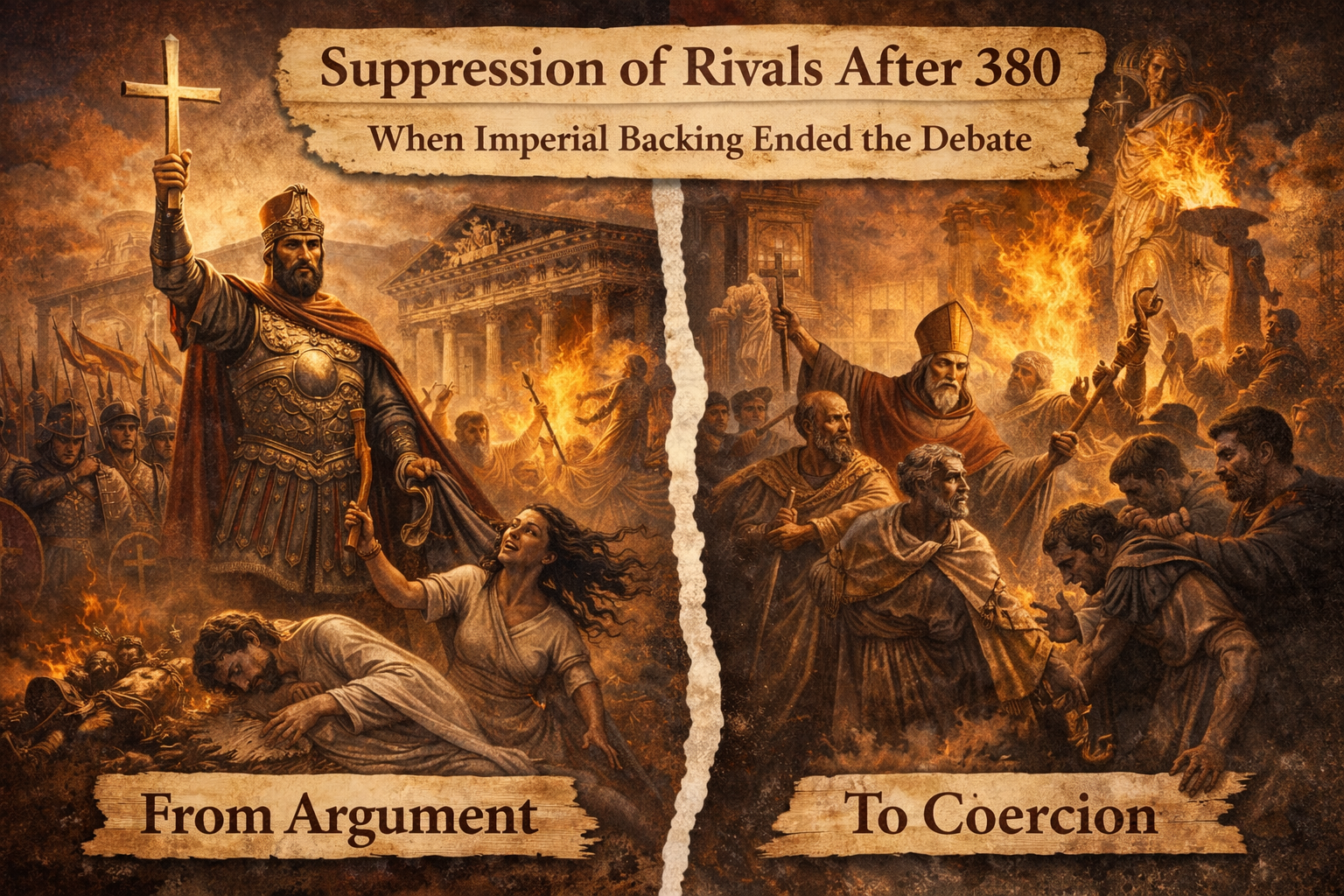
There is a version of Christian history that goes like this: the early church was persecuted, martyred and oppressed for three centuries, then Constantine gave it freedom, and the faith spread through the power of its message alone. That version is not entirely false. The persecution was real. The martyrs were real. Constantine's Edict of Milan in 313 AD genuinely extended tolerance. But the story stops precisely where it gets uncomfortable, because what came after Constantine and Edict of Milan is not a story about the power of a message. It is a story about the power of the state. Once Christianity had imperial backing, it did what institutions with power tend to do: it used that power to eliminate its competitors, define orthodoxy by force and punish deviation. The debate was not won. It was ended. There is a difference, and the difference matters for understanding every religious power play that has followed in the sixteen centuries since.
From Tolerance to Dominance: The Speed of the Shift
The distance between Constantine's tolerance edict in 313 and Theodosius's establishment of Nicene Christianity as the empire's sole official religion in 380 is sixty-seven years. Within that span, Christianity moved from persecuted minority to tolerated religion to favored faith to official state church. Each step accelerated the next. Once emperors began favoring Christian clergy with legal privileges, exempting them from certain civic obligations and funding church construction from the imperial treasury, the institutional weight of the empire began shifting. Christianity was not simply being tolerated. It was being subsidized, elevated and aligned with imperial authority in ways that transformed its social position entirely.
Constantine himself provides the first example of how quickly state backing changes a religion's behavior. His reign saw the destruction of some pagan temples, the melting down of cult statues for their gold and the transfer of temple revenues to Christian churches. These were not private acts of devotion. They were state-directed redistribution of religious wealth. Constantine also involved himself directly in theological disputes, most famously by convening the Council of Nicaea in 325 to settle the Arian controversy - the question of whether Christ was fully divine or a subordinate created being. The emperor did not merely observe the debate. He shaped its outcome, threw his weight behind the Nicene position and exiled bishops who refused to sign the resulting creed. Imperial preference had become theological enforcement. That pattern was established within years of the first Christian emperor. It did not require Theodosius to invent it. Theodosius simply completed what Constantine had started.
The Edict of Thessalonica in 380 was specific. It commanded all peoples under Roman rule to practice the religion followed by the bishop of Rome and the bishop of Alexandria - meaning Nicene Christianity. Those who deviated were to be regarded as "demented and insane" and punished with divine condemnation and the judgment of the emperor. Subsequent legislation in the Theodosian Code went further. The Theodosian decrees of the 380s and 390s banned pagan sacrifice, closed temples, prohibited apostasy from Christianity, and imposed legal disabilities on heretics - including loss of the right to make wills, inherit property and hold public office in some cases. This was not a system of religious preference. It was a system of legal coercion backed by imperial authority. The historian who wants to argue that Christianity spread purely through persuasion has to account for the fact that the empire was simultaneously making non-Christianity legally and economically costly.
What Happened to Pagan Worship
The fate of paganism after 380 is documented in enough detail to make the picture clear. It was not simply that pagans stopped believing. It is that the infrastructure of public pagan religion was systematically dismantled through a combination of imperial decree, ecclesiastical pressure, mob violence and official indifference to that violence. The process unfolded over decades and was uneven across regions. In some places temples were closed by law. In others they were seized and converted to churches. In others they were stripped of valuables and left to decay. In still others they were destroyed outright, sometimes by Christian mobs acting with the tacit or explicit approval of local bishops and civil authorities.
The philosopher and mathematician Hypatia of Alexandria is the most famous individual casualty of this period. In 415 AD she was dragged from her carriage by a Christian mob, stripped, murdered and mutilated in the street. Hypatia was not a political threat. She was a scholar and teacher associated with the Neo-Platonist philosophical tradition. She had maintained respectful relationships with Christians as well as pagans throughout her life. What she represented was the continued existence of an intellectual tradition that was not Christian, and in the Alexandria of 415 that was enough. The bishop Cyril of Alexandria, who was later canonized as a saint and declared a Doctor of the Church, bore at minimum moral responsibility for the climate that produced her murder. The degree of his direct involvement remains debated by historians. That a Christian bishop's political enemies included a pagan philosopher who was then killed by a Christian mob is not debated.
Paganism was not argued out of existence. It was legislated out of public life, stripped of its institutional infrastructure and subjected to violence that the state chose not to prevent. That is not religious persuasion. That is religious power.
What Happened to Christian Heretics
The treatment of pagan religion was only half the story. The other half was what Nicene Christianity did to Christians who believed differently. The Arian controversy that Constantine had tried to resolve at Nicaea did not stay resolved. Arianism - the position that Christ was subordinate to the Father rather than coequal - remained widespread, particularly among Germanic peoples and in the eastern provinces. The decades after Nicaea saw repeated swings between Nicene and Arian dominance depending on which emperor held power and which theological position he favored. Bishops were exiled, recalled, exiled again. Councils convened and contradicted each other. What had once been a theological argument conducted in letters and sermons became a political struggle conducted through imperial patronage and punishment.
Under Theodosius the Nicene position became permanent state orthodoxy, and Arianism was increasingly treated not as a theological error but as a criminal offense. Arian churches were confiscated and given to Nicene congregations. Arian clergy were barred from conducting services. Arian communities that had existed for generations found themselves defined as outside the acceptable range of Roman religious identity. The same pattern applied to other non-Nicene Christian groups - Donatists in North Africa, Manichaeans, Priscillianists in Spain. In 385 AD the bishop Priscillian of Avila became the first Christian executed by Christian authorities for heresy, condemned by a church council and put to death by the secular sword at the request of ecclesiastical authorities. The precedent of using civil execution to enforce theological conformity was now set. It would be used many times in the centuries that followed.
In 391 AD the Serapeum in Alexandria - one of the most impressive religious buildings in the ancient world, housing a famous library annex and dedicated to the Greco-Egyptian deity Serapis - was destroyed by a Christian mob led by the bishop Theophilus, acting with imperial authorization. The event was recorded by multiple ancient sources including the historian Socrates Scholasticus, who described the destruction of cult statues and the conversion of the temple space to Christian use. The Serapeum was not a minor local shrine. It was a major center of Alexandrian civic and intellectual life. Its destruction was not a spontaneous popular uprising. It was organized, bishop-led and backed by an imperial rescript granting permission for the operation. This is the pattern in miniature: ecclesiastical leadership, imperial authorization, mob execution and historical revisionism that presents the whole thing as the inevitable triumph of a superior faith over superstition. The people whose sacred space was destroyed experienced something different.
The Intellectual Cost: What Was Lost
The suppression of late antique paganism was not simply a religious event. It was a civilizational one. The philosophical traditions of the ancient world - Neo-Platonism, Stoicism, the Epicurean schools, the full range of Greek and Roman intellectual life - were embedded in pagan religious institutions and pagan social networks. When those institutions were closed and those networks were severed, the transmission of ancient learning became precarious. Some of it was preserved by Christian scholars who recognized its value. Much of it was not. The Library of Alexandria - or rather the collection of libraries that tradition has condensed into that single famous institution - was damaged and reduced across several episodes of conflict in this period, not in a single dramatic burning but in the cumulative loss that accompanies institutional destruction over generations.
The Platonic Academy in Athens, which had operated for nearly a thousand years and represented a continuous tradition of philosophical inquiry, was closed by Justinian in 529 AD as part of an ongoing campaign against paganism and its institutional remnants. Its scholars dispersed, some to Persia, carrying texts and traditions with them. That is the scale of what was lost or displaced: a millennium-old intellectual institution, shut down by imperial decree on religious grounds. Whether you regard that as a tragedy depends on how much you value the free transmission of ideas across generations. The people making the decision in 529 regarded it as a victory. That is precisely the problem with giving any institution - religious or otherwise - the power to decide which forms of inquiry are acceptable.
Why This Matters Beyond Ancient History
The events described in this post are not ancient curiosities with no bearing on the present. They are the foundational episode of what happens when a religion gains state power and uses it to reorganize society around its own definitions of truth, orthodoxy and acceptable practice. Every subsequent instance of religious coercion in the Christian tradition - the Inquisitions, the witch hunts, the colonial missions, the confessional wars - builds on the precedents set in this period. The logic that allowed Theodosius to criminalize heresy is the same logic that allowed later inquisitors to torture it out of people. The authorization of mob violence against pagan temples is the same authorization that allowed later generations to burn books, destroy indigenous sacred objects and execute dissenters.
The argument that this was all very long ago and that modern Christianity is entirely different is partly true and entirely insufficient. Modern Christianity in most of its Western expressions has genuinely internalized much of the Enlightenment critique and does not seek state power to enforce doctrine. But the same cannot be said of every expression of the tradition, and the current pressure from Christian nationalist movements to use governmental authority to enforce religious values operates from precisely the same premises that Theodosius operated from in 380. The specific doctrine changes. The structure of the claim does not: we have the truth, the state should serve that truth and those who disagree should be managed accordingly. That structure has a history. This series exists to make sure that history stays visible.
My Bottom Line
The story of Christianity after 380 is not a story of free persuasion succeeding on its merits. It is a story of institutional power reshaping the religious landscape of an empire through law, coercion and violence. Paganism did not simply fade because people found the Christian message more compelling. It was outlawed, its institutions were seized or destroyed, its practitioners were legally disadvantaged and its intellectual traditions were severed from their institutional bases. Rival Christian traditions were suppressed through the same mechanisms. The first Christian to be executed for heresy by Christian authorities died in 385 AD, five years after Nicene orthodoxy became state law. The precedent took less than a decade to bear its ugliest fruit.
None of this is an argument that Christianity has produced nothing good or that every Christian in late antiquity was a persecutor. It is an argument about what happens when any institution - religious or otherwise - acquires the coercive power of the state and uses it to enforce ideological conformity. The record from 380 to 529 is not ambiguous. The debate was not won. It was ended. And the method used to end it left marks on Western civilization that have not fully healed.
The lesson of late antiquity is not that Christianity is uniquely evil. It is that power is. The church of the martyrs became the church of the inquisitors in less than a century. That transformation did not require bad theology. It required state authority and the willingness to use it.
References
- Edict of Milan. (313 AD). In Lactantius, De Mortibus Persecutorum, ch. 48.
- Edict of Thessalonica. (380 AD). Codex Theodosianus 16.1.2.
- Codex Theodosianus. (438 AD). Book 16: On Religion. Compiled under Theodosius II.
- Socrates Scholasticus. (c. 440 AD). Historia Ecclesiastica. Book 5, ch. 16-17 (Serapeum destruction).
- Sozomen. (c. 445 AD). Historia Ecclesiastica. Book 7 (Theophilus and Alexandria).
- Gibbon, E. (1776). The History of the Decline and Fall of the Roman Empire, Vols. I-III. Strahan and Cadell.
- Nixey, C. (2017). The Darkening Age: The Christian Destruction of the Classical World. Macmillan.
- Freeman, C. (2002). The Closing of the Western Mind: The Rise of Faith and the Fall of Reason. Heinemann.
- Watts, E. J. (2017). Hypatia: The Life and Legend of an Ancient Philosopher. Oxford University Press.
- Drake, H. A. (2000). Constantine and the Bishops: The Politics of Intolerance. Johns Hopkins University Press.
- McLynn, N. B. (1994). Ambrose of Milan: Church and Court in a Christian Capital. University of California Press.
- Chadwick, H. (1976). Priscillian of Avila: The Occult and the Charismatic in the Early Church. Oxford University Press.
Disclaimer: The views expressed in this post are the personal opinions of the author and are offered for educational, commentary and public discourse purposes only. They do not represent the positions of any institution, employer, organization or affiliated entity. Nothing in this post constitutes legal, financial, medical or professional advice of any kind. References to historical events, primary sources and academic scholarship are based on publicly available sources cited above. This post examines historical episodes of religious coercion and does not make claims about contemporary Christianity or individual believers. Commentary on religious and historical subjects reflects the author's independent analysis and is protected expression of opinion. Readers are encouraged to consult primary sources and form their own conclusions.