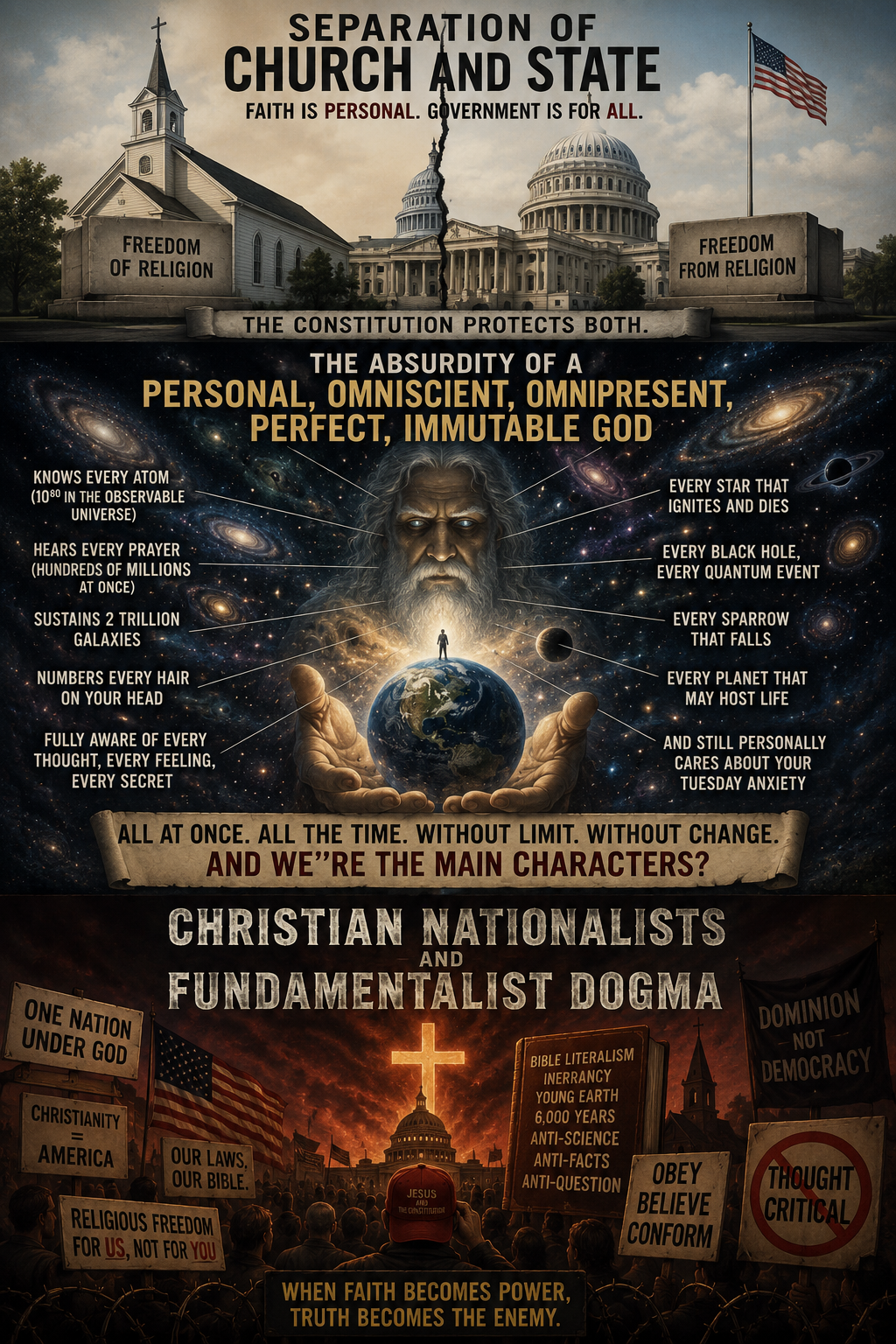
The observable universe is approximately 93 billion light-years in diameter, contains an estimated two trillion galaxies and has existed for roughly 13.8 billion years. The authors of Genesis believed the sky was a solid dome, that the Earth was flat, that the sun moved around it and that the entire cosmos was created in six days roughly six thousand years ago. Christian nationalists and biblical fundamentalists believe that the text produced by those authors is the infallible, immutable word of an omniscient God — perfect, inerrant and binding on human civilization for all time. They also believe that text should form the basis of American law, public policy, education and governance. That combination of claims is not just theologically ambitious. It is the clearest possible argument for why the separation of church and state is not optional in a pluralistic, scientifically literate republic.
What Biblical Inerrancy Actually Claims
Biblical inerrancy is not a fringe position. It is the stated belief of a large portion of American evangelical Christianity and the theological foundation of Christian nationalism. The Chicago Statement on Biblical Inerrancy, signed in 1978 by hundreds of evangelical scholars and leaders, declares that Scripture is "without error or fault in all its teaching" — not just in matters of salvation but in everything it affirms, including history and cosmology. The Southern Baptist Convention's statement of faith affirms that the Bible "has God for its author, salvation for its end, and truth, without any mixture of error, for its matter." Many fundamentalist traditions go further, insisting on a literal six-day creation, a young Earth and a global flood.
If the Bible is inerrant in all it affirms, you must accept that the Earth is approximately six thousand years old, that the cosmos was created in six literal days, that a single man and woman are the ancestors of all eight billion living humans, that a global flood killed every terrestrial creature except those on one wooden boat, and that the sun stopped moving in the sky at Joshua's command. Each of these claims is flatly contradicted by physics, astronomy, geology, genetics and basic mathematics. Inerrancy does not require faith. It requires the suspension of every empirical tool humanity has developed in the last five centuries.
The immutability claim compounds the problem. An immutable God and an inerrant Bible mean the moral framework embedded in those ancient texts cannot be revised, updated or corrected by anything — not science, not historical knowledge, not the accumulated experience of civilization. What was true for Bronze Age Levant nomads is true for twenty-first century America. What God commanded then, God commands now. The text does not grow. It does not learn. It cannot be wrong.
The Cosmological Problem Is Not Academic
The scale of the universe is not merely a scientific curiosity. It is a direct challenge to the theological claims on which Christian nationalism rests. The God of inerrancy is omniscient — knowing everything, simultaneously, across a cosmos containing an estimated 10 to the power of 80 atoms, two trillion galaxies, billions of probable planets and 13.8 billion years of history. That same omniscient God dictated or inspired a text that described the universe as a flat disk under a solid dome, placed the stars as decorative lights in the firmament a few thousand years ago and was apparently unconcerned that none of this matched physical reality.
There are two ways to handle this contradiction. The first is to say the cosmological passages in Scripture are not meant to be read literally — they are poetic, mythological, culturally situated expressions of spiritual truth rather than scientific description. That is a reasonable theological position held by many serious Christian thinkers. It is also completely incompatible with inerrancy. You cannot have a text that is without error in all it affirms and simultaneously say its cosmological affirmations are not meant to be taken literally. The escape hatch and the doctrine cannot both be open at the same time.
A God who is omniscient but dictated a cosmologically wrong text either did not know better, did not care or did not dictate it. None of those options is compatible with inerrancy.
Christian Nationalism and the Governance Problem
Christian nationalism — the belief that America was founded as a Christian nation and should be governed according to Christian principles derived from Scripture — takes these theological claims and applies them to public law. Its advocates are not shy about the goal. Andrew Torba, founder of the social media platform Gab and a prominent Christian nationalist voice, has said the movement aims to "build a parallel Christian society" and ultimately install biblical law as the governing framework for America. The New Apostolic Reformation, a charismatic movement with significant political influence, advocates for "dominionism" — the idea that Christians are called to take control of the seven spheres of cultural influence including government, education and media. Project Blitz, a legislative strategy coordinated by Christian nationalist organizations, has pushed model legislation in state capitols across the country to insert explicitly Christian content into public education and government.
Prayer in public schools, mandated and teacher-led. The Ten Commandments posted in courtrooms and classrooms. Biblical creationism taught alongside or instead of evolutionary biology. Abortion prohibited based on the theological claim that personhood begins at conception. LGBTQ rights restricted based on Levitical prohibitions. Marriage law defined by biblical rather than civil standards. Curriculum in public schools shaped by a reading of American history that treats the founding as a Christian enterprise. Each of these goals rests on the premise that an inerrant, immutable biblical text is the appropriate basis for the governance of a pluralistic secular republic.
Why an Inerrant Text Is Uniquely Dangerous in Government
The specific danger of inerrancy in governance is not that religious people hold public office or that faith informs personal values. Those things are normal and protected. The danger is what happens when a text declared to be without error and beyond correction becomes the basis for public law in a society containing citizens who do not share that text or that declaration.
Democratic governance depends on revision. Laws change when evidence changes, when circumstances change, when public understanding develops. A legislature can repeal a bad law. A court can overturn an unjust precedent. A constitution can be amended. These are features, not bugs. They are what allow a society to correct its mistakes. An inerrant text cannot be revised. It cannot be wrong. It does not update. The moment a government derives its authority from such a text, it has foreclosed the corrective mechanisms that make democratic governance functional. You cannot appeal a law whose basis is divine revelation to a God who cannot err.
This is precisely why the founders, and particularly Madison and Jefferson, were so insistent on the wall between church and state. They had watched what happened in European history when governments derived their authority from ecclesiastical sources. The result was not moral governance. It was the Inquisition, the Wars of Religion, the persecution of dissenters and the use of divine sanction to make political power unchallengeable. The separation of church and state was not anti-religious. It was the hard-won lesson of two centuries of European bloodshed.
The Immutability Problem and Democratic Self-Governance
An immutable God enforces an immutable moral order. That is the logic of fundamentalism. What was sin in Leviticus is sin today. What God commanded regarding women's roles, sexual behavior, religious observance and civil punishment in the ancient Near East applies with equal force in twenty-first century America because God does not change and His word does not change. This is not a caricature of the position. It is the position, stated plainly by its advocates.
The problem for democratic self-governance is direct. A republic is a society that governs itself through the consent and deliberation of its citizens. It depends on the premise that the people — all the people, not just the faithful — have a legitimate voice in the laws under which they live. Christian nationalism explicitly rejects that premise for anyone whose values conflict with its reading of Scripture. Your consent is not required. Your disagreement is not morally legitimate. You are in error, and the inerrant text says so.
Approximately 26 percent of Americans identify as religiously unaffiliated. Millions more are Jewish, Muslim, Hindu, Buddhist or members of other faith traditions that do not share evangelical Christianity's theological claims. Under Christian nationalist governance, these citizens do not disappear, but their consent becomes irrelevant. Their dissent becomes defiance of divine order rather than legitimate political disagreement. The separation of church and state is the only structural protection they have against being governed by a theology they did not choose and cannot vote out.
The Scale Argument Brought Home
Return to the universe. Two trillion galaxies. A cosmos 93 billion light-years wide and 13.8 billion years old. An Earth that formed 4.5 billion years ago. A human species approximately 300,000 years old. A civilization roughly ten thousand years old. A text written between roughly 800 BCE and 100 CE by people who believed the Earth was flat, the sky was a dome and the sun orbited the Earth. That text is now claimed to be the inerrant word of an omniscient God and the proper basis for governing the most scientifically advanced republic in human history.
The mismatch is not a detail. It is the whole argument. A God who is genuinely omniscient knew the universe was 93 billion light-years wide when Genesis was written. An inerrant text produced by that God would reflect that knowledge or at minimum not contradict it. The cosmological picture in Genesis is not vague. It is specific, and it is wrong by every measure science has developed. The fundamentalist response — that Genesis is not making scientific claims — surrenders inerrancy while refusing to admit it. The nationalist response — that secular science is corrupt or limited — requires rejecting the epistemological foundations of every productive human inquiry since the scientific revolution.
My Bottom Line
Biblical inerrancy and immutability are not just theological positions. When they enter governance, they become structural threats to democratic self-correction, pluralistic citizenship and the basic premise that law must be accountable to evidence and revision. Christian nationalism takes those theological positions and applies them to the machinery of the state. The separation of church and state is not a liberal invention or an anti-religious assault. It is the constitutional firewall between a functioning republic and a theocracy built on a text that got the age of the universe wrong by a factor of two million.
You are free to believe the Bible is inerrant. You are free to worship an immutable God. You are not free to make the rest of us live under laws derived from that belief. That is exactly the line the First Amendment draws, and it draws it for everyone's protection — including yours.
Why This Matters
The Christian nationalist movement is not a fringe. It has representation in Congress, influence in state legislatures, a presence in the judiciary and explicit backing from organized political networks with significant funding. Its theological assumptions — inerrancy, immutability, divine mandate for governance — are incompatible with the constitutional order Madison built. The separation of church and state is not under metaphorical threat. It is under organized, well-funded, legislatively active threat from a movement that has said plainly what it wants. Taking that seriously is not paranoia. It is reading the stated agenda of the people making the argument.
References
- The Chicago Statement on Biblical Inerrancy. (1978). International Council on Biblical Inerrancy.
- Southern Baptist Convention. (2000). Baptist Faith and Message, Article I: The Scriptures. sbc.net.
- Conselice, C. J., et al. (2016). The evolution of galaxy number density at z < 8 and its implications. Astrophysical Journal, 830(2).
- NASA. (2023). How big is the observable universe? science.nasa.gov.
- Whitehead, B. (2022). Christian nationalism and Project Blitz. Americans United for Separation of Church and State. au.org.
- Stewart, K. (2019). The power worshippers: Inside the dangerous rise of religious nationalism. Bloomsbury Publishing.
- Madison, J. (c. 1820). Detached Memoranda. (On the separation of church and state.)
- Engel v. Vitale, 370 U.S. 421 (1962).
- Kitzmiller v. Dover Area School District, 400 F. Supp. 2d 707 (M.D. Pa. 2005).
Disclaimer: The views expressed in this post are the personal opinions of the author and are offered for educational, commentary and public discourse purposes only. They do not represent the positions of any institution, employer, organization or affiliated entity. Nothing in this post constitutes legal, financial, medical or professional advice of any kind. References to public figures, institutions, historical events and current affairs are based on publicly available sources and are intended to support analysis and argument, not to state facts about any individual's character, intent or conduct beyond what the cited sources support. Commentary on religious, political and cultural subjects reflects the author's independent analysis and is protected expression of opinion. Readers are encouraged to consult primary sources and form their own conclusions. Any resemblance to specific individuals or situations beyond those explicitly referenced is coincidental.