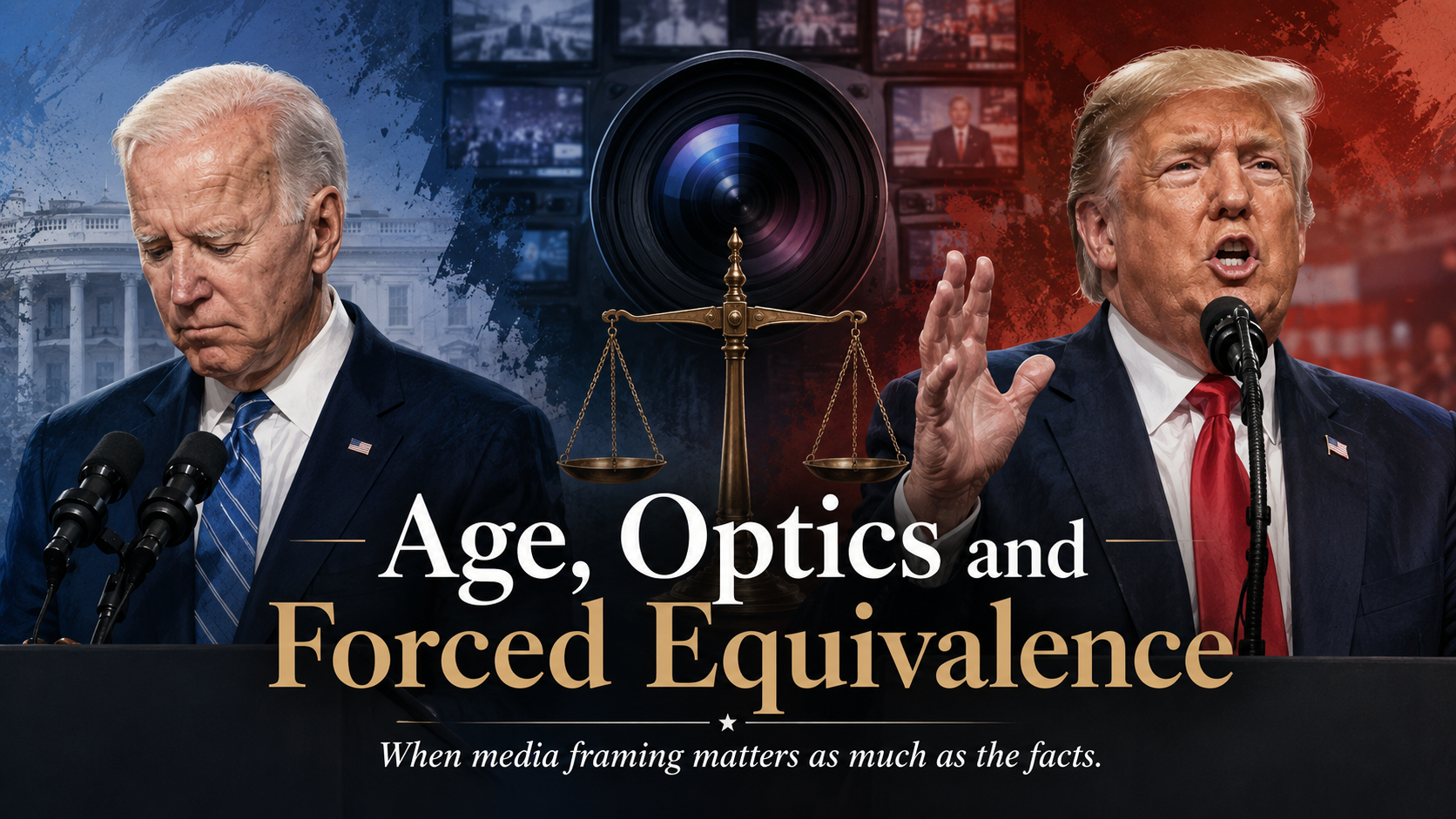
The Atlantic recently published Jonathan Lemire's article "A Different Kind of Fading President," arguing that Donald Trump's aging is not receiving the same level of scrutiny that Joe Biden's did. The core point is not entirely unreasonable. Trump is old. He was 78 when he began his second term, making him the oldest president to begin a term in American history. Any president that age deserves scrutiny, especially when the job involves national security, crisis management, stamina and judgment. But the article falls into a familiar media habit: forced equivalence. It tries to place Trump's age concerns and Biden's visible decline in the same political bucket, even though the evidence surrounding each case is not the same. That does not mean Trump should get a pass. It means the comparison should be honest.
Age Is Fair Game
Presidents should not be shielded from questions about age, health or mental fitness. The public has a right to know whether the person making life-and-death decisions is physically and mentally capable of doing the job. That applies to Biden. It applies to Trump. It will apply to every future president who seeks or holds office at an advanced age.
The presidency is not a ceremonial job. It requires judgment under pressure, long hours, quick decisions and the ability to communicate clearly with the country. A president does not need to be young, but he does need to be capable. When The Atlantic raises the issue of Trump's age, that part is legitimate. Comfortable shoes, reduced travel, moments of fatigue and visible physical changes can fairly be mentioned. They may not prove anything by themselves, but they are not off-limits. The problem is what the article does next.
Biden's Decline Was Not Just About Age
The article frames Biden as having become "quieter" while Trump becomes "louder." That is clever writing. It also softens what actually happened. Biden's issue was not merely that he aged, lost weight or spoke softly. The concern became unavoidable because of repeated public moments where he appeared physically weaker, verbally uncertain and cognitively diminished. The June 27, 2024 debate against Trump was the breaking point. Reuters described Biden's performance as "shaky" and "halting" and reported that it rattled Democrats enough that some openly questioned whether he should remain the nominee.
Less than a month later, on July 21, 2024, Biden ended his reelection campaign and endorsed Kamala Harris. Reuters reported that the decision followed his poor debate performance and concerns about his ability to continue the campaign. That is a very specific chain of events: public concern, debate collapse, party panic, withdrawal from the race. That is not the same as saying Trump is aging because he wears different shoes or appears tired during meetings.
Trump's Age Should Be Watched, But Evidence Still Matters
Trump is not immune from age-related scrutiny. He rambles. He exaggerates. He gets combative. He repeats himself. He often speaks in a style that is undisciplined and exhausting. Voters and journalists are right to ask whether that is personality, age or some combination of both. But there is a difference between evidence and inference.
If Trump repeatedly appears unable to finish thoughts, cannot handle unscripted public appearances, avoids normal presidential duties or requires staff to shield him from public scrutiny, that would be serious and should be reported aggressively. The public deserves better than vibes dressed up as diagnosis. Large physical presence does not prove fitness. Loudness does not prove sharpness. But the reverse is also true: comfortable shoes, hand discoloration and fatigue do not prove incapacity. An argument based mostly on optics is weak regardless of which direction it points.
Age is a number. Decline is evidence. Serious journalism should know the difference.
The Visibility Difference Matters
One major difference between Biden and Trump is visibility. Biden's public schedule became a concern because he appeared less available, less spontaneous and more managed. Critics argued that his team was protecting him from unscripted exposure. Whether one agrees with every criticism or not, the concern was grounded in a visible pattern.
Trump, by contrast, is almost impossible to avoid. The Atlantic article itself notes that he is constantly in front of cameras, speaking to reporters and generating news. That does not prove he is healthy, but it does give the public more raw material to judge. A president who is constantly visible can still be declining. But the evidence has to come from what the public can observe consistently, not from a writer's attempt to make two aging presidents seem interchangeable.
The Media's Real Problem: Late Scrutiny and Overcorrection
The stronger criticism here is not that Trump's age is being ignored. It is that Biden's age was not scrutinized seriously enough until it became impossible to avoid. For years, concerns about Biden's condition were often brushed aside as partisan attacks, right-wing editing or superficial commentary. Then the debate happened, and suddenly many of those concerns became acceptable to discuss.
That is not journalism operating at full strength. That is journalism catching up after reality kicked the door open. Now some outlets appear determined to balance the ledger by applying a similar decline narrative to Trump. But balance is not the same as accuracy. If Trump is declining, report it with evidence. If Biden declined, admit that the warning signs were there earlier than many in the press wanted to acknowledge. Do not flatten two different situations into the same story because it feels politically tidy.
My Bottom Line
Trump's age is a legitimate issue. Biden's decline was also a legitimate issue and it should have been treated that way sooner. The mistake is pretending that both situations are automatically equal because both men are old. The Atlantic article raises a fair question but weakens it by leaning too hard into forced equivalence. Trump should be scrutinized. Biden should have been scrutinized earlier. The public should expect honesty in both cases. What it should not accept is political symmetry masquerading as objective analysis.
Why This Matters
The presidency is too important for partisan selective vision. When media outlets downplay one president's decline and then overcorrect by stretching the same argument onto another, they do not rebuild trust. They damage it further. Americans do not need journalists to protect politicians. They do not need journalists to create balance where the facts are not balanced. They need journalists to say what is plainly visible, verify what is uncertain and stop confusing optics with evidence.
That should not be too much to ask.
References
- The Atlantic. (2026, May 18). A Different Kind of Fading President. Lemire, J.
- Associated Press. (2025). Trump is "fully fit" to serve as commander in chief, his doctor says after recent physical.
- Reuters. (2024, June 28). Biden's shaky Trump debate alarms Democrats, raises questions about campaign.
- Reuters. (2024, June 27). Biden falters as Trump unleashes falsehoods during debate.
- Reuters. (2024, July 21). Biden ends failing reelection campaign, backs Harris as nominee.
Disclaimer: The views expressed in this post are personal opinions offered for educational, commentary and public discourse purposes only. They do not represent the positions of any institution, employer or organization with which the author is affiliated. Nothing in this post constitutes professional legal, financial or medical advice. References to public figures, institutions and events are drawn from publicly available sources cited above and are intended to support analysis and commentary, not to make factual claims about individuals beyond what those sources establish. Political and religious commentary reflects the author's protected opinion. Readers are encouraged to consult primary sources and form their own conclusions. Any resemblance to persons or situations beyond those explicitly referenced is coincidental and unintended.