
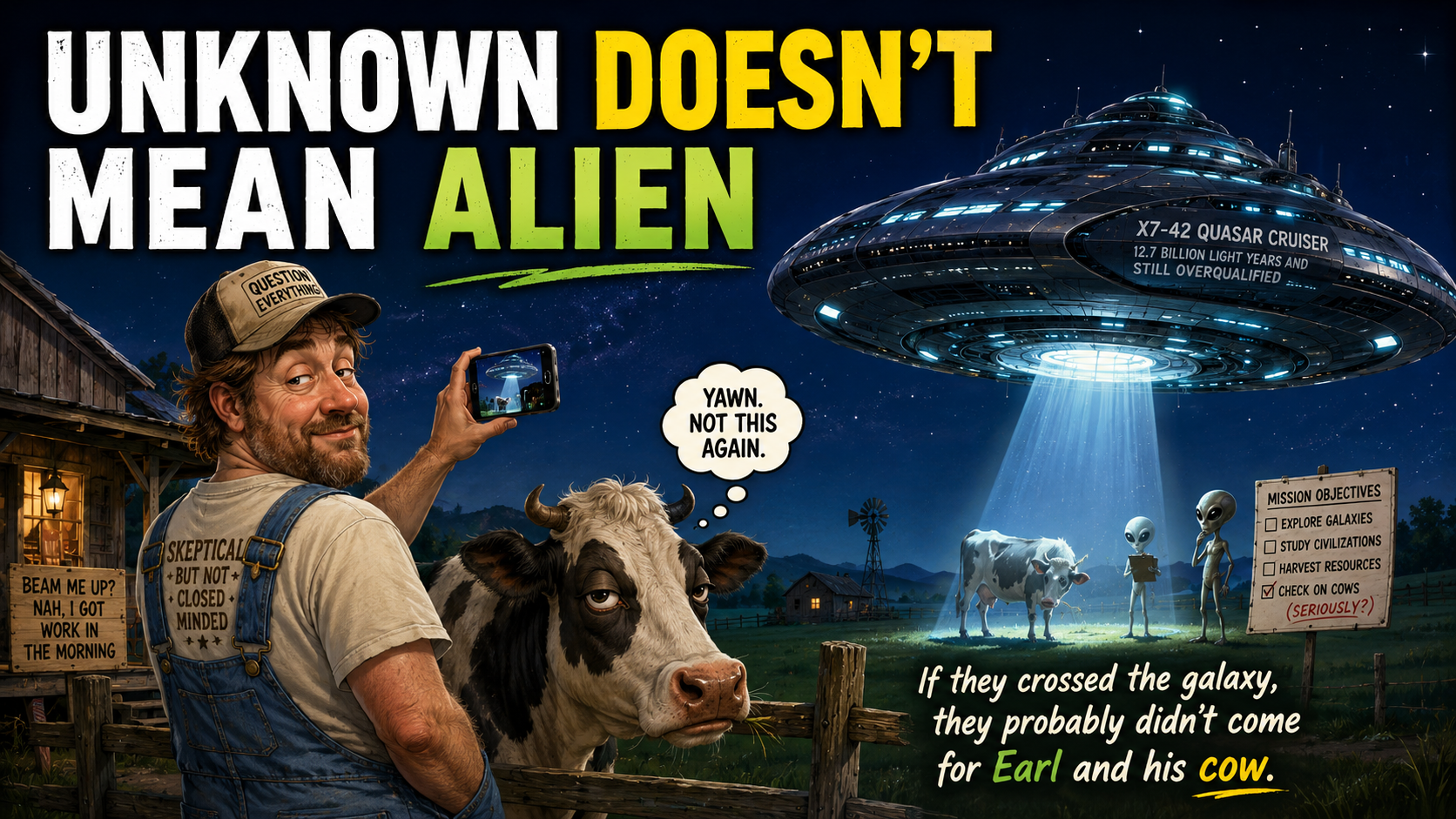
There is a big difference between saying, "I do not know what that is," and saying, "That must be an alien spacecraft." That difference matters.
A UFO, by definition, is an unidentified flying object. The newer government term is UAP - unidentified anomalous phenomenon. Neither term means "alien." It means something was seen, recorded or reported and the observer could not identify it with the available information. That is it.
Unknown does not mean supernatural. Unknown does not mean extraterrestrial. Unknown does not mean a species from another solar system crossed the endless violence of space to hover over a cornfield, scare a rancher, mutilate a cow and then vanish without leaving behind one piece of evidence strong enough to survive serious scrutiny.
I say that as someone who enjoys the subject. I like the mystery. I like the stories. I like the cultural weirdness of it all. But liking a story is not the same thing as believing it. And the UFO subject has always had one major problem: the evidence never seems to rise to the level of the claim.
A UFO Is Not Automatically an Alien
The first mistake people make is definitional. They hear "UFO" and immediately think "alien." That is bad reasoning.
If someone sees a strange light in the sky, that light may be unidentified to the person seeing it. But it may still be a drone, satellite, aircraft, balloon, meteor, reflection, military test, camera artifact or plain old human error. A thing can be unidentified to one person and perfectly ordinary in reality.
The government's own recent UAP work supports this basic point. AARO, the All-domain Anomaly Resolution Office, has said it uses a scientific and data-driven framework to examine UAP reports. In its 2024 public briefing, AARO stated that it had received more than 1,600 UAP reports and had resolved hundreds as commonplace objects such as balloons, birds, drones, satellites and aircraft. It also stated that more than 900 reports lacked enough scientific data for analysis. Most importantly, AARO said it had found no verifiable evidence of extraterrestrial beings, activity or technology.
That is not the same thing as saying every case is solved. It is saying the leap from "we do not know" to "aliens" is not justified by the evidence.
The Condon Report Problem
The Condon Report - the University of Colorado UFO study funded by the U.S. Air Force in the 1960s and led by physicist Edward Condon - remains one of the major historical attempts to treat UFO claims as a serious scientific question. CU Boulder summarizes it plainly: the Air Force commissioned Condon to investigate whether UFOs might be extraterrestrial, and the report concluded that UFOs did not warrant further scientific investigation.
The report was controversial, and not everyone accepted its conclusions. Fair enough. Scientists are allowed to argue. But the core issue has not changed much since then. The question is not whether people see strange things. They do. The question is whether those sightings add up to evidence of alien visitation.
Condon's own conclusion was blunt: further study of UFO reports was unlikely to advance science. The report also acknowledged that scientists should not simply bow to authority and that others were free to examine the evidence and disagree. That is how the subject should be handled - not mocked out of existence, but not inflated into nonsense either.
More Cameras, Less Convincing Evidence
We now live in a world where nearly everyone carries a camera. Not a disposable camera. Not a blurry Polaroid. A high-definition video camera connected to the internet.
Pew Research Center reports that 98% of American adults now own a cellphone and 91% own a smartphone, up from just 35% smartphone ownership in 2011. So where is the footage? Not the shaky dot in the sky. Not the glowing blob. Not the video that could be a balloon, drone, bird, Starlink satellite or reflection. Where is the clear, undeniable, multiple-angle, high-resolution evidence?
The National UFO Reporting Center still receives reports by the hundreds each month - 582 in January 2025, 394 in May 2025, 425 in October 2025 and 264 in December 2025. People are still reporting things. The issue is not the total disappearance of UFO claims. The issue is that the explosion of cameras has not produced an explosion of decisive proof.
Known Phenomena Explain a Lot
A serious UFO discussion should begin with the ordinary before racing to the extraordinary. The sky is busy. We have satellites, aircraft, drones, balloons, military exercises, weather events, atmospheric effects and experimental technology. Add modern camera problems - zoom distortion, rolling shutter effects, infrared artifacts and low-light blur - and plenty of "impossible" sightings become less impressive.
AARO's official imagery page shows this clearly. Some cases remain unresolved because the data is insufficient, but others have been resolved as birds, balloons or aircraft. In one case, AARO assessed with high confidence that the objects were almost certainly birds. In several others, it assessed that the objects were almost certainly balloons.
The Alien Logic Problem
Suppose an alien civilization exists. That is not crazy. The universe is enormous. It would be arrogant to assume Earth is the only place where life ever emerged. But there is a canyon between "alien life may exist somewhere" and "aliens are visiting Earth, abducting random people and slicing up cattle."
The universe is not a short drive. Interstellar travel is not like taking I-70 across Kansas. The distances are obscene. A civilization capable of crossing them would have solved problems of energy, propulsion, navigation, biology and time that we can barely wrap our heads around.
And this is where the popular UFO story gets ridiculous. A species advanced enough to travel the endless universe fast enough to reach Earth would also be advanced enough to collect biological samples without putting on a light show over a pasture. It would not need to mutilate livestock like a drunk butcher. It would not need to abduct the dumbest hillbilly it could find, communicate in riddles, scare the hell out of him and then leave without one clean trace.
If aliens came here and wanted to study humans, they would not need to pick up Earl behind the feed store and erase half his memory. They could observe us from orbit, sample our atmosphere, intercept our signals, study our biology remotely or do whatever a civilization that advanced would do. They would not need to behave like teenagers with a stolen truck and a spotlight.
That does not mean every strange story is fake. Some people may be sincere. Some may have experienced sleep paralysis, trauma, confusion, misperception or something else they could not explain. But sincerity is not evidence. A person can honestly describe what he believes happened and still be wrong about what happened.
Livestock Mutilation and the Pattern of Panic
The cattle mutilation stories are a perfect example of how folklore grows around uncertainty. The FBI's own archive includes animal and cattle mutilation files from the 1970s, when reports in western and midwestern states caused public concern. These cases were strange, disturbing and sometimes hard to explain neatly. But strange does not equal alien.
Dead animals decompose. Predators and scavengers target soft tissue. Blood pools, drains or disappears in ways that look bizarre to people who are not trained in animal death investigation. Ranchers are understandably angry and suspicious when they find mutilated livestock, but suspicion is not proof of extraterrestrial surgery.
The alien explanation makes the least sense. If an advanced life form needed tissue samples, it would not need to leave behind a grotesque crime scene in a pasture. That sounds less like advanced science and more like human panic trying to explain something ugly.
Government Secrecy Does Not Prove Aliens
One reason UFO theories persist is government secrecy. That part is understandable. The government lies. Agencies classify too much. Military programs are hidden. Experimental aircraft exist. National security excuses are often abused. Anyone who says, "Trust the government completely," has not been paying attention.
But distrust of government does not prove aliens. It may prove the government is hiding a military program. It may prove officials do not want to disclose sensor capabilities. It may prove agencies are embarrassed by what they do not know. It may prove bureaucrats are doing what bureaucrats do - covering, delaying and overclassifying.
In 2024, the Defense Department said AARO had found no verifiable evidence that any UAP sighting represented extraterrestrial activity and no verifiable evidence that the U.S. government or private industry had access to extraterrestrial technology. Could the government still be hiding things? Sure. But "the government hides things" is not the same as "the government has alien bodies in a freezer."
My Bottom Line
I believe there are UFOs in the literal sense. People see things they cannot identify. Pilots see things. Soldiers see things. Civilians see things. Cameras capture odd objects. Some cases deserve investigation, especially when they involve air safety or national security.
But I do not believe "unidentified" means "alien." The more advanced our cameras become, the more disappointing the evidence looks. The more reports officials review, the more many of them turn into balloons, birds, drones, satellites, aircraft or insufficient data. The more spectacular the claim, the weaker the proof seems to become.
Aliens may exist somewhere. I would not be shocked if life exists beyond Earth. But the idea that a civilization capable of crossing interstellar space gets here and spends its time scaring farmers, mutilating cows and whispering cosmic secrets to confused backwoods witnesses is not science.
Why This Matters
This matters because sloppy thinking does not stay in one lane. When people confuse unknown with proven, they become easier to manipulate. A light in the sky becomes an alien. A classified document becomes a conspiracy. A sincere witness becomes scientific proof. Before long, the standard for belief drops so low that anything mysterious becomes whatever the loudest storyteller says it is.
We can be open-minded without being gullible. We can admit there are unexplained sightings without pretending the explanation must be extraterrestrial. We can enjoy the mystery without surrendering common sense.
The honest answer is not always exciting, but it is usually the right place to start: I do not know what that was. That sentence is not weakness. It is intellectual discipline.
References
All-domain Anomaly Resolution Office. (n.d.). Official UAP imagery. U.S. Department of Defense.
Department of Defense. (2024). DOD report discounts sightings of extraterrestrial technology.
Department of Defense. (2024). Dr. Jon Kosloski, Director, AARO, media roundtable on the FY24 consolidated annual report on UAP.
Federal Bureau of Investigation. (n.d.). Animal mutilation. FBI Vault.
National UFO Reporting Center. (n.d.). Reports by month.
Pew Research Center. (2025). Mobile fact sheet.
University of Colorado Boulder. (2021). The Condon Report: CU Boulder's historic UFO study.
University of Colorado. (1968). Condon Report, Section I: Conclusions and recommendations.
The views expressed in this post are personal opinions offered for educational, commentary and public discourse purposes only. They do not represent the positions of any institution, employer or organization with which the author is affiliated. Nothing in this post constitutes professional legal, financial or medical advice. References to public figures, institutions and events are drawn from publicly available sources cited above and are intended to support analysis and commentary, not to make factual claims about individuals beyond what those sources establish. Political and religious commentary reflects the author's protected opinion. Readers are encouraged to consult primary sources and form their own conclusions. Any resemblance to persons or situations beyond those explicitly referenced is coincidental and unintended.