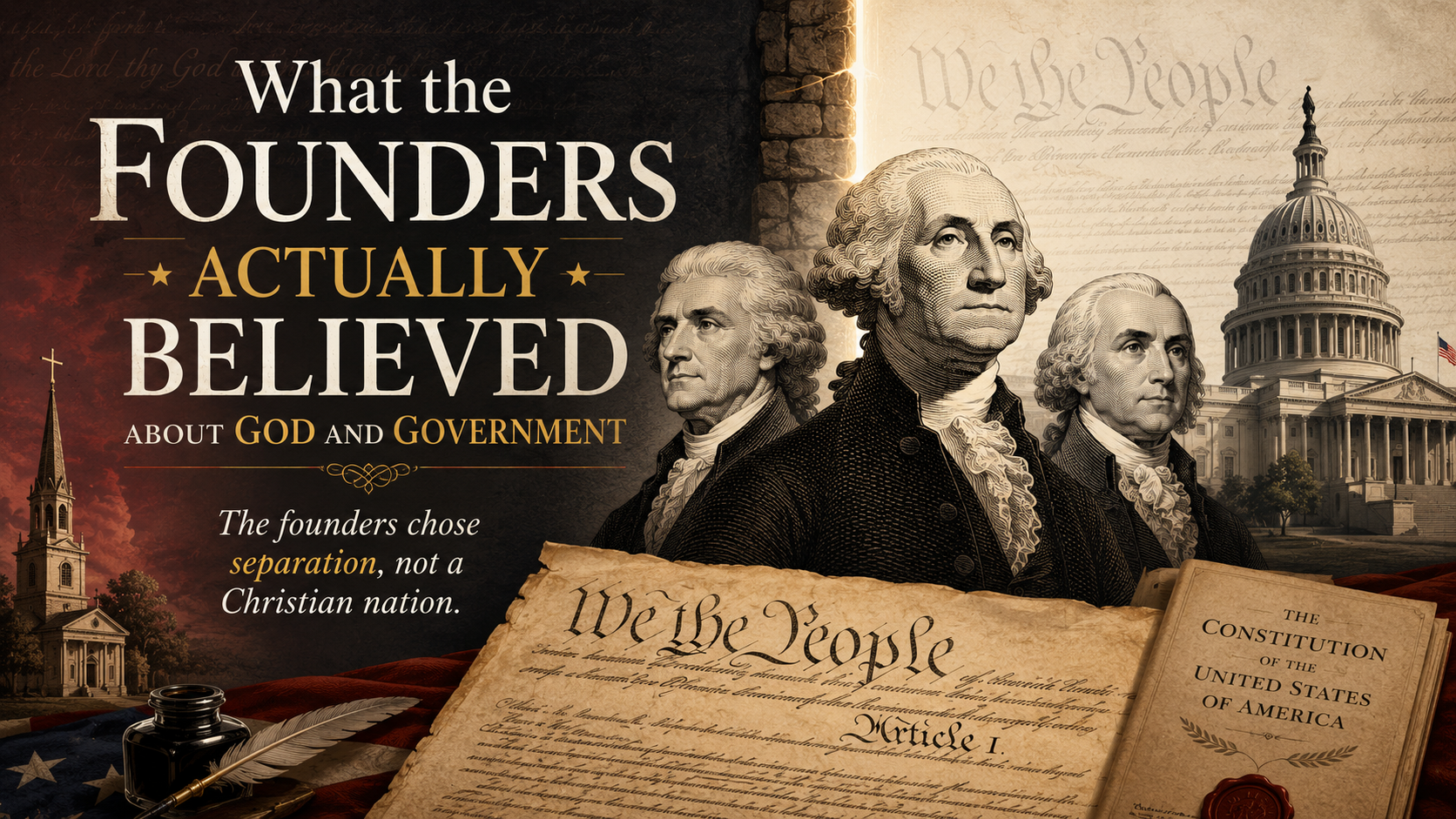
The people who argue America was founded as a Christian nation have usually not read the founders they are quoting. That is the short version. The longer version is that the record Jefferson, Madison and Washington left behind is extensive, specific and almost perfectly at odds with the mythology built on top of it. Jefferson rejected Christian orthodoxy in writing and refused to issue government prayer proclamations on constitutional principle. Madison wrote the First Amendment and later said he regretted the few times he let political pressure push him past it. The Senate of 1797 ratified a treaty explicitly stating the United States was not founded on the Christian religion, and nobody objected. This is not a revisionist reading of the founding. It is the founding.
Washington: Providence Without a Denomination
George Washington's public religious language is often cited as evidence that the founders intended America as a Christian nation. The evidence does not survive careful reading. Washington spoke frequently of providence, of the Almighty, of the Author of all good — language that is conspicuously and consistently non-denominational. He almost never invoked Christ, the Trinity, the Resurrection or any specifically Christian doctrine in his public addresses. This was not accident or omission. It was deliberate.
Washington was almost certainly a Deist in practice, though he kept his private theological views private with characteristic discipline. He attended Anglican services when it was politically and socially appropriate and often left before communion. His letters reveal a man who believed in a watchful divine providence but showed no evidence of the personal salvific Christianity that his modern admirers project onto him.
In his Farewell Address, Washington argued that religion and morality were indispensable supports for political prosperity. That is a claim about civic virtue, not a declaration of Christian nationhood. He did not say America was a Christian nation. He said that moral behavior — which he associated broadly with religious sensibility — was necessary for republican self-governance. His modern admirers routinely blur those two things into one.
Jefferson: The Wall Was Not a Metaphor
Thomas Jefferson is the clearest case because he left the clearest record. He did not believe in the divinity of Christ, the virgin birth, the Resurrection or the miracles of the New Testament. He said so in private letters with considerable bluntness. He produced what is now called the Jefferson Bible, a version of the Gospels from which he physically cut out every miracle and supernatural event, leaving only the moral teachings of Jesus, which he admired as a philosopher and ethical guide. This is not a controversial scholarly interpretation. It is what the document says.
As president, Jefferson refused to issue Thanksgiving proclamations or national prayer proclamations. His predecessor Adams had issued them. Jefferson considered them a violation of the constitutional principle he had articulated in his 1802 letter to the Danbury Baptist Association, in which he wrote that the First Amendment built "a wall of separation between church and state." That phrase, which has become the central metaphor of Establishment Clause jurisprudence, was not a casual remark. It was a considered statement of constitutional philosophy by the man who wrote the Declaration of Independence and who regarded the Virginia Statute for Religious Freedom as one of the three achievements worth listing on his tombstone.
Jefferson did not merely tolerate the separation of church and state. He regarded it as one of the defining accomplishments of his life. That is not a fact the "Christian nation" argument can absorb.
Madison: The Architect Who Meant What He Wrote
James Madison is the most important founder for this argument because he is the one who actually drafted the First Amendment. His views on religion and government were not ambiguous. He was deeply suspicious of any entanglement between religious institutions and state power, not because he was hostile to religion but because he believed that entanglement corrupted both.
Madison opposed congressional chaplains. He thought government-paid clergy violated the Establishment Clause because they used public funds for religious purposes and because their presence implied that Congress endorsed religion. He said so in his posthumously published Detached Memoranda. He also opposed government-issued prayer proclamations. He had issued a few as president during the War of 1812 under political pressure, and he later said he regretted them. He wrote that they constituted a "deviation" from the principle of separation that the Constitution required.
In his Detached Memoranda, Madison wrote that religious proclamations by government "imply and certainly nourish the erroneous idea of a national religion." He argued that the proper reading of the Constitution left no room for government involvement in religious observance, however seemingly benign. He also wrote that "the establishment of the chaplainship to Congress is a palpable violation of equal rights, as well as of Constitutional principles." This is the man who wrote the First Amendment. His interpretation of it is not a minor data point.
The Treaty of Tripoli: The Document They Never Quote
In 1796, the United States entered into the Treaty of Peace and Friendship with Tripoli. Article 11 of that treaty states, in full: "As the Government of the United States of America is not, in any sense, founded on the Christian religion — as it has in itself no character of enmity against the laws, religion, or tranquility of Mussulmen — and as the said States never entered into any war or act of hostility against any Mahometan nation, it is declared by the parties that no pretext arising from religious opinions shall ever produce an interruption of the harmony existing between the two countries."
The treaty was negotiated under Washington, signed by John Adams and ratified unanimously by the Senate in 1797. It was read aloud on the Senate floor. It raised no objection from any senator. It was published in the major newspapers of the day without apparent controversy. "The Government of the United States of America is not, in any sense, founded on the Christian religion." That sentence was not a diplomatic nicety or a translation artifact. It was the official position of the United States government in 1797, agreed to by the founders then in office and ratified without dissent.
It is the document that the "Christian nation" argument cannot survive, which is presumably why it is almost never cited by those making that argument.
The Constitution's Deliberate Silence
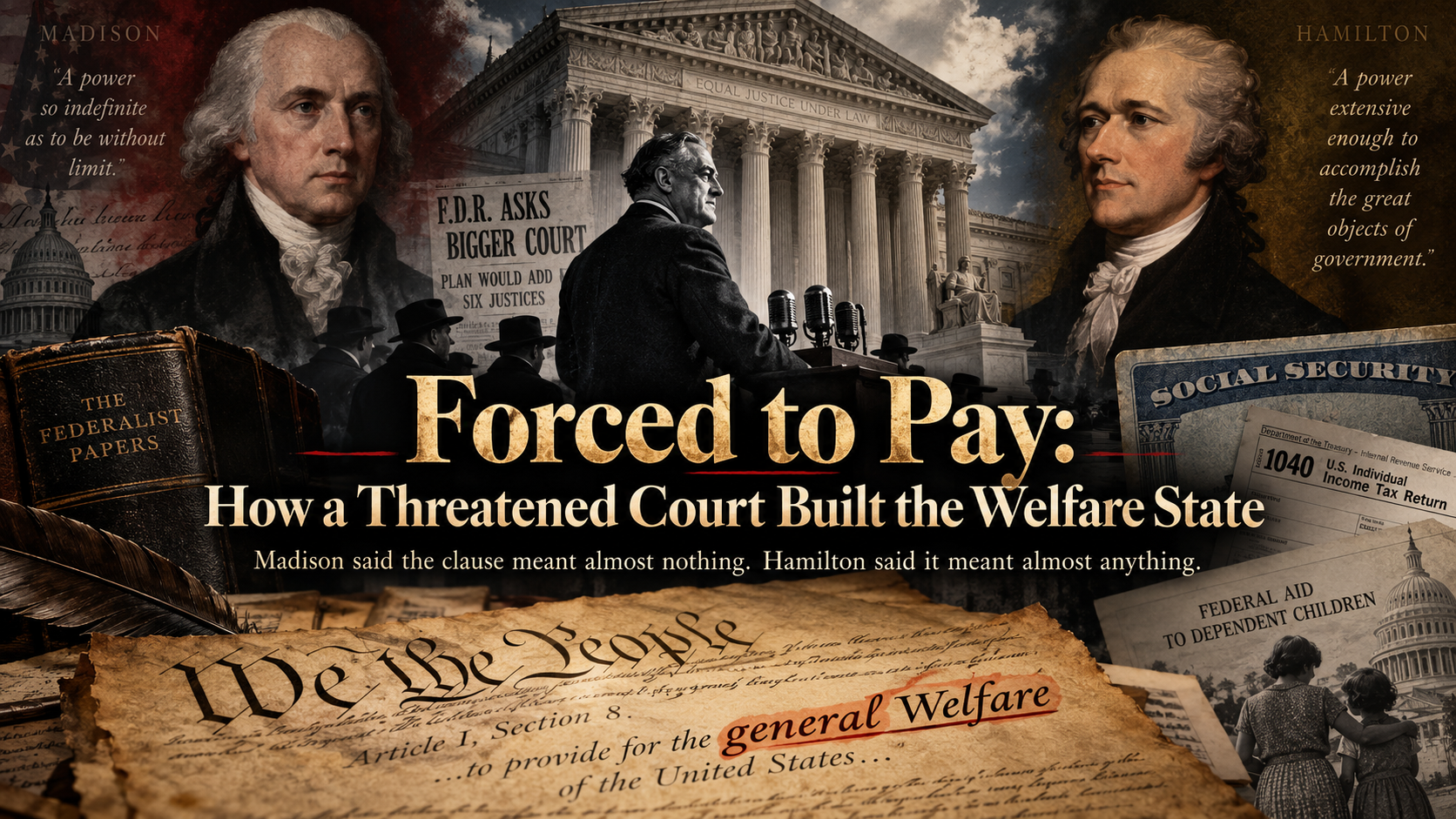
The Constitution of the United States does not mention God. It does not mention Jesus. It does not mention Christianity. It does not invoke the Bible. It does not declare the nation to be under divine authority. This is not an oversight. The founders knew how to invoke God. The Declaration of Independence does so four times. The Constitution, the actual governing document, does not do it once. The only mentions of religion in the original Constitution are prohibitive: Article VI bans religious tests for public office, and the First Amendment bars Congress from establishing religion or prohibiting its free exercise.
Constitutional silence on God was not a drafting accident. Several state constitutions of the era explicitly invoked Christianity and required religious oaths for officeholders. The framers of the federal Constitution knew those models and deliberately chose not to follow them. The absence of religious language in the Constitution is as intentional and as significant as any language that is present. A document designed to establish a Christian nation would not look like the Constitution of the United States.
The "Christian Nation" Argument and What It Actually Requires
For the Christian nation argument to work, you have to do several things simultaneously. You have to discount Jefferson's explicit rejection of Christian orthodoxy and his stated views on church-state separation. You have to ignore Madison's opposition to congressional chaplains, prayer proclamations and any government entanglement with religion. You have to treat Washington's vague deistic language as evangelical Christianity. You have to explain away the Treaty of Tripoli. You have to account for the Constitution's deliberate omission of any religious foundation. And you have to argue that a tradition of selective prayer proclamations by some presidents — contested by others from the beginning — settles a constitutional argument that the founders themselves disputed in their own time.
That is a great deal of work to produce a conclusion that the primary documents do not support. The founders were not a unified religious bloc. They were complicated men with divergent views on theology who agreed on one foundational political proposition: government should stay out of religion and religion should stay out of government, because the history of their entanglement was a history of oppression, corruption and war that the new republic was designed to leave behind.
Why Tradition Does Not Trump the Constitution
The final argument deployed for practices like the National Day of Prayer, "In God We Trust" on currency, congressional chaplains and prayer at government events is that these things are old. They have been around for a long time. They are part of the fabric of American public life. Therefore, the argument goes, challenging them is ahistorical, un-American and disrespectful of tradition.
But the Constitution does not become irrelevant because a tradition is old. The length of a practice does not determine its constitutionality. School-sponsored prayer was a long tradition in American public schools until the Supreme Court ruled in Engel v. Vitale in 1962 that it violated the Establishment Clause. Racial segregation was an older tradition still. Longevity is not a constitutional argument. It is an appeal to inertia dressed up as reverence for history.
If a practice violates the principle of separation between church and state — the principle Madison drafted, Jefferson articulated and the Treaty of Tripoli announced to the world — then the fact that it has been going on for fifty or a hundred or two hundred years does not make it right. It makes it an overdue correction.
My Bottom Line
The founders left a clear record. Jefferson built the wall and refused to breach it. Madison wrote the First Amendment and later said he regretted the few times he let political pressure push him past it. Washington spoke of God in terms deliberately stripped of Christian specificity. The Senate of 1797 ratified a treaty explicitly stating that the United States was not founded on the Christian religion. The Constitution omitted God by design. This is not a revisionist reading of the founding. It is the founding. The people who disagree have simply not read it straight.
The "Christian nation" argument does not fail because it is offensive. It fails because it is wrong. The founders who thought most carefully about this question got it right the first time, and their answer was separation — clear, principled and deliberately chosen.
Why This Matters
History matters in this debate because the Christian nation argument claims historical authority. When that authority is examined closely it dissolves. What remains is a political argument dressed in historical costume — an effort to use the prestige of the founders to advance a position the most important founders explicitly rejected. A republic that cannot read its own founding documents honestly is a republic that cannot govern itself honestly. The founders deserves better than to be turned into ventriloquist dummies for arguments they would have opposed.
References
- Jefferson, T. (1802). Letter to the Danbury Baptist Association. Library of Congress.
- Jefferson, T. (1820). Letter to William Short. Jefferson Papers, Library of Congress.
- Madison, J. (c. 1820). Detached Memoranda. William and Mary Quarterly (published posthumously).
- Washington, G. (1796). Farewell Address. National Archives.
- Treaty of Peace and Friendship Between the United States and the Bey and Subjects of Tripoli of Barbary (1796/1797). Article 11. Avalon Project, Yale Law School.
- U.S. Constitution, Article VI, clause 3; Amendment I (1791).
- Engel v. Vitale, 370 U.S. 421 (1962).
- Lillback, P. A., & Newcombe, J. (2006). George Washington's Sacred Fire. (Cited as representative of the "Christian nation" interpretation for contrast.)
- Frazer, G. (2012). The Religious Beliefs of America's Founders. University Press of Kansas.
Disclaimer: The views expressed in this post are the personal opinions of the author and are offered for educational, commentary and public discourse purposes only. They do not represent the positions of any institution, employer, organization or affiliated entity. Nothing in this post constitutes legal, financial, medical or professional advice of any kind. References to public figures, institutions, historical events and current affairs are based on publicly available sources and are intended to support analysis and argument, not to state facts about any individual's character, intent or conduct beyond what the cited sources support. Commentary on religious, political and cultural subjects reflects the author's independent analysis and is protected expression of opinion. Readers are encouraged to consult primary sources and form their own conclusions. Any resemblance to specific individuals or situations beyond those explicitly referenced is coincidental.