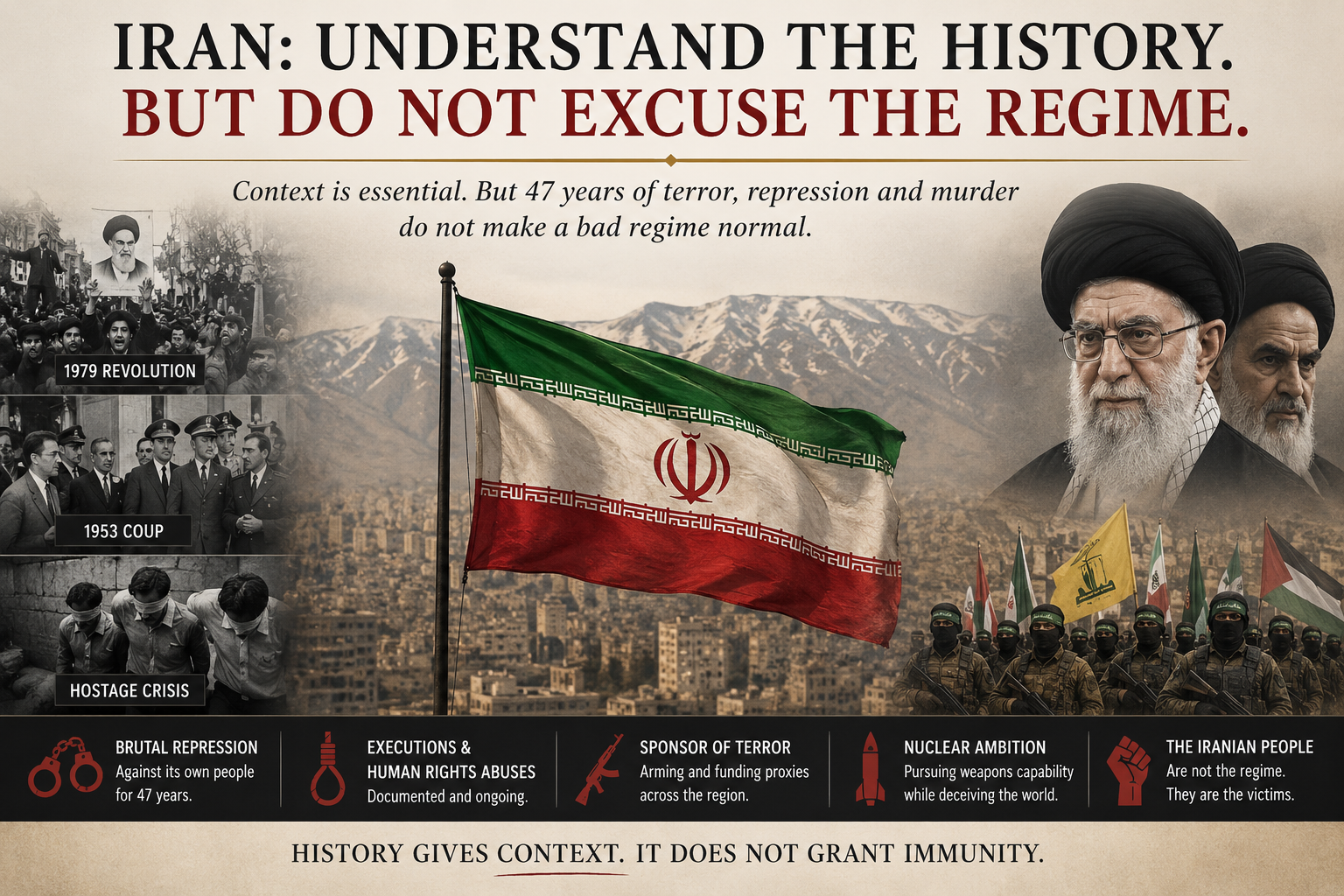
Any serious discussion of Iran should start with history. The 1953 CIA-backed coup that removed Prime Minister Mohammad Mosaddegh, Western support for the Shah's authoritarian government, and decades of sanctions all help explain why many Iranians carry a deep distrust of the United States and Western governments generally. Students should understand that background. Historical memory shapes foreign policy calculations, and dismissing it produces analysis that is flat and wrong.
But context is not absolution.
"A government can have historical grievances and still be a bad actor. A country can have legitimate national interests and still be ruled by leaders who murder dissidents."
The Iranian people's mistrust of foreign interference is one thing. The conduct of the Islamic Republic's ruling regime is another thing entirely. Since 1979, Iran's leadership has built an authoritarian theocracy that represses its own citizens, punishes dissent, enforces ideological control and uses violence as a tool of state power. Human Rights Watch has documented brutal crackdowns on the "Woman, Life, Freedom" protests that followed Mahsa Amini's death in morality police custody, reporting hundreds killed and thousands arrested. These are not rumors. They are documented facts from organizations that operate under rigorous evidentiary standards.
The 1953 coup — known in Iran as the 28 Mordad coup — was orchestrated jointly by the CIA and British intelligence. It ended Iran's democratic government and restored the Shah. This history is not contested. It is taught at American universities and acknowledged by U.S. officials. Knowing it is a prerequisite for serious analysis. Using it as a blanket defense for everything the Islamic Republic has done since is not analysis. It is deflection.
The regime's record abroad is just as serious. The U.S. State Department has designated Iran a state sponsor of terrorism continuously, and current assessments describe a sustained strategy of supporting armed proxy groups through funding, weapons, training and logistical networks. That includes Hezbollah in Lebanon, Hamas in Gaza, Shia militias operating across Iraq, and the Houthis in Yemen. These are not spontaneous regional movements that Iran merely sympathizes with from a distance. Iran arms them, trains them, funds them and coordinates with them. This is a deliberate foreign policy architecture built around proxy violence and plausible deniability.
Calling that "regional influence" is the kind of euphemism that belongs in a diplomatic cable, not a classroom.
The real tragedy is the distinction that gets lost in most coverage: the Iranian people are not the same thing as the Iranian regime. That sentence should carry weight. Ordinary Iranians have resisted clerical rule at enormous personal risk. Protesters, women's rights advocates, journalists, students, religious minorities and political dissidents have paid with their freedom, and sometimes their lives, for challenging the state. Human Rights Watch and other monitors continue to report executions without fair trial, arbitrary detention and systematic repression. The people on the streets chanting "Woman, Life, Freedom" were not agents of Western imperialism. They were Iranians who wanted to live without a regime telling them how to dress, who to worship and whether they had the right to speak.
"History gives context. It does not grant immunity."
So yes, students should learn the history. They should understand the coup, the revolution, the hostage crisis, the nuclear deal, the sanctions regime and the long record of mutual grievance between Tehran and Washington. But they should also be taught plainly that none of that history washes away 47 years of repression, hostage-taking, proxy warfare, state-sponsored terrorism and the murder of dissidents at home and abroad.
Acknowledging that the West has done wrong things in Iran does not require treating the Islamic Republic as a victim acting within normal bounds. Two things can be true simultaneously: the United States helped destroy Iran's democratic government in 1953, and the regime that emerged from 1979 has spent nearly five decades proving it is not a normal government. Refusing to hold both truths at once is not nuance. It is intellectual cowardice dressed up as balance.
A serious classroom discussion holds both truths at once without flinching from either. Iran has historical reasons to distrust Western power. The Islamic Republic has spent nearly half a century demonstrating that it is not a government operating within normal diplomatic and moral boundaries. Both statements are supported by evidence. Both deserve to be said out loud.
History explains the mistrust. It does not explain away the repression, the proxies or the executions. Students who leave a course on Iran knowing only the first half of that sentence have been given an education that stops exactly where it gets uncomfortable.
That is not education. That is political grooming with footnotes.
References
- Human Rights Watch. (2023). Iran: Protests Crackdown Update. Documentation of deaths, arrests and detentions following the death of Mahsa Amini. hrw.org
- U.S. Department of State. State Sponsors of Terrorism. Country Reports on Terrorism, Bureau of Counterterrorism. Iran has held this designation since 1984. state.gov
- Kinzer, S. (2003). All the Shah's Men: An American Coup and the Roots of Middle East Terror. Wiley. Standard historical account of the 1953 coup.
- Abrahamian, E. (2008). A History of Modern Iran. Cambridge University Press. Foundational academic treatment of modern Iranian political history.
- Congressional Research Service. (2024). Iran: Background and U.S. Policy. Covers Iran's proxy network, nuclear program, sanctions history and regional conduct.
- Human Rights Watch. (2024). Iran: Executions Surge to 25-Year High. Annual reporting on capital punishment and judicial conduct inside Iran. hrw.org
- National Security Archive. (2013). CIA Confirms Role in 1953 Iran Coup. Declassified documents acknowledging U.S. involvement. George Washington University. nsarchive.gwu.edu