There is nothing wrong with political commentary. There is nothing wrong with advocacy. There is nothing wrong with arguing that one side is right and the other side is wrong. I do that all the time on this site and I am not apologizing for it. But there is something dishonest about dressing campaign literature up as news, and that is exactly what Scott Dworkin's May 5, 2026 edition of The Dworkin Report does. It takes real events - a whistleblower returning to work, a court blocking deportations, a Medicaid funding fight, a failed nominee - and buries them under so much emotional theater that the facts become almost secondary. The article is not written to inform the reader. It is written to activate the reader. It tells the audience who the villains are, who the heroes are and what emotional response they are supposed to have before the reader has had a chance to think. That is not journalism. That is political hypnosis with hyperlinks.
The Language Gives the Game Away
The first clue is the vocabulary. "Regime." "Resistance." "Quack." "We did that." "The fight is winnable." "Help us keep up the fight." "Truth worth fighting for." This is not neutral reporting. It is not even subtle commentary. It is movement propaganda written in the style of a fundraising email. The article does not simply say that a Trump policy lost in court. It says the "regime" lost. It does not simply say a nominee faced opposition. It says "the quack is out" and credits "resistance working." It does not present readers with facts and analysis and let them reach conclusions. It hands them a script. And the script is always the same: Trump is tyranny, Democrats are saviors, activists are heroes and every development is proof that the movement is winning. That is emotionally satisfying for people who already agree with the conclusion. It is also intellectually cheap, because it converts news into confirmation and readers into audience.
Real Issues Deserve Better Than Cartoon Framing
Some of the issues Dworkin covers are serious. Whistleblower retaliation is serious. Temporary Protected Status is serious. Medicaid funding is serious. Surgeon General qualifications are serious. These are not small matters. They affect real people, real institutions and real policy outcomes. That is exactly why they should be handled with care. Instead, the article turns them into episodes in a comic-book war between good and evil. A federal judge does not merely issue a ruling - he becomes a hero in a resistance narrative. A governor does not sign a complicated funding bill with tradeoffs and unresolved components - he "saves healthcare for three million people." A nominee is not simply criticized as underqualified - she is branded a "quack." That framing might drive clicks. It might generate likes, restacks and paid subscriptions. But it does not make the reader smarter. It makes the reader more emotionally obedient. The article is not asking readers to understand government. It is asking them to join a team and stay angry enough to fund it.
A news article would slow down. It would explain the legal issue. It would identify the statute involved. It would clarify what the court actually decided and what remains unresolved. It would quote both sides. This article does none of that. It leads with moral certainty and uses each story as proof of a larger political narrative. Then it asks you to subscribe.
Advocacy Is Not the Same as Reporting
The problem is not that the writer has a point of view. Everyone has a point of view. The problem is presenting advocacy copy as though it were news. A news article would slow down. It would explain the legal issue at stake in the TPS ruling. It would identify the specific statutory authority DHS claimed and what the judge found wrong with it. It would clarify what the court's block actually covers and what remains unresolved pending the Supreme Court. It would separate confirmed facts from accusations. It would quote both sides or at least summarize the opposing argument clearly enough that readers could understand the dispute rather than just absorb the verdict. Dworkin's article does none of that. It leads with moral certainty, loads the language and uses each story as a data point in a larger political narrative. Then it repeatedly asks the reader to like, restack, comment, subscribe and fund the fight. That is not an accident. That is the business model. Fear sells. Outrage sells. Victory laps sell. The reader is kept in a constant emotional loop: panic, anger, hope, subscription request, repeat.
The article's structure is worth examining. It does not simply provide information and then allow readers to decide whether to support the writer. It repeatedly frames subscription and sharing as part of the political struggle itself. You are not just subscribing to a newsletter. You are helping defeat Trump. You are not just clicking a button. You are refusing to look away. You are not just reading. You are part of the resistance. That is clever marketing dressed as civic duty. It turns ordinary reader engagement into a moral act - don't just read, fight; don't just share, resist; don't just subscribe, save democracy. This is where political media becomes manipulative. The reader is not being asked to support better journalism. The reader is being told that failure to engage is close to a civic failure. That is a neat emotional trap. And both sides run versions of this exact machine. Conservative media does it with different vocabulary. One side says "regime," the other says "deep state." One side says "resistance," the other says "patriots." One side says "save democracy," the other says "save America." The product in both cases is outrage on demand. The mechanism is identical.
When Everything Is Fascism, Nothing Is Analysis
The word "regime" is doing significant work in this article. It is meant to make ordinary political conflict sound like life under a dictatorship. It is meant to shift the reader out of analysis and into alarm. Once the other side is a regime rather than an administration with which you disagree, normal distinctions disappear. Policy disagreement becomes oppression. Administrative action becomes tyranny. Court rulings become liberation. Political activism becomes moral warfare. That is dangerous because it trains people to stop thinking in categories and start reacting to slogans. Was the TPS deportation order lawful? What did the judge actually rule and on what grounds? What authority did DHS claim and where did that claim fail legally? What did the state Medicaid bill actually include and what did it fail to address? What were the nominee's actual qualifications and what specifically was deficient? Those are the questions a serious reader should ask. Hyperbolic political media does not want that kind of reader. It wants a reader who reacts instantly, shares quickly and feels morally superior while doing it. That is how propaganda functions - not always through outright lies but through the arrangement of selected facts inside a moral cartoon where the heroes and villains are identified in advance.
The Insanity of Permanent Emergency
This style of writing depends on permanent emergency as a business condition. Every story is urgent. Every nominee is dangerous. Every ruling is historic. Every vote is democracy's last stand. Every donation is part of the fight. Every political opponent is not wrong or misguided but a threat to civilization itself. That kind of rhetoric burns people out and, more importantly, makes them less capable of the distinctions that democratic citizenship actually requires. A functioning republic needs citizens who can tell the difference between bad policy and tyranny, between poor judgment and fascism, between a legal dispute and a constitutional crisis. When political writers collapse all those categories in service of activation, they are not defending democracy. They are degrading the habits and cognitive disciplines that democracy requires to sustain itself. Democracy needs citizens who can think. This kind of writing wants followers who can be triggered. Those are different products and the difference is not trivial.
The Honor Costume
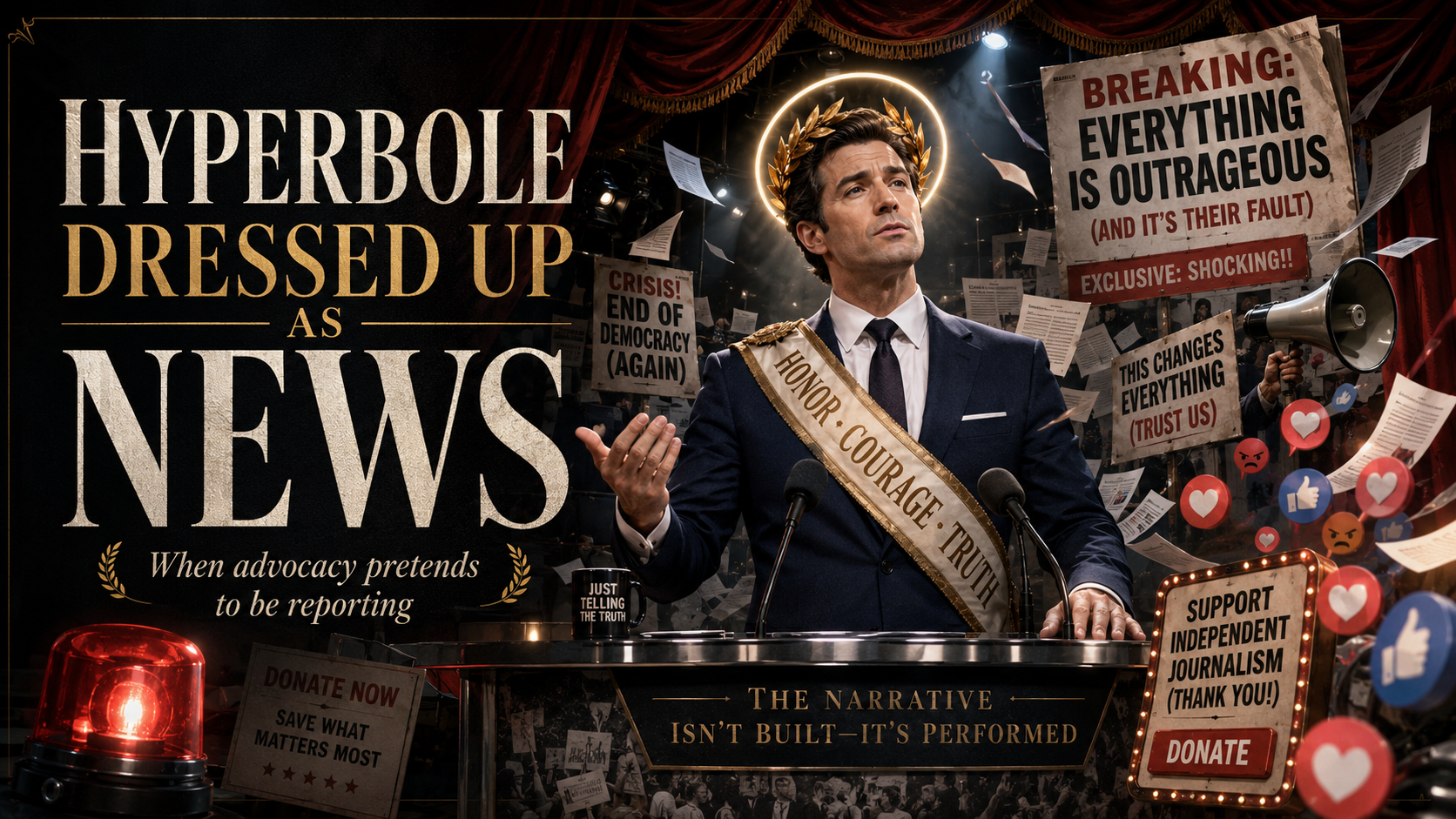
The most irritating part of this style is the moral costume it wears. The article presents itself as honorable, brave and truth-telling. It praises whistleblowers. It celebrates courage. It frames the reader's participation as part of a noble civic struggle. That all sounds good until you notice that honor requires discipline and truth-telling requires restraint. If the facts are strong, they do not need to be buried under melodrama to do their work. A judge blocked an agency action? Explain why - cite the statute, describe the legal reasoning, note what remains unresolved. A whistleblower returned to work? Show the timeline and the process. A governor signed a Medicaid bill? Describe what the bill did and what it failed to do and what comes next. A nominee failed? Lay out the qualifications, the specific objections and the procedural outcome. That would be useful to a reader. But useful and profitable are different things. Useful informs. Hyperbole mobilizes. Mobilization is what drives the subscription numbers, and subscription numbers are what Dworkin is building.
My Bottom Line
This kind of article is not news. It is advocacy copy with a press badge pinned to its shirt. It takes legitimate issues and processes them through a partisan outrage machine. It does not ask readers to think carefully. It asks them to feel correctly. It does not trust the facts to persuade on their own merits. It wraps them in slogans, panic and self-congratulation and calls the combination truth worth fighting for. The issues it covers - TPS, whistleblower protection, Medicaid funding, executive nominee standards - are real and they matter. They deserve the kind of reporting that would actually help readers understand what happened, what it means legally and politically, what remains unresolved and what readers could do about it if they wanted to engage substantively. What Dworkin delivers instead is a moral script with subscription prompts. People make political decisions based on what they consume. A steady diet of exaggerated, emotionally loaded, one-sided content produces citizens who are easier to manipulate and harder to reason with. That is bad for politics. It is worse for the truth that Dworkin claims to be fighting for. A good argument can survive without hysteria. A weak one usually cannot. The country does not need more political theater pretending to be journalism. It needs more adults willing to say: give me the facts, spare me the sermon and stop trying to pick my emotions for me.
Americans are not stupid. They can see when a rule is selectively enforced and when outrage is selectively manufactured. The moment a reader has to ask whether they are reading news or a fundraising email, the writer has already answered the question. They just did not mean to.
References
- Dworkin, S. (2026, May 5). Trump's deportations to war zone blocked, whistleblower returns to work, and a Democratic governor saves healthcare for 3 million people. The Dworkin Report. dworkinsubstack.com.
Disclaimer: The views expressed in this post are the personal opinions of the author and are offered for educational, commentary and public discourse purposes only. They do not represent the positions of any institution, employer, organization or affiliated entity. Nothing in this post constitutes legal, financial, medical or professional advice of any kind. References to published articles and public figures are based on publicly available sources cited above. Commentary on media, journalism practices and political communication reflects the author's independent analysis and is protected expression of opinion. Readers are encouraged to consult primary sources and form their own conclusions.