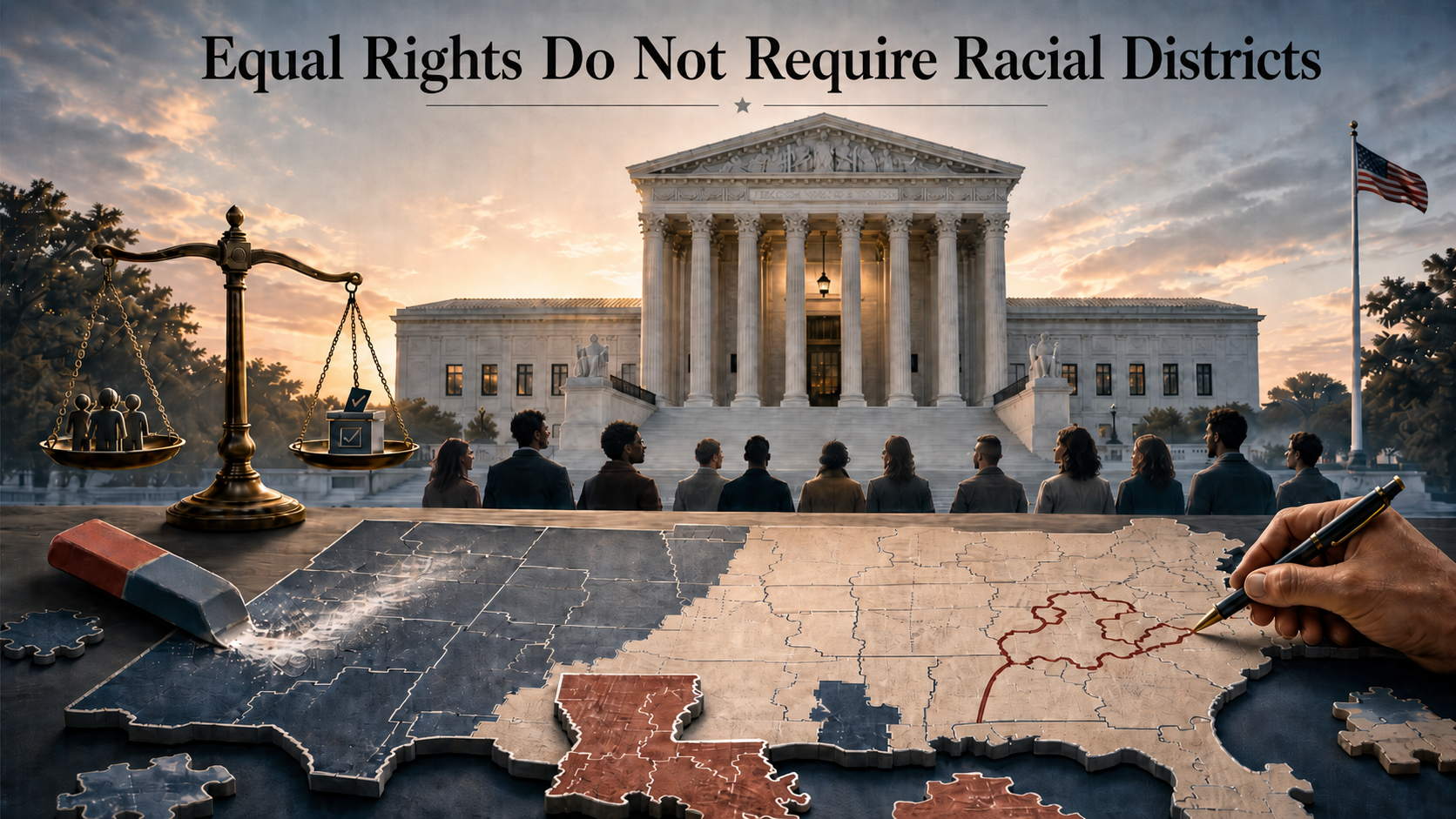
A viral post making the rounds claims the Supreme Court's recent voting rights ruling just handed Republicans the 2026 midterms. The argument runs like this: the Court ruled 6-3, Louisiana's race-based congressional map got thrown out and now Republican-led states can redraw a dozen Democrat-held seats that only exist because courts forced states to create Black-majority districts. It is a fascinating argument because there is real political substance underneath it. But the post does what viral political posts reliably do: it takes a serious legal development, strips out the nuance, adds certainty, pours gasoline on the whole thing and calls it analysis. The truth is more complicated and considerably more important than the viral version. The Supreme Court's ruling in Louisiana v. Callais is a major redistricting decision. It could reshape House races, especially in the South. It could weaken parts of the Voting Rights Act as courts have applied it for decades. It could give Republican-led legislatures a real legal opening to revisit districts drawn under court pressure. But the claim that the midterms are now decided, or that every majority-minority district is automatically unconstitutional, is too clean. Politics is rarely that clean and law is almost never that clean.
What the Court Actually Did
The Supreme Court ruled 6-3 that Louisiana's congressional map violated the Equal Protection Clause because race predominated too heavily in the drawing of a second majority-Black district. The case arrived after Louisiana had been ordered to draw a map complying with Section 2 of the Voting Rights Act, which prohibits voting practices that dilute minority voting strength. That is the core tension. Courts had previously determined that Louisiana's earlier map likely violated the VRA because Black voters representing roughly a third of the state's population were not given a fair opportunity to elect candidates of their choice. But once Louisiana created a second majority-Black district to comply, challengers argued the state had gone too far - that race had become the controlling factor rather than a considered element. Reuters described the ruling as striking down Louisiana's second Black-majority district and weakening a key VRA tool used in redistricting cases. The National Constitution Center summarized it as narrowing states' ability to use race as the determining factor when creating election districts. The Court did not say states may never consider race. It said there are constitutional limits and those limits become serious when race takes over the mapmaking process.
Voting Rights or Racial Sorting?
This is where the conversation becomes genuinely difficult and where both sides would rather have a slogan than an argument. The Voting Rights Act was created for a moral and constitutional reason that should not be minimized. For much of American history Black citizens were blocked, intimidated, manipulated or diluted out of meaningful political participation through literacy tests, poll taxes, organized intimidation and racially rigged systems. Those were not theoretical threats. They happened. People were beaten for trying to register. So when the VRA is defended, what is being defended is one of the most important civil rights statutes in American history - not an abstract procedural preference. The history is real and the law's purpose was legitimate.
But there is also a genuine constitutional problem when the remedy for racial discrimination becomes racial districting. At what point does protecting minority voting strength become sorting voters by skin color? That is the line the Court has been trying to draw across multiple decisions spanning decades. A country cannot constitutionally say race should not determine political power and then build districts where race is the dominant design principle. That contradiction was always going to collide with the Equal Protection Clause. The collision is not a Republican invention and pretending otherwise does not help anyone understand what is actually at stake.
A court ruling can move the chessboard. It does not checkmate the election by itself. Every state has its own timing rules, state-law complications, political fights and litigation risks. "Legally challengeable" is not the same as "gone."
The Political Stakes Are Real. The Certainty Is Borrowed.
The viral post is strongest when it argues this ruling could have serious consequences for the House. AP reported that the decision could open the door for Republican-led states to eliminate or redraw Black and Latino electoral districts that tend to favor Democrats. Reuters likewise reported that Republicans may be able to target Democratic districts in the South, though immediate redistricting before the midterms could be complicated by election calendars and pending litigation. Louisiana is the obvious first case. The Supreme Court also allowed the ruling to take effect ahead of the normal schedule, which gives Louisiana a faster path to drawing a new map before 2026. Congressional control can turn on just a handful of seats and if Republican-led states can successfully redraw several districts created or preserved through VRA litigation, that could shift the battlefield meaningfully. That part deserves serious attention and nobody should dismiss it.
The viral post falls apart when it treats the ruling like a magic button - SCOTUS just made twelve seats legally redrawable. Maybe. Maybe not. Some analysts believe several Democratic-held districts could become vulnerable, particularly in the South. But vulnerable is not gone. A district being legally challengeable is not the same as a legislature successfully redrawing it, surviving subsequent court review and flipping the seat in a real election. Every state operates under its own timing rules, state constitutional constraints, political dynamics and litigation risk. Some maps will be redrawn. Some will not. Some new maps will be challenged in court. Some districts will stay competitive regardless of how they are drawn. Some voters will decline to behave the way mapmakers planned. The line that the 2026 midterms were just decided 6-3 is campaign rhetoric, not analysis. The ruling may matter enormously and may affect control of Congress. Elections are still decided by voters, candidates, turnout, issues, money and timing.
The viral post implies that Democrats holding seats in court-ordered districts is somehow not a real election result. That argument is sloppy and it should be named as such. A court-ordered map is not automatically illegitimate. Courts order maps when someone challenges an existing map and persuades a court that it likely violates the law. In these cases the argument was generally that minority voting strength had been diluted in violation of Section 2. The NAACP Legal Defense Fund called the Callais decision a major blow to Section 2 and argued that it undermines voters of color by limiting remedies for vote dilution. The Campaign Legal Center described it as opening the door for discriminatory maps. One does not have to accept every claim from those organizations to understand the point they are making. The dispute is not simply that Democrats cheated with racial districts. The dispute is whether the VRA remedy itself went further than the Constitution permits. That is a considerably more serious question than the viral post frames it as - and getting it wrong in either direction has real consequences for real people.
Republicans Should Be Careful What They Celebrate
Republicans may see this ruling as a political gift. In the short term it may be. But if the principle being applied is that race should not dominate districting, that principle needs to apply in both directions and both parties need to be held to it. It cannot mean racial districting is constitutionally problematic when Democrats benefit and fine when Republicans benefit. The deeper conservative argument should be about constitutional neutrality: districts should be compact, contiguous, geographically coherent and built around communities of interest rather than racial targets or partisan engineering. That is an intellectually defensible position that could command genuine public support across racial lines. But it requires consistency that neither party has historically been willing to demonstrate. Both parties use redistricting for power when they have it. Both wrap their motives in the language of democracy and fairness. Both are usually defending seats more than principles. Voters are entitled to be skeptical of both sides claiming the high ground on this one.
The Question That Was Always Coming
This ruling forces a question America has been deferring for decades: what does representation mean in a multiracial country? Does it mean every racial group should have districts drawn to maximize its political power? Does it mean voters should be treated as citizens without the government sorting them by race? Does it mean race can be considered as one factor among many but not the predominant one? Or does it mean the VRA requires race-conscious remedies specifically because race-neutral systems can still produce racially diluted outcomes? These are not easy questions and the honest answer is that the Constitution and the VRA have been in genuine tension for years. The left often pretends any limit on race-conscious districting is an attack on democracy. The right often pretends race has stopped mattering in American voting and politics. Both positions are too simple and both serve to avoid the harder conversation. Race has mattered historically in American voting - that is not deniable. The Constitution also cannot permanently tolerate government systems that make race the controlling factor in political design - that is not deniable either. The hard part is balancing those truths without reducing elections to racial arithmetic. Callais did not resolve that tension. It sharpened it.
My Bottom Line
The viral post is right that the Callais ruling could have major political consequences. Republican-led states may now have a stronger legal argument for revisiting districts created under VRA pressure, Louisiana is the immediate example and other Southern states will be watching closely. But the post is wrong to treat the ruling as a guaranteed Republican takeover mechanism. It overstates the certainty. It oversimplifies the law. It treats every court-ordered majority-minority district as illegitimate without engaging the serious constitutional argument that produced those districts in the first place. The better takeaway is this: the Supreme Court just made it significantly harder to justify race-dominant districting even when states claim VRA compliance as their justification. That may help Republicans politically in the South. The real constitutional question is larger than party advantage. America has to decide whether voting districts should be organized around citizens or around racial categories. That question was always going to arrive. It is now here and the people who want to answer it honestly - rather than score points with it - are going to have to do harder work than a viral post allows.
Redistricting is where democracy often gets quietly engineered before voters ever show up. The shape of the district can decide the race before the first yard sign goes up. That is why this conversation deserves to be serious. Not "Democrats cheated" and not "Republicans hate voting rights." The real question is whether America can protect equal voting rights without making race the permanent operating system of its democracy. That is worth arguing about honestly.
References
- Associated Press. (2026). Supreme Court weakens the Voting Rights Act and aids GOP efforts to control the House. apnews.com.
- Campaign Legal Center. (2026). The U.S. Supreme Court has eviscerated the Voting Rights Act - what's next? campaignlegal.org.
- NAACP Legal Defense Fund. (2026). Louisiana v. Callais. naacpldf.org.
- National Constitution Center. (2026). The Supreme Court's Callais decision sets new framework for racial gerrymandering. constitutioncenter.org.
- Reuters. (2026). U.S. Supreme Court guts key provision of Voting Rights Act. reuters.com.
- Reuters. (2026). U.S. Supreme Court lets Voting Rights Act ruling take effect ahead of schedule. reuters.com.
- Supreme Court of the United States. (2026). Louisiana v. Callais, Nos. 24-109 and 24-110. supremecourt.gov.
Disclaimer: The views expressed in this post are the personal opinions of the author and are offered for educational, commentary and public discourse purposes only. They do not represent the positions of any institution, employer, organization or affiliated entity. Nothing in this post constitutes legal advice of any kind. References to Supreme Court opinions, news reporting and advocacy organization statements are based on publicly available sources cited above. Commentary on constitutional law and electoral politics reflects the author's independent analysis and is protected expression of opinion. Readers are encouraged to consult primary sources and form their own conclusions.