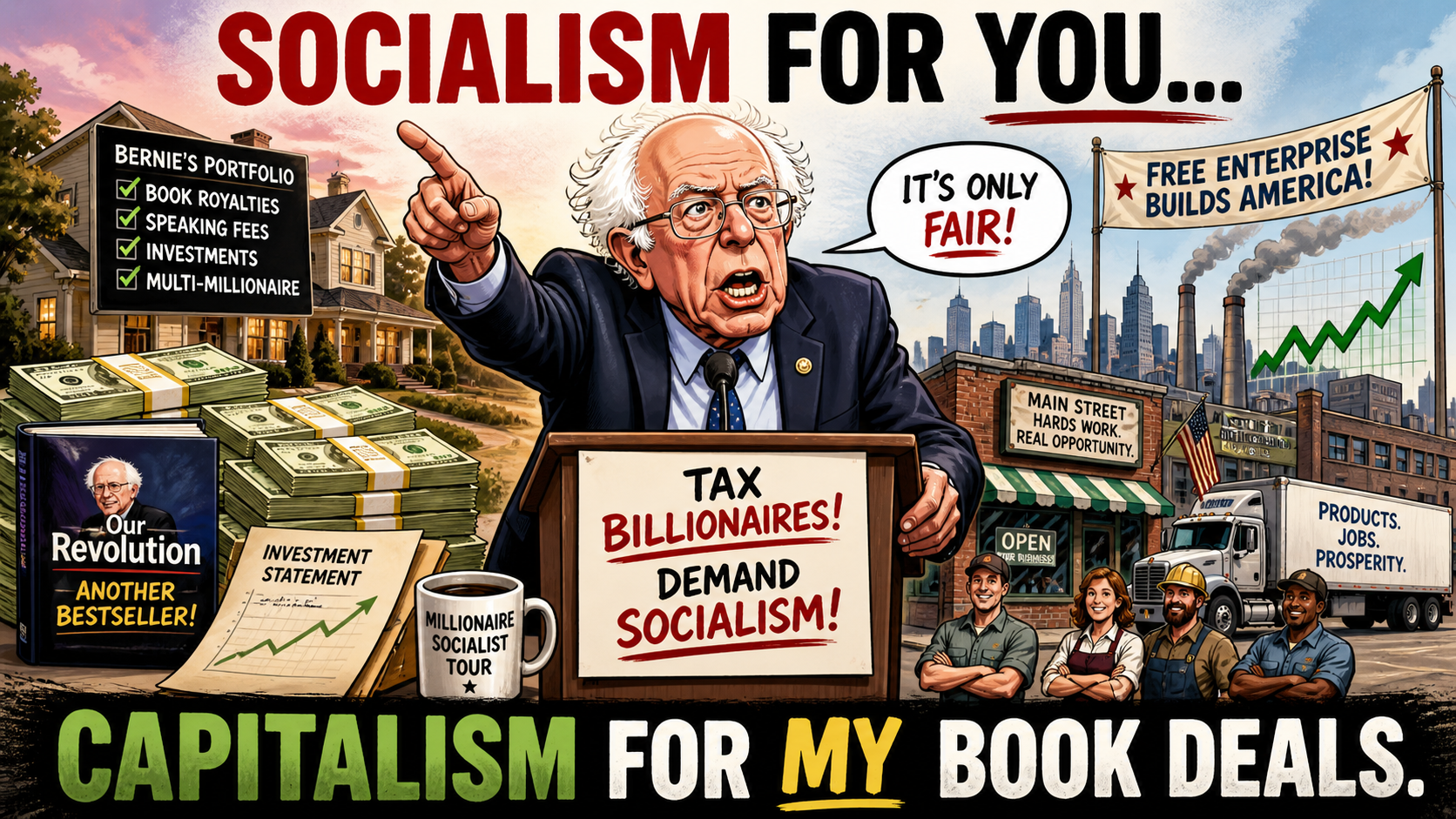
Bernie Sanders has built his entire political brand around one core message: the rich are greedy, billionaires are dangerous and capitalism is rigged against ordinary people. It is a powerful message because resentment is easy to sell. Tell people the system is stacked against them, point at a billionaire, promise free stuff and call it justice. Sanders has been running that play for decades and the media has obliged him with a level of credulity it does not extend to people who advocate for the system that actually made this country prosperous. But after all those decades, Sanders is not exactly living like a monk in a cold Vermont cabin. He is a millionaire. He owns property. He has made serious money from book deals. He draws government benefits and status most Americans will never touch. That does not make him evil. It makes him the perfect symbol of modern American socialism: a wealthy man explaining why wealth is morally suspect, unless it happens to be his.
The Socialist Who Got Rich in a Capitalist System
Sanders describes himself as a democratic socialist. His politics are built around expanded government control, higher taxes, massive redistribution and the belief that more of American life should be managed through federal programs. That is his right. This is America and he can argue for socialism all day long. But the irony is hard to miss. Forbes estimated his fortune at roughly $2.5 million in 2019, citing real estate, investments, government pensions and book earnings. A separate Forbes analysis found Sanders earned approximately $2.5 million in book advances and royalties from 2011 through 2022 according to his own financial disclosures. Write a book. Build a brand. Sell the product. Cash the checks. That is capitalism working exactly as described. Apparently the market-based exchange of intellectual products for profit is fine as long as it is him doing the profiting.
Sanders did not build Amazon. He did not start Apple or create Tesla or Walmart or FedEx or Home Depot. He spent decades in politics and then turned political celebrity into personal wealth. That is legal. It is also very capitalist. The hypocrisy is not that Sanders has money. Plenty of people have money and do not spend their careers attacking the system that produced it. The hypocrisy is that he enjoys the benefits of accumulated wealth while constantly signaling that wealth itself is morally suspicious. There is a difference between arguing for a fair tax system and declaring that billionaires should not exist. Sanders has consistently favored the second approach. That is not tax policy. That is ideological envy with economic packaging.
Capitalism is exploitative until the royalty statement clears. That has been the Sanders operating principle for thirty years. The system is rigged - except for the part where a man builds a political brand and converts it into real estate and book deals. That part is apparently fine.
The "Fair Share" Trick
One of the most dishonest phrases in American politics is pay your fair share, and Sanders has deployed it more aggressively than almost anyone. It sounds reasonable until you ask the obvious follow-up question: fair compared to what? The National Taxpayers Union Foundation reports that in tax year 2023 the top 1% paid 38.4% of all federal income taxes while earning 20.6% of adjusted gross income. The top 5% paid 59.3%. The top 25% paid roughly 87% of all federal income taxes. So when Sanders says billionaires need to pay their fair share, the question he is never asked is: compared to people who pay little or no federal income tax? Compared to politicians who spend other people's money for a living? Compared to voters being promised benefits paid for by someone else? This is not an argument that tax law is perfect or that every loophole should stay open. Tax reform has legitimate dimensions worth debating. But pretending the wealthy do not already carry an enormous share of the federal income tax burden is not an argument for fairness. It is political theater performed for people who will not check the numbers.
In 2026, Sanders and Ro Khanna introduced a proposal for a 5% annual wealth tax on U.S. billionaires, projected by supporters to raise $4.4 trillion over ten years. It sounds straightforward: take money from billionaires and distribute it. But wealth is not the same as cash in a checking account. Much of billionaire wealth is tied up in companies, stock value, ownership stakes and assets that fluctuate with market conditions. Taxing unrealized wealth means the government is no longer taxing income - it is taxing estimated paper value that may not exist in liquid form. That creates immediate pressure to sell productive assets simply to satisfy the government's claim on theoretical value. It punishes ownership. It attacks investment. And once the government normalizes taxing wealth itself rather than income, the historical pattern is clear: the threshold never stays where it starts. Income tax was introduced as a modest levy on the very wealthy. The middle class was not initially in scope. Then it was. Government always starts with "the rich." When the revenue is insufficient - and it always is - the definition of rich expands to wherever the money actually is.
Capitalism Built This Country
This is the part Sanders never seems to grasp or never seems to respect properly. America did not become the most powerful, innovative and prosperous country in recorded human history because bureaucrats redistributed wealth more efficiently than anyone else. America thrived because of capitalism. Private property. Free enterprise. Profit motive. Competition. Risk-taking. Innovation. Investment. Entrepreneurship. The right to build something, own it and benefit from it. That system created the American middle class. It built the factories, highways, railroads, farms, energy systems, technology companies, medical breakthroughs and consumer abundance that made this country different from every empire, kingdom and socialist experiment that preceded it. The World Bank's GDP data shows the United States remains the world's largest economy by current-dollar GDP. That is not coincidence or geographic luck. It is the accumulated result of an economic system that rewards production, scale, innovation and risk across two and a half centuries.
Capitalism is not perfect because people are not perfect. Markets can be gamed, monopolies can form, regulations can be captured and wealth can be protected by those who already have it. Those are legitimate problems worth addressing through specific targeted policy rather than through the wholesale condemnation of the system itself. Because capitalism, for all its failures, has done something no other economic system has ever managed at comparable scale: it lifted hundreds of millions of people out of poverty, created the conditions for the longest sustained improvement in human life expectancy and standard of living in history and produced the technological innovations that make modern medicine, communication and agriculture possible. Socialism does not create wealth. It distributes wealth that capitalism already created. And once the producers are punished sufficiently, the pile gets smaller for everyone.
Socialism Always Needs Capitalism to Feed On
The great trick of modern socialism is that it markets itself as compassion while depending entirely on capitalism to fund the compassion. Free college. Free healthcare. Free housing. Free childcare. None of it is free. All of it is paid for by workers, businesses, investors and productive activity generated by the capitalist system Sanders claims is rigged. The socialist promise always sounds noble because it skips the hard part: who produces the wealth being redistributed and what happens to production when the producers are punished enough to stop? Capitalism creates. Socialism allocates. Capitalism rewards risk. Socialism taxes the reward. Capitalism says build it. Socialism says hand it over. That is why socialism always has to attach itself to a productive economy. It needs something to drain. Every socialist experiment in history that tried to replace rather than supplement the productive economy eventually ran out of other people's money. Sanders has been making promises for thirty years that depend on an engine he has spent thirty years attacking. At some point the engine has to actually run.
My Bottom Line
Bernie Sanders is not economically crazy in a clinical sense. He is politically brilliant - in the narrow sense that resentment is a reliable electoral fuel and he has mined it more consistently than almost anyone in modern American politics. But the worldview he sells is economic fantasy. He attacks billionaires while living comfortably off the capitalist system that made his own wealth possible. He rails against greed while collecting royalties, drawing government pensions and sitting on property. He demands higher taxes from people who already pay an enormous share of federal income taxes and then sells the whole package as moral courage. It is not courage. It is envy politics with good branding. America does not need more resentment. It needs more builders, more entrepreneurs, more skilled workers, more risk-takers and more people creating value instead of politicians promising to carve it up. Capitalism made America prosperous. Socialism made Bernie Sanders famous. That distinction tells you everything about what each system actually produces.
When politicians convince people that wealth is theft, success becomes suspicious. When success becomes suspicious, government power grows. When government power grows, freedom shrinks. The American system works best when people are free to build, compete, fail, recover and succeed. It does not need a millionaire senator explaining why that freedom is the problem.
References
- Congressional Budget Office. (n.d.). Distribution of federal taxes. cbo.gov.
- Forbes. (2019). How Bernie Sanders, the socialist senator, amassed a $2.5 million fortune. forbes.com.
- Forbes. (2023). Bernie Sanders has raked in this much in book payments while a senator. forbes.com.
- National Taxpayers Union Foundation. (2026). Who pays income taxes: Tax year 2023. ntu.org.
- Reuters. (2024). Global billionaire wealth leaps, fueled by U.S. gains, UBS says. reuters.com.
- The Guardian. (2026). Bernie Sanders and Ro Khanna propose bill to impose wealth tax on billionaires. theguardian.com.
- World Bank. (n.d.). GDP, current US$. data.worldbank.org.
Disclaimer: The views expressed in this post are the personal opinions of the author and are offered for educational, commentary and public discourse purposes only. They do not represent the positions of any institution, employer, organization or affiliated entity. Nothing in this post constitutes legal, financial, medical or professional advice of any kind. References to public figures are based on publicly available statements and published sources cited above. Commentary on political figures and economic policy reflects the author's independent analysis and is protected expression of opinion. Readers are encouraged to consult primary sources and form their own conclusions.