
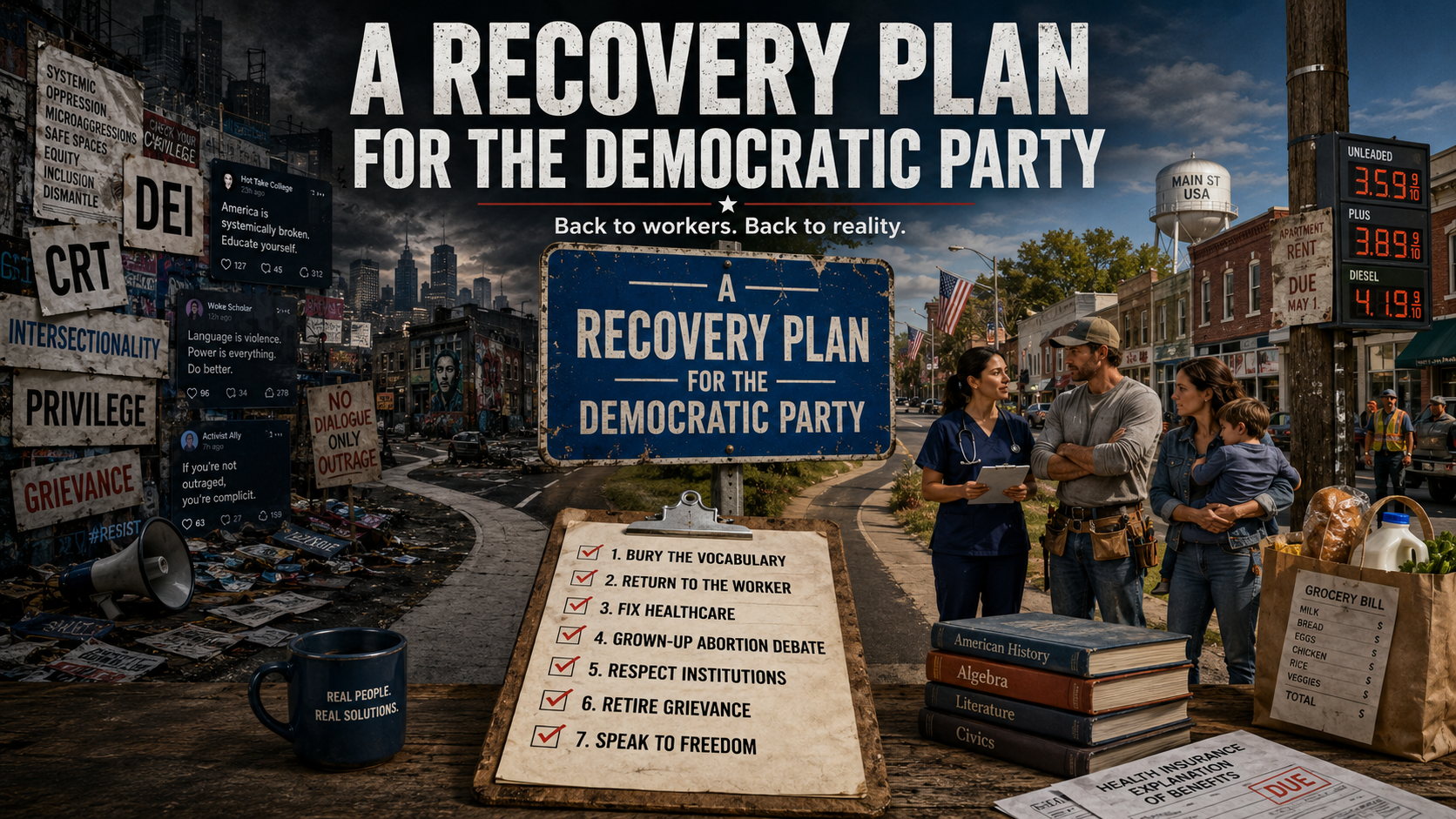
Let me be clear about what this post is not. It is not a celebration of Republican dominance, an endorsement of everything happening in Washington or a declaration that the left has nothing worth saying. It is something more uncomfortable for the people who need to read it most: an honest assessment of how the Democratic Party drove itself into a ditch and a practical map for climbing back out. This is the first post in a running series. Each installment will take one piece of the collapse apart and offer something specific in return. Not platitudes. Not "both sides" mush. A real argument about what a serious, credible Democratic Party would actually look like — and why the country needs one.
The diagnosis is not complicated. The Democratic Party spent a decade chasing academic frameworks, campus vocabulary and activist energy at the direct expense of the working-class voters who built it. It dressed up power politics as moral evolution. It mistook Twitter for America. It turned disagreement into bigotry, ordinary people into suspects and institutional destruction into principle whenever institutions produced outcomes it disliked. And then it was shocked — genuinely shocked — when tens of millions of Americans who pay rent, drive to work, worry about healthcare costs and want their kids to learn to read decided they had had enough.
Step One: Bury the Vocabulary
The first and most urgent thing the Democratic Party needs to do is stop speaking a language that most Americans do not recognize as their own. Woke, DEI, CRT, intersectionality, lived experience, centering marginalized voices, decolonizing the curriculum — these phrases mean something in academic and activist spaces. In the rest of America they signal one thing: this party is not talking to you.
That is not an argument against the underlying concerns. Discrimination is real. Inequality is real. History matters. But there is an enormous difference between addressing a real problem in plain language and performing ideological fluency for a captive audience of true believers. The second approach wins applause at conferences. It loses elections in Michigan, Wisconsin and Pennsylvania.
The 2024 election results were not a fluke. Democrats lost ground with Black men, Hispanic men, working-class voters across racial lines and young men who did not see themselves in a party that seemed more interested in pronouncing their privilege than addressing their economic anxiety. Voters who once reliably pulled the lever for Democrats looked at the party's messaging and saw a movement that was not built for them anymore.
A party that cannot explain its values in a sentence a welder in Toledo would find reasonable is a party that has lost its footing. Not its principles. Its footing. The distinction matters because it is correctable.
Step Two: Return to the Worker
The Democratic Party was built on the proposition that government should be the instrument by which ordinary working people have a fair shot against concentrated economic power. That is a winning idea. It has always been a winning idea. The party abandoned it not by rejecting it explicitly but by gradually replacing it with a politics of cultural grievance that spoke to college-educated professionals in coastal cities while leaving everyone else increasingly cold.
A return to the worker means talking about wages, not just wage gaps. It means talking about the cost of groceries, rent, childcare and gasoline in terms that reflect what those costs actually do to a family budget, not as occasions to lecture about systemic causes. It means organizing around economic solidarity that crosses racial lines rather than fracturing every coalition into its component identity groups and then wondering why the math does not add up on Election Day.
You cannot build a working-class coalition by making working-class people feel like suspects in their own country.
The party that fights for the nurse who cannot afford her own prescriptions, the contractor who cannot get his kids on a decent health plan and the single mother rationing insulin is a party with a future. The party that spends its energy explaining why those people harbor unconscious bias is a party writing its own obituary.
Step Three: Fix Healthcare Without the Theater
Healthcare is the issue Democrats should own. They have the better factual case. Americans pay more for healthcare than any comparable nation and get worse outcomes on key measures. Prescription drug prices are a genuine scandal. Medical bankruptcy is an American institution that does not exist at scale in other wealthy countries. These facts are not disputed. They are devastating. And they belong to the Democrats if the Democrats would just make the case plainly and stop muddying it with every other ideological priority.
The path is not complicated in concept even if the politics are hard. Lower prescription drug prices through negotiation and reimportation authority. Protect and expand coverage so that losing a job does not mean losing access to medicine. Control hospital consolidation that drives costs up without improving care. Make price transparency real rather than symbolic. None of these require turning the entire healthcare system into a federal agency. All of them address something a majority of Americans across party lines say they want.
Every time Democrats got close to a healthcare win they loaded the bill with unrelated priorities, allowed the message to be captured by its most extreme advocates and watched the coalition collapse. The lesson is not that healthcare reform is impossible. The lesson is that every fight cannot be fought simultaneously. Pick the issue that helps the most people. Win it. Then move to the next one. That is called governing, and the Democrats have largely forgotten how to do it.
Step Four: Have a Grown-Up Conversation About Abortion
The Democratic position on abortion has been among the most politically self-destructive exercises in recent memory — not because the underlying principle is wrong, but because the party has consistently refused to articulate it with any nuance at all. Demanding that opponents simply accept an absolute position without acknowledgment of the genuine moral complexity involved is not persuasion. It is capitulation theater performed for a base that is already convinced.
Most Americans hold a genuinely complicated view of abortion. They believe in a woman's right to make her own medical decisions. They also become less comfortable as pregnancies advance. They support access to early abortion. They have reservations about later procedures except in the clearest medical circumstances. That is not hypocrisy. That is the morally serious position that reflects the actual difficulty of the question.
A Democratic Party willing to say "we believe in protecting access to abortion in the early stages of pregnancy, we believe in medical exceptions that are real and enforceable and we are willing to have a serious conversation about the rest" would command a much broader coalition than a party that treats any acknowledgment of complexity as betrayal. Winning the political argument requires meeting people where they are, not demanding they meet you where your most committed activists are.
Step Five: Stop Attacking Institutions You Will Need Tomorrow
One of the most damaging habits the modern Democratic Party developed is the willingness to attack the legitimacy of American institutions the moment those institutions produce outcomes the party dislikes. The Supreme Court's rulings become evidence of illegitimacy. The Electoral College is a relic of white supremacy. The Senate's structure is an antidemocratic obstacle. The filibuster is Jim Crow by other means. And on and on.
There are legitimate debates to be had about all of these structures. But there is a profound difference between arguing for constitutional reform through proper democratic channels and spending years teaching your voters that American institutions are fundamentally corrupt and then expecting those same voters to defend those institutions when someone else comes for them. The Democrats spent years undermining institutional trust and are now surprised to find themselves in a country with very little of it.
You do not get to selectively respect institutions. You respect them because their integrity protects everyone, including you, when you are out of power. A party that packed courts when convenient and denounced them as illegitimate when inconvenient does not get to claim the moral high ground on institutional preservation. The rule of law is not a weapon. It is a foundation. Treat it accordingly.
Step Six: Retire the Grievance Machine
The grievance economy has been good business for a lot of people inside the Democratic ecosystem. Foundations get funded. Organizations get staffed. Consultants get contracts. Activists get platforms. The problem is that running a political party as a permanent outrage industry produces a coalition held together by shared enemies rather than shared goals. And coalitions built on enemies tend to collapse the moment the enemy changes shape or the outrage supply runs dry.
The Democrats need to shift from a party defined by what it is against to a party defined by what it is for. That sounds obvious. It is surprisingly hard for people who have built careers on opposition. But voters, especially persuadable voters in the middle of the electorate, are not primarily motivated by grievance. They are motivated by results. They want lower prices, safer streets, better schools and a government that operates competently. None of those things require an enemy. They require a plan.
Step Seven: Speak to Freedom, Not Just Safety
The Democratic Party's natural instinct, shaped by decades of expanding the safety net, has been to speak the language of protection. Protect workers from exploitation. Protect consumers from predation. Protect the environment from destruction. All legitimate. All worth defending. But protection is a passive and ultimately unsatisfying political message on its own. People do not just want to be safe. They want to be free.
Freedom is not the exclusive property of the political right. Freedom from crushing medical debt is freedom. Freedom from a predatory employer who knows you cannot afford to quit is freedom. Freedom to start a business without being crushed by regulatory complexity designed to protect incumbents is freedom. Freedom to send your child to a school that actually educates them is freedom. The Democrats have ceded the language of freedom almost entirely and it has cost them enormously. Taking it back does not require abandoning a single progressive commitment. It requires reframing those commitments in terms of what they actually deliver: more room for ordinary people to live their lives on their own terms.
My Bottom Line
The Democratic Party does not need a new ideology. It needs to rediscover its old one. It was built to fight for the person who punches a clock, pays taxes, worries about tomorrow and does not have a lawyer on retainer to navigate whatever the powerful throw at them. That person exists in every ZIP code in America, in every racial and ethnic community, in every religious tradition and in every region the party has written off as unreachable.
The path back is not complicated. Stop talking in ways that make ordinary people feel judged. Start talking about things that affect their actual lives. Engage institutions with respect rather than contempt. Make the case for your values in language that a high school graduate finds reasonable. Win elections by expanding the coalition rather than purifying it. And accept that persuasion — actual persuasion, not virtue signaling — is the only legitimate path to power in a democracy.
The Democrats have everything they need to be a serious governing party again. What they lack right now is the humility to admit how far they drifted and the discipline to walk it back. That is a solvable problem. Whether they choose to solve it is another question entirely.
Why This Matters
A republic needs two serious parties. Not two parties that agree on everything but two parties that compete honestly for the votes of ordinary Americans by offering coherent, reality-based visions of what the country should be. When one party loses that coherence, the other has no incentive to earn it either. The stakes of Democratic recovery are not just partisan. They are constitutional. A healthy opposition makes better governance on both sides. The country needs that badly enough to say so plainly, even to the party that needs to hear it most.
The next post in this series will go deeper on one of the seven steps laid out here: the vocabulary problem. Language shapes perception. The words a party chooses signal who it thinks it is talking to. And the Democrats have been talking to the wrong room for a very long time. That conversation is next.
Disclaimer: The views expressed in this post are the personal opinions of the author and are offered for educational, commentary and public discourse purposes only. They do not represent the positions of any institution, employer, organization or affiliated entity. Nothing in this post constitutes legal, financial, medical or professional advice of any kind. References to public figures, institutions, historical events and current affairs are based on publicly available sources and are intended to support analysis and argument, not to state facts about any individual's character, intent or conduct beyond what the cited sources support. Commentary on religious, political and cultural subjects reflects the author's independent analysis and is protected expression of opinion. Readers are encouraged to consult primary sources and form their own conclusions. Any resemblance to specific individuals or situations beyond those explicitly referenced is coincidental.