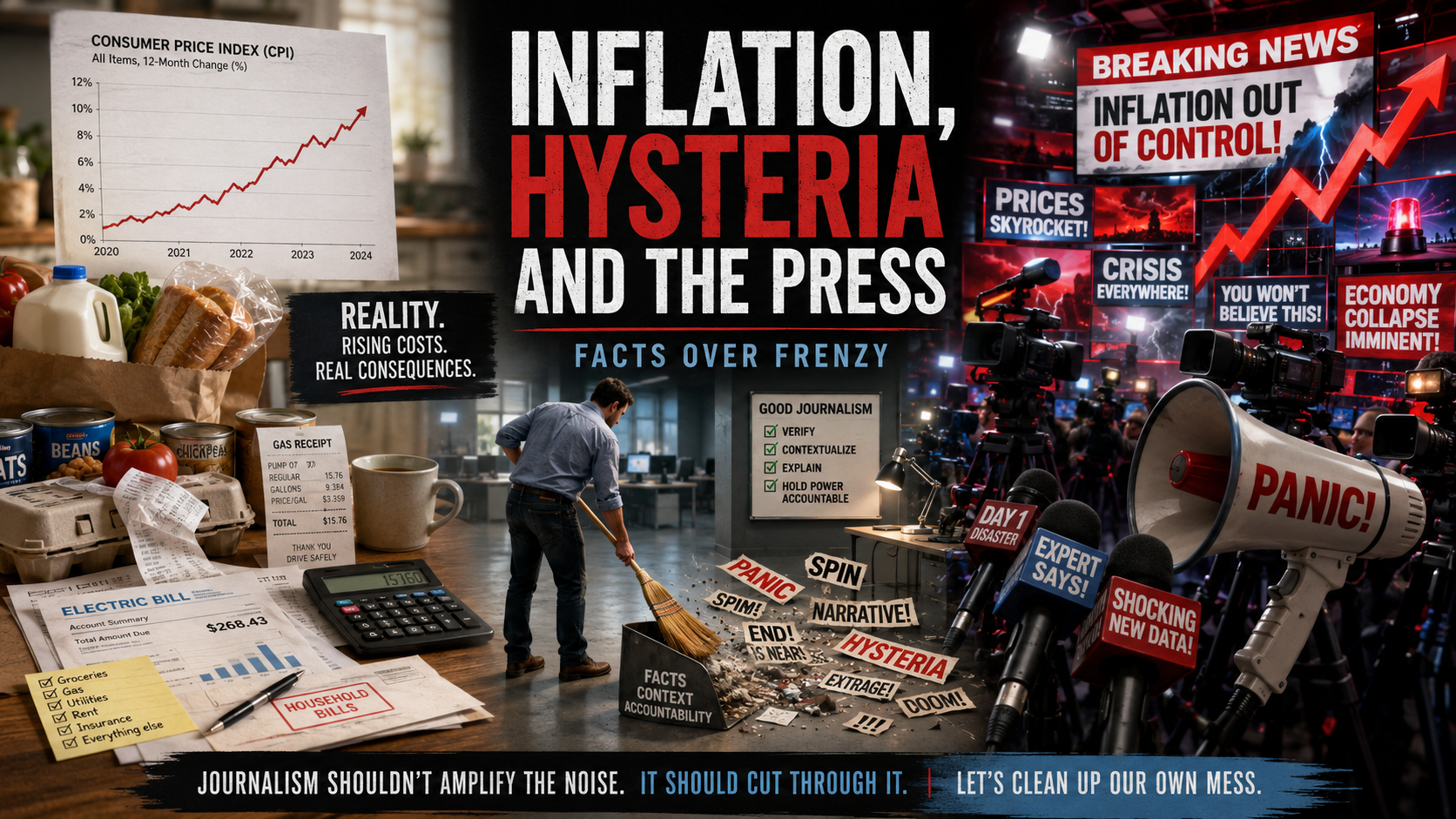
There is a difference between reporting bad economic news and turning bad economic news into a five-alarm psychological event. The April 2026 inflation report was not good. That part is real. The Consumer Price Index rose 0.6% in April after rising 0.9% in March, and prices were up 3.8% over the previous 12 months. Energy was the biggest driver, rising 3.8% in April and accounting for more than 40% of the monthly CPI increase. Food rose 0.5%, shelter rose 0.6% and core CPI, excluding food and energy, rose 0.4%. Over the year, energy was up 17.9%, food was up 3.2% and core CPI was up 2.8%. That is not nothing. That is not a rounding error. But it is also not the end of civilization.
This is where modern financial and political journalism keeps failing the public. It does not simply report reality. It frames reality in ways designed to provoke, soothe, blame, panic or manipulate. Some outlets want you terrified. Others want you numb. Some want to turn every economic report into an indictment of whoever they already disliked before the report came out. That is not journalism. That is narrative laundering. And at some point, the profession needs to clean up its own mess.
The Reality: Inflation Is Still a Problem
Inflation remains too high. A 3.8% annual CPI increase is well above the Federal Reserve's long-term 2% inflation target. Core inflation at 2.8% is also still above target. Worse, the price increases are not buried in some obscure technical category nobody feels. They are showing up in energy, food, shelter, electricity, gasoline and airline fares.
Economists and reporters love to talk about "core CPI" because food and energy are volatile. That is technically fair. But the average family does not live in core CPI. They live in grocery stores, gas stations, rent checks, utility bills and insurance premiums. When gasoline is up 28.4% over the year, electricity is up 6.1%, food away from home is up 3.6% and shelter is up 3.3%, people feel it. The public is not crazy for noticing.
The Hyperbole: Every Report Is Not a National Breakdown
The April CPI report does not mean the economy has collapsed. It does not mean America is finished. It does not prove that capitalism failed, democracy failed or that every politician you hate personally caused your grocery bill. The report shows a sharp inflationary jump largely driven by energy, with the ongoing Iran conflict pressuring oil prices and filtering into gasoline, food and transportation costs.
Inflation is moving the wrong way. Household costs are still too high. Energy is creating renewed pressure across the economy. That is serious. But serious does not require panic. In fact, panic makes people dumber. Energy shocks can be brutal, but they are not always permanent. Oil moves. Gas moves. Supply chains adjust. Conflicts end or widen. Markets overreact and then correct.
The correct reaction is not denial. It is also not hysteria. Those are not the only two options, even if modern media has largely forgotten that.
The Problem With "Mass Hysteria" Journalism
The real issue is not that outlets report inflation. They should. The issue is how often economic reporting is packaged like emotional ammunition. A CPI report should tell readers what happened, what drove it, what it means and what remains uncertain. Instead, too much modern reporting slides into one of two dishonest modes.
Panic porn: Everything is "surging," "crashing," "exploding" or "devastating." Every report becomes a moral emergency shoved into the broader narrative that America is being sabotaged by whichever political tribe the outlet dislikes.
Soft-pedaling: Inflation is "moderating," "mixed" or "better than feared," even while families are getting hammered by food, rent, gas and utilities. Technical language used to imply the public should calm down about the prices they actually pay.
Both approaches are bad. One makes people hysterical. The other makes people distrustful. And both leave readers less informed than they were before they clicked.
Stripping Out Food and Energy Does Not Strip Out Reality
The phrase "excluding food and energy" has become one of the most abused phrases in economic journalism. There is a legitimate reason economists use core CPI — it helps identify underlying trends by removing volatile categories. But when journalists use core CPI to imply the public should calm down about the prices they actually pay, they are being too clever by half.
Food and energy are not luxuries. They are not abstract inputs. They are household fundamentals. When energy jumps, it does not stay neatly inside the energy category. It spreads. Fuel affects trucking. Trucking affects groceries. Jet fuel affects airfare. Utilities affect businesses. Businesses pass costs along.
Telling people to focus on a cleaner number while they are paying uglier bills is how institutions destroy credibility.
The April report showed gasoline up 5.4% in April and 28.4% over the year. Fuel oil was up 54.3% over the year. Airline fares were up 20.7% over the year. Those numbers belong in every inflation story, not buried below three paragraphs about core trends.
Journalism Has Become Too Comfortable With Narrative
A lot of modern journalism does not seem interested in being a referee anymore. It wants to be a player. It wants to shape the emotional meaning of an event before the reader has even had a chance to understand the event. An inflation report comes out and before the public can digest the numbers, the machinery starts. Who does this hurt politically? What does it mean for the next election? What does it prove about the people you already disliked?
Those are not irrelevant questions. But they should come after the basic facts, not replace them. The basic facts from the April report are enough: prices rose, energy was the main driver, food and shelter also increased, core inflation remains above target and the Federal Reserve now has less room to discuss rate cuts. Reuters reported that the April increase created additional pressure on the Fed to keep interest rates steady into 2027 because inflation remains sticky and energy pressures remain unresolved.
That is the story. Not the apocalypse. Not the excuse-making. Not the spin. Journalists should trust readers enough to tell them that without turning the whole thing into theater.
The Public Is Tired of Being Managed
This is why people no longer trust the press. It is not because the public suddenly became stupid. It is because people can feel the gap between what they experience and what they are told to believe. They know groceries cost more. They know insurance costs more. They know rent is insane. They know utilities are up. They know a "good economy" does not feel very good when their paycheck gets mugged before it reaches the end of the month.
So when journalism either minimizes that reality or exaggerates it into political hysteria, readers smell the con. The press has spent years burning credibility and then acting shocked that people no longer grant it automatic trust. Trust is not owed. It is earned. And right now, too much journalism is trying to win a food fight instead of earning public confidence.
Journalism Needs to Police Itself
At some point, journalism has to stop blaming everyone else for its credibility problem. Not every criticism of the press is authoritarian. Not every complaint is anti-media. Sometimes the press is being criticized because it is sloppy, sensational, partisan or addicted to outrage.
Inflation reporting should be one of the easiest places to restore discipline. The numbers are public. The methodology is available. The categories are defined. The Bureau of Labor Statistics publishes the report. The basic data is not hidden. So why make it worse? Why turn a CPI report into either a sedative or a siren? Journalism should police itself by doing a few basic things: report the data clearly, separate fact from interpretation, explain uncertainty, avoid emotional bait and stop pretending every economic release is proof of a pre-written political thesis. That should not be hard. But apparently it is.
My Bottom Line
The April CPI report is bad enough without the theatrics. Inflation is still too high. Energy is driving much of the pain. Food and shelter are still rising. Core inflation is still above target. Households are right to be frustrated. But panic is not analysis. Political spin is not reporting. And mass hysteria dressed up as journalism does not help the public understand anything.
The country does not need reporters to tuck us into bed with soothing nonsense. It also does not need them running through the streets with their hair on fire. It needs adults. Tell the truth. Explain the numbers. Drop the narrative. That would be a nice start.
Why This Matters
Bad reporting creates bad citizens. When journalism exaggerates, people panic. When journalism minimizes, people stop trusting. When journalism politicizes every economic report, people stop learning and start rooting. Inflation is too important for that. It affects households, businesses, retirees, workers, borrowers, contractors and investors. People need clear information, not emotional manipulation. The press keeps demanding trust. Fine. Then earn it. Start with the numbers. Stay with the facts. Stop treating readers like cattle to be herded toward the preferred reaction of the day.
References
- Bureau of Labor Statistics. (2026, May 12). Consumer Price Index Summary — April 2026. U.S. Department of Labor.
- Reuters. (2026, May 12). US annual consumer inflation accelerates amid broad increase in prices.
Disclaimer: The views expressed in this post are opinions of the author for educational and commentary purposes only. They are not statements of fact about any individual or organization, and should not be construed as legal, medical, or financial advice. References to public figures and institutions are based on publicly available sources cited in the article. Any resemblance beyond these references is coincidental.