A Vox producer has produced a video connecting Pete Hegseth's interest in the Crusades to the future of U.S. foreign policy and the war in Iran. The framing is dramatic. The implication is that Hegseth's medieval fixation is not just a personality quirk but a live ideological threat shaping how America fights wars. That is a serious charge. It deserves a serious response. And the serious response is this: the argument is mostly insinuation dressed up as investigation.
Let me be clear about what this is not. It is not a defense of Pete Hegseth across the board. He is a controversial figure who has said provocative things, carries visible Christian nationalist-adjacent symbolism and has staked out combative positions on military culture. All of that is fair game for scrutiny. If you want to argue he is too ideological for the job, make that case with his actual decisions and statements as defense secretary. That would be journalism.
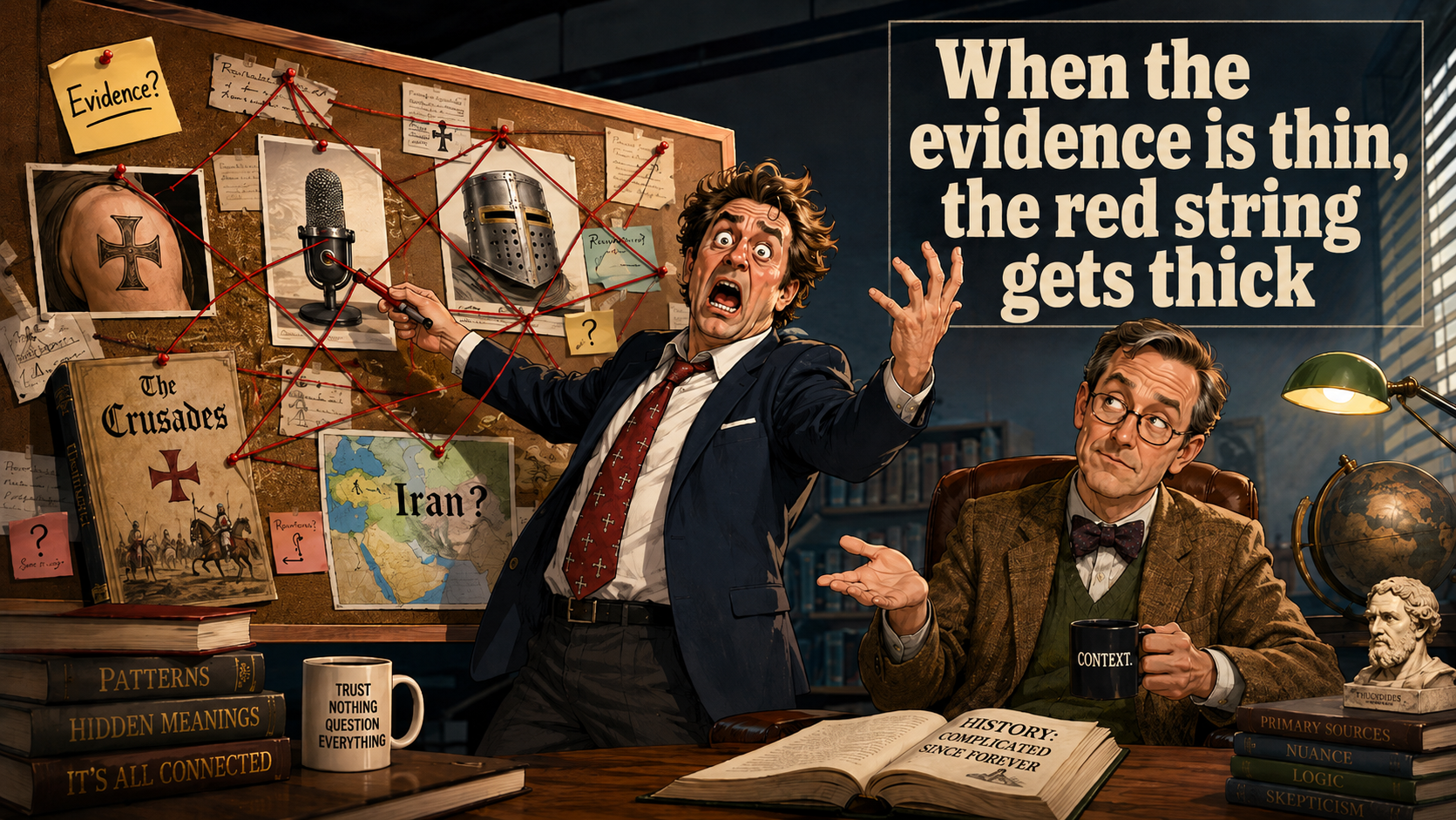
What Vox is doing is something else. It is building an insinuation chain: Hegseth likes the Crusades, the Crusades were a religious war, therefore Hegseth's worldview might turn the Iran conflict into a holy war. Each link in that chain sounds alarming. Together they do not constitute evidence of anything.
The Crusades Are Not a Foreign Policy Position
Interest in the Crusades is not rare, not fringe and not inherently sinister. Military historians study them extensively. Strategists have drawn on them for lessons about coalition warfare, logistics and the limits of occupying distant territory. Christians reflect on them as a complicated and often shameful chapter of church history. Secular conservatives find in them an example of Western civilization confronting an external threat. None of that constitutes a roadmap for theocratic war-making.
The Vox framing treats Hegseth's interest as though it were self-evidently alarming — as though no reasonable person could be fascinated by medieval military history without harboring plans to resurrect it. That is not how human beings work. Your uncle who is obsessed with World War II submarines is probably not planning to sink anything. The analogy the post uses cuts against its own argument.
If we treated every leader's historical interests as a direct prediction of policy, we would be in serious trouble. FDR was fascinated by naval history. Does that mean every modern president with a naval interest is planning a Pacific war? Abraham Lincoln read extensively about the Founders. Does that mean interest in 1776 signals authoritarian nostalgia? The logic does not hold.
What the Argument Actually Requires
To make the case that Hegseth's Crusades interest is shaping foreign policy in dangerous ways, you need to show one of a few things. You need to show that he has explicitly framed current conflicts in religious terms in official settings. You need to show that specific policy decisions reflect a holy-war framework rather than conventional strategic logic. Or you need to show that his religious views have produced concrete outcomes that diverge from secular military doctrine in ways that matter.
A Vox video about medieval history does not establish any of those things. It establishes that Hegseth has talked about the Crusades, has a Crusader cross tattoo and holds strong Christian beliefs. That is a profile of a religious conservative in a prominent position. It is not evidence of a theocratic foreign policy.
Calling someone a religious extremist requires more than a tattoo and a podcast comment. It requires evidence that the religion is driving the policy in ways it should not be.
The Iran Question Is Being Misused Here
Connecting Hegseth's medieval interests to the Iran conflict is the most strained move in the piece. The U.S. conflict with Iran has geopolitical drivers that predate Hegseth by decades: nuclear proliferation concerns, regional proxy warfare, oil politics, Israeli security commitments and the legacy of 1979. Serious analysts across the ideological spectrum have been debating Iran policy through those lenses for forty years. To suggest that what is really animating current U.S. posture is a defense secretary's fascination with 12th-century crusading armies is not analysis. It is mood-setting.
It also does a disservice to legitimate criticism of Iran policy. If you think the current approach to Iran is wrong, say why. Argue about deterrence, about escalation risk, about the wisdom of military versus diplomatic pressure. That is a real debate worth having. Wrapping it in crusade imagery makes the critique feel atmospheric rather than substantive.
Where the Legitimate Concern Lives
None of this means religious influence on national security decision-making is a nothing issue. It is not. When leaders frame conflicts in explicitly civilizational or theological terms in official settings, that deserves scrutiny. When religious identity shapes rules of engagement, treatment of prisoners or the selection of military targets, that is a concrete concern with concrete stakes. Those are the questions worth asking about any defense secretary whose faith is publicly prominent.
There is a real difference between a person of faith who holds a powerful job and a person whose faith is actively overriding secular strategic judgment in ways that endanger people or violate law. The first describes most of American history. The second is a genuine problem. The Vox piece never establishes which one Hegseth is, because establishing that would require actual evidence rather than historical atmosphere.
My Bottom Line
The post makes a suggestive argument while doing the work of an alarming one. It uses medieval history as a mood board, connects Hegseth's personal faith to a major ongoing conflict and leaves the audience with a vague sense that something dangerous is happening without specifying what, when or how.
That is not accountability journalism. That is vibes journalism. And vibes journalism about a sitting defense secretary, however much you dislike him, sets a standard that will be applied back against people you do like the next time the political winds shift.
If Pete Hegseth is letting religious ideology drive strategic military decisions in ways that are dangerous or illegal, prove it with decisions and outcomes. Until then, the Crusades are just history — and interest in history is not a crime.
Disclaimer: The views expressed in this post are the personal opinions of the author and are offered for educational, commentary and public discourse purposes only. They do not represent the positions of any institution, employer, organization or affiliated entity. Nothing in this post constitutes legal, financial, medical or professional advice of any kind. References to public figures, institutions, historical events and current affairs are based on publicly available sources and are intended to support analysis and argument, not to state facts about any individual's character, intent or conduct beyond what the cited sources support. Commentary on religious, political and cultural subjects reflects the author's independent analysis and is protected expression of opinion. Readers are encouraged to consult primary sources and form their own conclusions. Any resemblance to specific individuals or situations beyond those explicitly referenced is coincidental.