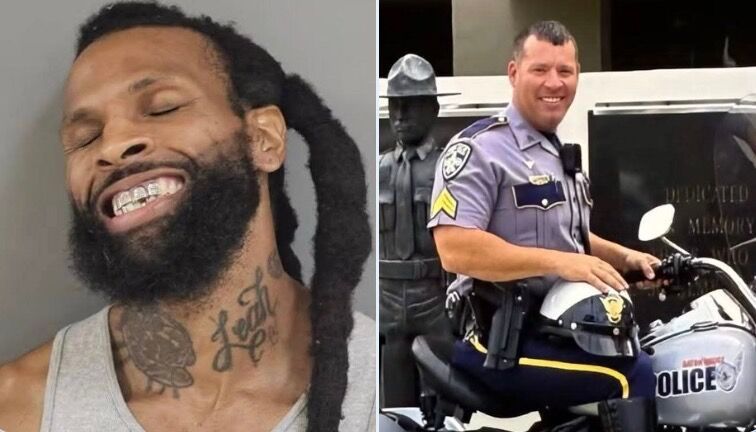
There are crimes that shock people because of the violence. Then there are crimes that shock people because of what they reveal. The killing of Baton Rouge Police Sgt. Caleb Eisworth appears to be both. According to local reporting, Gad Black is accused of intentionally following and striking Sgt. Eisworth with a pickup truck while Eisworth was riding a marked police motorcycle on June 16, 2025. Eisworth was knocked from the motorcycle and dragged more than 500 feet. He suffered catastrophic injuries, including the eventual amputation of both legs above the knee, before dying in August 2025 after weeks in the hospital. Black was initially charged with attempted first-degree murder of a police officer, hate crimes and resisting an officer. After Eisworth died, the charge was upgraded to first-degree murder. Prosecutors have since filed notice that they intend to seek the death penalty.
That is not a traffic accident. That is not a "bad interaction." That is not another vague story to be filtered through political fog. If the allegations are proven, this was a targeted attack on a police officer because he was a police officer. And that should bother every sane person in this country.
The Murder of a Symbol
Sgt. Eisworth was not just a uniform. He was a husband, a father and a 23-year veteran of the Baton Rouge Police Department. He had served in the motorcycle division since 2008 and had received the department's Medal of Valor for pulling a motorist from a burning vehicle while off duty. That matters because the people who hate police rarely hate individual human beings. They hate the symbol. They hate the badge. They hate the authority. They hate the fact that someone exists whose job is to stand between order and chaos.
The officer does not have to know the attacker. He does not have to have wronged him. He does not have to have done anything except wear the uniform. In that warped mind, the badge is enough.
According to arrest documents, Black had a "deep-rooted hatred for law enforcement" and admitted he followed Eisworth before the crash. Investigators also found disturbing social media posts connected to the incident. That phrase — deep-rooted hatred — should not be brushed aside. Hatred does not begin with a truck. It begins with a story told over and over until someone decides to act on it.
Generational Hate Is Taught
Nobody wakes up one morning hating police in a vacuum. Hatred is taught, repeated, excused, rationalized and eventually normalized. A child hears adults talk about cops as pigs. A teenager sees every police shooting stripped of context and turned into a racial parable before the facts are known. A young man is told that law enforcement is not imperfect but evil. Not accountable but illegitimate. Not flawed humans doing dangerous work but an occupying force.
That kind of thinking has consequences. There is a massive difference between holding police accountable and teaching people to despise police as a class. Good citizens should demand professionalism, discipline and restraint from law enforcement. Bad cops should be fired. Corrupt cops should be prosecuted. Abuse of power should be exposed. But that is not what anti-police hatred does. It does not seek reform. It seeks resentment. It turns every officer into a villain, treats every encounter as oppression and celebrates defiance while minimizing criminal behavior and portraying the basic enforcement of law as an act of social cruelty. Sooner or later, somebody acts on it.
The Cowardice of Selective Outrage
The media knows how to turn a story into a national morality play when it wants to. If a police officer makes a mistake or fits the preferred narrative of institutional guilt, the story can become national news overnight. There will be panels, experts, activists, hashtags, think pieces and demands for systemic change before the body camera footage is even fully reviewed.
But when an officer is allegedly targeted, run down, dragged down a road and left to die because someone hated law enforcement, the volume drops. Local media covered this case — WAFB, WBRZ and other outlets reported the facts — but the broader national appetite for stories like this is noticeably thin.
That silence is not neutral. It tells the public which victims are useful and which ones are inconvenient.
A murdered officer does not fit the preferred script. He complicates the narrative. He reminds people that police are not abstractions. They are the ones walking toward domestic calls, stolen vehicles, armed suspects, traffic stops and violent people that everyone else avoids. That does not mean every officer is heroic. It means the job is real, the danger is real and the hatred aimed at them is real.
The Badge Does Not Erase the Human Being
One of the nastiest tricks in modern political language is the way it strips people of personhood. An officer becomes "the police." A business owner becomes "privilege." A victim becomes "collateral." A criminal becomes "misunderstood." Once people are reduced to categories, cruelty becomes easier.
That is how a man can allegedly run over a police sergeant and later brag about "stretching one," according to reporting on the investigation. One. Not a man. Not a father. Not a husband. Not a public servant who spent more than two decades in uniform. One. That is the language of dehumanization. And dehumanization is the first step toward moral permission. Once the target is no longer fully human, anything can be excused.
Law Enforcement Is Not the Enemy of Civilization
America has serious problems. Crime is real. Bad policing is real. Broken trust between communities and law enforcement is real, and those complaints deserve a hearing. But civilization cannot survive the idea that law enforcement itself is illegitimate. Police are not the enemy of a free society. Lawless power is. Mob rule is. Selective justice is. Political violence is. A culture that teaches people to hate the very idea of order is playing with fire in a dry field.
A society can survive imperfect policing. It cannot survive the normalization of hatred toward everyone who enforces the law. You can support police accountability and still condemn anti-police hatred without hesitation. You can criticize misconduct and still understand that murdering an officer is not resistance. It is evil. You can demand better training, better leadership and better discipline while still recognizing that most officers are doing a difficult job under conditions most critics would not last a week in. The adult position is not complicated. Hold bad cops accountable. Honor good cops. Punish those who target them.
Why This Matters
The killing of Sgt. Caleb Eisworth matters because it shows where poisoned rhetoric leads when hatred is allowed to harden into identity. If the allegations are proven, this was not just an attack on one officer. It was an attack on the idea that society has the right to enforce its laws. It was a message sent through violence: the badge itself is enough to make someone a target.
A country that excuses hatred of police will eventually get fewer good officers, more emboldened criminals and more citizens wondering who is coming when they call 911. And the answer may be no one worth trusting, because the decent ones decided the job was no longer worth being hated, hunted or dragged down a road for.
Sgt. Caleb Eisworth deserved better than this. His family deserved better. His department deserved better. And the country deserves a more honest conversation than the childish lie that every criticism of police is reform and every defense of police is blind loyalty. When a man is accused of targeting a police officer and leaving him to die because of hatred for law enforcement, the decent response is not nuance. It is condemnation.
References
- Police1. (2025, August 11). La. officer dies two months after being intentionally struck.
- WAFB Staff. (2025, June 16). Man accused of intentionally ramming BRPD officer.
- WAFB Staff. (2026, April 14). DA seeking death penalty for man accused of intentionally running over BRPD sergeant.
- WBRZ. (2026, April 13). Man who allegedly killed BRPD sergeant asks to represent himself in court.
- Unfiltered with Kiran. (2025, June 20). Man accused of targeting Baton Rouge officer has history of similar attacks.
Disclaimer: The views expressed in this post are the personal opinions of the author and are offered for educational, commentary and public discourse purposes only. They do not represent the positions of any institution, employer, organization or affiliated entity. Nothing in this post constitutes legal, financial, medical or professional advice of any kind. References to public figures, institutions, historical events and current affairs are based on publicly available sources and are intended to support analysis and argument, not to state facts about any individual's character, intent or conduct beyond what the cited sources support. Commentary on religious, political and cultural subjects reflects the author's independent analysis and is protected expression of opinion. Readers are encouraged to consult primary sources and form their own conclusions. Any resemblance to specific individuals or situations beyond those explicitly referenced is coincidental.