Let me be direct about what this post is and what it is not. It is not an attack on Christianity, on faith, or on the billions of people who organize their lives around religious belief. Faith is a private matter and deserves respect as such. What this post examines is a specific claim — a factual, testable, scientific claim — that some Christian sects treat not as metaphor or parable but as literal historical truth: that all of humanity descended from two people named Adam and Eve, created roughly six thousand years ago in a garden. That claim can be evaluated. And when evaluated honestly, it does not survive contact with biology, genetics, mathematics or the fossil record.
That matters for reasons beyond theology. When literal interpretations of ancient origin stories become the basis for educational policy, curriculum design and public law, the separation of church and state stops being an abstract constitutional principle and becomes a live practical question. This series takes that question seriously.
The Population Problem: Two Into Eight Billion Does Not Go
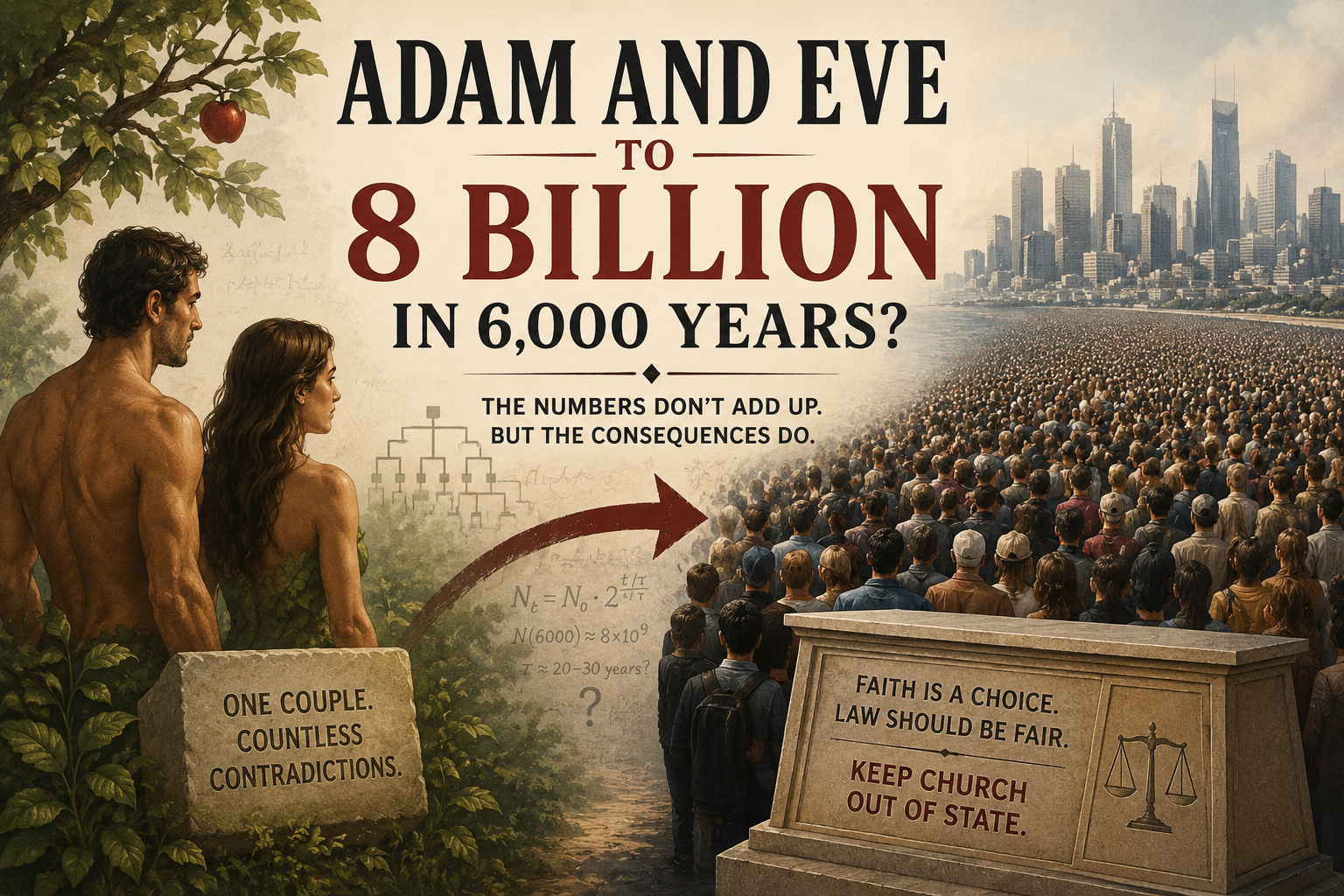
Start with the arithmetic. Young Earth Creationism — the theological position that the Earth and all life on it were created approximately six thousand years ago — requires that the entire human population of today, roughly eight billion people, descended from a single pair of ancestors within that timeframe. Let us think carefully about what that requires.
For the human population to reach eight billion from two individuals in six thousand years, the math demands generational doubling rates that have no parallel in recorded demographic history. Even under the most favorable assumptions about early fertility and survival, population geneticists have calculated that the numbers simply do not support a single founding pair at that timescale. The oldest anatomically modern human fossils, found in Morocco at the Jebel Irhoud site, have been dated to approximately 300,000 years ago. Homo sapiens did not appear six thousand years ago. The species existed for nearly three hundred times that span before the supposed date of Eden.
Anatomically modern human remains have been found dating to approximately 300,000 years ago in North Africa. Human-like ancestors in the genus Homo extend back nearly two million years. Archaeological evidence of human behavioral complexity, including cave art, tools and burial practices, predates the proposed Adam and Eve timeline by tens of thousands of years. The timeline is not off by a little. It is off by several orders of magnitude.
The Genetics Problem: DNA Does Not Lie
Modern population genetics delivers perhaps the most decisive blow to the two-person origin story. The field of phylogenetics allows scientists to trace human genetic diversity backward through time, estimating the size of ancestral human populations at various points in history. The results are consistent and they are unambiguous.
Human genetic diversity cannot be explained by descent from a single pair of individuals at any point in the last several hundred thousand years. Studies analyzing mitochondrial DNA, Y-chromosome lineages and autosomal genetic variation all converge on the same conclusion: the ancestral human population was never smaller than several thousand individuals. The technical term for this floor is the effective population size. For humans, that figure is estimated at roughly ten thousand individuals at its most restricted points during population bottlenecks. Two is not ten thousand. The gap is not a rounding error. It is the difference between a founding pair and a founding tribe.
The science does not say Adam and Eve are unlikely. It says a two-person founding event is genetically impossible given the diversity that exists in the human genome today.
This is not a matter of scientific opinion open to reasonable dispute. It is the consensus finding of population genetics, genomics and evolutionary biology, fields that have been independently verified through multiple methodologies over decades of research. When an evangelical geneticist at BioLogos, Francis Collins, who mapped the human genome, says the genetics rules out a two-person origin, that is worth noting.
The Biology Problem: Cain's Wife and the Unavoidable Question
Even setting aside the fossil record and the genetics, the Genesis narrative creates a biological and moral problem it never adequately resolves. Adam and Eve are said to have produced Cain, Abel and Seth, along with unnamed daughters. After Cain kills Abel and is cast out, the text notes that Cain knew his wife and she conceived. This raises the question that has troubled theologians for centuries and that literalists have never satisfactorily answered: where did Cain's wife come from?
The only logically consistent answer within the framework of a literal two-person origin is that Cain married his sister. There is no other option. The same logic applies to the next generation and the generation after that. For humanity to have populated the Earth from a single pair, the early generations would have required sibling-to-sibling reproduction as a matter of biological necessity, not exceptional circumstance. This is not a fringe reading. It is the unavoidable arithmetic of the story as told.
Close-kin reproduction produces offspring with significantly elevated rates of homozygosity, meaning two copies of the same recessive alleles. This dramatically increases the expression of harmful genetic mutations that normally remain dormant when paired with a dominant healthy copy from an unrelated parent. In small populations practicing consistent close-kin reproduction, genetic disease loads accumulate rapidly across generations. This is precisely why virtually every human society has developed incest prohibitions, and why science understands those prohibitions as having a biological basis, not merely a cultural one. The Genesis population model would have required exactly the conditions that produce genetic collapse.
Some literalists argue that early humans had "perfect" genomes before the Fall and therefore could safely reproduce with close relatives without the genetic consequences that affect modern humans. This argument requires inventing biological mechanisms that have no scientific basis to rescue a narrative from its own internal contradictions. It is not explanation. It is special pleading.
The Theological Problem: Metaphor Is Not Weakness
It is worth noting, before going further, that many serious theologians, biblical scholars and faithful Christians do not read Genesis as a literal scientific account. They read it as ancient cosmological poetry, as myth in the technical sense of a story that conveys profound truths about human nature, moral responsibility and the relationship between creation and creator, without making specific historical or biological claims. That reading has deep roots in the tradition. Augustine in the fifth century warned against Christians making claims about natural science on the basis of scripture, arguing that such claims brought the faith into disrepute when they were contradicted by evidence.
The problem is not Christianity. The problem is a specific subset of Christian interpretation that insists on treating as literal, historical, scientific fact a narrative that the evidence clearly places in the category of sacred literature rather than historical chronicle. That insistence, when it moves from the pew into the classroom, is where the constitutional issue begins.
The Constitutional Problem: When Fable Becomes Curriculum
The separation of church and state exists for reasons that the framers understood clearly. A pluralistic republic cannot have the government endorsing a particular religious interpretation of reality as official truth. This is not hostility to religion. It is the structural protection that allows religious diversity to flourish without any single tradition imposing its metaphysics on citizens who do not share it.
When Young Earth Creationism is proposed as an alternative to evolutionary biology in public school curricula, as it has been repeatedly across multiple states, it is not a scientific alternative being offered. It is a specific theological position being dressed in scientific language and presented to children as equivalent to or superior to a scientific consensus that has been established through more than a century of converging evidence. Courts have consistently recognized this, most clearly in Kitzmiller v. Dover Area School District in 2005, where a federal judge found that intelligent design, a rebranded version of creationism, was a religious proposition rather than a scientific one and could not be taught in public school science classes.
The question is not whether people have the right to believe in a literal Genesis. They do, fully and without apology. The question is whether that belief can be imposed through public institutions on people who do not share it.
The answer the Constitution gives is no. And the reason that answer matters is not abstract. Science education shapes how citizens evaluate evidence, assess risk, understand public health and navigate a world increasingly governed by technical complexity. When students are taught that the Earth is six thousand years old and that human beings were created in their current form without common descent, they are being given tools that will fail them in any encounter with biology, medicine, geology, climatology or evolutionary science. That is not a religious outcome. That is an educational one.
Why This Series Exists
This is one post in a longer series examining the relationship between religious belief and public life. The goal is not to mock faith. The goal is to apply the same standard of honest examination to religious claims that we apply to every other category of claim that affects public policy. Faith that remains in its proper domain, personal conscience, community, meaning, morality, spiritual practice, has nothing to fear from honest scrutiny. The moment it reaches beyond that domain and asks public institutions to enforce its specific interpretations of reality, scrutiny is not only appropriate. It is required.
The story of Adam and Eve is ancient, powerful and rich with symbolic meaning. As literature it has shaped Western civilization in ways that are impossible to overstate. As a factual account of human origins, it is contradicted by every relevant scientific field that has examined the question. Treating those two things as the same kind of truth is not faith. It is a category error. And when that category error is written into law or taught as science in a public school, it becomes everyone's problem.
My Bottom Line
Two people cannot produce eight billion descendants in six thousand years. Human genetic diversity cannot be explained by a founding pair at any point in the species' history. The internal logic of a two-person origin requires generations of sibling reproduction with the genetic consequences that entails. The fossil record places modern humans at a minimum of three hundred thousand years of age. None of these are contested findings at the margins of science. They are the settled conclusions of biology, genetics, anthropology and paleontology.
People are free to believe whatever they choose about human origins. That freedom is fundamental. But freedom of belief does not confer the right to have that belief taught as science, encoded in public curriculum or used as the basis for policy in a republic where millions of citizens hold different beliefs. That is precisely the line the First Amendment was designed to hold.
Faith and reason are not natural enemies. But they are not the same thing. A society that cannot tell the difference will struggle to protect either one.
References
- Hublin, J. J., et al. (2017). New fossils from Jebel Irhoud, Morocco and the pan-African origin of Homo sapiens. Nature, 546, 289–292.
- Tenesa, A., et al. (2007). Recent human effective population size estimated from linkage disequilibrium. Genome Research, 17(4), 520–526.
- Collins, F. S. (2006). The language of God: A scientist presents evidence for belief. Free Press.
- Venema, D., & McKnight, S. (2017). Adam and the genome: Reading Scripture after genetic science. Brazos Press.
- National Academy of Sciences. (2008). Science, evolution, and creationism. National Academies Press.
- Kitzmiller v. Dover Area School District, 400 F. Supp. 2d 707 (M.D. Pa. 2005).
- Augustine of Hippo. (c. 415 AD). The literal meaning of Genesis (De Genesi ad Litteram).
Disclaimer: The views expressed in this post are the personal opinions of the author and are offered for educational, commentary and public discourse purposes only. They do not represent the positions of any institution, employer, organization or affiliated entity. Nothing in this post constitutes legal, financial, medical or professional advice of any kind. References to public figures, institutions, historical events and current affairs are based on publicly available sources and are intended to support analysis and argument, not to state facts about any individual's character, intent or conduct beyond what the cited sources support. Commentary on religious, political and cultural subjects reflects the author's independent analysis and is protected expression of opinion. Readers are encouraged to consult primary sources and form their own conclusions. Any resemblance to specific individuals or situations beyond those explicitly referenced is coincidental.