Budgets tell the truth politicians try to avoid. A speech can say anything. A press release can promise compassion, fairness and fiscal responsibility all in the same sentence. But a budget shows what government actually values. It shows who gets protected and who gets told to wait. That is why New York City's proposed cut to veterans spending is not a minor accounting footnote. It is a declaration of priorities.
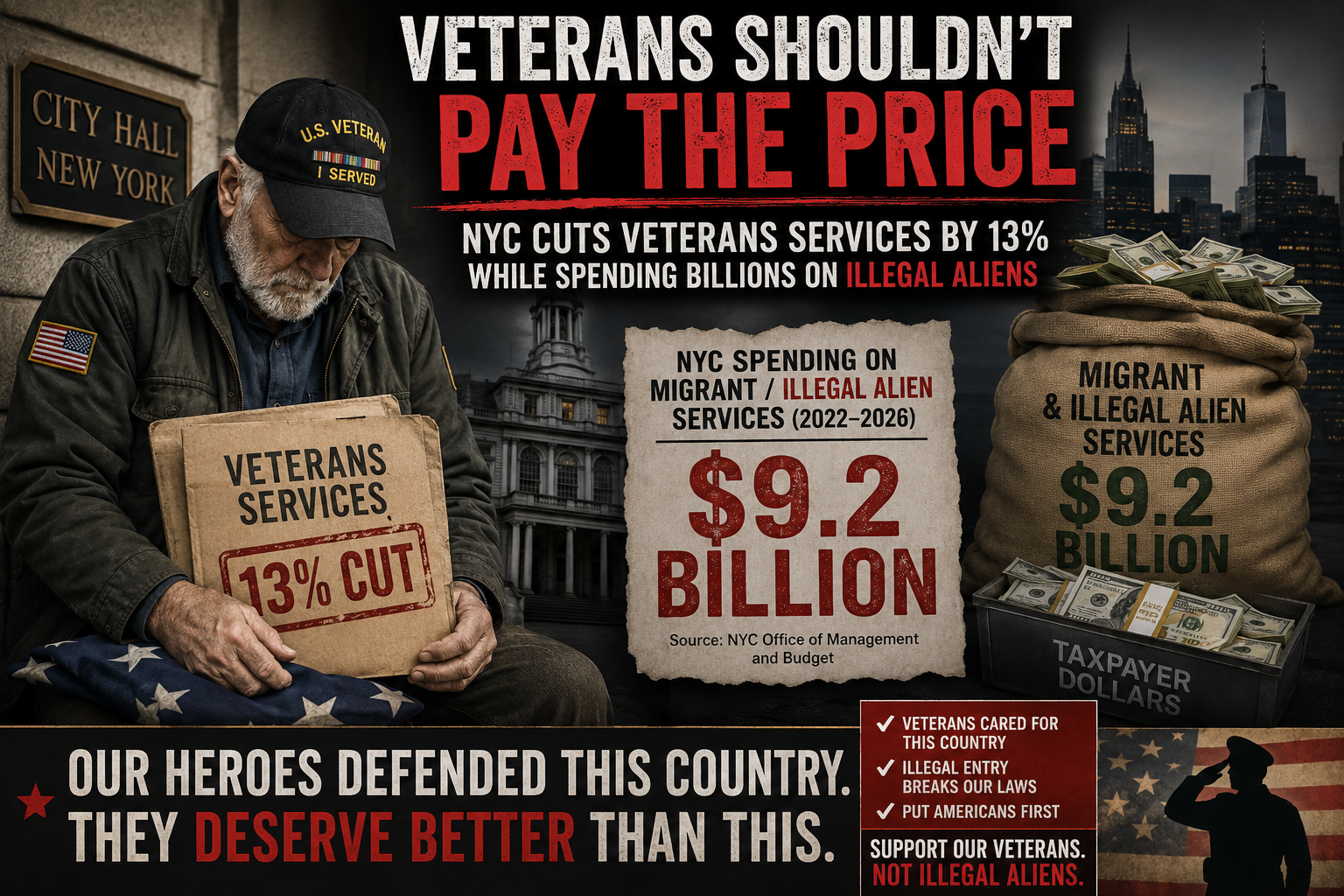
The Department of Veterans' Services is facing a roughly $1 million reduction in the proposed FY2027 budget, dropping from approximately $7.6 million to $6.6 million. That is about a 13 percent decrease. At the same time, New York City's own budget documents acknowledge an estimated $9.2 billion spent between July 2022 and March 2026 to support asylum seekers, with around 28,400 still in city care every night as of late April 2026. One group is being cut. Another group continues receiving massive public support. The city's budget may not include a line that says so in plain language. Government documents are rarely that honest. But the practical reality is not hard to read.
"A ticker-tape parade is nice. Speeches are nice. Social media posts are cheap. Budgets are real."
Veterans should not be the first place any government looks for savings. There are many places a city can find efficiencies: bloated consulting contracts, duplicative offices, failed programs, symbolic initiatives that generate press conferences but no results. The people who served this country already paid their bill. Some paid with years of their lives. Some paid with their bodies. Some came home with physical injuries, traumatic memories, broken families and mental health challenges that do not disappear because a budget year changes. New York City is home to thousands of veterans who need housing assistance, employment help, mental health support and benefits navigation. Cutting the agency responsible for serving them sends a rotten message at any time. Cutting it while the city is still spending billions on people who entered the country illegally or are awaiting asylum determinations sends a message that is impossible to misread.
New York City's FY2027 executive budget materials report that more than 234,000 asylum seekers sought city assistance through the end of FY2025. The city estimates it spent $9.2 billion on this population between July 2022 and March 2026. The Department of Veterans' Services budget for the same fiscal year is proposed at $6.6 million — a reduction of roughly $1 million from the prior year. In a city budget measured in the tens of billions, that cut is not a financial necessity. It is a choice.
The official term is "asylum seekers." That phrase may apply accurately to some. But it is also true that a significant portion of people in this broader crisis entered the country unlawfully or remain in legal gray zones while their cases move through an overwhelmed system. Politicians resist the phrase "illegal alien" because it strips away the fog. The fog is useful to them. If someone crossed the border outside the legal process, that person is here illegally until the system determines otherwise. That does not mean people should be treated cruelly. It means words should still mean something, and it means that a government with finite resources has an obligation to establish an honest order of priorities.
A country that will not name a thing clearly will not fix a thing clearly either.
The standard defense will be that New York has no choice — that legal obligations under the city's right-to-shelter framework and emergency response policies have created commitments that cannot simply be unwound. There is some truth to that. New York carries obligations most cities do not. But that does not absolve city leaders of responsibility for the choices still within their control. If the city has engineered a system in which people who entered the country illegally receive enormous taxpayer support while the department serving American veterans must shrink, the answer is not to present that outcome as inevitable. The answer is to fix the system. Politicians who hide behind process while veterans absorb the cut deserve exactly the scrutiny they are getting.
"If the cut is small in the context of the total budget, then why make it at all?"
Some will say the $1 million reduction is minor. That argument makes the decision worse, not better. If the cut is small relative to the total city budget, then why impose it on veterans at all? The city spent $9.2 billion on the migrant crisis. Finding $1 million in savings somewhere other than the veterans department is not a feat of political imagination. It is a decision not to bother. That indifference is the problem. Veterans do not need ceremonial patriotism twice a year. They need actual support when budgets are written.
Legal immigrants are not the problem and should not be treated as such. People who followed the process, came here lawfully, built families, worked and contributed deserve respect. America has benefited enormously from legal immigration. The problem is a political class that refuses to distinguish between legal immigrants and people who bypassed the legal process entirely — a refusal that is deliberate, because it allows every criticism of illegal entry to be recast as an attack on immigrants as a whole. That framing is dishonest, and it pollutes a debate that honest governance requires.
There is a basic order of obligation a functioning government should maintain. Citizens come first. Veterans come before noncitizens. Law and public order matter. Lawful residents and legal immigrants deserve protection. Emergency humanitarian assistance has its place, but not at the expense of those obligations. New York City has scrambled that order. It has poured billions into emergency migrant services while trimming the agency tasked with serving the people who wore the uniform. That is not compassion. It is mismanagement that dresses itself as virtue, which is the worst kind because it is the hardest to challenge without being accused of cruelty.
History will not remember the accounting language. It will not preserve the budget footnotes or the careful wording in the mayor's message. It will remember who got protected and who got cut. On that test, New York City is failing. The fix is not complicated. Restore the funding. Not with a statement, not with a task force, not with another listening session. With money. Veterans earned that much. They earned considerably more.
A city that can spend billions on people who broke immigration law has no standing to plead poverty when the bill for veterans comes due.
References
- New York Post. "Mamdani blasted for planned cuts to veterans services, axing events including parade." (2025).
- New York City Office of Management and Budget. FY2027 Executive Budget — Message of the Mayor. Includes migrant services spending totals and asylum seeker population figures through April 2026.
- New York City Mayor's Office. "Mayor Zohran Mamdani Releases $124.7 Billion Executive Budget." (2025). Official budget release materials.
- New York State Comptroller. Asylum Seeker Spending Report. Independent fiscal analysis of city expenditures related to the asylum seeker crisis.
- New York City Department of Veterans' Services. Agency budget history, FY2026–FY2027. Referenced via OMB executive budget documents.