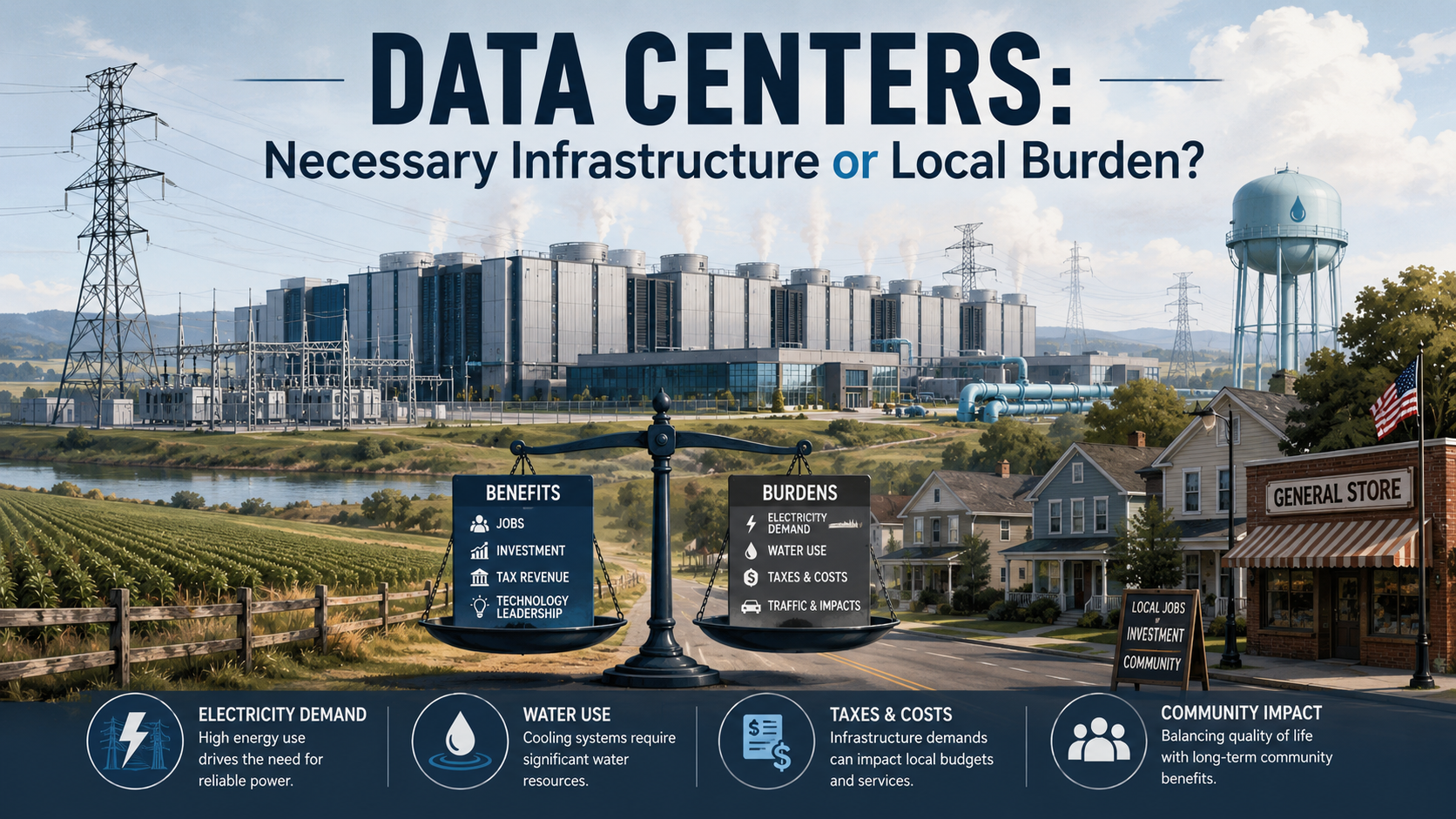
Data centers have become one of those issues where both sides can be right and wrong at the same time. On one side, data centers are necessary. They are not some useless luxury project. Modern banking, hospitals, logistics, cloud storage, streaming, business software, cybersecurity, government records, artificial intelligence and everyday internet use all depend on them. If we want a digital economy, we need physical infrastructure to support it.
On the other side, communities are not wrong to push back. Data centers consume major amounts of electricity, require cooling, may use significant water, demand grid upgrades, alter local land use and often arrive with tax incentives that deserve real scrutiny. The fight is not really about whether data centers should exist. They should. The fight is about where they go, who pays for them and whether local communities actually benefit.
That is where the conversation needs to get more honest.
Data Centers Are Not Optional Anymore
The first mistake in this debate is pretending data centers are unnecessary. They are not.
A data center is the physical backbone of the digital world. Every online purchase, medical record, bank transaction, cloud backup, video call, AI search, business database and streaming service runs through server infrastructure somewhere. The internet may feel weightless, but it is not. It sits in buildings, runs on electricity, uses cooling systems and depends on real estate, water, transformers, substations, fiber and transmission capacity.
Artificial intelligence has intensified the issue because AI-focused data centers use far more computing power than traditional data storage or basic cloud services. The International Energy Agency projects that global data center electricity consumption could roughly double from 485 terawatt-hours in 2025 to around 950 terawatt-hours by 2030, with AI-focused data centers growing even faster.
The IEA projects global data center electricity consumption could nearly double by 2030 — from 485 terawatt-hours to roughly 950. That is not a rounding error. That is serious infrastructure demand arriving fast.
So the anti-data-center argument falls apart if it starts with the idea that communities can simply say no to digital infrastructure forever. That is fantasy. A modern economy needs data centers just like it needs roads, warehouses, ports, water systems, power plants and rail lines.
But the pro-data-center argument also falls apart when it acts like necessity gives companies a blank check. It does not.
The Real Issue Is Cost Shifting
The central question is simple: who should pay?
If a data center requires new substations, upgraded transmission lines, expanded water infrastructure, backup generation, road work or major utility planning, those costs should not be quietly dumped onto ordinary ratepayers. The companies creating the concentrated demand should shoulder the direct costs of serving that demand.
That does not mean every dollar is easy to assign. Utility systems are complicated. Power grids are shared networks. Some upgrades benefit more than one customer. But the principle still matters: when a private project creates a major new burden, the public should not be left holding the bag.
This is especially important as data center growth strains electric grids. On the PJM grid, the largest electric grid operator in the United States, wholesale power costs reportedly rose sharply in early 2026, with data center demand identified as a major driver. Bloomberg reported that PJM wholesale power averaged $136.53 per megawatt-hour in the first quarter of 2026 compared with $77.78 during the same period in 2025.
That does not mean data centers are the only cause of higher power prices. Energy markets are affected by fuel costs, generation retirements, transmission bottlenecks, weather, regulation and demand growth across multiple sectors. But it does mean data centers are now large enough to matter. They are no longer a niche load hiding in the background.
Who Should Shoulder the Costs?
The fairest answer is a layered one.
The data center developer should pay for site-specific infrastructure, including interconnection costs, dedicated substations, transformers, backup systems, road improvements directly tied to the facility and any water or wastewater infrastructure required for the project.
The utility should pay for broader grid improvements only when those upgrades clearly benefit the wider system, and even then regulators should make sure data centers are not getting subsidized by residential and small-business customers.
State and local governments should be extremely careful with tax incentives. There may be cases where a data center strengthens the local tax base, but blanket giveaways are hard to justify when the permanent job count is often modest. Good Jobs First reported that at least 36 states have special subsidy programs for data centers, but only 11 disclose which companies receive them. That lack of transparency is a problem.
Local residents should not be asked to pay higher utility bills, absorb water risk, lose rural land, tolerate industrial noise and accept reduced transparency while being told the project is automatically "economic development." Economic development for whom? That question should be asked every time.
Will Data Centers Benefit Locals?
Sometimes, yes.
Data centers can expand a tax base. They can bring construction jobs during the buildout. They can support electricians, mechanical contractors, security contractors, maintenance companies, fiber providers, engineers and some local service businesses. In places with weak tax revenue, a large facility can help fund schools, roads, fire districts or county services if the tax structure is fair.
They can also attract related infrastructure investment. A community with strong fiber, power capacity and technology infrastructure may become more attractive for other businesses.
The biggest local benefit often happens during construction, not long-term operation. Brookings noted that economic benefits to the surrounding community tend to decline substantially after the construction phase ends. A good deal for locals should include measurable permanent jobs, strong tax revenue after incentives, utility protections, water protections, emergency service planning and enforceable community commitments.
So the claim that every data center is a local jobs machine deserves skepticism. A warehouse, factory or corporate campus may employ hundreds or thousands of people. A data center may require a large capital investment but far fewer permanent workers once it is running.
Will Data Centers Harm Locals?
They can.
The most obvious risk is electricity cost. If data centers increase grid demand faster than supply can be built, everyone can end up paying more. That is especially unfair for homeowners, retirees, small businesses and low-income households that did not create the demand.
The second risk is water. Some data centers use large volumes of water for cooling, though the amount depends heavily on design, location, climate and cooling technology. The World Resources Institute warns that the data center boom is reshaping local energy grids, water systems and land use, often with limited public information about long-term impacts.
The third risk is land use. A data center may not create the truck traffic of a warehouse, but it can still convert rural or suburban land into industrial infrastructure. Residents near proposed projects often worry about noise, backup diesel generators, visual impact, property values, water pressure and the long-term character of the community. That is not irrational.
In Medina County, Texas, residents pushed back against a proposed 265-acre technology park near Castroville, raising concerns about water use, emissions, property values and the industrialization of a rural area. In Georgia, controversy erupted after a large data center reportedly used roughly 30 million gallons of water during drought conditions before the billing issue was resolved.
The Tax Break Problem
Tax incentives are where this issue gets especially muddy.
Politicians love ribbon cuttings. Companies love incentives. Local officials like announcing billion-dollar investments. But taxpayers need to look past the headline number. A $1 billion project does not automatically mean $1 billion of local benefit.
If the company receives major property tax abatements, sales tax exemptions, utility discounts or infrastructure support, the community needs to know what it is giving up. If the permanent jobs are limited, the subsidy needs to be justified with hard numbers, not press-release language.
The right standard should be simple: no secret deals, no vague promises and no subsidies without measurable local return.
If a data center creates major tax revenue, pays for its infrastructure burden, protects utility customers and uses responsible water and energy planning, then it may be a reasonable deal. If it gets special treatment, raises pressure on the grid, consumes scarce water and produces limited permanent employment, then locals are right to object. That is not anti-business. That is basic business judgment.
The Environmental Question Needs Honesty
The environmental debate is also often dishonest on both sides.
Some critics act like data centers are uniquely evil. That is too easy. The entire modern economy depends on digital infrastructure. Hospitals, emergency systems, research institutions, small businesses, universities and ordinary households all benefit from cloud computing and data storage.
But some industry defenders act like "efficiency" and "renewable energy commitments" solve everything. They do not. A data center needs reliable power around the clock. Renewable energy can help, but it does not eliminate the need for firm power, storage, transmission and backup systems. If AI demand grows faster than clean power and grid capacity, the gap may be filled by natural gas or delayed retirements of fossil-fuel generation.
That does not make data centers automatically bad. It means the energy plan has to be real. A responsible project should disclose expected power demand, water demand, cooling method, backup generation, emissions impact, utility upgrade requirements and who pays for each piece. Communities should not have to decode corporate sustainability language to understand what is being built next door.
What Good Policy Should Look Like
Nobody serious is asking to kill every data center. And nobody serious should be rubber-stamping every shiny billion-dollar project because a politician wants a press release. The answer is in the middle, and it is not complicated.
The developer pays for the infrastructure it creates. That means interconnection, substations, road impacts, water and wastewater tied directly to the project. Not the ratepayer. Not the county. The company that needs the power load of a small city should fund the infrastructure of a small city.
Utility regulators need to stop letting concentrated private demand get quietly socialized across residential and small-business customers. If a data center is driving grid costs up, it needs its own rate class. That is not anti-business. That is what any competent businessperson would call cost allocation.
In water-stressed areas, closed-loop cooling or recycled water should not be optional. A facility should not be allowed to quietly compete with farmers, residents and small businesses for limited supply while local officials celebrate the groundbreaking.
Tax incentives need to come with teeth. Performance-based. Transparent. With clawback provisions if the jobs and revenue do not materialize. No more secret deals and vague promises dressed up as economic development.
And before any large project gets approved, the public deserves full disclosure. Power demand. Water demand. Generator use. Noise profile. Tax impact. Emergency service load. Communities should not have to file public records requests to understand what is being built next door to them.
The Bottom Line
Data centers are necessary. The digital economy does not run on magic. It runs on servers, wires, water, power, cooling systems and land. But necessity does not excuse bad deals.
If Big Tech needs massive infrastructure, Big Tech should pay its fair share of the infrastructure burden. If a local community is asked to host the project, that community should receive more than vague promises and a ribbon-cutting ceremony. The benefits should be real, measurable and local.
Data centers are becoming one of the defining infrastructure fights of the AI era. If handled well, they can support the digital economy, strengthen local tax bases and improve infrastructure. If handled poorly, they can raise utility bills, drain public resources, strain water systems and leave residents wondering why they were treated as an afterthought.
Progress is not the problem. A bad deal dressed up as progress is the problem.
References
Brookings Institution. "Turning the data center boom into long-term, local prosperity."
Good Jobs First. "Cloudy Data, Costly Deals: How Poorly States Disclose Data Center Subsidies."
Harvard Gazette. "Why are communities pushing back against data centers?"
International Energy Agency. "Key Questions on Energy and AI."
Bloomberg. "AI Buildout Drives 76% Power Bill Jump on Largest US Grid."
World Resources Institute. "7 Ways Data Centers Affect US Communities."
MySA. "265-acre technology park draws backlash from tiny Texas town."
New York Post. "Georgians outraged after data center drains 30M gallons of water amid drought conditions."
Personal opinions expressed for educational, commentary and public discourse purposes only. Not institutional positions. Not professional advice. References support analysis, not factual claims about individuals. Political and religious commentary is protected opinion. Readers are encouraged to consult primary sources. No resemblance beyond explicit references is intended.