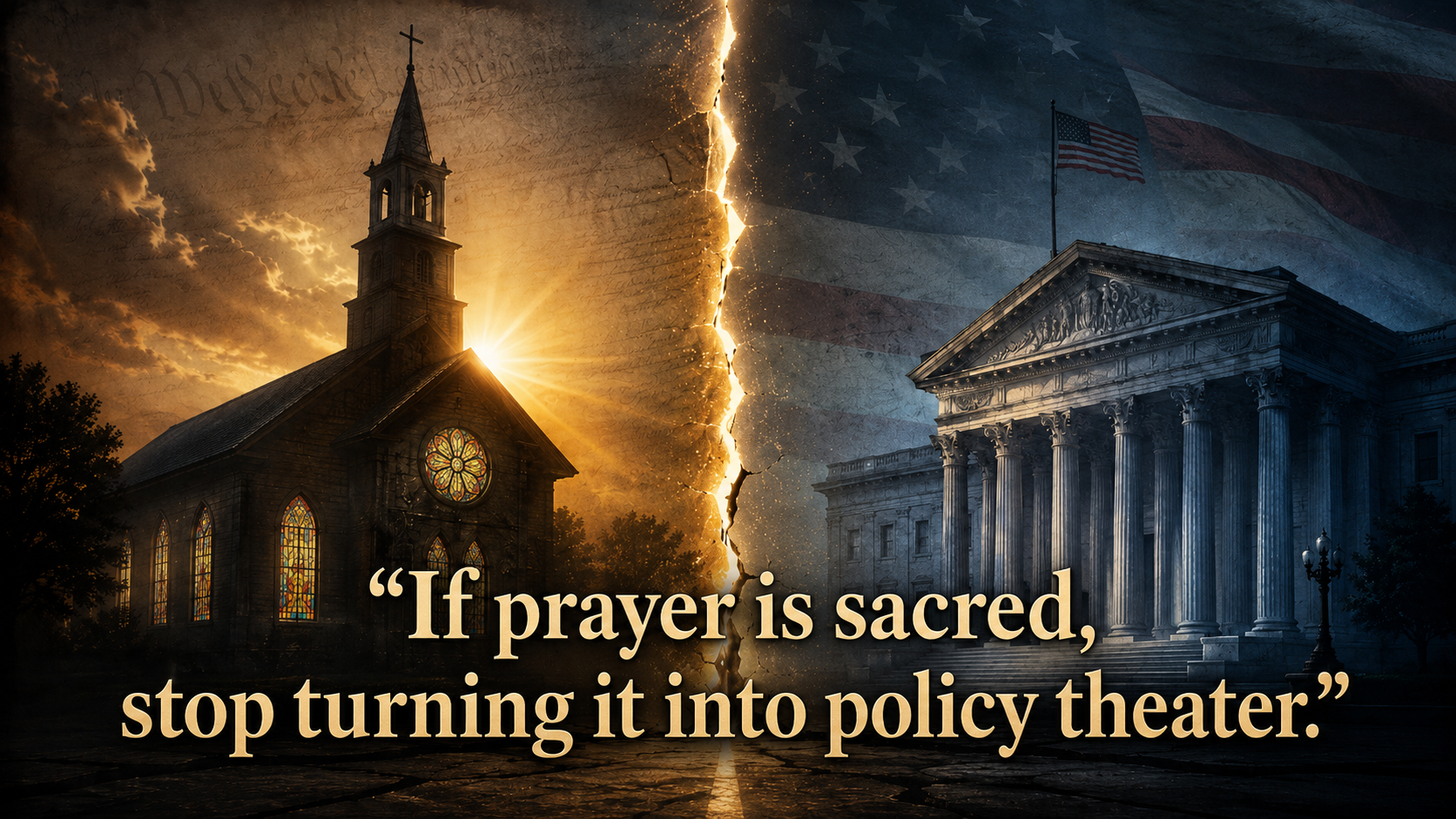
Every year on the first Thursday of May, the President of the United States issues a proclamation calling on Americans to pray. Members of Congress gather on the Capitol steps. Evangelical organizations sponsor events in courthouses, town squares and public buildings across the country. The National Day of Prayer Task Force, a private Christian organization, coordinates the whole operation with official blessing and treats the day as a distinctly Christian occasion. And the secular republic established by the First Amendment pretends not to notice. This is a problem — not because prayer is wrong, not because faith is illegitimate, but because government has no business scheduling, promoting or hosting it. The National Day of Prayer is sincere in its origins, politically useful to its modern organizers and constitutionally indefensible. All three things are true simultaneously.
Let me be precise about what this argument is and what it is not. It is not an argument that prayer is worthless to those who practice it. Whatever comfort, meaning, clarity or community prayer provides to the people who engage in it belongs entirely to them and is none of the government's business. That is exactly the point. It is none of the government's business — which is precisely why the government should stop making it its business once a year in a nationally coordinated event that implicitly endorses one mode of spiritual practice over all others.
Where It Came From and Why That Does Not Settle the Question
The National Day of Prayer has early American roots that its defenders invoke constantly. The Continental Congress called for days of prayer and fasting during the Revolutionary War. Presidents from Washington through Lincoln issued prayer proclamations during times of national crisis. Congress formally established the National Day of Prayer by statute in 1952 and in 1988 fixed it permanently to the first Thursday in May. President Reagan signed that legislation. The tradition feels old, patriotic and woven into the fabric of national identity.
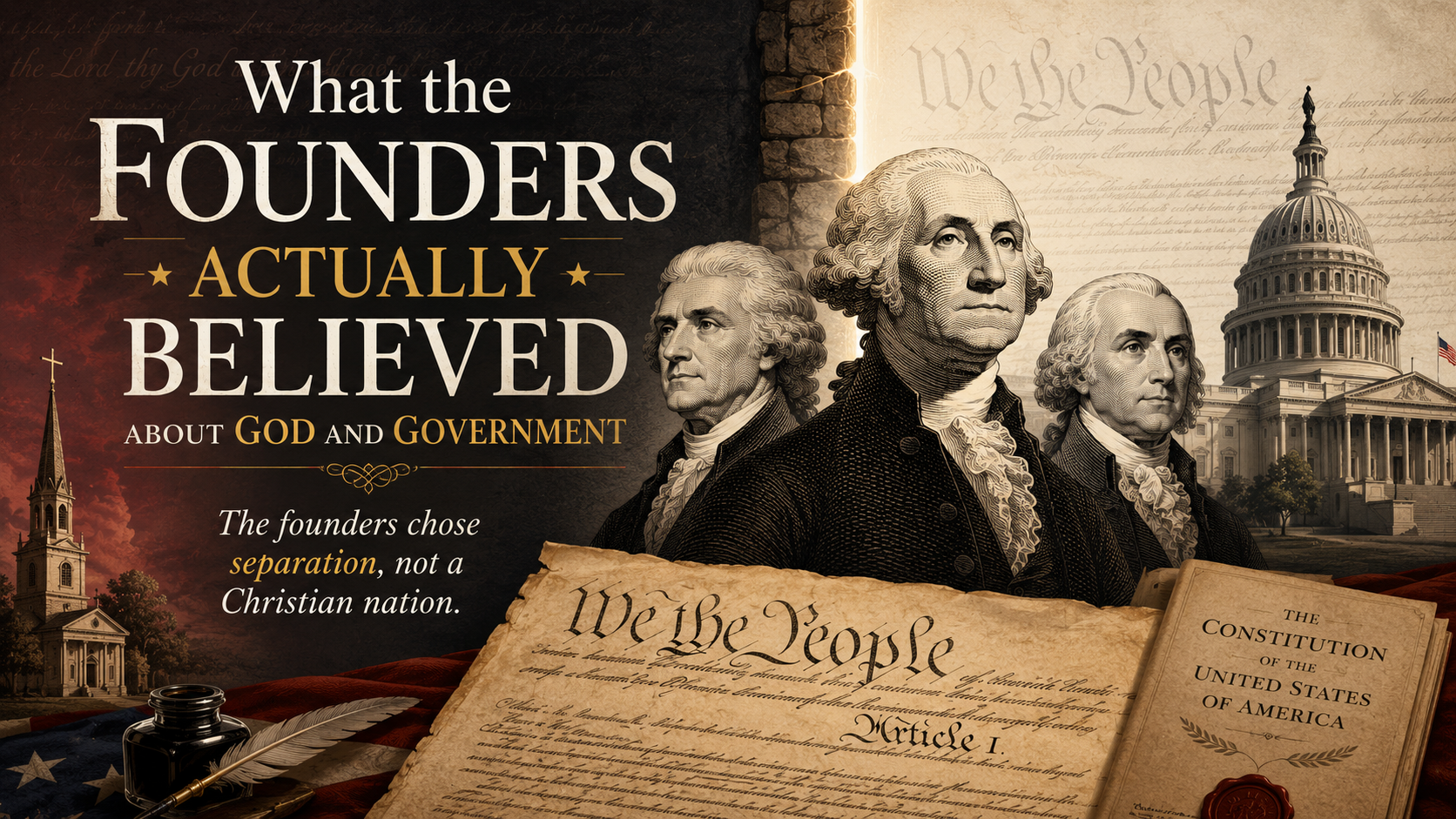
The founders were not a unified religious bloc. Washington and Jefferson spoke of providence and the divine in deliberately vague, non-sectarian terms. Jefferson refused to issue prayer proclamations as president, considering them a violation of the wall between church and state he had helped construct. Madison, the primary architect of the First Amendment, opposed congressional chaplains and government-sponsored prayer days on the same grounds. The early republic's practice of prayer proclamations was not unanimous, was not without controversy and cannot be used to foreclose constitutional argument two centuries later. The Constitution does not become irrelevant because a tradition is old.
What Congress did in 1952 and what Reagan codified in 1988 was institutionalize a practice that the most rigorous constitutional thinkers among the founders had explicitly opposed. The historical pedigree of the National Day of Prayer does not settle the constitutional question. It is often invoked precisely to avoid engaging with it.
The Establishment Clause Is Not Complicated
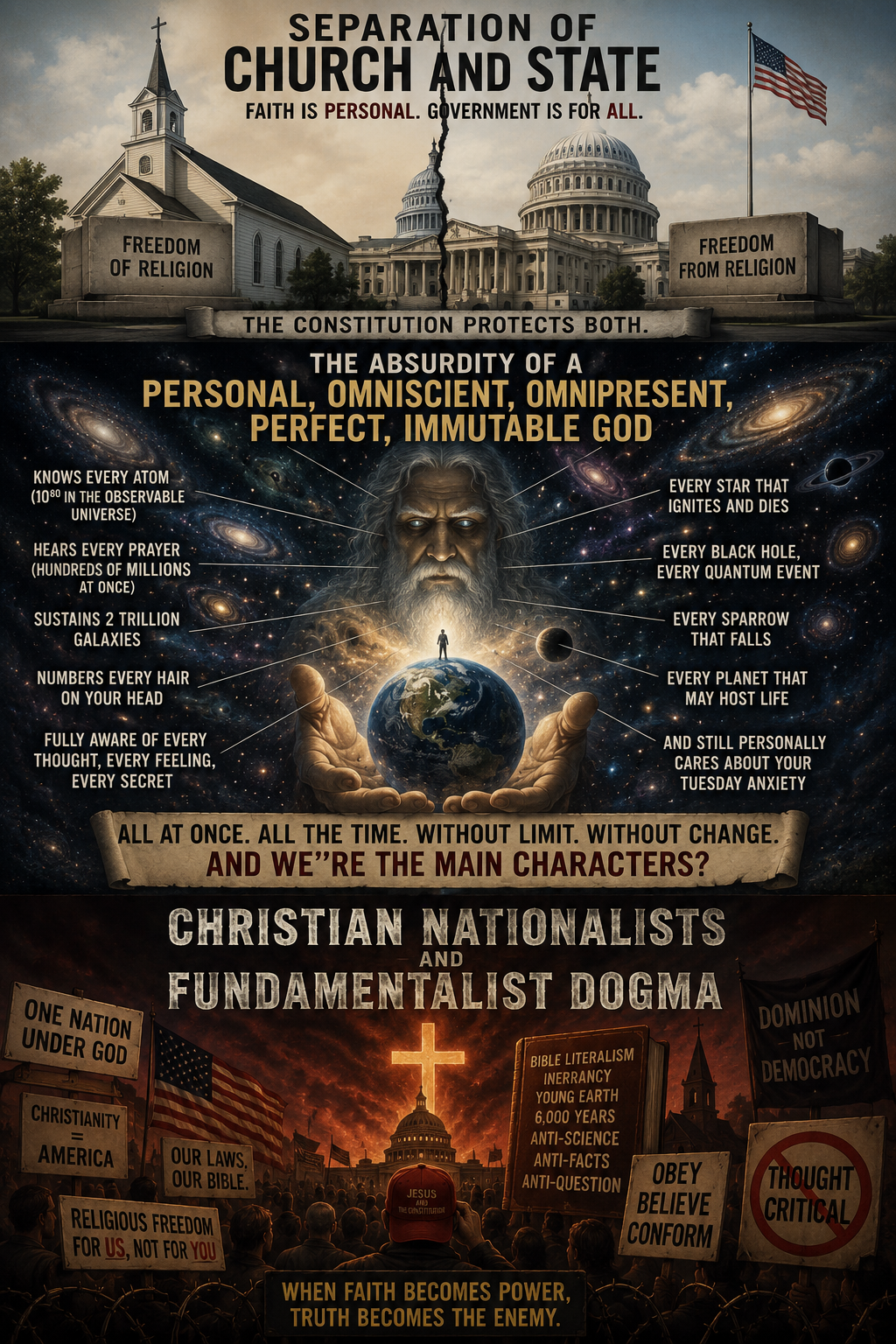
The First Amendment begins with sixteen words: "Congress shall make no law respecting an establishment of religion, or prohibiting the free exercise thereof." Those two clauses do two distinct things. The Establishment Clause prevents government from endorsing, promoting or favoring religion. The Free Exercise Clause protects individuals in their private religious practice. They work together to create a space where faith flourishes free of government interference precisely because government stays out of it.
A statute that directs the president to designate a day for the nation to "turn to God in prayer and meditation" is a government endorsement of religious practice. It is not a neutral accommodation. It is not a mere acknowledgment of religious diversity. It is the federal government telling the country that prayer is what Americans should do on this particular Thursday — and the organizational machinery that surrounds the day makes clear that the prayer in question is broadly Christian in character. The National Day of Prayer Task Force, which holds official recognition and hosts events at public venues, has stated explicitly that its mission is to communicate the Christian message.
The government does not get to tell citizens what to do with their souls. That is not what republics are for. It is precisely what the First Amendment was designed to prevent.
On the Question of Whether Prayer Works
This is the part of the conversation that makes people uncomfortable, so let me say it plainly and without apology. The empirical evidence that intercessory prayer — prayer directed at changing outcomes in the external world — produces measurable effects does not exist at a level that meets any serious scientific standard. The largest and most rigorous study of the subject, the 2006 Study of the Therapeutic Effects of Intercessory Prayer conducted at Harvard Medical School, found no significant difference in outcomes between patients who were prayed for and those who were not. Patients who knew they were being prayed for actually had slightly worse outcomes, possibly due to performance anxiety.
This is not a theological claim. It is an empirical one. People who pray report subjective benefits — reduced anxiety, greater sense of meaning, community connection, psychological grounding. Those benefits are real and worth taking seriously. But they are internal, personal and spiritual. They are not measurable external interventions in physical reality. There is no documented mechanism by which group prayer on a federally designated Thursday prevents hurricanes, ends wars, heals disease or improves national outcomes.
Prayer as personal spiritual practice: meaningful, private, protected absolutely by the First Amendment's Free Exercise Clause. Government has no business touching it. Prayer as national policy tool: empirically unsupported, constitutionally problematic and a poor substitute for the actual work of governance. These are not the same thing, and treating them as interchangeable is how one obscures the other.
When a president signs a proclamation calling the nation to prayer in response to a crisis — a pandemic, a hurricane, a terrorist attack — the proclamation does nothing to address the crisis. It addresses the political need to be seen doing something spiritually serious. That is not governance. That is theater in vestments.
Who Gets Left Out
A national day of prayer organized around broadly Christian practice sends an unmistakable signal to everyone who does not share that practice. Jewish Americans, Muslim Americans, Hindu Americans, Buddhist Americans, Sikh Americans and the roughly 26 percent of Americans who identify as religiously unaffiliated — atheists, agnostics and the category the Pew Research Center calls "nothing in particular" — are all quietly excluded from the national moment their government is promoting. They are not invited to participate in a government act. They are reminded that the government does not quite think of their spiritual life, or their lack of one, as the default American experience.
That is precisely the harm the Establishment Clause was designed to prevent. Not persecution. Not explicit discrimination. The quieter exclusion of being told, by the sovereign government of your country, that the proper national response to difficulty is prayer — an act that presupposes a god, a receptive deity and a theological framework that a significant portion of the citizenry does not share.
What the Courts Have Said
The constitutionality of the National Day of Prayer has been litigated. In 2010, a federal district court in Wisconsin ruled in Freedom From Religion Foundation v. Obama that the statute violated the Establishment Clause. The Seventh Circuit Court of Appeals reversed on standing grounds in 2011, meaning it did not reach the constitutional merits. The Supreme Court has never directly ruled on the statute. The legal question remains genuinely unsettled, which is itself an argument for a legislature that takes the Establishment Clause seriously to revisit what it put on the books in 1952.
In Lee v. Weisman in 1992, the Supreme Court held that a school-sponsored prayer at a graduation ceremony violated the Establishment Clause even though attendance was technically voluntary, because the social pressure to participate made it coercive. The same logic applies with considerable force to a nationally coordinated prayer day backed by the presidency, Congress and the organizational infrastructure of evangelical Christianity. Participation may be voluntary in the technical sense. The message the government sends is not.
What Belongs in the Public Square and What Does Not
None of this means religion should be invisible in public life. It should not be. Religious voices have every right to participate in public debate, to advocate for policies rooted in their values, to build institutions, to educate and to organize. The Catholic Church's role in the civil rights movement, the Black church's role in American democracy, the religious roots of abolitionism — these are all part of the legitimate public presence of faith in a free society. Religion does not need to be pushed out of the public square to protect the Establishment Clause. It needs to be kept out of government.
There is a difference between a church holding a prayer service on the National Day of Prayer and a president issuing a formal proclamation directing the nation to pray. The first is protected religious exercise. The second is government endorsement. A government that understands the First Amendment should be able to tell the difference and act accordingly.
My Bottom Line
The National Day of Prayer is well-intentioned, historically rooted and constitutionally problematic. Prayer is a private spiritual act. Its value, if it has value, lies in the genuine faith of the person performing it — not in the political designation of a Thursday by a federal statute. The government gains nothing by scheduling it. The people who pray gain nothing from the government's endorsement. And the people who do not pray are told, once a year, that the government considers their absence from the pew something worth noting.
The founders who thought most carefully about this — Jefferson, Madison — got it right. Keep the government out of the sanctuary. Keep the sanctuary out of the government. Not because faith is dangerous, but because it is too important to be used as a prop for governance and too personal to be directed by statute.
If prayer works, it does not need a presidential proclamation to make it work. If it does not, the proclamation changes nothing. Either way, the government has no role in the question — and the First Amendment says so plainly.
Why This Matters
The separation of church and state is not a weapon against religion. It is religion's greatest protection in a pluralistic democracy. A government that can designate a national day of Christian prayer today can designate a different religion's practice tomorrow. The wall goes both ways, and its integrity depends on consistency. Every time the government blurs the line between civic life and spiritual practice, it weakens the protection that line provides to every faith community in America — including the majority ones that currently feel comfortable with the blurring.
References
- U.S. Code, 36 U.S.C. § 119. National Day of Prayer.
- Benson, H., et al. (2006). Study of the Therapeutic Effects of Intercessory Prayer (STEP) in cardiac bypass patients. American Heart Journal, 151(4), 934–942.
- Pew Research Center. (2023). Religious landscape study: Religious "nones." pewresearch.org.
- Freedom From Religion Foundation v. Obama, 641 F.3d 803 (7th Cir. 2011).
- Lee v. Weisman, 505 U.S. 577 (1992).
- Madison, J. (1817). Detached memoranda (posthumously published). On government-sponsored prayer days and chaplains.
- Jefferson, T. (1808). Letter refusing to issue a prayer proclamation. Jefferson Papers, Library of Congress.
- National Day of Prayer Task Force. (2026). Mission and vision statement. nationaldayofprayer.org.
Disclaimer: The views expressed in this post are the personal opinions of the author and are offered for educational, commentary and public discourse purposes only. They do not represent the positions of any institution, employer, organization or affiliated entity. Nothing in this post constitutes legal, financial, medical or professional advice of any kind. References to public figures, institutions, historical events and current affairs are based on publicly available sources and are intended to support analysis and argument, not to state facts about any individual's character, intent or conduct beyond what the cited sources support. Commentary on religious, political and cultural subjects reflects the author's independent analysis and is protected expression of opinion. Readers are encouraged to consult primary sources and form their own conclusions. Any resemblance to specific individuals or situations beyond those explicitly referenced is coincidental.