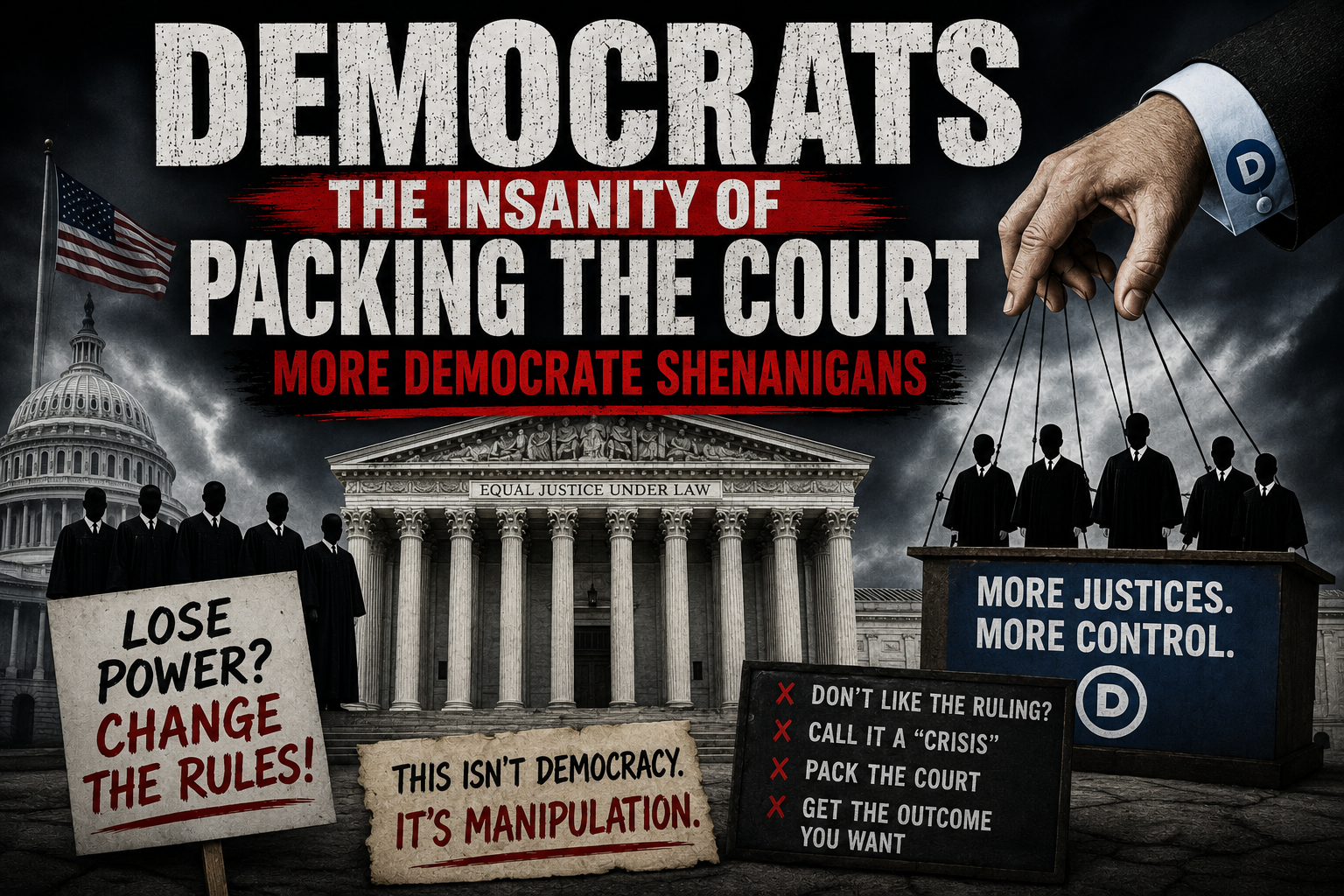
Every time Democrats lose control of an institution, a strange thing happens. Suddenly the institution is broken. Lose the Electoral College? Abolish it. Lose influence in the Senate? Make D.C. and Puerto Rico states. Lose a Supreme Court majority? Pack the Court. The pattern is not subtle. It is not reform. It is not some noble defense of democracy. It is political panic dressed up in civics-class language. Strip away the speeches, the hashtags and the academic panels and the core argument is simple: we do not like the current Court, so give us more seats. That is not democracy. That is institutional vandalism with a law degree.
The Court Is Not Broken Just Because Democrats Lost It
The Constitution does not set the number of Supreme Court justices. The Court began with six justices and the number changed several times before settling at nine in 1869. Congress has the legal power to change the size of the Court. But legality is not the same thing as wisdom. Congress also has the power to do a lot of reckless things. That does not mean it should.
The modern court-packing push is not about caseload efficiency or administrative necessity. It is about outcomes. Democrats do not like decisions on abortion, guns, religious liberty, administrative power and election law, so they want to change the scoreboard after the game has already been played. That is the shenanigan.
FDR Tried It and Even That Was Too Much
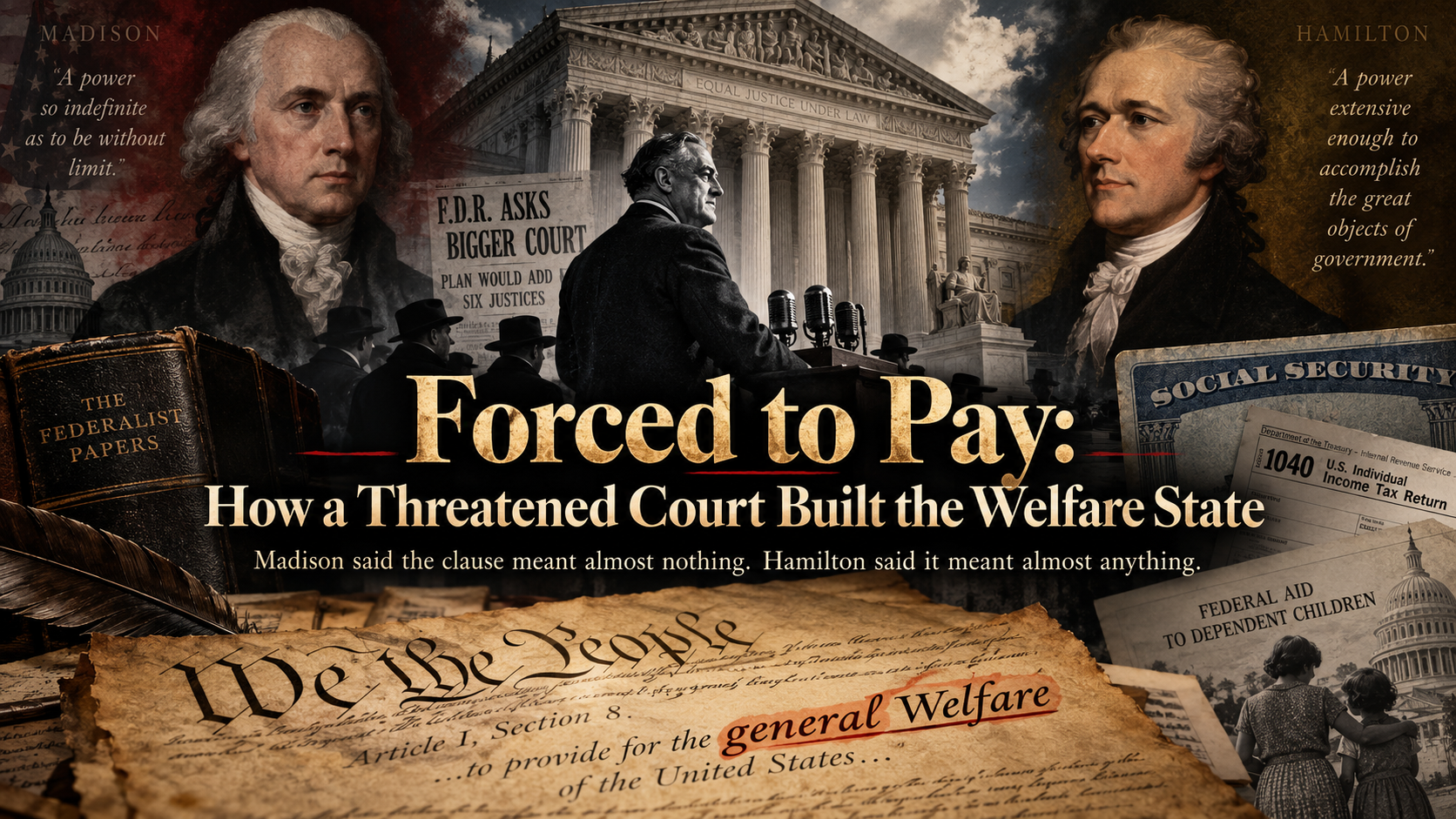
Franklin Roosevelt tried it in 1937 after the Supreme Court struck down parts of his New Deal agenda. His plan would have allowed him to add one justice for every justice over age 70, up to six additional justices. The Federal Judicial Center is direct about the motive: Roosevelt wanted to shape the ideological balance of the Court so it would stop striking down his legislation. That is court packing in its purest form.
FDR was a powerful president. He had just won a landslide election. He had enormous public support. And still, the plan was widely criticized and never enacted. Even people who supported Roosevelt's broader agenda understood the danger. Once the Court becomes just another political weapon, the referee is gone. The Court is not supposed to be a third legislative chamber. It is supposed to interpret the Constitution and law, even when doing so irritates politicians, activists and cable-news panels.
The New Version Is the Same Old Trick
Modern Democrats have revived the idea under softer language. Restore balance. Protect democracy. Reform the Court. Restore legitimacy. That sounds noble until you ask the obvious question: would they be saying any of this if the Court had a liberal majority? Of course not.
In 2023, Democratic lawmakers including Ed Markey, Elizabeth Warren, Tina Smith, Jerry Nadler, Hank Johnson, Cori Bush and Adam Schiff reintroduced legislation to expand the Supreme Court from nine justices to thirteen. The bill was openly framed as a response to the current conservative majority. That is not neutral reform. That is retaliation. They call it "restoring legitimacy." What they mean is restoring control.
The Court is legitimate when it gives them the rulings they want and illegitimate when it does not. That is childish politics dressed in constitutional language. And here is the real problem: if Democrats expand the Court from nine to thirteen, what stops Republicans from expanding it to fifteen or seventeen when they get power back? Nothing. Then Democrats expand it again. Then Republicans answer again. The Supreme Court becomes a political accordion. That is madness.
This Is About Power, Not Principle
The argument for court packing usually begins with complaints about Republicans blocking Merrick Garland in 2016 and confirming Amy Coney Barrett in 2020. Fine. Senate Republicans played hardball. They did. But hardball confirmation politics is not the same thing as permanently restructuring the Supreme Court because one side dislikes the result.
Democrats had no problem with judicial power when courts were producing outcomes they liked. For decades, liberals relied heavily on courts to settle issues that could not always be won through legislation. When the Court shifted right, suddenly judicial review became a crisis. That is not principle. That is losing. There is a difference.
The honest argument would be: "We want more progressive rulings, so we want more progressive justices." At least that would be transparent. Instead we get the usual fog machine. Translation: give us power.
Biden's Own Commission Could Not Save the Argument
President Biden created a commission in 2021 to study Supreme Court reform. It submitted its final report in December 2021, reviewing arguments for and against possible reforms including expansion. It did not deliver the grand moral commandment that activists wanted. Even a commission created under a Democratic president understood that court expansion is not a harmless tweak. It is a structural escalation that changes how every future political actor thinks about the Court.
Once the norm is broken, it does not politely reassemble itself. Political norms are like glass. Once shattered, they do not go back into the box because someone writes a nice op-ed about democracy.
Yes, the Court Has Changed Size Before. That Does Not Settle It.
The Court changed size in earlier eras for reasons tied to circuit structure, judicial administration and the development of the federal judiciary. The current push is plainly about ideological control. Using old institutional history to justify modern partisan revenge is intellectually dishonest. It is like saying people have remodeled houses before, while quietly leaving out that this particular remodel involves burning down the living room because you hate the wallpaper.
The Court's Job Is Not to Make Everyone Happy
A Court that always pleases one political side is not a Court. It is an auxiliary committee. The Supreme Court will make decisions people hate. That is built into the system. Conservatives hated plenty of liberal Court decisions. Liberals hate plenty of conservative ones. That is not proof the Court is broken. That is proof the Court is doing something other than taking daily political polling.
The answer to bad rulings is better law, better constitutional arguments, better candidates and better elections. The answer is not adding seats until the Court gives you the desired result. That is not reform. That is tampering.
The Dangerous Precedent
The most dangerous part of court packing is not the first expansion. It is the second, third and fourth. Once one party says we can add seats because the Court is too ideological, the other party gets to say the same thing later. And it will. Do not pretend otherwise. If Democrats add four justices, Republicans will eventually answer. They would be politically foolish not to. The Court would no longer have institutional stability. It would become an election prize.
America already has enough institutions that behave like partisan machinery. The Supreme Court is one of the last that still depends on some public belief that law is not merely politics by another name. Court packing would shred that belief. Once Americans conclude that justices are simply party agents wearing robes, compliance with Court decisions becomes more fragile and respect for constitutional limits weakens. That is how republics decay — not through one dramatic collapse but through endless little "reforms" that are really power grabs.
My Bottom Line
Court packing is a bad idea for the country even if it temporarily helps one party. It is not brave. It is not democratic. It is not a defense of norms. It is the destruction of a norm because Democrats do not like the current ideological math. The Supreme Court has nine justices. Democrats lost the Court through elections, retirements, Senate rules and timing. That may be frustrating. But frustration is not a constitutional crisis.
Sometimes losing is just losing. Adults do not respond to losing by changing the rules and calling it virtue.
Why This Matters
The Supreme Court is one of the last institutions that still depends on public belief that law is not simply politics by other means. Court packing would finish that off. Every major ruling would become just another partisan event. Compliance with constitutional limits would depend entirely on whether the losing side felt like complying. That is not a republic. That is a standoff. Call court packing what it is and refuse to dress it up as anything else.
References
- Federal Judicial Center. (n.d.). FDR's "Court-Packing" Plan. fjc.gov.
- Markey, E. J. (2023, May 16). Sen. Markey, Rep. Johnson announce legislation to expand Supreme Court, restore its legitimacy. United States Senate. markey.senate.gov.
- Presidential Commission on the Supreme Court of the United States. (2021, December 8). Final report. The American Presidency Project. presidency.ucsb.edu.
- Supreme Court of the United States. (n.d.). The Court as an Institution. supremecourt.gov.
Disclaimer: The views expressed in this post are opinions of the author for educational and commentary purposes only. They are not statements of fact about any individual or organization, and should not be construed as legal, medical, or financial advice. References to public figures and institutions are based on publicly available sources cited in the article. Any resemblance beyond these references is coincidental.