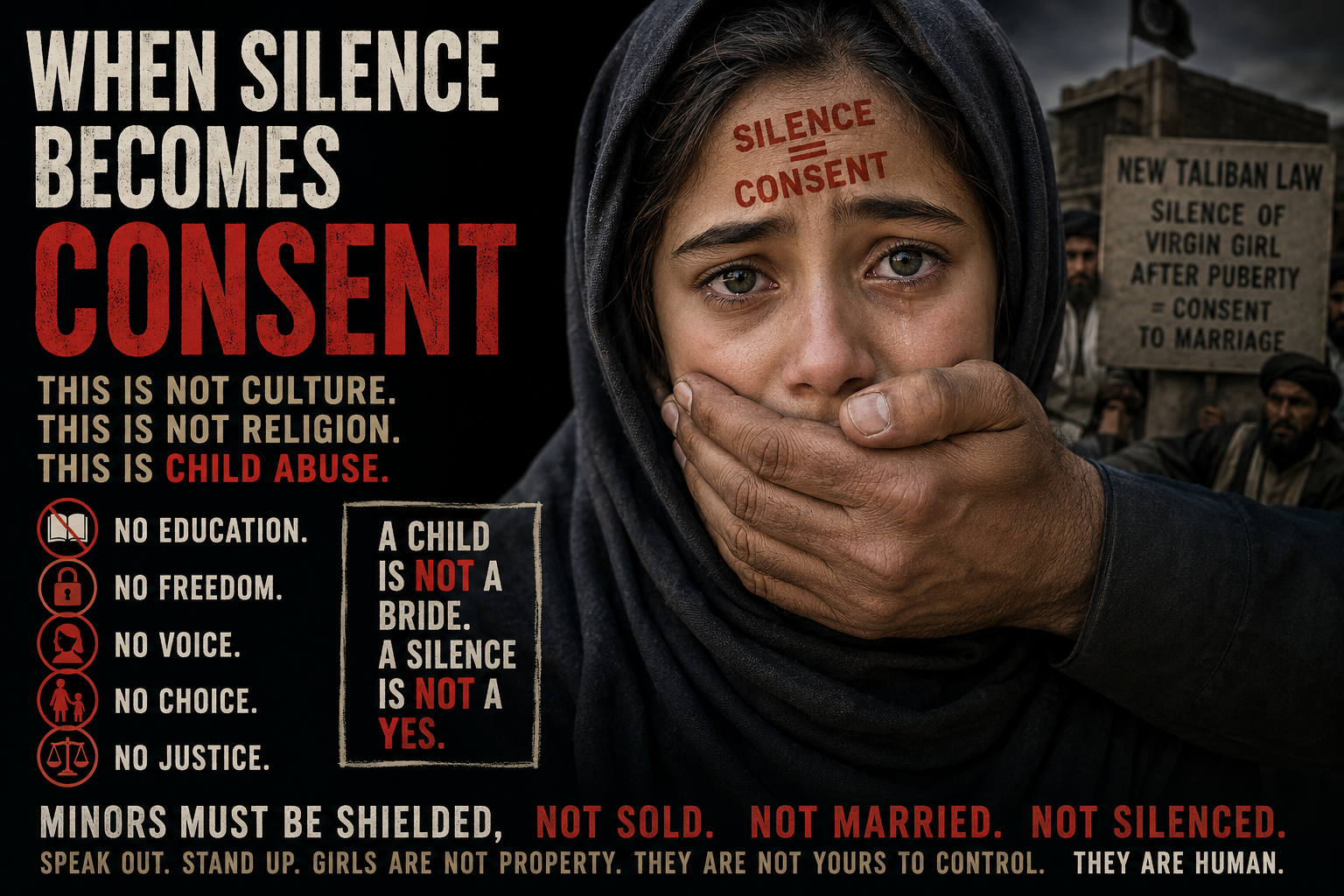
There are bad laws, there are stupid laws and then there are laws so morally warped they reveal the soul of the regime that wrote them. The Taliban's new family-rule framework reportedly allows the silence of a girl after puberty to be treated as consent to marriage. Let that settle for a moment. A girl does not have to say yes. She does not even have to speak. Her silence can be used against her. Fathers and grandfathers are given broad authority over child marriages under the same framework, and girls married young may have to seek annulment through Taliban courts after puberty. That is not family law. That is legalized predation wrapped in religious language.
This Is Not Consent
Consent is not silence. Consent is not fear. Consent is not obedience to a father, a grandfather, a judge or a cleric. Consent is a clear, voluntary, informed yes from someone old enough and free enough to give it. A minor cannot meaningfully consent to marriage with an adult, especially in a society where girls are already stripped of schooling, movement, public life and legal independence.
The Taliban knows this. That is why the rule is written the way it is. A girl's actual voice is too dangerous to them. So they replace it with silence and then pretend the silence means agreement. That is the kind of legal fiction cowards construct when they want power without accountability.
Child Marriage Is Child Molestation With Paperwork
Polite language is part of how evil gets laundered, so let us be direct. When a minor is married off to an adult, we are not talking about romance or a meaningful family arrangement. We are talking about a child placed into sexual access, domestic control and lifelong dependence before she is old enough to understand the bargain being forced on her.
That is child molestation with paperwork. That is abuse with witnesses. That is trafficking dressed up as tradition. No civilized society should hesitate on this point. Minors deserve protection, not courts that ask whether their silence was sufficient consent.
Islamism Is Not Just "Another Religion" When It Becomes Government Power
A private religious belief is one thing. A family going to mosque is not the same as a theocratic regime using religious law to control women, punish dissent and erase childhood. Taliban Islamism is not simply faith. It is faith fused with state power, armed men, courts, punishments and social control. That makes it categorically different from religion as personal conscience. The cleric, the judge and the gunman all speak with the same voice.
That is why the usual soft language fails here. This is not cultural difference. This is not traditional family structure. This is not their way of life. It is the state taking a girl's silence and converting it into permission. A government that can do that deserves condemnation in the plainest possible terms, and the people with the loudest moral platforms have an obligation to use them.
The issue is not ordinary Muslims. Millions of Muslims reject this barbarism. The issue is a regime using Islam as a legal weapon against girls who have not yet learned to read.
The Pope's Convenient Silence
Pope Francis has demonstrated, repeatedly and without apparent hesitation, that he is willing to step directly into Western political controversy. He has criticized Donald Trump's immigration policies publicly and by name. He has called mass deportations a disgrace and compared restrictive border enforcement to actions historically associated with Nazism. He has weighed in on American economic inequality, climate policy, gun culture and the tone of political discourse. He has spoken about the dangers of nationalism and populism in terms that leave little doubt about which political movements he has in mind. The man has opinions, and he shares them freely when the target is sufficiently Western.
Pope Francis called Trump's mass deportation plans "a shame" and "a disgrace." He has spoken about the moral failures of Western immigration enforcement in language that generates international headlines. He has invoked the Gospel to criticize specific American policy choices by specific American leaders. He has described certain political approaches as contrary to the dignity of the human person. He is not, by any reasonable measure, a leader who avoids controversy or fears the consequences of speaking plainly about power.
Which makes his near-total silence on the Taliban's systematic erasure of girls from public life all the more striking. The Taliban has banned girls from school beyond sixth grade. It has prohibited women from universities, from most employment, from appearing in public without a male guardian, from speaking loudly enough to be heard by strangers and now, under the new family-law framework, from having their actual spoken consent required before marriage. This is one of the most comprehensive and documented campaigns against the human dignity of women and girls in the world today. The Pope, who leads a church of 1.4 billion people and who speaks regularly about the preferential option for the poor and the vulnerable, has not made it a central moral priority.
There is no shortage of Vatican statements condemning abstract evils. There is a conspicuous shortage of the kind of direct, personal, named condemnation that Francis applies so readily to Western political figures. The disparity is not subtle. It is not accidental. And it deserves to be named for what it is: moral selectivity in service of a political posture.
Pope Francis does not claim to speak only on spiritual matters. He has explicitly entered political debate on immigration, economics, climate, nationalism and democratic norms. Having claimed that authority, he cannot then retreat to spiritual neutrality when the abusers are not Western and not conservative. The girls in Afghanistan are exactly the vulnerable people his stated theology demands he defend. His relative silence on their condition, while maintaining a running commentary on American political life, is a moral failure proportionate to his platform.
The Pattern Was Always Clear
This did not come from nowhere. First the Taliban told girls they could not go to school beyond certain grades. Then women were removed from universities. Then from most work, then from public life, then from freedom of movement. Then morality rules tightened. Now comes control over marriage, consent and the body itself. Remove education. Remove independence. Remove income. Remove movement. Remove voice. Then call the silence consent. That is not a justice system. That is a cage built in stages so the world could pretend each stage was an isolated policy dispute rather than a coordinated campaign of total subjugation.
The West Needs Its Moral Clarity Back
The West has developed a bad habit of becoming tongue-tied whenever abuse hides behind religion, culture or anti-colonial rhetoric. We can criticize Christian nationalism, cult abuse, forced marriage in fundamentalist communities and institutional cover-ups in the Catholic Church without hesitation. The same directness should apply when the abuse comes from Islamist theocracy. Moral consistency is not bigotry. It is the minimum requirement for moral credibility.
When a government says a girl's silence can count as consent, decent people do not need a seminar on cultural sensitivity. They need to say clearly that this is wrong, that it will always be wrong and that no religious framework — no matter how sincerely held — makes it otherwise. The Pope understands this standard when the subject is American border enforcement. He should apply it with equal force when the subject is a girl in Kabul who was never asked anything at all.
My Bottom Line
A society that cannot protect children from sexual control by adults has failed at the most basic moral level. A regime that writes that failure into law and calls it consent deserves condemnation without apology or qualification. And a moral leader who reserves his sharpest language for Western political disputes while offering measured silence on the systematic destruction of girlhood in Afghanistan has revealed something important about where his moral priorities actually lie.
The Taliban did not just attack women's rights. It attacked childhood itself. That is the statement that should be coming from every pulpit, every parliament and every platform with the reach and standing to make it matter.
When a girl's silence can be called consent, civilization has a problem. When the people with the largest moral platforms stay quiet about it while loudly criticizing politicians they dislike, civilization has a hypocrisy problem on top of the first one.
Why This Matters
Language shapes the fight. If we call this controversial family law, we make it sound like a policy dispute. If we call it traditional marriage practice, we make it sound quaint. If we call it religious custom, we hand predators a shield. Call it what it is: state-enabled child exploitation, the legal erasure of girls and a regime making sure that even when a girl says nothing, men in power can still claim she agreed. The silence of the powerful in the face of that is not neutrality. It is a choice — and choices have consequences, including for the moral authority of the people who make them.
References
- Amu TV. (2026). Reporting on Taliban family-law regulation and provisions concerning marriage, annulment and consent.
- NDTV. (2026, May 17). New Taliban law says "silence of virgin girl" counts as consent for marriage.
- The Week. (2026, May 17). Afghanistan: Under new Taliban rules, "silence of a virgin girl" can signal marriage consent.
- Reuters. (2025). Pope Francis calls Trump deportation plan "a disgrace."
- Associated Press. (2025). Pope Francis criticizes mass deportations, compares to historical atrocities.
- Vatican News. (2025). Pope Francis statements on immigration, nationalism and political discourse. vaticannews.va.
Disclaimer: The views expressed in this post are the personal opinions of the author and are offered for educational, commentary and public discourse purposes only. They do not represent the positions of any institution, employer, organization or affiliated entity. Nothing in this post constitutes legal, financial, medical or professional advice of any kind. References to public figures, institutions, historical events and current affairs are based on publicly available sources and are intended to support analysis and argument, not to state facts about any individual's character, intent or conduct beyond what the cited sources support. Commentary on religious, political and cultural subjects reflects the author's independent analysis and is protected expression of opinion. Readers are encouraged to consult primary sources and form their own conclusions. Any resemblance to specific individuals or situations beyond those explicitly referenced is coincidental.