- Part 1 — Why Church and State Must Stay Separate (this post)
- Part 2 — Suppression of Rivals After 380: When Imperial Backing Ended the Debate
- Part 3 — Holy War and Mob Slaughter: The Crusades in Full
- Part 4 — The Inquisitions: Torture, Fear and the Architecture of Heresy Control
- Part 5 — Forced Conversion and Expulsion: Spain, Goa and the Colonial World
- Part 6 — The Witch Hunts: Christian Europe's Ugliest Moral Panic
- Part 7 — Colonial Brutality Under a Christian Banner
- Part 8 — Christian-on-Christian Violence: The Confessional Wars
- Part 9 — Moral Cover for Slavery
- Part 10 — Resistance to Modern Liberties: Institutional Christianity vs. the Enlightenment
A Christian can believe Christ is Lord. A Muslim can believe the Quran is the final revelation. A Jew can believe the Torah is sacred. An atheist can believe all of that is man-made mythology. In a free country, all of them get to hold those views, argue for them, build communities around them and live by them. What none of them gets to do is use the state to force everybody else to live under doctrines built on unproved supernatural claims. That is not hatred of religion. That is civic self-defense. The American principle of separation between church and state is not some technical legal quirk invented by hostile secularists. It is one of the few lessons history has taught with enough blood to count as settled. Once religion gets a long enough leash, it does not merely ask for respect. It starts asking for compliance. Then privilege. Then immunity. Then control. The pattern is old. It is consistent across traditions. And it is repeating.
The Shared Political Danger
Christianity and Islam are not the same religion. Their theology is different, their internal diversity is real and their histories are not interchangeable. A scholar of either would rightly object to any attempt to flatten two thousand years of distinct development into a single category. But they share one political danger that deserves naming directly: each contains truth claims that are universal, exclusive and missionary in spirit. Each has deep traditions telling believers that ultimate truth is not local, private or optional. It is binding. It applies to everyone whether they consent to it or not. That conviction, when held privately, is harmless. When organized into political power, it becomes something else entirely.
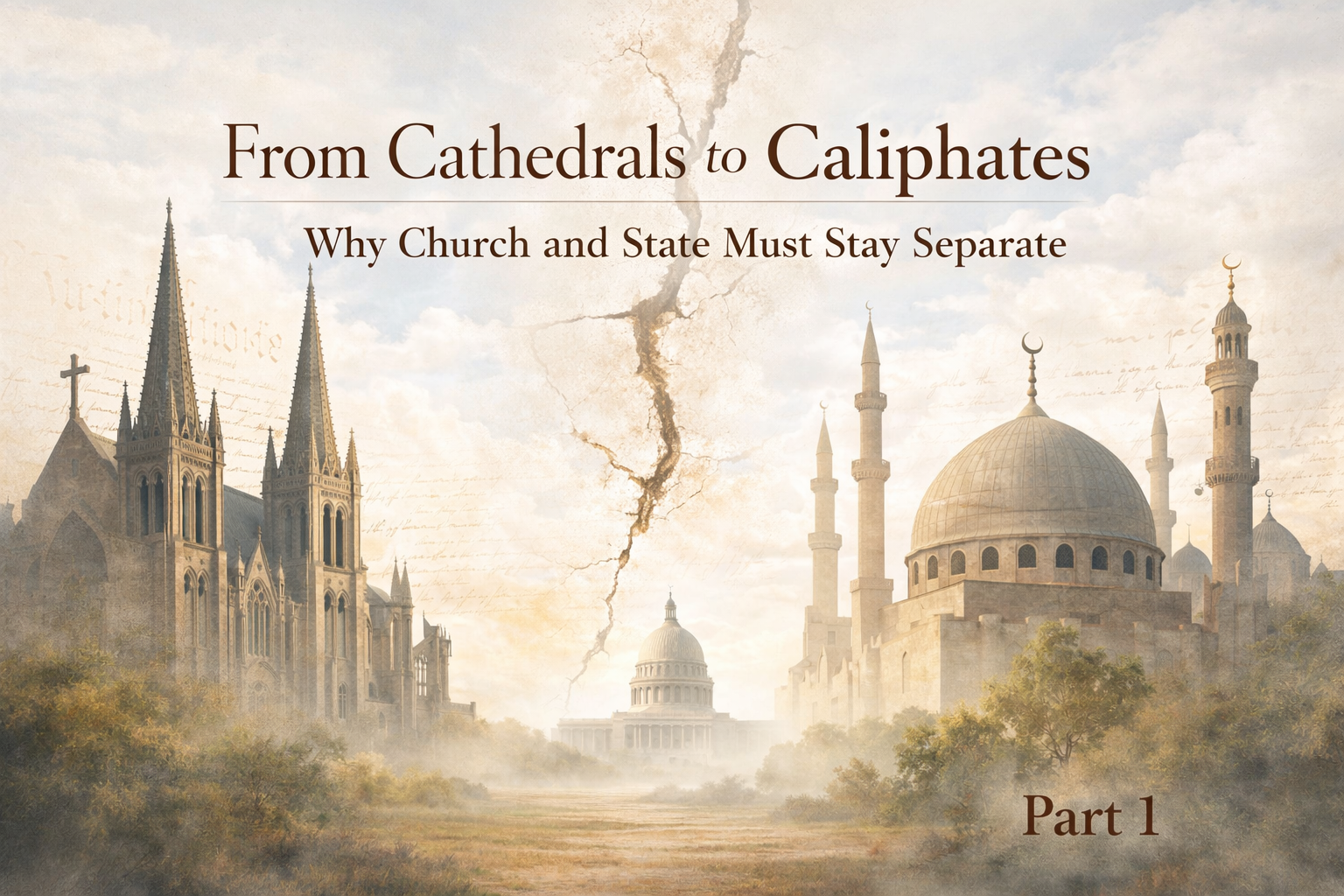
The issue is not whether every Christian or every Muslim wants theocracy. Most do not. The issue is what these religions have repeatedly shown they are capable of producing when fused with state authority, social panic or ideological zeal. Christianity in power gave Europe inquisitions, persecution, censorship, blasphemy laws, forced conversions and moral policing that controlled daily life for centuries. Islam in power has repeatedly produced state religious enforcement, apostasy punishments, blasphemy punishments, restrictions on women and repression of dissent across different places and periods. You can argue about degree, era, geography and denomination. You cannot honestly argue that the pattern is imaginary. The title of this post is not rhetorical. From cathedrals to caliphates, the infrastructure is different. The impulse is the same.
Once people think they possess the final truth handed down by God, compromise starts to look like cowardice and dissent starts to look like rebellion against heaven. That is not a theology problem. It is a power problem.
The Pattern Shows Up Early: 380 AD
If people think concern about religious power is some modern overreaction, they should look at what happened after 380 AD when Emperor Theodosius I made Nicene Christianity the official religion of the Roman Empire. That was one of the great turning points in Western history and it is worth sitting with in some detail, because it illustrates how fast the dynamic changes once a religion acquires state backing.
Christianity had spent its first three centuries as a persecuted faith. Believers were intermittently harassed, imprisoned and killed for refusing to honor the state gods. That history of suffering shaped Christian identity profoundly and produced much of its moral and theological depth. Then the situation reversed. Constantine extended tolerance to Christians in 313 AD. By 380 AD under Theodosius, Nicene Christianity was not merely tolerated. It was the official religion of the Roman state. And what happened next is the part modern Christians who romanticize state-backed faith tend to skip over.
Pagan worship was increasingly restricted. Temples were closed, stripped of valuables or destroyed. Religious sacrifice was banned. Rival Christian sects that had existed for generations were pushed out, condemned as heretical and in some cases punished. What had once been theological argument became enforcement. What had once been persuasion became policy. The state was no longer merely coexisting with Christianity. It was actively helping Christianity dominate. And in doing so, it was doing what powerful truth systems so often do when they get access to force: they stop asking and start requiring.
People lost the freedom to practice older religions openly. The Altar of Victory, a symbol of Roman civic religion that had stood in the Senate for centuries, was removed. Dissenters were no longer merely disagreed with. Christians who held theologically incorrect views were increasingly treated as enemies of social order rather than simply as people who got the doctrine wrong. The Nicene Creed was not just true according to the church. It was now enforceable by the state. Deviation from orthodoxy had always been theologically dangerous. After Theodosius it became politically dangerous as well. That shift from argument to enforcement is the critical one. It is the moment the history of Christian freedom ends and the history of Christian power begins. The two are not the same thing and the people who lived through that transition understood the difference.
Islam Followed the Same Path
The Islamic world offers parallel history with different geography and different centuries. The early Muslim community under Muhammad in Medina was a political as well as religious entity from the beginning, which distinguishes it structurally from early Christianity. But the relevant pattern for this argument is what happened as Islamic governance expanded and matured. The classical caliphate was not merely a political administration that happened to be run by Muslims. It was a theocratic state in which Islamic law governed civil and criminal matters, in which apostasy from Islam carried the death penalty in many interpretations, in which non-Muslim subjects paid a special tax and occupied a legally subordinate status and in which the distinction between religious and civil authority was explicitly collapsed by design.
Contemporary examples are not hard to find. Iran under the Islamic Republic executes people for apostasy, criminalizes blasphemy, requires women to comply with religious dress codes enforced by state police and bases its constitutional structure on the concept of velayat-e faqih, governance by the Islamic jurist. Saudi Arabia maintains a religious police force, restricts public worship by non-Muslims and until recently prohibited women from driving under a religiously justified legal framework. These are not medieval curiosities. They are operating governments in 2026. The argument that Islamic governance in power tends toward theocratic enforcement is not Islamophobia. It is a description of governments that describe themselves in exactly those terms.
The point is not that Islam is uniquely dangerous or uniquely prone to theocracy. Christianity produced equivalent systems when it held equivalent power. The point is that both traditions contain the theological and organizational raw material for exactly this kind of fusion, and history shows that raw material gets used when the opportunity presents itself. The modern secular state is the response to that historical observation, not an attack on the faiths themselves.
How Erosion Actually Happens
The erosion of secular governance rarely begins with a full theocracy. Nobody declares a religious state and hands over the legal code to a council of clerics in a single announcement. It happens the way all serious institutional damage happens: gradually, through steps that each seem manageable in isolation. A little more religious language in public authority. A little more pressure to treat one faith as culturally native and others as tolerated guests. A little more demand that law reflect biblical values or God's design or the moral traditions of the nation's founding faith. It is always sold as harmless restoration rather than dangerous innovation. It rarely stays that way.
The contemporary American example is not hard to see. In 2022 the Supreme Court ruled in Kennedy v. Bremerton School District that a public school football coach had a First Amendment right to pray on the field after games. The decision was narrow. The cultural signal was not. Within months school officials across several states interpreted it as permission to reintroduce organized prayer into public school settings. That is the mechanism in real time: a legal decision with modest scope gets read as cultural authorization for a broader advance. Each individual step looks defensible. The cumulative direction is unmistakable. Slow erosion is harder to resist than a sudden assault precisely because it never arrives with a clear moment of decision. By the time the pattern is visible, the institutions that might have pushed back have already been reshaped.
Religion Is Not Harmless Once It Becomes Law
People often talk about religion as though it is harmless unless it becomes physically violent. That framing is too narrow by a long distance. A religion can damage freedom long before it lights a pyre or swings a sword. Once it influences law it can regulate marriage, speech, education, medical choices, sex, gender roles, reproductive autonomy, artistic expression, scientific teaching and the social status of outsiders. It can divide people into the normal and the deviant without a single act of violence. It can make dissent feel dirty. It can brand unbelief as moral defect. It can produce conformity through social pressure, legal disadvantage and institutional exclusion long before it produces persecution in the traditional sense. None of that requires a dungeon to matter. The person who loses their job because they do not attend the right church, the student whose textbook has been sanitized to conform to one tradition's cosmology, the couple whose marriage is not recognized because it offends a religious majority - none of them has been imprisoned. All of them have lost something real.
And once a faith becomes politically flattered, criticism of it gets treated as cruelty while criticism from it gets treated as moral leadership. That double standard is one of the first signs that secular ground is being lost. When a religious leader makes political pronouncements, he is exercising prophetic authority. When a secular observer responds with historical or empirical argument, he is being hostile to faith. That asymmetry is not accidental. It is designed to make one side of the argument appear to operate from principle while the other appears to operate from malice. Identifying it is not cynicism. It is pattern recognition.
Separation of church and state is not an attack on religion. It is the rule that keeps religious disagreement from turning into political domination. Every tradition benefits from it, including the ones that currently think they do not need it.
This Is Not Hatred of Believers
Religious people hear this argument and often translate it into prejudice. That is either honest confusion or a rhetorical dodge. Criticizing a doctrine is not the same thing as attacking the people who hold it. Opposing prayer in public schools as state policy is not hatred of Christians. Opposing sharia-inspired civil restrictions is not hatred of Muslims. Opposing public policy built from biblical sexual ethics is not hatred of believers. It is opposition to privilege, and that opposition applies equally regardless of which tradition is seeking the privilege.
The secular citizen is not saying believers should shut up, disappear or lose their private rights. The secular position is much simpler. Your religion is yours. It is not mine. It is not the government's. It is not the country's operating manual. You are free to preach it, teach it, practice it and organize around it. You are not free to launder it through law and call that neutrality. The First Amendment bars laws respecting an establishment of religion while protecting free exercise - not because the Founders hated faith but because a government that can establish one religion can punish another. That wall is there for everybody, including the traditions that currently think they do not need it.
My Bottom Line
I do not care how fashionable religion becomes in politics. I do not care how many candidates suddenly discover God on campaign stops. I do not care how often people say the country needs to return to faith. That is not the government's job. The government's job is not to ratify supernatural claims. It is not to choose among scriptures. It is not to prefer believers to unbelievers. It is not to turn doctrine into policy because enough people call it sacred.
The reason to resist that is not hostility to faith. It is memory. Christianity and Islam, in different ways and different eras, have both demonstrated what happens when people convinced they speak for God are given too much room to govern other people's lives. The historical record is not ambiguous on this point. It is extensive, documented and consistent across centuries and continents. The answer is not to ban religion or drive it from public life. Religious belief is a permanent feature of human existence and it produces genuine goods - community, meaning, moral seriousness and the kind of personal courage that has nothing to do with politics. The answer is to keep religion out of the driver's seat of government, where it has repeatedly shown it cannot resist the temptation to make the road its own.
A country with many faiths and no faith cannot stay free if government starts acting like one religion is more authentic, more moral or more entitled to shape public life than everyone else. The cathedrals and the caliphates have different aesthetics and different scriptures. They produce the same result when given the same authority. That is the lesson. It is old. It keeps needing to be repeated.
The wall between church and state is not there because religion is evil. It is there because power is. And power does not become less dangerous because it believes it is holy.
References
- First Amendment, U.S. Constitution. Constitution Annotated, Library of Congress.
- Madison, J. (1785). Memorial and Remonstrance Against Religious Assessments. Virginia General Assembly.
- Theodosius I. (380 AD). Edict of Thessalonica (Cunctos populos). Codex Theodosianus 16.1.2.
- Pew Research Center. (2022). Christianity's place in politics and Christian nationalism.
- Pew Research Center. (2020). Comparing levels of religious nationalism around the world.
- Freedom House. (2025). Iran: Freedom in the World 2025. freedomhouse.org.
- U.S. Department of State. (2024). 2023 Report on International Religious Freedom: Iran.
- U.S. Department of State. (2024). 2023 Report on International Religious Freedom: Saudi Arabia.
- Gibbon, E. (1776). The History of the Decline and Fall of the Roman Empire, Vols. I-VI. Strahan and Cadell.
- Nixey, C. (2017). The Darkening Age: The Christian Destruction of the Classical World. Macmillan.
- Dreisbach, D. L. (2002). Thomas Jefferson and the Wall of Separation Between Church and State. New York University Press.
Disclaimer: The views expressed in this post are the personal opinions of the author and are offered for educational, commentary and public discourse purposes only. They do not represent the positions of any institution, employer, organization or affiliated entity. Nothing in this post constitutes legal, financial, medical or professional advice of any kind. References to historical events, government reports, academic scholarship and current affairs are based on publicly available sources cited above and are intended to support analysis and argument. This post critiques the fusion of religious authority and governmental power across historical and contemporary contexts. It does not make claims about individual believers or assert that any religious tradition is inherently violent or malicious. Commentary on religious and political subjects reflects the author's independent analysis and is protected expression of opinion. Readers are encouraged to consult primary sources and form their own conclusions.