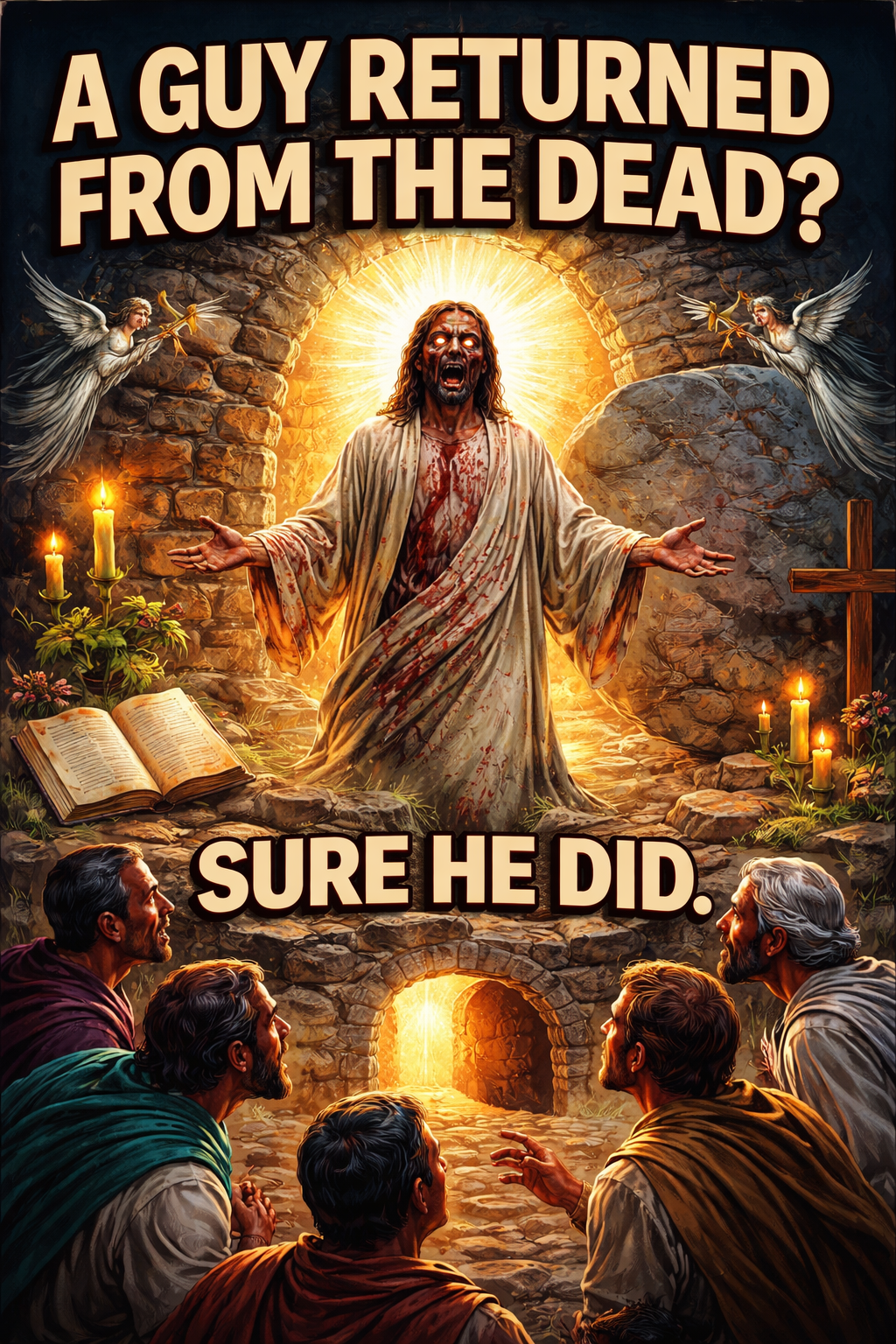
Christianity stands or falls on one central claim: that Jesus of Nazareth, after being crucified and buried, physically rose from the dead. Strip that away and the religion changes completely. What remains is not orthodox Christianity. What remains is the memory of a Jewish preacher, an executed teacher, a moral voice, perhaps even an apocalyptic prophet whose death had to be explained by followers too emotionally and spiritually invested to accept defeat. That is not a minor adjustment. That is the difference between miracle and memorial. Christians know this, even if many do not like saying it bluntly. Paul himself wrote that if Christ has not been raised, the faith is vain. The resurrection is not decorative. It is the hinge on which the whole thing swings. It is the claim that turns a dead reformer into the divine savior of the world. Which is why the usual treatment of this subject is so maddening.
When skeptics question the resurrection, believers often act as though something sacred has been attacked and therefore reason should lower its voice, remove its shoes and walk gently around the doctrine. No. If a religion asks the world to believe that a dead man came back to life, exited a tomb and appeared to followers who then declared him divine, that religion is asking for the most extraordinary historical exception imaginable. It does not get gentler scrutiny because the claim is holy. It gets harsher scrutiny because the claim is radical. And under that scrutiny, the resurrection does not hold. It survives only if people grant it a kind of special immunity they would never grant to miracle stories from other religions, other centuries or other desperate followers of other failed prophets.
People Confuse Emotional Power with Historical Credibility
The resurrection story is powerful. It is emotionally effective for obvious reasons. It tells human beings exactly what they most want to hear: that death is not final, injustice does not win, loss can be reversed and hope can break into history at the darkest possible moment. Of course that story endured. Of course people cling to it. It reaches directly into fear, grief and longing. But emotional usefulness is not evidence. That is one of the oldest mistakes in religion. A claim becomes psychologically satisfying, socially central and morally meaningful, and then people quietly start treating those features as though they somehow count as proof. They do not. A comforting story can be false. A civilizational story can be false. A story that produces cathedrals, hymns, paintings, moral reflection and lifelong devotion can still be false as history.
Human beings are deeply vulnerable to meaningful fiction. We love narratives that redeem suffering. We love stories in which the humiliated are vindicated, the bloodied are glorified and the grave is denied the final word. That tells you something important about human psychology. It does not tell you the event happened. This is where believers usually retreat into a fog of reverence. They stop arguing historically and start speaking devotionally. They say the story has transformed lives. Fine - so have many religious stories. They say billions have believed it. Fine - billions have believed all sorts of things. They say Christianity changed the world. Yes, it did. That has nothing to do with whether a corpse got up and walked. Influence is not evidence. Beauty is not evidence. Need is not evidence. Repetition is not evidence. Tradition is not evidence.
The resurrection is protected not by evidence but by familiarity. Put the same structure anywhere else and most people would laugh it out of the room. That is the point.
The Accounts Do Not Read Like Clean History
Once people move beyond stained-glass impressions and actually read the texts closely, the problem becomes obvious. The New Testament does not give us one clean, straightforward account of what happened after Jesus died. It gives several versions, written later, shaped theologically and differing in ways that matter. Who went to the tomb? What did they see? Was there one angel or two? Did the women tell anyone immediately or say nothing because they were afraid? Did Jesus first appear near Jerusalem or in Galilee? Was the ascension folded into the same day or separated in time? These are not trivial details if the event in question is supposedly the single most important miracle in human history.
Christian apologetics responds by insisting the contradictions are really just complementary witness perspectives. The stories differ, therefore they must be authentic. But that argument only works if the differences are minor and the core event is independently secure. Here, the differences show something else: the tradition was developing, being shaped, expanded and retold according to each author's theological needs. That is exactly what one would expect from a religious movement constructing identity around a dead leader whose death was a traumatic public failure. Mark, likely the earliest Gospel, ends awkwardly and abruptly with fear and an empty tomb. Later manuscript traditions tack on a longer ending because the earlier ending felt incomplete. Matthew adds drama and authority. Luke reshapes geography and sequence. John gives long, highly theological scenes that read less like bare recollection and more like mature spiritual storytelling. This is not how strong, stable eyewitness reporting looks. It is how tradition behaves as it hardens into doctrine.
The earliest Christian material comes from Paul, not from the later Gospel narratives. Paul is important because he takes us closer to the origins of the movement. But what does Paul actually give us? He gives proclamation. He gives theological conviction. He gives a tradition that Christ died, was buried, was raised and appeared. He gives belief language, not investigative reporting. And Paul's own encounter with the risen Jesus is not described as him casually bumping into a resuscitated man on a roadside. It is visionary, revelatory and wrapped in religious experience language. If the earliest major Christian witness is rooted in revelation rather than physical encounter, that points away from courtroom-grade historical verification and toward the kind of religious experience that launches movements. People have visions. People have grief experiences. People in tightly bonded spiritual groups reinforce one another's convictions. None of that proves fraud. It does not need to. Ordinary human psychology does plenty of work here without any supernatural intervention required.
The Empty Tomb Is Not the Slam Dunk Believers Pretend It Is
The empty tomb has become the apologetic centerpiece because it sounds concrete. A vision can be dismissed. A transformed heart proves nothing. But an empty grave sounds like hard evidence. The problem is that the case for the empty tomb is nowhere near as strong as Christians pretend. The stories appear in texts written decades after the fact, by unknown authors, in a highly theological environment. The accounts differ. The earliest Christian preaching emphasized resurrection but does not dwell on the empty tomb the way later believers do. And even if a tomb were found empty, an empty tomb by itself does not prove resurrection. It proves only absence. Absence has many possible explanations - wrong tomb, reburial, theft, loss, legend development, narrative invention, symbolic storytelling. We do not know because we do not have the kind of evidence that would let honest people know.
Yet apologists take the empty tomb and run directly to miracle as though no other explanation is available. That is not reasoning. That is a leap powered by doctrinal desire. Consider the logic. Christians want the world to believe that the creator of the cosmos suspended the ordinary finality of death in first-century Roman Judea, then left behind records so messy and contradictory that two thousand years later believers still spend endless energy harmonizing them. If God wanted this event to function as the decisive proof of Christianity for all humanity, the evidentiary package is strangely weak. Not subtly weak. Blatantly weak. An omnipotent deity could have done better than disputed texts, missing bodies, secondhand testimony and theological embellishment. That does not look like a universal revelation. It looks like legend attached to belief.
The Double Standard That Runs Through Every Defense
The word miracle is constantly used as though it answers the objection. It does not. It simply labels the event in religious terms while leaving the evidence question entirely untouched. To say it was a miracle is not to show that it happened. It is to declare the interpretation you prefer if it happened. That is a very different thing. Dead people do not come back to life after being fully dead. That is one of the most stable observations in human experience. Anyone claiming otherwise shoulders a massive burden. The burden is not met by ancient texts alone, especially when those texts come from committed insiders writing in a culture already comfortable with divine signs, supernatural claims and theological storytelling.
Christians often get annoyed when skeptics apply ordinary standards to the resurrection. But ordinary standards are exactly what matter. If someone today claimed a dead cult leader had risen and appeared to followers, would Christians accept it on the basis of internal testimonies written by believers decades later? Of course not. They would ask whether the followers were grieving, mistaken, credulous or psychologically primed to interpret experiences in religious ways. In other words, they would use the very skepticism they suspend when it comes to their own miracle. That double standard is the whole game. Every religion wants special treatment for its own sacred claims. Every religion thinks its own miracles are the exception. Once you see that pattern, the resurrection stops looking like a unique historical triumph and starts looking like the familiar self-certainty of religious tribalism.
Rejecting a miracle claim is not rejecting hope. It is rejecting the attempt to convert theology into public fact without meeting the burden that real facts require.
The Resurrection Makes Perfect Sense as Myth
People hear the word myth and instantly treat it as an insult. They should grow out of that. Myth does not mean worthless. Myth means a meaning-rich narrative that carries a culture's deepest fears, hopes, values and identity. It does not need to be factual to be potent. In fact its power often depends on the opposite. The resurrection is myth in the strongest sense of the word. It answers death with vindication. It turns shame into glory. It tells the faithful that earthly defeat is not ultimate. It reorders the moral imagination so that what looked like collapse is actually the doorway to triumph. That is mythic architecture, and it is strong mythic architecture. It worked magnificently. A crushed movement became a global religion. An execution became atonement. A dead preacher became the risen Lord of history.
But effectiveness is not evidence. A story can be historically false and still civilizationally explosive. The resurrection did exactly what a myth of redemptive reversal is supposed to do. It kept the movement alive. It resolved the humiliation of the cross. It provided cosmic meaning where there had been public disaster. It made loyalty possible after catastrophe. It did not spread because skeptics were vanquished by airtight evidence. It spread because human beings are vulnerable to redemptive narrative, especially when that narrative arrives wrapped in community, ritual, suffering and promised eternity.
My Bottom Line
People are free to believe whatever they want privately. If a Christian finds comfort, beauty and moral purpose in the resurrection story, that is his business. The problem begins when believers insist that everyone else must treat the claim as historical knowledge rather than theological commitment. That is where religion stops asking for freedom and starts asking for privilege. A secular society should protect the right of Christians to celebrate Easter, preach the resurrection and organize church life around it. It should not pretend the story has met the standards of public evidence. It should not let miracle claims stroll into history class wearing a fake mustache and a nametag that says fact.
The resurrection of Jesus is one of the most influential stories ever told. It is emotionally powerful, culturally central and theologically indispensable to Christianity. But none of that makes it good history. The accounts are inconsistent. The sources are late and partisan. The earliest testimony shows conviction, not verification. The empty tomb is nowhere near the decisive proof believers pretend it is. The psychological and social mechanisms that could generate resurrection belief are entirely understandable without any supernatural event. And the story itself functions exactly the way powerful myth tends to function: by transforming catastrophe into meaning. That is why I do not buy it. Not because I am hostile to hope. Not because I lack reverence for the emotional life of believers. I do not buy it because a dead man returning to life is an extraordinary claim, and the evidence offered does not come remotely close to carrying that burden.
Christians are free to believe it by faith. What they are not free to do is pretend disbelief is irrational. It is not irrational to reject miracle claims that rest on old texts, contradictory narratives and theological need. That is not cynicism. That is intellectual self-respect.
Once sacred claims are given a free pass because they are old, beloved or socially dominant, evidence itself starts to erode. A story can move you, shape you and inspire you and still not be true in the literal sense. The moment society loses the courage to say that, reason becomes a servant of nostalgia.
References
- The Holy Bible, 1 Corinthians 15; Matthew 28; Mark 16; Luke 24; John 20-21.
- Ehrman, B. D. (2014). How Jesus Became God: The Exaltation of a Jewish Preacher from Galilee. HarperOne.
- Ludemann, G. (1994). The Resurrection of Jesus: History, Experience, Theology. Fortress Press.
- Hume, D. (1748). An Enquiry Concerning Human Understanding, Section X: Of Miracles. A. Millar.
- Carrier, R. (2014). On the Historicity of Jesus: Why We Might Have Reason for Doubt. Sheffield Phoenix Press.
- Martin, M. (1991). The Case Against Christianity. Temple University Press.
Disclaimer: The views expressed in this post are the personal opinions of the author and are offered for educational, commentary and public discourse purposes only. They do not represent the positions of any institution, employer, organization or affiliated entity. Nothing in this post constitutes legal, financial, medical or professional advice of any kind. References to religious texts, historical scholarship and philosophical works are based on publicly available sources cited above and are intended to support analysis and argument. This post expresses skepticism about specific historical claims and does not constitute an attack on individual believers or religious communities. Commentary on religious and philosophical subjects reflects the author's independent analysis and is protected expression of opinion. Readers are encouraged to consult primary sources and form their own conclusions.