House Speaker Mike Johnson stood at the 2026 National Catholic Prayer Breakfast and told the room that separation of church and state is one of the most misunderstood issues in American society. He said the phrase does not appear in the Constitution. He said Jefferson only meant to protect religion from government, not the other way around. He urged America to return to prayer and rededicate itself to the founders' vision. He said it with confidence. He said it as a former constitutional law professor. And he was wrong — not ambiguously wrong, not debatably wrong, but wrong in ways the founders documented in their own handwriting, which is still publicly available to anyone willing to read it.
This is not a close call. This is not a matter of competing interpretations that reasonable people can weigh. The founders were not subtle about this. They were emphatic, detailed and alarmed by the exact argument Johnson is making — that government and religious authority belong together, that moral virtue requires religious influence in public life, and that the wall Jefferson described was really just a one-way door. They built the wall specifically to stop that reasoning. Johnson has the receipts in his own face and is calling them forgeries.
Johnson's Actual Argument
Johnson's position has two parts. First, the phrase "separation of church and state" does not appear in the Constitution — it appears in Jefferson's 1802 letter to the Danbury Baptist Association. Second, Jefferson intended the wall to run only one direction: protecting the church from government encroachment, not keeping religious principles out of governance.
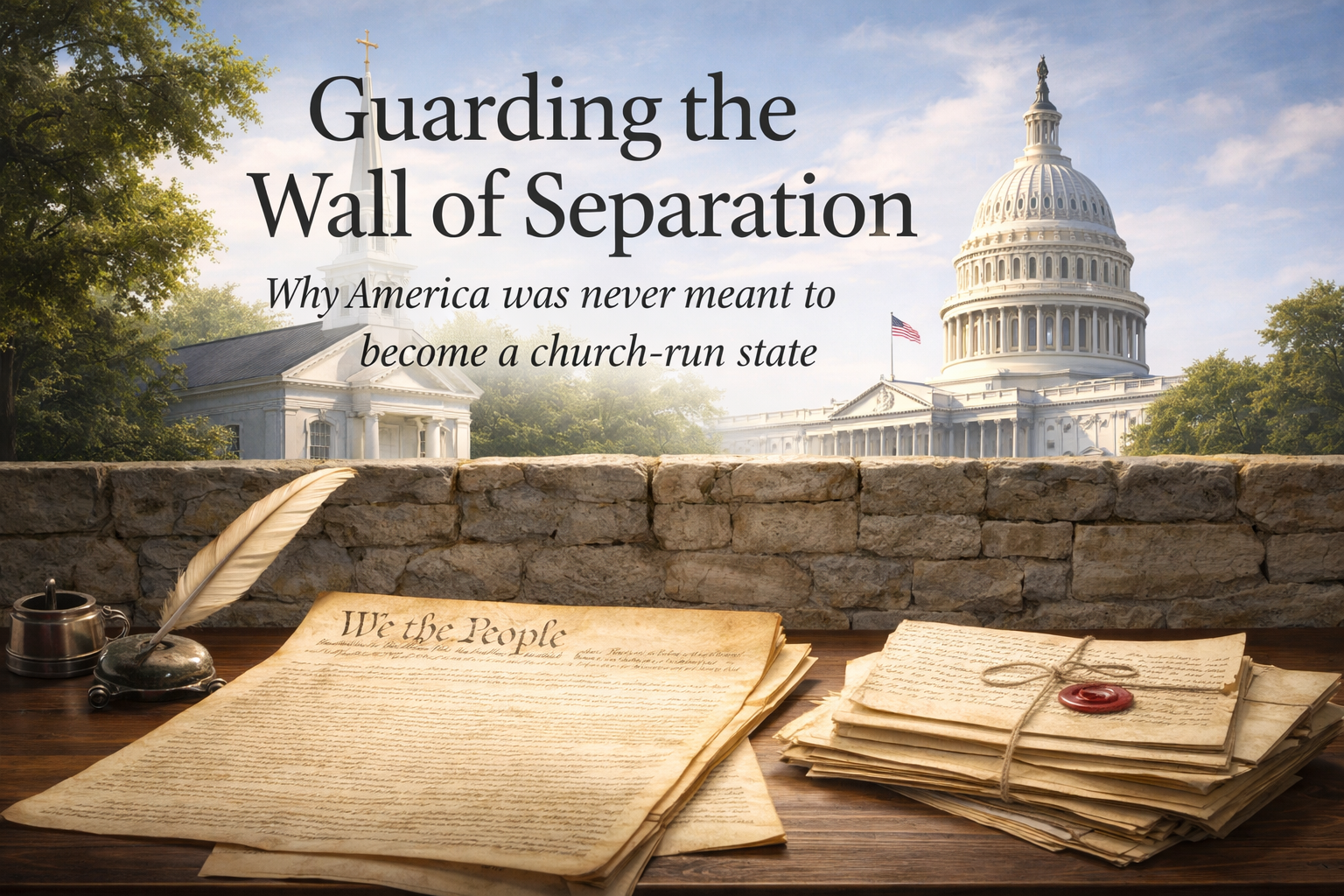
The first part is technically true and strategically useless. The phrase is not in the Constitution. Neither is "separation of powers," "judicial review," "cabinet," or "political party." The absence of a phrase from a document does not erase the principle the document encodes. The Establishment Clause of the First Amendment — "Congress shall make no law respecting an establishment of religion" — is in the Constitution. That clause is the wall. Jefferson's letter named it. He did not invent it.
The second part is where Johnson's argument collapses entirely. He claims Jefferson was only protecting religion from government. Read the letter. Jefferson wrote that the legitimate powers of government reach actions only, not opinions, and that religion is a matter which lies solely between man and his God. That is not a narrow protection of church autonomy. That is a declaration that government has no jurisdiction over religious life in any direction. The wall runs both ways. Jefferson said so in the same letter Johnson is citing as his authority.
Johnson cites Jefferson's Danbury letter as his authority. Jefferson wrote in that letter that religion lies solely between man and his God and that government's legitimate powers reach actions only, not opinions. That is the wall running both ways. The Speaker's own source contradicts him.
What Madison Actually Said
Thomas Jefferson gets cited constantly in this debate because the Danbury letter is memorable. But the more important founder on this question is James Madison — the man who actually drafted the Constitution and the Bill of Rights, and who spent decades writing about exactly what he meant.
In 1785, before the Constitution existed, Madison wrote the Memorial and Remonstrance Against Religious Assessments in response to a Virginia bill that would have taxed citizens to fund Christian teachers. His argument was not narrow. He did not say the bill was wrong because it favored one denomination over others. He said the bill was wrong because religion, by its nature, cannot be directed by force or violence — only by reason and conviction. He said government has no cognizance of religion. He said religious establishments historically produce pride and indolence in clergy, ignorance and servility in laity, and bigotry and persecution in both.
That is not a man who believed religious principles should have a robust presence in the public square through government. That is a man who believed the two systems corrupt each other on contact. Madison did not soften this view as he aged. In 1819, writing to Robert Walsh, he stated that the total separation of church from state had manifestly increased the number, industry, morality and devotion of the people. In an undated memo, he wrote that the civil government functions with complete success by the total separation of the church from the state. Total separation. Not directional separation. Total.
"The Religion then of every man must be left to the conviction and conscience of every man; and it is the right of every man to exercise it as these may dictate." — Madison, Memorial and Remonstrance, 1785.
"Who does not see that the same authority which can establish Christianity, in exclusion of all other Religions, may establish with the same ease any particular sect of Christians, in exclusion of all other Sects?" — Madison, Memorial and Remonstrance, 1785.
"Whilst the number, the industry, and the morality of the priesthood and the devotion of the people have been manifestly increased by the total separation of the Church from the State." — Madison, Letter to Robert Walsh, 1819.
Madison had the Virginia Statute for Religious Freedom passed in 1786. Jefferson listed it on his tombstone as one of the three great accomplishments of his life — alongside founding the University of Virginia and writing the Declaration of Independence. Not his presidency. The statute. That is how seriously they took this.
The "Not in the Constitution" Deflection
Johnson leans hard on the fact that the phrase does not appear in the Constitution because it sounds like a gotcha. It is not. It is a distraction from what does appear in the Constitution, which is the Establishment Clause. That clause has been interpreted by the Supreme Court in case after case across two and a half centuries. In Reynolds v. United States in 1879, the Court described Jefferson's wall of separation as an authoritative declaration of the scope and effect of the First Amendment. In Everson v. Board of Education in 1947, Justice Hugo Black cited Madison's Memorial and Remonstrance directly and held that the Establishment Clause applies to state governments as well as federal.
Johnson knows this. He is a former constitutional law litigator. He is not confused about the case law. He is making a political argument dressed as a historical one. The tell is the conclusion he reaches. If the founders only meant to prevent an official national denomination, then everything short of officially naming a state church is constitutionally permissible. That reading would gut the Establishment Clause entirely and leave the door open to exactly what Madison spent his career fighting: government using religious authority to consolidate power over conscience.
The Johnson Amendment and What He Is Really After
Johnson's recent push goes beyond the rhetorical. In July 2025, after the IRS agreed to lift its ban on churches endorsing political candidates, Johnson celebrated the decision and called the Johnson Amendment unconstitutional. He argued that people of faith had been censored by the tax code and that removing the restriction was a teachable moment about the true meaning of separation of church and state.
Let us be direct about what this means. If churches can endorse candidates while keeping their tax-exempt status, they become political action committees with steeples. They take tax-deductible donations, pay no property tax, pay no income tax, occupy prime real estate in every city and town in America, and now they can tell their congregations how to vote from the pulpit without any of the disclosure requirements that apply to every other political organization. That is not religious freedom. That is a political subsidy. And the Speaker of the House is its most powerful advocate.
If churches can endorse candidates while keeping tax-exempt status, they become political action committees with steeples. That is not religious freedom. That is a political subsidy dressed as faith.
The Founders' Real Concern
Johnson frames his argument as a defense of the founders' vision. The founders' actual vision is documented and available. Madison watched Europe bleed for centuries under state-sponsored religion. Jefferson's Virginia Statute for Religious Freedom was a direct response to the Church of England's stranglehold on Virginia's public life. These men were not theorizing. They had seen what happens when religious and civil authority merge, and they built explicit structural barriers against it because they knew human nature and institutional ambition do not expire.
Madison wrote in the Memorial and Remonstrance that the rulers who encroach on the rights of conscience exceed the commission from which they derive their authority and are tyrants. He was writing about a tax bill to fund Christian teachers in Virginia. He used the word tyrants. That is not a man who believed robust religious influence in government was consistent with the founding vision. That is a man who considered it a dangerous usurpation of power. His words. His emphasis. His founding.
Johnson does not get to invoke the founders while reversing everything they built. The founders left a paper trail. It does not support him.
Why the Speaker's Office Makes This Worse
A private citizen arguing that Jefferson's wall only runs one direction is wrong but harmless. The Speaker of the House arguing it is something else. Johnson sets the legislative agenda for one chamber of Congress. He holds the third highest office in the United States government. When he declares that separation of church and state is misunderstood and calls the nation to return to prayer as a governing philosophy, he is not making a theological observation. He is announcing a governing intention. Every non-Christian citizen in America — every Jew, Muslim, Hindu, Buddhist, atheist and agnostic — just heard the Speaker tell them that the framework protecting their equal standing in this republic is based on a misunderstanding he intends to correct.
That is not a small thing. Johnson serves 335 million Americans. He does not serve a congregation. The moment his governing philosophy is organized around bringing the country back to God, the citizens who do not share his framework are no longer fully represented. They are subjects of a majority religious preference backed by the power of the House of Representatives. Madison called that tyranny. He was right then. He is right now.
The wall is not misunderstood. It is inconvenient. Those are different problems. One requires education. The other requires accountability. Mike Johnson is getting the second one whether he wants it or not.
Why This Matters
This is not a culture war skirmish. It is a structural question about who the government represents and by what authority it governs. A republic built on consent of the governed cannot simultaneously be governed by divine authority without destroying one or the other. The founders understood this with clarity that has not aged. They built separation of church and state not as a concession to secularism but as the only arrangement that keeps both institutions honest. Government unchecked by secular accountability becomes theocracy. Religion entangled with government becomes a political instrument and loses its moral authority.
Madison said it plainly in 1785: during almost fifteen centuries the legal establishment of Christianity had been on trial, and its fruits were pride and indolence in the clergy, ignorance and servility in the laity, and in both, superstition, bigotry and persecution. He was not hostile to faith. He was honest about what state power does to it. Speaker Johnson would do well to read the man he claims to be honoring. The founders built the wall because they knew what happens without it. So do we.
References
- Madison, J. (1785). Memorial and Remonstrance Against Religious Assessments. Founders Online, National Archives. founders.archives.gov.
- Jefferson, T. (1802). Letter to the Danbury Baptist Association. Library of Congress. loc.gov.
- Jefferson, T. (1786). Virginia Statute for Religious Freedom. Virginia General Assembly.
- Madison, J. (1819). Letter to Robert Walsh. Founders Online, National Archives. founders.archives.gov.
- U.S. Constitution, Amendment I. Establishment Clause.
- Reynolds v. United States, 98 U.S. 145 (1879). U.S. Supreme Court.
- Everson v. Board of Education, 330 U.S. 1 (1947). U.S. Supreme Court.
- Johnson, M. (2026, March 20). Remarks at the 2026 National Catholic Prayer Breakfast. Washington, D.C. Reported by Christian Post and Beliefnet.
- Johnson, M. (2025, July 16). The true meaning of the separation of church and state. Deseret News. deseret.com.
- Treaty of Tripoli, Article 11 (1796). U.S. Senate.
Disclaimer: The views expressed in this post are the personal opinions of the author and are offered for educational, commentary and public discourse purposes only. They do not represent the positions of any institution, employer, organization or affiliated entity. Nothing in this post constitutes legal, financial or professional advice of any kind. Political and constitutional commentary reflects the author's independent analysis and constitutes protected expression of opinion. References to public figures, institutions and historical documents are based on publicly available sources cited in the article. Readers are encouraged to consult primary sources and form their own conclusions. No resemblance to individuals or entities beyond those explicitly referenced is intended.