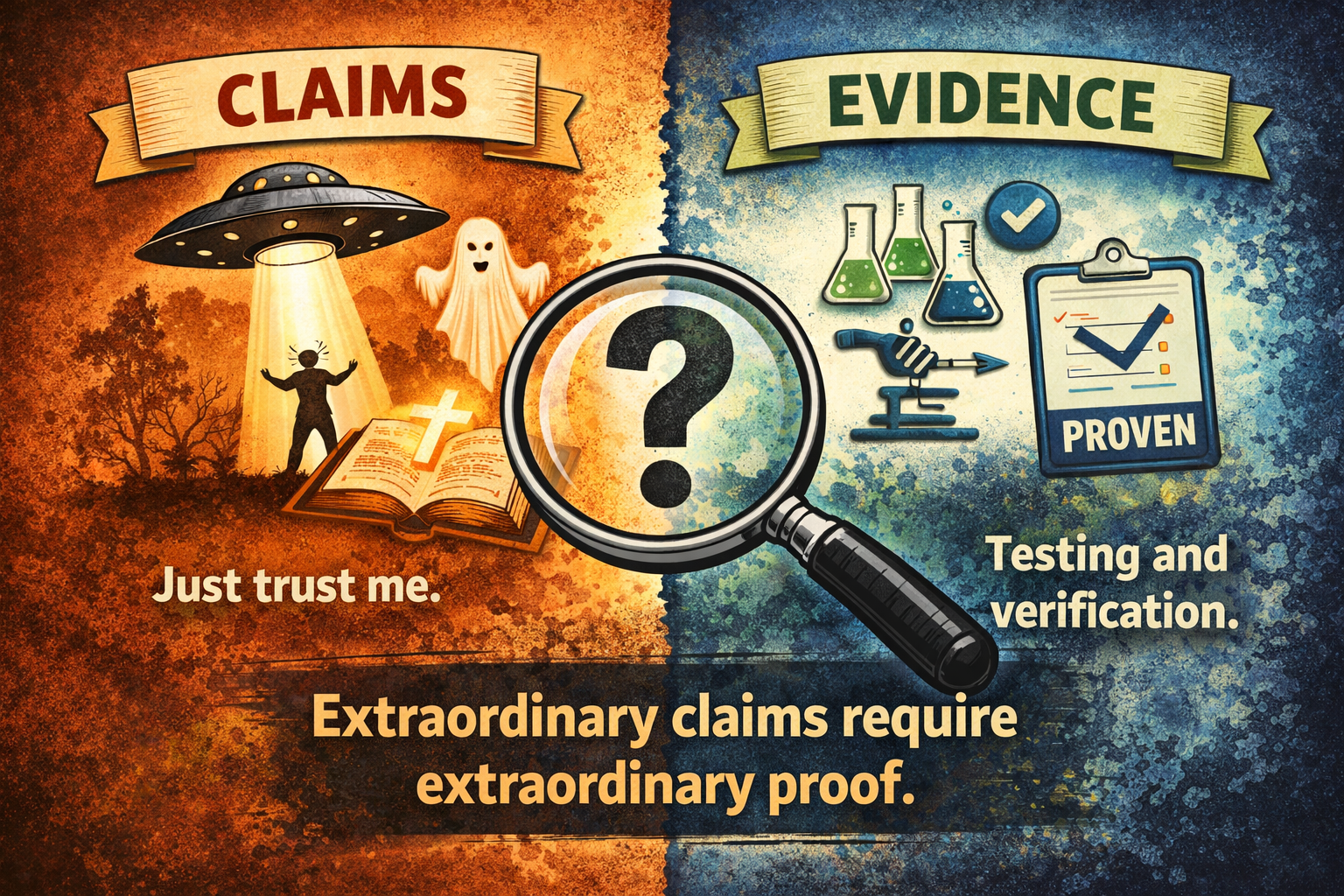
One of the most abused words in modern argument is evidence. People use it constantly. Religious believers use it. UFO enthusiasts use it. Conspiracy theorists use it. Political partisans use it. And far too often, what they call evidence is nothing more than a story, an impression, a coincidence, or a conclusion they badly want to be true. That is the problem. Evidence is not just anything that points in the direction of your preferred belief. It is not a feeling. It is not a hunch. It is not an old text making a claim about itself. It is not a strange light in the sky. It is not a personal experience that cannot be tested, repeated, or independently verified.
Real evidence is what remains after an assertion, hypothesis, or unknown has been subjected to scrutiny. It is what survives testing. It is what holds up when alternative explanations are considered and ruled out. It is what can be examined by other people using the same standards and methods. That distinction matters because once people start calling every claim "evidence," the word becomes useless. And when that word becomes useless, so does serious thinking.
A Claim Is Not Evidence for Itself
A claim is not evidence for itself. That sounds obvious, but people violate this rule constantly. A religious text says God exists, performs miracles, or raised someone from the dead. A UFO witness says he saw a craft do impossible things. A conspiracy theorist says a secret group controls events behind the scenes. Then they point back to the claim itself as though the statement somehow proves the statement.
It does not. A book claiming divine origin is still a book making a claim. A person telling a dramatic story is still a person telling a dramatic story. An internet thread alleging a hidden plot is still an allegation. None of those things automatically become evidence simply because someone asserts them with confidence or because many people repeat them. If that were enough, then every religion would be equally proven, every miracle story would be equally real, and every conspiracy would deserve the same credibility as a lab result. Claims are where inquiry begins. They are not where it ends.
Claims are where inquiry begins. They are not where it ends. Confidence is not confirmation. Repetition is not proof. A dramatic story is still a story.
Evidence Comes After Testing
Evidence, in any meaningful scientific or rational sense, is the result of a process. That process begins with a question, an assertion, or a hypothesis. Then it moves to testing, observation, measurement, comparison, replication and criticism. Along the way, alternative explanations must be considered. Sources of error must be examined. Bias must be controlled as much as possible. The idea must be exposed to the possibility of being wrong.
That last part is critical. A claim that cannot in principle be shown false is not operating on the same level as a scientific claim. It may be a philosophical belief. It may be a theological commitment. It may be a personal worldview. But if nothing could ever count against it, then it is not being tested the way scientific claims are tested. Science does not simply collect stories and vote on which one feels most inspiring. It asks: what would we expect to observe if this claim were true? What else might explain the same observation? Can the result be repeated? Can it be measured? Can independent investigators reach similar conclusions? Evidence is not the claim. Evidence is what emerges when the claim survives that process.
The philosopher Karl Popper identified falsifiability as the dividing line between scientific and non-scientific claims. A claim is scientific if it makes predictions that could, in principle, be shown to be false. A claim that can absorb any result without being contradicted is not scientific. It is unfalsifiable. That does not automatically make it meaningless — but it does mean it operates by different rules and cannot claim scientific authority. When someone says "God works in mysterious ways" in response to contradicting evidence, they have stepped outside the testable domain. That is fine as theology. It is not fine as empirical argument.
Anecdotes Are Weak Evidence at Best
Human beings are pattern-seeking creatures. We misperceive things. We misremember things. We fill in gaps. We interpret events through prior belief. We exaggerate. We misunderstand probability. We see agency where there may be none. We connect unrelated events into stories because stories are how the mind organizes chaos. That does not mean every anecdote is false. It means anecdotes are unreliable unless supported by stronger forms of evidence.
If someone says he saw an angel, the question is not merely whether he believes he saw one. The question is what actually happened and what methods exist to distinguish an angel from misperception, hallucination, memory distortion, suggestion, fraud, sleep paralysis, stress response, or plain old mistake. If someone says a UFO accelerated at impossible speed, the question is not whether he is sincere. Sincere people can still be wrong. The question is whether instrumentation, radar, multiple independent measurements, environmental conditions, known optical effects and competing explanations have been examined. Anecdotes can prompt investigation. They do not settle it.
Scripture Is a Source, Not a Scientific Result
Religious believers often treat scripture as though it occupies a special category above ordinary claims. From an evidentiary standpoint, it does not. The Bible is a collection of texts containing theology, poetry, moral teaching, narrative, law, mythic elements, genealogies, cultural memory and claims about supernatural events. Whatever else one thinks about it, it is still a body of writings making assertions. Those assertions do not become evidence merely because they are ancient, revered, or emotionally powerful.
If the Bible says God spoke, performed miracles, flooded the earth, raised the dead, or inspired prophets, those are claims. To call them evidence in the strong sense is to skip the step where claims are independently tested and other variables are ruled out. The same standard applies to any other sacred text. The Quran making a claim is not proof of Islam. Hindu texts making a claim are not proof of Hinduism. Mormon scripture making a claim is not proof of Mormonism. Otherwise, mutually contradictory systems would all be proven by the simple fact that their books say so. That is not evidence. That is circular reasoning.
Mutually contradictory religious systems cannot all be proven by the fact that their books say so. If that logic worked, all of them would be simultaneously true. Which means none of them are being proven that way.
Nature Is Not Automatic Proof of God
Another common move is to point to the existence of the universe, a tree, a star, DNA, consciousness, or a human being and say: there is your evidence of God. No, there is not. What you have there is a phenomenon in need of explanation. You do not get to smuggle your preferred explanation in as though it were already established fact.
A tree exists. A star exists. Human beings exist. None of that by itself establishes that a god exists, much less a particular god with particular traits described by a particular religion. To reach that conclusion, you would have to rule out alternative explanations, establish a valid method for identifying divine causation, and show how the conclusion can be independently verified rather than merely asserted. You would also have to explain why the god-hypothesis is better supported than natural explanations, unknown explanations, or the honest admission that we do not yet know. That is the part believers usually skip. They move from "this is amazing" to "therefore God did it." Amazement is not evidence. Wonder is not validation. Ignorance is not proof. "Science cannot explain everything" does not equal "therefore my theology is true."
Consistency Is Not Confirmation
Here is the distinction people blur most often. Lots of things are consistent with a claim without proving it. A person prays and later gets what he wanted. That is consistent with divine intervention. It is also consistent with coincidence, ordinary causation, selective recall, or confirmation bias. A witness sees something odd in the sky. That is consistent with an exotic craft. It is also consistent with misidentification, atmospheric distortion, sensor error, or an ordinary object observed under unusual conditions. A political scandal feels coordinated. That is consistent with conspiracy. It is also consistent with incompetence, incentives, institutional groupthink, or opportunistic behavior that requires no hidden master plan.
Real evidence has to do more work than fit the preferred story. It has to fit the preferred story better than the alternatives. That is a higher bar. Most claims never clear it because the people making them stop at consistency and declare victory.
Part of the reason is emotional investment. People do not merely hold beliefs. They build identity around them. Once that happens, evidence stops being something they seek and becomes something they recruit. Anything consistent with the belief gets promoted. Anything that challenges it gets minimized, rationalized, or ignored. The psychological term for this is confirmation bias, and it operates below conscious awareness in most people. The cure is not intelligence. It is discipline — the trained habit of asking not just "does this support my view" but "what would change my view, and have I actually looked for it?"
Science Is Not Perfect, But It Beats Assertion
At this point somebody usually objects that science does not know everything, scientists make mistakes, studies get overturned, and institutions can be biased. All true. Science is conducted by human beings, and human beings are flawed. There are bad studies, weak methods, political pressure, funding bias, publication bias and career incentives. None of that is news.
But notice what follows from that. The answer is not to abandon scientific standards and replace them with anecdotes, sacred texts, intuitions and internet speculation. The answer is to demand better science, cleaner methods, stronger replication, more skepticism and more intellectual discipline. Science is not valuable because scientists are saints. It is valuable because the method contains self-correcting features that personal revelation and dogma do not. Claims can be challenged. Results can be retested. Errors can be exposed. Methods can be examined. Data can be reanalyzed. Findings can fail to replicate. That process is messy because truth-seeking is messy. But it is still better than declaring your conclusion and calling it evidence.
The Honest Answer Is Often "We Don't Know"
One thing many people seem unable to tolerate is uncertainty. They would rather have a bad answer than no answer. So when they encounter mystery, they rush to fill the gap. God did it. Aliens did it. The deep state did it. Ancient civilizations did it. Maybe none of the above.
The mature mind can say "I do not know." That is not weakness. That is discipline. "I do not know" is often the beginning of honest inquiry. It leaves the question open. It resists the temptation to pretend. It avoids crowning a favorite explanation before the work has been done. A lot of what passes for open-mindedness today is really gullibility dressed up as curiosity. Real open-mindedness is the willingness to follow the evidence wherever it leads, including away from the story you were hoping to tell.
Evidence is not whatever someone points to with passion in his voice. It is what remains after the claim has been tested, the alternatives have been ruled out, and the result can be independently examined. That bar is not unreasonably high. It is just higher than most people want to clear.
Why This Matters
Once people stop distinguishing between a claim and evidence, they can be led anywhere. They can be manipulated by preachers, grifters, ideologues, internet cranks, political propagandists and self-appointed truth tellers who rely on confidence rather than proof. They become easy marks for every dramatic explanation that flatters their fears or confirms their worldview.
A culture that cannot define evidence clearly will eventually lose the ability to reason clearly. And once that happens, truth becomes whatever sounds forceful, comforting, or exciting in the moment. That is not a theoretical risk. It is the description of a large portion of current public discourse, where the loudest claim wins, the most emotionally satisfying explanation spreads fastest, and the people demanding rigorous proof get called closed-minded for the trouble.
Calling someone closed-minded for requiring evidence is not an argument. It is a tell. It means the evidence is not there and the speaker knows it. Intellectual consistency is in short supply. It should not be. It is the minimum requirement for getting reality right — and getting reality right is the only way any of us navigate the world without being permanently lost in someone else's story.
References
- Dawkins, R. (2006). The God delusion. Houghton Mifflin.
- Hume, D. (1748/2007). An enquiry concerning human understanding. Oxford University Press.
- Popper, K. (1959). The logic of scientific discovery. Basic Books.
- Sagan, C. (1996). The demon-haunted world: Science as a candle in the dark. Ballantine Books.
- Shermer, M. (2011). The believing brain: From ghosts and gods to politics and conspiracies. Times Books.
Disclaimer: The views expressed in this post are the personal opinions of the author and are offered for educational, commentary and public discourse purposes only. They do not represent the positions of any institution, employer, organization or affiliated entity. Nothing in this post constitutes legal, financial or professional advice of any kind. Commentary on religious and philosophical subjects reflects the author's independent analysis and constitutes protected expression of opinion. This post critiques evidentiary standards as applied to various belief systems and does not make claims about the sincerity or character of believers. Readers are encouraged to consult primary sources and form their own conclusions.