Richard Carrier and I disagree about many things. He is a democratic socialist. I am not. He approaches politics from the left. I generally approach it from the right. On cultural and political questions we are frequently on opposite sides of the argument, and I do not expect that to change. When it comes to things other than culture and politics, however, I find myself agreeing with him more often than most people on my side of the aisle would expect. His discussion of the principle that extraordinary claims require extraordinary evidence is one of those occasions. There is an irony worth naming at the outset: many Christians who reject Carrier's conclusions about their own faith would readily apply this same evidentiary standard to every other religion on earth. If someone claimed Muhammad ascended into heaven, Joseph Smith translated golden plates with divine assistance or a Hindu miracle occurred yesterday, most Christians would rightly ask where the evidence is. That is not hostility. That is skepticism. Carrier's point is that we should apply the standard consistently, even to our own beliefs. On that point, I think he is exactly right.
Carrier arrives at that standard through his work as a historian of early Christianity and a critic of religious truth claims, and for what it is worth, I find his historical and religious arguments persuasive. Where my interest diverges from his is in the civic application. I am not primarily writing here about whether the resurrection happened. I am writing about whether governments are permitted to legislate as if it did. Those are different questions, and the second one has a constitutional answer that does not depend on resolving the first. That is what this post is about.
The Principle Is Not Controversial
Carrier's argument is that the more improbable a claim appears, the stronger the evidence required before we should accept it. That is not atheism. It is not anti-Christianity. It is how we navigate reality every day. If someone tells me they caught a trout in Colorado, I will believe them without photographs. If they tell me they caught a twenty-foot trout that speaks Latin and predicts lottery numbers, I need considerably more evidence. The claim changed, so the evidentiary burden changed. That is rational thinking, not hostility to any particular worldview. Most people apply this standard reflexively in every domain of life. The question Carrier presses, and the one I find genuinely compelling, is why that standard should suddenly become optional when the claim in question is religious.
Evidence requirements shape criminal trials, medical research, engineering safety, financial regulation and scientific peer review. A law affecting millions of citizens goes through legislative deliberation, constitutional scrutiny and often judicial review. The only domain where extraordinary claims routinely escape the evidentiary standard that governs everything else is when those claims are religious in origin and when governments use them to justify legislation. Carrier's argument is not that religion should be abolished. It is that the same standard we apply to every other claim should apply here too. That is a position worth taking seriously regardless of one's own faith.
Where This Becomes a Government Problem
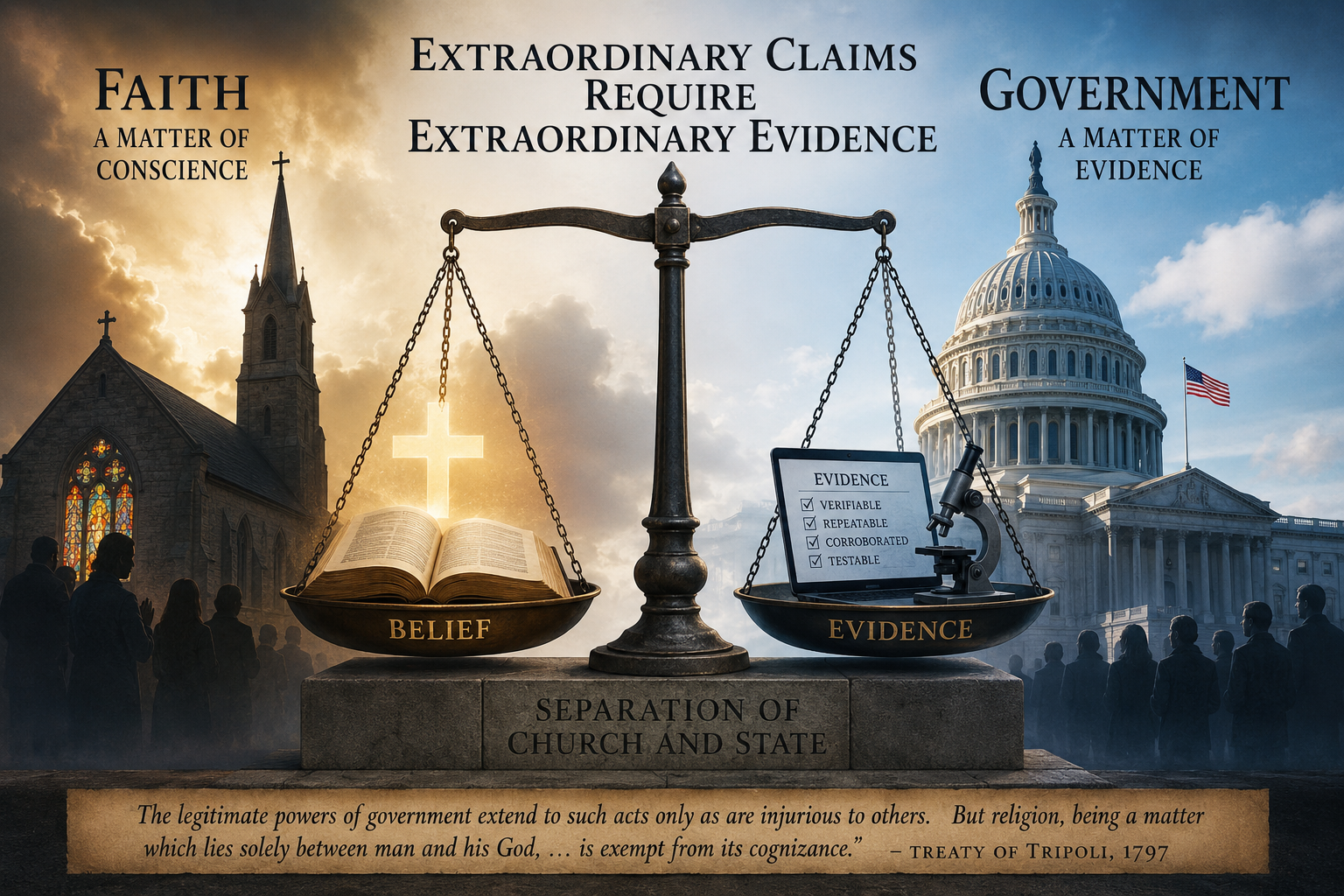
Where Carrier's argument matters most for me is not the question of whether Christianity is true. People should remain completely free to believe whatever religion they choose, and I mean that without qualification. The question that keeps me up at night is different: should governments make laws based on claims that cannot meet normal evidentiary standards? My answer has always been no, and the reason is practical before it is philosophical. Government exercises force. It collects taxes. It imprisons people. It regulates education. It fights wars and determines rights. Those decisions cannot rest on supernatural claims that one religion accepts and another rejects, because the citizens subject to those decisions include people from every religious tradition and none. They must rest on evidence every citizen can evaluate regardless of faith. That is precisely why the founders prohibited religious tests for public office and barred Congress from establishing a national religion. They understood that religious liberty survives best when government does not choose theological winners and losers.
The moment faith requires government authority to enforce belief, it has already admitted that persuasion alone was insufficient. That admission should concern believers more than anyone else.
Separation Protects Both Sides
Some people hear "separation of church and state" and immediately assume hostility toward Christianity. Nothing could be further from the truth. The separation protects churches from government as much as it protects government from churches. History is filled with examples where religion gained political power and dissent subsequently disappeared, and equally filled with examples where governments that became entangled with religion eventually moved to control it. Neither outcome is healthy for faith or for freedom. Faith should persuade through its own moral and spiritual force. Government should govern through the consent of the governed. Once faith requires the machinery of government to enforce compliance, something has gone wrong with the faith itself, not just with the political arrangement.
This Is Not an Attack on Faith
Critics of secularism often accuse its proponents of trying to eliminate religion from public life. That is a mischaracterization worth correcting directly. People should be free to worship, pray, evangelize, build churches and raise their children according to their beliefs. Those freedoms are constitutionally protected and deserve fierce defense. The line I am drawing is narrower and more specific: religious believers should not be free to transform unverified supernatural claims into public policy that governs people who do not share those beliefs and never consented to be governed by them. That is where liberty ends and coercion begins, and the distinction matters enormously for anyone who actually values religious freedom rather than simply preferring that their religion be the one with the power.
My Bottom Line
Carrier's ultimate conclusions about Christianity extend well beyond where many religious people are willing to go, and I am not suggesting otherwise. The narrow point where I find his argument convincing is the reminder that evidence matters, and that it should matter consistently. Whether a claim comes from an atheist, a Christian, a Muslim, a politician or a scientist, extraordinary assertions deserve careful examination before they are accepted as fact and especially before they are written into law. That principle is not anti-religious. It is pro-reason and pro-liberty. It is also, in my view, exactly what the founders were protecting when they built a government that remains neutral in matters of religion while fiercely protecting every citizen's right to believe or not believe as conscience dictates.
Skepticism is not cynicism. It is intellectual discipline. When governments wield power over millions of lives, intellectual discipline is not merely desirable. It is the minimum the governed are owed.
The separation of church and state is not about keeping religion out of people's lives. It is about keeping government from deciding which religious claims deserve the force of law. That distinction is everything, and it is one Richard Carrier and I reach from entirely different starting points.
Disclaimer: The views expressed in this post are the personal opinions of the author and are offered for educational, commentary and public discourse purposes only. They are not institutional positions and do not constitute professional advice of any kind. References to public figures and published works support analysis and do not constitute factual claims about individuals beyond what is explicitly stated. Political and religious commentary is protected expression of opinion. Readers are encouraged to consult primary sources and form their own conclusions. No resemblance beyond explicit references is intended.