
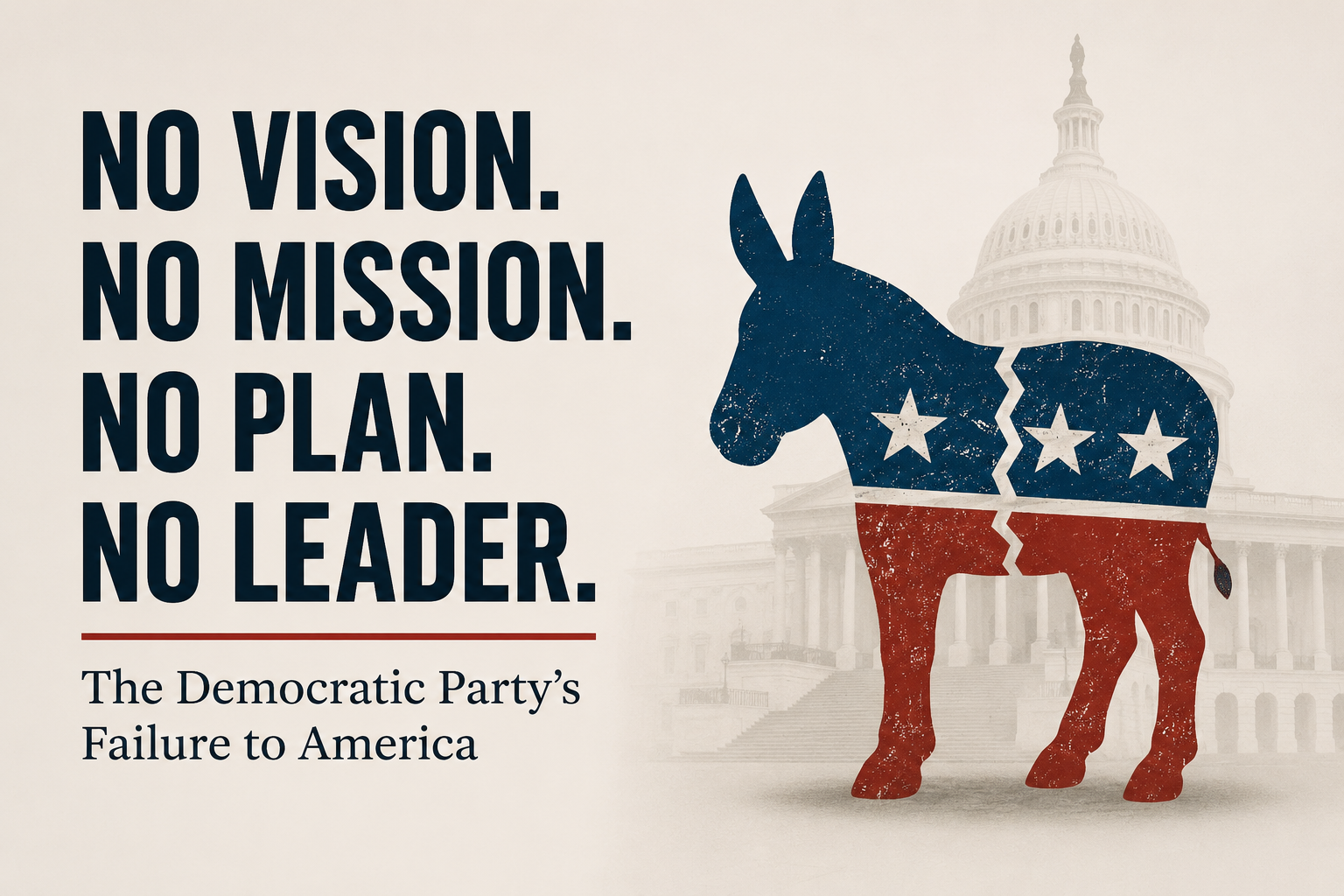
Let me start by saying something that should not need to be said but apparently does: I want the Democratic Party to get its act together. Not because I agree with them. Not because I am a Democrat. Because a republic needs two serious parties and right now it has one. A governing party without a credible opposition becomes unaccountable, sloppy and eventually corrupt. The Democratic Party, as currently constituted, is not a credible opposition. It is a grievance operation with a donor list. It has no coherent vision for America, no mission statement that survives contact with the voters it needs to win back, no governing plan that addresses the issues ordinary Americans actually care about and no leader capable of making the case for any of it. What it does have, in abundance, is Trump Derangement Syndrome, performative outrage, a cultural agenda that most of the country finds alien and a bench so thin and so ideologically constrained that it cannot produce a national candidate who speaks to anyone outside the coastal professional class. This is a problem. Not just for Democrats. For the country.
Drop the TDS and Stop the Grandstanding
The party has spent ten years making Donald Trump the organizing principle of its entire existence. Every issue runs through him. Every fundraising email invokes him. Every protest is about him. Every congressional hearing is about him. Every news cycle is processed through the question of how dangerous he is rather than what Democrats would actually do differently. The American public has been told for a decade that Trump represents the end of democracy, and they watched democracy continue producing elections, courts continue issuing rulings and the republic continue functioning through two terms of the man the party says is the gravest threat in American history. The credibility of that claim is spent. The people who still believe it already vote Democratic. The people who need to be persuaded have stopped listening.
The grandstanding is the companion problem. Al Green shouting during a presidential address did not save Medicaid. The No Kings protest drew millions and changed nothing. Congressional hearings staged for clips rather than information produce clips. Fundraising emails about existential threats produce money for consultants. None of it produces governance, policy or persuasion. A party that has confused performance with politics for a decade has forgotten how to do the second thing. The forgetting shows.
When opposition to one man is a party's primary product, two things happen. First, the party loses the ability to develop policy independent of that opposition. Every position gets defined by what Trump does, not by what Democrats believe. Second, the party becomes dependent on Trump's continued centrality to survive financially and organizationally. That dependency is not healthy for the party and it is not healthy for the country. A party that needs its enemy more than it needs its own ideas is not a governing party. It is a fundraising machine.
Abandon DEI and Identity Politics
The DEI framework and the identity politics architecture built around it have done more damage to the Democratic Party's electoral coalition than any Republican campaign ever could. Working-class voters of every racial background have been leaving the party in measurable numbers for a decade. Hispanic men voted for Trump in 2024 at rates that would have been unthinkable in 2012. Black men under 45 moved toward Republicans in ways the party's leadership still has not honestly reckoned with. The reason is not complicated. The voters leaving were told their primary identity was their demographic group, that their political interests were determined by their race or gender, that any deviation from progressive orthodoxy was internalized oppression or false consciousness, and that their actual lived concerns about crime, cost of living, schools and economic opportunity were secondary to a cultural project they did not ask for and did not want.
DEI in practice sorted people into favored and disfavored categories based on group membership. It replaced merit with representation metrics. It embedded ideological compliance requirements into hiring, promotion, contracting and government operations. Most Americans, including most minority Americans, believe in equal opportunity rather than engineered equal outcomes. The party that champions the second while calling it the first will keep losing voters who know the difference.
Stop Protecting Illegal Immigration and Fighting ICE
The Democratic Party's sustained opposition to immigration enforcement is one of the most politically self-destructive positions in modern American political history. The Biden years produced the highest illegal crossing numbers ever recorded. The party's response was to characterize enforcement agents as fascists, celebrate sanctuary policies, fight deportation in court and treat the border as a humanitarian corridor rather than a national security perimeter. The communities that absorbed the consequences of that policy — working-class neighborhoods where wages were undercut, schools where resources were strained, cities where public services were overwhelmed — noticed. They voted accordingly.
Opposing the deportation of people with criminal records is not compassion. It is a political choice to prioritize non-citizens with criminal histories over the safety of citizens in the communities where those people live. The party has never made an honest case for that choice because it cannot. It simply calls enforcement cruel and hopes the accusation sticks. With an increasingly large portion of the electorate, it no longer does.
You cannot simultaneously tell working-class Americans that you fight for them and then spend your political capital fighting the enforcement of immigration laws they want enforced. They notice the contradiction. That is why they left.
Protect Children: No Trans Surgery on Minors, No Men in Women's Sports
On both of these issues, the Democratic Party holds positions that are out of step with large majorities of the American public, including large majorities of Democratic voters. Polling consistently shows that most Americans, across party lines, believe biological males should not compete in female athletic categories and that minors should not receive irreversible gender-transition medical procedures. The NCAA changed its policy to reflect reality. The Supreme Court upheld state restrictions on pediatric transition procedures in United States v. Skrmetti. The party's activist base is on one side of these issues. The country is on the other. A party that keeps choosing its activist base over the country on questions this visible will keep losing the voters in the middle who decide elections.
These are not peripheral concerns. Parents across the political spectrum care deeply about what happens to children. When the Democratic Party signals that it will protect a gender ideology agenda over the concrete concerns of parents about their children's safety and fairness in sport, it loses parents. It has been losing them for years and has not stopped.
Build an Economic Plan That Actually Helps Americans
The Democratic Party governed for four years with unified congressional control during the Biden administration and produced the worst inflationary period in forty years, watched real wages decline, presided over energy costs that hammered working families and offered an economic message centered on spending programs that generated headlines rather than relief. The party has no credible economic narrative for 2026 and beyond. It cannot run against Trump on the economy because voters credit Republicans with taking inflation seriously even when they disagree with the methods. It cannot run on the Biden record because the Biden record is the reason the party lost in 2024.
A real economic agenda would address the cost of living directly, would acknowledge that energy affordability matters to working families, would support domestic production and manufacturing, would address the housing supply crisis without simply blaming it on investors and would speak to small business owners and contractors who feel squeezed from every direction. None of that requires abandoning progressive values. It requires prioritizing the economic reality of the people the party claims to represent over the cultural priorities of the professional class that funds it.
Develop a Geopolitical Strategy That Is Pro-American
The Democratic Party's foreign policy posture has drifted into something that looks, to ordinary voters, like a preference for global institutions and foreign interests over American ones. The party that once stood for a strong national defense and clear-eyed American engagement in the world now produces members of Congress who qualify their condemnations of terror organizations, who vote against military aid to allies defending themselves against aggression from hostile states and who treat American national interest as a suspect concept requiring apology. That posture is a political loser and it is also wrong on the merits. A serious American foreign policy starts from the premise that American security and prosperity come first, that alliances serve American interests, that adversaries respond to strength and that the United States has both the right and the obligation to act in its own interests without seeking permission from multilateral bodies that do not share those interests.
Return to Meritocracy
The abandonment of meritocracy as a governing principle has cost the Democratic Party more credibility than almost any other single shift. Americans across racial lines believe in merit. They believe in working hard, earning advancement, competing fairly and being judged on performance rather than on demographic category. The progressive critique of meritocracy — that it is a mask for privilege, that standardized tests are racist, that objective criteria encode bias — is an elite academic argument that has been embedded in policy at the cost of the people the policy was supposed to help. Schools that eliminated gifted programs in the name of equity produced worse outcomes for the students who most needed advanced instruction. Colleges that dropped test requirements did not produce more diverse campuses. They produced campuses where the absence of objective criteria gave admissions officers more discretionary power, which is not a recipe for fairness.
The Democratic Party needs to say: we believe in merit. We believe the best qualified person should get the job, the promotion and the admission slot. We believe equal opportunity is the goal, not equal outcomes engineered by bureaucracies. We believe in helping people compete rather than rigging the competition. We believe a Black child in a failing school deserves access to excellence, not to a system that lowers standards in the name of equity and then calls the result progress. That is the message that wins back the working-class voters of every background who left. It requires abandoning a decade of activist orthodoxy. The party is not ready to do that. Until it is, it will keep losing.
Find a Leader and Build a Vision
A vision without a leader is a document. A leader without a vision is a celebrity. The Democratic Party currently has neither. Its bench consists of figures who are well-known within the existing coalition and unknown or polarizing outside it. Its ideological constraints are so tight that a candidate who supports border enforcement, questions DEI, acknowledges biological reality in sport, defends meritocracy and puts American economic interests first will be primaried from the left before reaching a general election. Those constraints produce candidates who are acceptable to the base and unpersuasive to everyone else. Until the party is willing to have the internal fight about those constraints, it will keep producing the same result.
The vision has to come before the leader. What does the Democratic Party believe about the role of government? The value of borders? The relationship between rights and responsibilities? The proper limits of federal power? The connection between economic growth and working-class prosperity? The answers to those questions have been crowded out for a decade by the Trump obsession. The party needs to answer them honestly, even when the honest answers conflict with the preferences of its activist donors and credentialed professionals. That is the hardest political work there is. It is also the only work that produces a party capable of governing.
My Bottom Line
This is not a Republican wish list for Democratic failure. It is an honest accounting of what the only other party in America needs to do to be worth voting for. A republic with one serious governing party is a republic without accountability. Republicans get worse when they face no serious competition. Every institution gets worse without it. The Democratic Party owes the country a credible alternative, a coherent vision, a governing plan and a leader who can make the case to Americans outside the progressive bubble. It owes them an economics argument that addresses real costs, a foreign policy that puts American interests first, a cultural posture that respects the majority's values without abandoning minority rights and an honesty about what went wrong in the years it held power.
The list of things the party needs to abandon — TDS, grandstanding, DEI, identity politics, open-border absolutism, trans ideology in schools and sport, anti-meritocracy and reflexive anti-Americanism in foreign policy — is long. The cost of abandoning them is real. The activist base will be furious. The donor class will object. The media environment that rewards outrage will punish restraint. None of that changes the arithmetic. The party that chooses its activist base over the country keeps getting the result it has been getting. The country deserves better than that. So does the party.
No vision. No mission. No plan. No leader. That is the Democratic Party's balance sheet today. The country is waiting for the audit to produce something different. So far, it is still waiting.
Why This Matters
Unaccountable power produces bad governance regardless of which party wields it. The Democratic Party's collapse into permanent opposition theater is not just bad for Democrats. It is bad for the republic. Every institution becomes worse when it faces no serious competition. The country needs Democrats to compete on the issues that actually govern people's lives — their safety, their economic security, their children's futures, their country's standing in the world. Until the party is willing to do that work honestly, it will remain what it currently is: a grievance operation with excellent fundraising infrastructure and nothing to show for it in the places where it matters most.
References
- Pew Research Center. (2024–2026). Political typology and voter priorities surveys. pewresearch.org.
- Gallup. (2024–2026). Party affiliation, immigration, crime and economic priority polling. gallup.com.
- Associated Press / NORC. (2024). Voter priorities: cost of living, border, crime, education.
- NCAA. (2025). Transgender student-athlete participation policy change. ncaa.org.
- Supreme Court of the United States. (2025). United States v. Skrmetti.
- U.S. Customs and Border Protection. (2025). Southwest border enforcement statistics. cbp.gov.
- Bureau of Labor Statistics. (2024). Real earnings summary, 2021–2024. bls.gov.
Disclaimer: The views expressed in this post are the personal opinions of the author and are offered for educational, commentary and public discourse purposes only. They do not represent the positions of any institution, employer, organization or affiliated entity. Nothing in this post constitutes legal, financial, medical or professional advice of any kind. References to public figures, institutions and current affairs are based on publicly available sources cited above. Commentary on political subjects reflects the author's independent analysis and is protected expression of opinion. Readers are encouraged to consult primary sources and form their own conclusions.