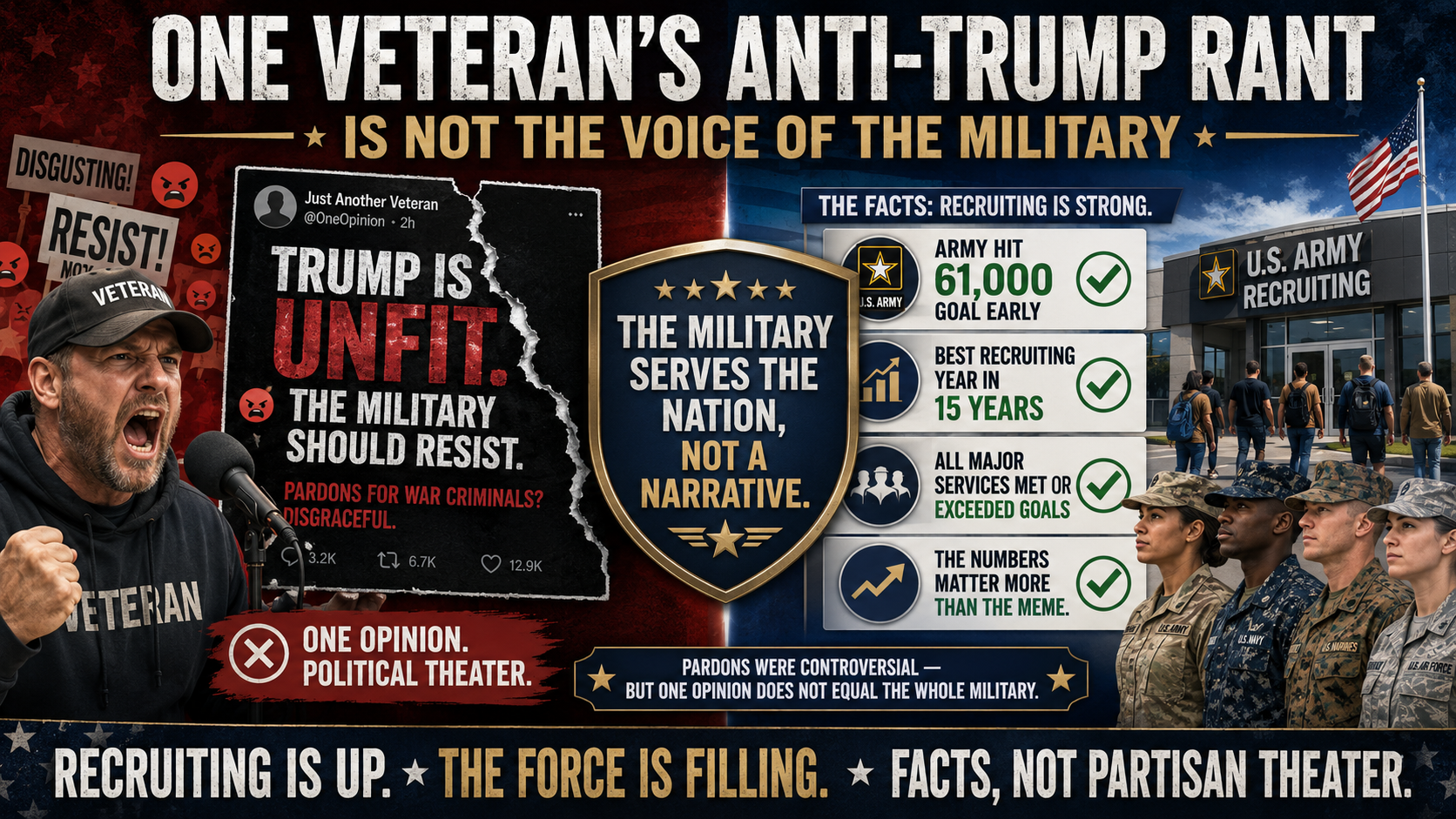
There is a familiar kind of anti-Trump meme that shows up every election cycle. It finds one veteran, usually one with a strong political identity, places him next to a grim photograph of Donald Trump and presents his opinion as if it represents the entire United States military. The latest version claims that service members endured anguish under Trump because he pardoned people accused or convicted in war-crimes cases and supposedly disrespected America's brave men and women. That is one man's opinion. He is entitled to it. He served, and service earns respect. But his opinion is not the military's opinion. It is not a survey. It is not recruiting data. It is not retention data. It is not readiness data. It is a political statement dressed up as institutional truth. And the facts do not support the sweeping narrative.
The Military Is Not Collapsing Under Trump
The easiest way to test this kind of claim is to look at behavior instead of slogans. Are people joining? Are the services meeting recruiting goals? Is the all-volunteer force falling apart because young Americans supposedly cannot stomach serving under Trump? In fiscal year 2025, the Army hit its recruiting goal four months ahead of schedule — and that goal was more than 10 percent higher than the prior year. The Army described the result as evidence of a surge in interest and enthusiasm. The Department of Defense reported that fiscal year 2025 produced the best recruiting numbers in 15 years. The Army, Navy, Air Force, Space Force and Marine Corps all met or exceeded their active-duty goals. The Navy exceeded its goal by more than 8 percent.
That does not sound like a force in moral rebellion against its commander in chief. It sounds like a military recovering from a real recruiting crisis and finally filling the ranks again.
People vote with their feet. In fiscal year 2025, tens of thousands of Americans walked into recruiting stations and joined. The DoD called it the strongest recruiting performance in 15 years. The Army hit its goal early. The Navy exceeded its goal. The Marine Corps met its target. Do those numbers prove every service member loves Trump? No. Do they prove morale is perfect? No. Do they absolutely refute the claim that Americans were unwilling to serve under him? Yes.
The Recruiting Crisis Was Real — and It Had Nothing to Do With Trump's Pardons
The military did have a genuine recruiting problem. The Army missed goals badly in 2022 and 2023. The services expanded prep programs, offered bonuses and changed outreach strategies because fewer young Americans were eligible, interested or prepared to serve. Obesity, drug use, mental health disqualifiers, criminal records, poor academic preparation and declining institutional trust all contributed. That crisis did not begin because Trump pardoned anyone. It was a long-developing national problem built from cultural, demographic, educational and institutional factors accumulating for years. The country produced fewer eligible young adults. The military became less visible to many families. COVID disrupted recruiting pipelines. Schools and recruiters lost access to young people.
So when recruiting improves dramatically under the same commander in chief supposedly destroying morale, that matters. It means the narrative of collapse is too simple. It means young Americans are still willing to serve. It means the uniform still carries meaning.
Yes, the Pardons Were Controversial
Here is the part the meme gets partly right. Trump's military-justice pardons were controversial. In 2019, Trump pardoned or intervened in several cases involving American service members accused or convicted of serious battlefield misconduct. Critics argued those actions undermined military discipline and the laws of war. Supporters argued the men had been treated unfairly, that battlefield judgment is genuinely complex and that the commander in chief has clear constitutional pardon authority. That is a real debate. A serious person can object to those pardons. A serious person can defend them.
But that is not what the meme does. The meme does not make a careful argument about military justice. It does not distinguish between conviction, accusation, rank restoration and pardon. It does not weigh the facts of individual cases. It does not discuss command authority or appellate review. It simply says: Trump pardoned war criminals, therefore the military suffered anguish, therefore he disrespected the troops. That is not analysis. That is a campaign ad.
One Veteran Does Not Speak for Every Veteran
Veterans disagree with each other constantly. Anyone who has served knows this. Put ten veterans in a room and you get twelve opinions about presidents, wars, rules of engagement, generals, VA benefits, recruiting standards, foreign policy and whether the chow hall was ever any good. Some veterans despise Trump. Some voted for him twice. Some care primarily about pay, benefits and readiness. Some care about foreign policy. Some care about culture-war issues. That diversity is normal. What is dishonest is pretending one retired officer's political statement equals the military's verdict. It equals one retired officer's political statement. That distinction matters because politicians and activists love to use veterans as moral shields, on both sides. They find a veteran who agrees with them, put a uniformed photo on the screen and imply that disagreement with the message is disrespect for service.
Respecting veterans does not require agreeing with every veteran's politics. Military service gives someone credibility on military experience. It does not make every political opinion immune from challenge.
"Disrespecting the Troops" Has Become a Cheap Slogan
The phrase gets thrown around too easily. If a president cuts military pay, neglects wounded warriors, misuses troops for political theater, ignores battlefield realities, botches a withdrawal or treats service members as props — then criticism is fair and should be direct. But not every controversial decision is disrespect. Not every policy disagreement is an insult to the force. Not every veteran's anger is proof of institutional crisis. Trump's style is blunt. He says things many people dislike. He personalizes fights. He often lacks the ceremonial polish people expect from presidents. All of that is fair ground for criticism. But the actual military question is not whether Trump offends Democrats on social media. It is whether the force is recruiting, training, retaining, modernizing and preparing to fight and win. On recruiting, the evidence is not on the meme's side.
The Military Belongs to the Country, Not a Party
The most dangerous part of this rhetoric is the attempt to make the military sound like it belongs emotionally to one political side. Democrats do this when they present anti-Trump veterans as the authentic voice of the armed forces. Republicans do it when they imply every real patriot must support their commander in chief. Both habits are wrong. The military belongs to the Constitution and the American people. It is not a Democratic institution. It is not a Republican institution. It is a national institution whose legitimacy depends on remaining above the partisan food fight as much as possible. Memes like this use the uniform to launder political emotion. They make partisan anger look like military judgment. They take one veteran's view and try to pass it off as the verdict of the force. That is not respect for the military. That is using the military.
My Bottom Line
Trump's military pardons were controversial and reasonable people can debate them. Some veterans were angry. They have every right to be. But the claim that the military as a whole suffered some unique Trump-driven anguish is not supported by the broader picture. Recruiting is up. The services met or exceeded fiscal year 2025 goals. The Army hit its goal early. The DoD reported the strongest recruiting performance in 15 years. That does not happen in a force that has lost confidence in its mission. One politically active veteran dislikes Trump and said so. The internet turned that into a meme. Democrats and anti-Trump activists shared it because it flatters their view of the world. That is not the voice of the military. That is one man's political statement wearing a uniform for credibility it has not earned.
The men and women who serve are not props for anyone's campaign narrative. They are citizens in uniform, with different views, different experiences and different reasons for serving. They deserve better than being dragged into another lazy anti-Trump meme.
Why This Matters
America needs a military that is respected without being politicized. It needs commanders in chief who are accountable and service members who are honored without being conscripted into partisan arguments. If someone wants to argue that Trump's pardons were wrong, make that argument on the merits. If someone wants to argue that presidential clemency in military cases risks weakening discipline, make that argument directly. Those are real debates worth having. What is not worth having is the pretense that one man's partisan quote speaks for an institution of 1.3 million active-duty service members. The actual evidence shows a force that continues to attract volunteers and fill its ranks. The country should honor that. It should also stop letting political operatives use veterans as props every time the calendar shows an election approaching.
References
- Department of Defense. (2025). Fiscal year 2025 sees best recruiting numbers in 15 years. defense.gov.
- U.S. Army. (2025). Army meets fiscal year 2025 recruiting goals four months early. army.mil.
- Military Times. (2025). Military recruiting off to strong start for fiscal 2026, DoD says.
- Associated Press. (2024). The U.S. military spent $6 billion in the past three years to recruit and retain troops.
- PBS NewsHour. (2019). Trump intervenes in military justice cases, grants pardons.
- National Defense University Press. (2020). Pardon the paradox: Making sense of President Trump's interventions in military justice.
Disclaimer: The views expressed in this post are opinions of the author for educational and commentary purposes only. They are not statements of fact about any individual or organization, and should not be construed as legal, medical, or financial advice. References to public figures and institutions are based on publicly available sources cited in the article. Any resemblance beyond these references is coincidental.