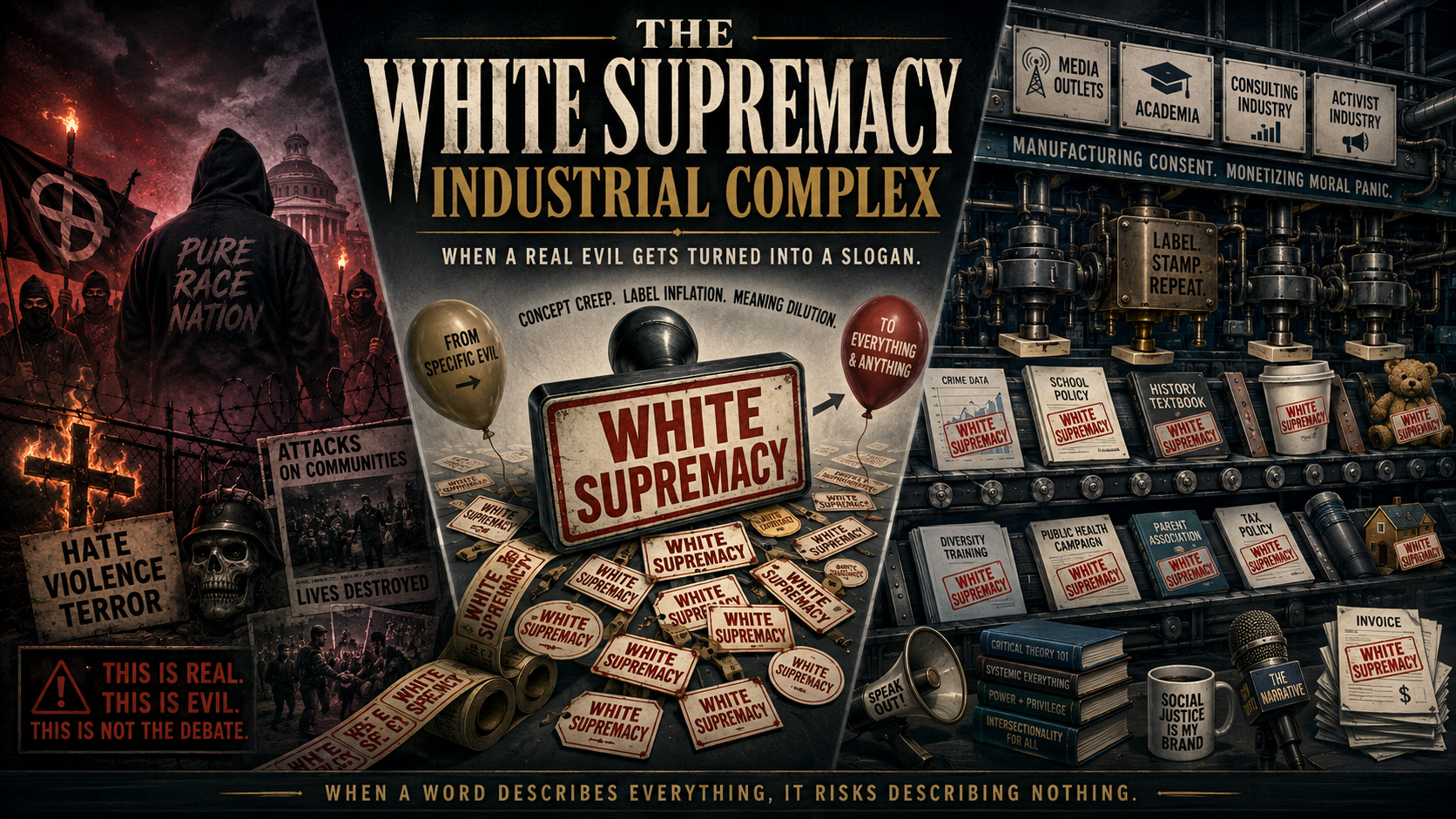
White supremacy is real. Neo-Nazis exist. The Ku Klux Klan still holds rallies. The mass shooter who drove to El Paso to target Latinos published a manifesto citing white nationalist ideology. The shooter who murdered eleven people at the Tree of Life synagogue in Pittsburgh left a documented trail of white supremacist beliefs. These are not phantoms. They are documented, prosecuted and condemned by virtually every serious institution in America, including the FBI, which lists domestic violent extremism as a top counterterrorism priority. When white supremacists commit violence, they deserve to be called white supremacists and they deserve the full weight of the law. That sentence should be completely uncontroversial. The problem is what happened next — the annexation of the phrase "white supremacy" by a broader cultural movement that decided the term was too useful to leave limited to actual white supremacists. Once that annexation was complete, the word stopped describing a specific ideology and started describing anything the movement wanted to condemn. That is where the trouble begins.
What White Supremacy Actually Is
White supremacy in its original and accurate meaning is the belief that white people are inherently superior to people of other races and that this alleged superiority justifies political, social and economic domination. It is the ideology behind slavery's intellectual defense, behind Jim Crow's legal architecture, behind the Third Reich's racial hierarchy and behind the domestic terror groups that have committed documented violence in this country within living memory. It is specific, identifiable, documented and genuinely dangerous. The Southern Poverty Law Center tracks hundreds of active white nationalist and white supremacist groups. The FBI investigates and prosecutes them. Courts convict their members. That system works imperfectly but it exists and it is directed at a real target.
The expansion of the term began with good intentions, as these things often do. Scholars studying systemic disparities in housing, lending, education and criminal justice argued that racially unequal outcomes did not require individual racist actors — that institutions built during periods of explicit white supremacy could perpetuate racial inequality through neutral-seeming rules that had discriminatory effects. That is a legitimate academic argument that deserves serious evaluation. Redlining was real. Racially restrictive covenants were real. The GI Bill's administration produced racially disparate outcomes. These are documented historical facts with documented contemporary effects. The honest study of those facts is not the problem.
The problem begins when the academic framework for studying institutional disparities gets detached from its evidentiary requirements and deployed as a universal accusation. When every institution that produces unequal outcomes is declared white supremacist by definition — regardless of the intent of the people running it, the rules governing it or the efforts made to address the disparity — the term has been upgraded from a description of ideology to a verdict that requires no proof. That is not analysis. That is a label that forecloses analysis by declaring the conclusion in advance.
White Institutionalism and Its Evidentiary Problem
The theory of white institutional supremacy or white institutional racism — the idea that American institutions are systemically structured to advantage white people and disadvantage everyone else — is not a fringe position. It is the operating assumption of large portions of academia, much of the nonprofit sector, a large piece of the corporate diversity-and-inclusion industry and the DEI infrastructure that was embedded in federal agencies before the current administration dismantled it. The theory appears in teacher training programs, university orientation curricula, corporate sensitivity training and government contractor requirements. It has institutional backing, credentialed advocates and a profitable publishing industry behind it.
What it does not have, in its strong form, is the evidentiary standard it demands of competing explanations. The strong version of the theory holds that disparities between racial groups in income, education, incarceration, health outcomes and wealth are primarily or substantially explained by ongoing systemic racism embedded in American institutions. That is a specific empirical claim. It requires ruling out alternative explanations — differences in family structure, geographic concentration, cultural factors, historical starting points, individual choices and the specific policy environments of specific cities and states. Those alternative explanations are not automatically correct. But they are not automatically wrong either, and a framework that treats any appeal to them as itself evidence of racism has built unfalsifiability into its foundations. An unfalsifiable theory is not social science. It is doctrine.
Calling someone a racist takes one second. Proving it takes evidence, context, standards and intellectual honesty. One is a weapon. The other is work. When a political culture decides the weapon is more useful than the work, it should not be surprised by what weapons produce.
The "Hate Whitey" Industry
Beyond the academic framework is a cruder cultural phenomenon that has been given institutional cover by the academic language while having little of the academic rigor. It shows up in the assertion that all white people are inherently racist by virtue of their race and in diversity training sessions that ask white participants to "own their whiteness" and acknowledge their implicit bias as a fixed feature of their identity. It shows up on social media with the casual deployment of "white tears," "white fragility," "Karen" as a racial epithet and the ambient cultural acceptance of anti-white hostility as not just permitted but righteous. It shows up in educational curricula that present white people and whiteness primarily as the source of the world's problems rather than as one part of a complex human story that includes both achievement and atrocity.
Ibram X. Kendi's argument in How to Be an Antiracist — that there is no such thing as a non-racist, only racists and antiracists, and that all racial disparities are by definition the result of racist policies — is the intellectually formalized version of this framework. Robin DiAngelo's White Fragility adds the claim that any white person who pushes back on these accusations is demonstrating the fragility that proves the accusation. Together these frameworks construct a closed epistemic loop: the accusation cannot be wrong because disagreement proves guilt. That is not a standard of evidence. That is a system designed to prevent challenge.
What This Does to Actual Racism
The effect of this inflation on the fight against actual racism is the same as the effect of any currency inflation on purchasing power. When the supply of accusations expands without a corresponding expansion of actual conduct, the value of each accusation declines. A culture in which every institution is white supremacist, every white person is racist by definition, every policy disagreement is racial animus and every achievement gap is proof of ongoing oppression is a culture in which the word racism no longer identifies anything specific. It names everything, which means it names nothing. The person who actually commits a racially motivated act of violence, who actually discriminates against a job applicant because of race, who actually maintains a policy specifically designed to disadvantage a racial group — that person no longer stands out from the background noise of universal accusation. They are just one more entry on a list that already contains every white person in America.
This is the damage that concept creep does. The scholars who first expanded the term from individual bigotry to institutional pattern were doing legitimate work. The activists who expanded it further to mean any outcome they disliked were doing political work. The trainers and consultants and authors who packaged it into a billion-dollar industry were doing commercial work. None of them stopped to ask what the expansion was doing to the word's precision, and precision is the only thing that makes the word useful for its original purpose.
The FBI's most recent hate crime statistics show that hate crimes motivated by racial bias occur across all demographic groups — white perpetrators against Black victims, Black perpetrators against white victims, anti-Asian crimes from multiple perpetrator groups, anti-Semitic crimes and anti-Hispanic crimes. The United States does not have a hate crime problem that maps neatly onto any single racial axis. It has a hate crime problem that is distributed across a complex, multiracial, multiethnic society with deep historical grievances running in multiple directions. A framework that can only see one direction of that problem is not describing the reality Americans live in. It is describing a simplified version that serves a political purpose.
The Political Utility of "Whiteness" as a Universal Explanation
The reason the white institutionalism framework has been so durable despite its evidentiary problems is that it is politically useful in ways that a more honest analysis would not be. If racial disparities are primarily explained by ongoing systemic racism, then the solution is primarily political — more government intervention, more redistribution, more DEI infrastructure, more institutional oversight. If racial disparities are explained by a combination of historical legacy, policy failures, family structure, cultural factors and individual choices, then the solution is more complex, the political coalition is harder to maintain and the implied culpability is spread more evenly across the political spectrum. The white institutionalism framework conveniently locates the problem entirely with one group and one political coalition, which is exactly where the Democratic Party's base of activist voters and credentialed professionals wants the problem to be located.
That is not an argument that racial disparities are not real or that historical racism played no role in producing them. Both of those things are true. It is an argument that a framework organized around political utility rather than evidentiary discipline will consistently produce conclusions that serve the framework's political function and consistently fail to accurately describe the thing it claims to be analyzing. When the framework is also used to shut down disagreement by labeling challenge as evidence of racism, it has become something closer to a political religion than a social science.
What Honest Discussion Would Look Like
Honest discussion of race in America would start by distinguishing between things that are not the same. Documented historical racism with documented ongoing effects is real and demands honest accounting. Documented hate crimes and domestic terror from white supremacist ideology are real and demand aggressive prosecution. Racial disparities in institutional outcomes are real and deserve serious investigation of all contributing factors, not predetermined conclusions about which factor is decisive. Anti-white hostility in cultural spaces is also real and deserves the same moral standards applied to anti-Black or anti-Hispanic hostility. A country that applies consistent moral standards across racial groups is not ignoring racism. It is taking it seriously enough to refuse double standards.
The people who have the most to lose from the inflation of racial accusation are the actual victims of actual racism. When a Black applicant is passed over for a job because of race, the word that describes that conduct needs to mean something specific and serious enough that institutions respond to it. When that word already covers every institution in America by definition, the specific victim of specific discrimination has no claim that distinguishes their experience from the ambient accusation that everyone is already swimming in. Precision is not a concession to racism. Precision is the only thing that makes the accusation of racism useful for the people who most need it.
My Bottom Line
White supremacy is real and it deserves the word. White institutional racism as a framework for studying historical and ongoing disparities is a legitimate area of inquiry that deserves rigorous evidence standards. The wholesale condemnation of white people as a racial group, the attribution of every bad outcome to white malice and the cultural normalization of anti-white hostility as righteous are not the same thing as the first two, and conflating them has done serious damage to the fight against the real thing. The overwhelming majority of what circulates under the banner of white supremacy charges in 2026 is not describing neo-Nazis or documented discrimination. It is describing policy disagreements, demographic statistics and the existence of majority-white institutions — things that have been relabeled through a framework designed to put the conclusion before the evidence.
Real racism deserves to be called racism. Real white supremacists deserve to be prosecuted and condemned. Real institutional discrimination deserves exposure and remedy. What does not deserve the same language is the ordinary demographic fact of a majority-white country, the existence of institutions that produce unequal outcomes without documented discriminatory intent, or the political opinions of people who disagree with the activist left's proposed solutions. Calling those things white supremacy does not fight racism. It dilutes the word until it cannot do the work it was built to do.
When white supremacy describes everything, it describes nothing. The people who most need the word to mean something are the ones who can least afford for it to be spent on everything else.
Why This Matters
It matters because a country that cannot have an honest conversation about race cannot solve its actual racial problems. The inflation of accusation does not produce justice. It produces defensiveness, backlash, political polarization and a growing population of white Americans who conclude that the conversation is not actually about racism but about political power — and who respond accordingly. That conclusion may be wrong in specific cases and it is being reached partly as a defensive reaction rather than honest analysis. But a framework that has been designed to make challenge impossible and disagreement guilty is going to produce exactly that reaction in a significant portion of the population it accuses. The people who built that framework and the institutions that embedded it did not ask what it would do to the broader project of racial justice in America. They should have. The answer is: real damage, documented in the backlash that has been building for a decade and that voters have now translated into political power at the highest levels of government.
References
- FBI. (2025). Hate crime statistics, 2024. fbi.gov.
- FBI. (2025). Domestic terrorism: White supremacist extremism. fbi.gov.
- Kendi, I. X. (2019). How to be an antiracist. One World.
- DiAngelo, R. (2018). White fragility: Why it's so hard for white people to talk about racism. Beacon Press.
- Haslam, N. (2016). Concept creep: Psychology's expanding concepts of harm and pathology. Psychological Inquiry, 27 (1), 1–17.
- Brady, W. J., et al. (2023). Overperception of moral outrage in online social networks inflates beliefs about intergroup hostility. Nature Human Behaviour.
- Sowell, T. (2018). Discrimination and disparities. Basic Books.
- Loury, G. C. (2002). The anatomy of racial inequality. Harvard University Press.
Disclaimer: The views expressed in this post are the personal opinions of the author and are offered for educational, commentary and public discourse purposes only. They do not represent the positions of any institution, employer, organization or affiliated entity. Nothing in this post constitutes legal, financial, medical or professional advice of any kind. References to public figures, institutions, research and current affairs are based on publicly available sources cited above. Commentary on racial, political and cultural subjects reflects the author's independent analysis and is protected expression of opinion. Readers are encouraged to consult primary sources and form their own conclusions.