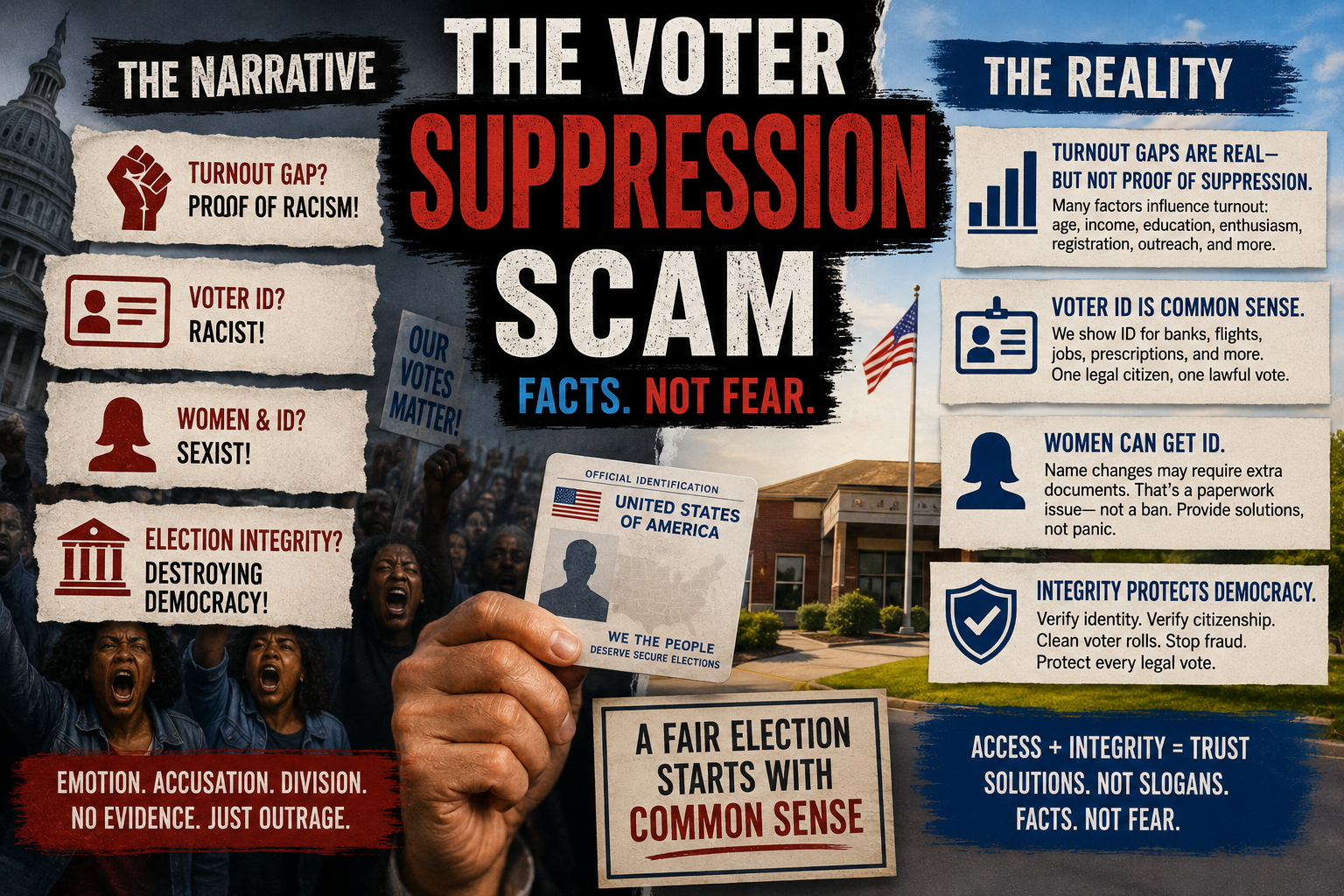
Every election cycle, the same tired scare campaign gets dragged out, dusted off and sold as moral emergency. Republicans support voter ID, proof of citizenship or tighter election rules. Democrats and activist groups immediately declare that democracy is under attack, minorities are being suppressed, women will be blocked from voting and America is sliding back toward Jim Crow. The latest version involves claims about racial turnout gaps and Justice Samuel Alito's use of Department of Justice data in a Voting Rights Act case. The argument goes roughly like this: Black turnout trails white turnout in recent presidential elections, especially in Louisiana, therefore Republicans are corrupt and trying to destroy democracy. That is not analysis. That is a slogan wearing a lab coat. A racial turnout gap may be real. It may deserve study. It may reflect party investment, voter enthusiasm, age, income, education, registration patterns or candidate appeal. But a turnout gap by itself does not prove voter suppression. It does not prove racism. It does not prove corruption. That is the trick: take a data point, attach a moral accusation, then act as if the accusation has been proven by the existence of the data.
A Gap Is Not a Crime Scene
There are turnout gaps across almost every demographic category in American elections. Older voters turn out more than younger voters. Married voters turn out more than unmarried voters. Homeowners often vote at higher rates than renters. People with higher incomes and more education tend to vote more than people with lower incomes and less education. None of those gaps automatically proves a conspiracy. They prove that different groups participate at different rates. That is basic political reality.
When an activist group says Black turnout trails white turnout, the first question should not be "who is the villain?" It should be "what does the data actually show and what explains the difference?" That requires looking at registration, age structure, citizenship status, residential stability, campaign outreach, local races, enthusiasm and whether voters believed the candidates were worth showing up for. It also requires asking whether the party claiming suppression did a good enough job persuading and mobilizing the voters it says were harmed. But that is not how the game is played. Instead, the gap gets converted into an accusation. The accusation becomes a headline. The headline becomes fundraising language. And the public is expected to accept the whole thing as settled proof that Republicans are destroying democracy.
Part of the dispute over turnout data involves methodology. The Guardian criticized the use of racial turnout calculations based on total adult population rather than eligible citizen voters. That is a legitimate methodological concern — using the wrong denominator can distort the comparison meaningfully. But jumping from "this calculation may be flawed" to "they are corrupt and destroying democracy" is a leap that requires its own landing strip. If the number is wrong, correct the number. If the denominator is bad, use a better one. Challenge the legal reasoning on its merits. But do not pretend every statistical disagreement is proof of corruption. That is not civic engagement. That is hysteria.
The Voter ID Panic Is Even Worse
The same dishonest pattern shows up with voter ID and proof-of-citizenship laws. We are told minorities cannot get ID. We are told poor people cannot get ID. We are told elderly people cannot get ID. Recently, we have been told that married women who changed their names may not be able to vote if proof-of-citizenship laws pass. That last one is where the argument crosses from concern into absurdity. Women get official identification every day. Women drive cars, board airplanes, cash checks, open bank accounts, get mortgages, buy homes, purchase firearms, work jobs, enroll in school, apply for benefits, get passports and interact with government agencies constantly. The idea that women as a class cannot navigate official identification is not only false. It is insulting.
The honest version of the concern is narrower. Some women who changed their names may have documentation mismatches — a birth certificate showing a maiden name while a current driver's license shows a married name. That can require a marriage certificate or other document to reconcile the records. That is a paperwork issue. So fix the paperwork process. Allow marriage certificates. Allow naturalization documents. Allow passports. Create a reasonable cure period. Train election workers. Make the process clear. Do not block eligible citizens because of a name-change technicality. That is a serious answer. Screaming that voter ID is sexist and women will be disenfranchised is not.
A burden is not automatically a ban. A documentation requirement is not automatically disenfranchisement. A paperwork mismatch is not proof of misogyny. Asking voters to prove citizenship before registering to vote is not an attack on democracy. It is a basic protection of it.
The "Fraud Is Rare" Argument Does Not End the Discussion
Another standard line is that voter fraud is rare, so voter ID and citizenship verification are unnecessary. That sounds reasonable until you consider how every other system in society works. Bank fraud is rare relative to the number of transactions, but banks still require identification. Airport hijackings are rare, but airports still require ID. Prescription fraud is rare, but pharmacies still verify identity. Tax fraud is not committed by most people, but the IRS still requires documentation. We do not eliminate safeguards because most people are honest. Election integrity works the same way.
The point of voter ID is not that every voter is a criminal. The point is that voting is important enough to verify. One legal citizen, one lawful vote. That should be the least controversial sentence in American politics. But somehow it has become controversial because one side benefits from treating basic verification as oppression. They do not want to debate whether a specific ID law is well written. They do not want to discuss whether states should provide free ID, mobile services, expanded DMV hours or better document-replacement systems. Those are practical questions that can be solved practically. Instead they jump straight to racism, sexism and democracy panic because those accusations shut down discussion. That is the goal.
Access and Integrity Are Not Enemies
A serious country can do two things at once. It can make voting accessible to eligible citizens and make fraud harder. Those goals are not contradictory. States should provide free or low-cost voter ID. They should help elderly citizens get documents. They should accommodate disabled voters. They should allow reasonable cure processes for name mismatches. They should ensure rural voters and tribal communities have workable access. They should make registration rules clear and predictable. And they should also verify identity, verify citizenship, maintain clean voter rolls, prevent duplicate registrations, remove people who are not eligible and enforce election laws.
That is not voter suppression. That is election administration. The problem is that activists have learned to frame any rule as suppression. Require ID — suppression. Check citizenship — suppression. Clean voter rolls — suppression. Limit ballot harvesting — suppression. Ask for signature matches — suppression. At some point the word loses meaning entirely. Real voter suppression is serious. If a state deliberately blocks eligible citizens from voting because of race, party or protected status, that should be exposed and stopped. But calling every election-integrity measure suppression cheapens the term, makes honest debate almost impossible and insults the voters it claims to protect.
When Democrats win, democracy has spoken. When Republicans win, democracy is in danger. When courts rule for progressive causes, the rule of law is sacred. When courts rule against them, the courts are corrupt. When states loosen voting rules, it is access. When states tighten them, it is authoritarianism. That is not principle. That is convenience. Democracy does not mean Democrats win. It does not mean every preferred policy gets protected by courts. It does not mean election rules can never be tightened. It means eligible citizens vote under lawful rules and the results are counted fairly. That requires access and integrity. The activists only want to discuss one side of that equation.
Why the Narrative Never Dies
The voter suppression argument works because it flatters the audience. It tells Democratic voters they are defenders of democracy. It tells activists they are civil rights warriors. It tells media outlets they are exposing injustice. It tells losing campaigns they did not fail to persuade people — they were robbed by suppression. It tells political professionals that every turnout problem can be blamed on Republican villainy rather than Democratic weakness. That is emotionally satisfying. But emotional satisfaction is not evidence.
Maybe a candidate failed to inspire voters. Maybe a party took voters for granted. Maybe turnout dropped because people were tired, disappointed or unconvinced. Maybe voters had other priorities. Maybe working-class voters of every race are less interested in elite democracy lectures than the people giving those lectures want to admit. Those possibilities require self-reflection. It is much easier to blame suppression. That is why the narrative never dies. It is too useful. It explains losses. It raises money. It energizes activists. It demonizes opponents. Useful does not mean true.
My Bottom Line
The claim that racial turnout gaps automatically prove corruption or democracy destruction is wrong. A turnout gap is a fact to investigate, not a verdict to announce. The claim that voter ID is racist or that women cannot obtain official identification is worse — it is the same tired panic dressed for a new election cycle. The sane position is simple: eligible citizens should be able to vote, ineligible people should not, states should make ID and documentation accessible, states should verify identity and citizenship, paperwork problems should be fixed and election integrity should not be demonized. That is where most normal Americans are. They do not want eligible citizens blocked. They also do not want elections run on the honor system.
The activist class refuses to accept that balance because balance does not help their narrative. They need villains. They need panic. They need every election rule to look like Jim Crow and every Republican judge to look like the end of democracy. It is dishonest and voters should stop falling for it.
Asking someone to prove who they are before they vote is not destroying democracy. It is part of preserving it. Any honest adult who thinks about it for thirty seconds already knows that.
Why This Matters
Trust in elections is not built by screaming "democracy" every time someone proposes a safeguard. Trust is built when citizens believe the system is fair, accessible and secure. If eligible voters face legitimate barriers, fix them. If documentation rules are confusing, simplify them. If elderly voters, rural voters or married women with name changes need a clearer process, give them one. But do not pretend that every request for verification is oppression. A republic cannot function when one side treats election security as racism and the other side treats every loss as fraud. Both habits are destructive. The country needs election rules that are fair, clear and enforceable. It needs voters who can trust the process. And it needs adults willing to say the obvious.
References
- Brennan Center for Justice. (2026). New SAVE Act bills would still block millions of Americans from voting. brennancenter.org.
- U.S. Census Bureau. (2025). 2024 presidential election voting and registration tables. census.gov.
- FactCheck.org. (2025). Will SAVE Act prevent married women from registering to vote? factcheck.org.
- The Guardian. (2026). Samuel Alito's Voting Rights Act ruling cited misleading DOJ data.
- PolitiFact. (2026). SAVE America Act and women voters. politifact.com.
- U.S. Citizenship and Immigration Services. (2026). SAVE: Systematic Alien Verification for Entitlements. uscis.gov.
Disclaimer: The views expressed in this post are opinions of the author for educational and commentary purposes only. They are not statements of fact about any individual or organization, and should not be construed as legal, medical, or financial advice. References to public figures and institutions are based on publicly available sources cited in the article. Any resemblance beyond these references is coincidental.