
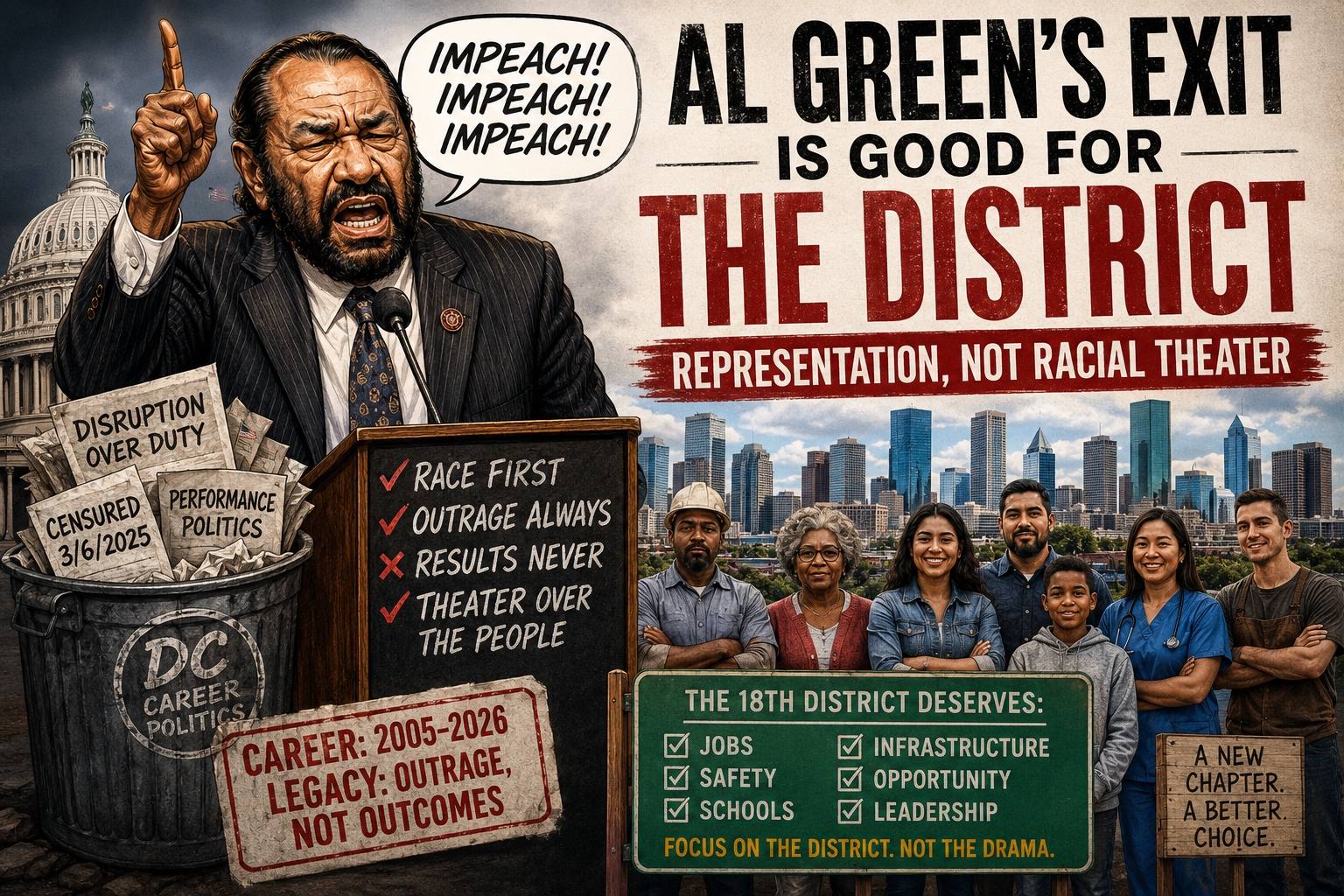
Al Green's defeat in the Democratic runoff for Texas' newly redrawn 18th Congressional District is not just a political changing of the guard. It is a mercy killing for a district that deserves better than performative outrage, racial grievance politics and a congressman whose public brand became less about representation and more about resistance theater. Green has been in Congress since 2005. That is more than two decades in Washington. In that time he became known less for solving district-level problems and more for making himself one of the loudest anti-Trump voices in the Democratic Party. That may thrill cable-news audiences and progressive activists, but a congressional district is not supposed to be a stage prop for one man's crusade. It is supposed to be represented by someone focused on jobs, public safety, infrastructure, schools, housing and the daily reality of the people who actually live there. Christian Menefee's victory represents voters saying they are ready to move on from a style of politics that confuses noise with courage and resentment with leadership.
The Long Career of a One-Note Politician
Green's congressional career did not begin as a Trump-era spectacle. Before Congress he had a background in law, civil rights advocacy and local public service, and there is no need to pretend the man never did anything worthwhile. He represented Houston-area voters for years and spoke often about housing, discrimination, financial services and social programs. Those are legitimate issues that a district with working-class families, minority communities and real economic challenges deserves to have taken seriously. The problem is that Green's public identity became increasingly trapped in a politics of accusation.
During Trump's first term, Green became one of the earliest and loudest voices calling for impeachment. In 2017, before the Mueller report, before the Ukraine impeachment and before January 6, he was already introducing articles of impeachment, citing Trump's public statements and arguing that rhetoric was impeachable. He did not wait for a specific constitutional crisis. He treated Trump's political style as impeachable from the beginning. That became the model. Every dispute was moralized. Every disagreement became a threat to democracy. Every political fight became a civil rights emergency. That kind of politics loses its force over time because it treats normal democratic conflict as though it is always one step from tyranny. It also insults voters who disagree by implying that their choices are not merely wrong but morally corrupt.
A representative can oppose Trump. A representative can oppose Republicans. A representative can disagree strongly with immigration policy, welfare reform, tax cuts, foreign policy or judicial appointments. But when a politician makes racial accusation and moral panic the default setting, he stops persuading and starts performing. A congressional seat exists to serve a district, not to provide one man with a national platform for his grievances. Green lost track of which one was the purpose.
Racial Double Standards by Any Other Name
Green's public behavior has consistently framed political disagreement through the lens of racial hostility. That does not mean racism never exists. It obviously does. It does not mean Trump or Republicans are above criticism. They are not. But Green's approach routinely skipped past evidence and went straight to accusation. When every Republican action is treated as an assault on minorities, the word racism loses meaning. When every conservative policy dispute becomes proof of hatred, public debate becomes impossible. When a representative turns race into a standing accusation rather than a serious charge requiring evidence, he harms the very cause he claims to defend.
This is the difference between fighting racism and using racism as a political club. Actual racism should be confronted directly and without hesitation. Racial discrimination should be exposed. Unequal treatment under the law should be challenged. But disagreements over Medicaid, immigration, crime, school choice, policing, taxes and border security are not automatically racial animus. Sometimes people disagree because they have different ideas about government, responsibility, law, economics or public safety. Green's style too often refused to allow that possibility. That is not principled. It is politically corrosive, civically unhealthy and bad for the district he claimed to represent.
The Disruptions Were Theater, Not Courage
The clearest example came when Green disrupted Trump's address to Congress in March 2025. He stood, shouted that Trump had no mandate to cut Medicaid, refused to sit down and was removed from the chamber. The House later voted to censure him. Green defended the behavior as moral courage. It was not. Members of Congress have microphones, staff, committees, press access, floor speeches, interviews, op-eds, town halls, hearings and votes. They have more avenues to speak than almost anyone in America. Shouting during a presidential address is not some last desperate act of the voiceless. It is a stunt by one of the most powerful elected officials in the country.
Green did not expose a hidden injustice by shouting. He did not save Medicaid by waving his outrage in front of the cameras. He reminded voters that for some politicians, the performance is the product. Standards do not become optional because the target is Trump.
A member of Congress is part of the institution. He has a duty to conduct himself with at least some respect for the chamber, even when he despises the president. If Republicans had behaved the same way during a Democratic president's address, Green and his allies would not have called it courage. They would have called it disgraceful and dangerous. They would have been right. The standard applies regardless of who is sitting in the chair.
Impeachment as Personal Branding
Impeachment is supposed to be a grave constitutional remedy, not a personal brand, a fundraising message or a recurring press conference. For Green it became a signature issue. He pushed for Trump's impeachment early, often and repeatedly, and his defenders called that consistency. A more honest reading is that he helped normalize the idea that impeachment could be used as a permanent weapon of opposition politics. That did real damage. When impeachment becomes just another partisan tool, the public stops treating it as serious, and the next real constitutional crisis is harder to address because voters have already been trained to see it as a political tantrum. Green was not alone in that abuse. But he made himself one of the most visible faces of it, and he seemed to believe that being first and loudest made him principled. It made him predictable.
The District Needs Representation, Not Symbolism
The 18th District needs a member of Congress who is grounded, practical and focused on the people who live there. Houston-area voters have real problems. They need economic development, safer communities, competent constituent services, schools that work and infrastructure that does not fall apart. They need federal representation that brings resources home without turning every issue into a cable-news sermon. The problem with politicians like Green is that they become so attached to the moral drama of national politics that local needs get treated as background scenery. The district becomes a platform rather than the purpose.
A congressional seat is not meant to provide a stage for one politician's identity. It exists to serve the people who live there — Democrats, Republicans, independents, conservatives, liberals, voters of every background, business owners, workers, retirees and young families trying to build something better. A representative who sees everything through racial and partisan categories cannot serve that whole district well. Not because race never matters. Because race is not the only thing that matters.
My Bottom Line
Al Green had a long career. He had supporters. He had moments where his advocacy aligned with real concerns in his community. But longevity is not the same as effectiveness and passion is not the same as wisdom. His political style became too racialized, too performative and too tied to opposition for opposition's sake. He treated Trump not just as a president to oppose but as the central organizing principle of his own public identity. He used impeachment too casually, disruption too comfortably and racial accusation too freely. That may energize a narrow base. It does not build a healthy civic culture.
Green's loss is not a tragedy. It is a correction. After more than twenty years, the voters of the 18th District decided they wanted a member of Congress who can fight for the district without turning every disagreement into a racial indictment and every political moment into a stunt. Whether Menefee delivers on that is something voters will judge by his record. But the door is at least open now in a way it has not been for two decades.
A republic needs representatives, not performers. The 18th District finally voted for the distinction. That alone is progress worth noting.
Why This Matters
American politics is full of people who confuse outrage with leadership. They learn that if they shout loudly enough, accuse broadly enough and perform dramatically enough, they can build a career without solving much of anything. That is bad for Congress, bad for voters and bad for the country. Green's defeat is a reminder that even long careers eventually run into voter fatigue. People may tolerate theatrical politics for a while, especially when it flatters their side. But eventually voters want more than slogans, more than confrontation and more than another elected official auditioning for the next viral clip. That is not a Republican observation. It is a civic one.
References
- Associated Press. (2026). Rep. Christian Menefee defeats Rep. Al Green in primary runoff fueled by redistricting.
- Houston Chronicle. (2026). Christian Menefee defeats Al Green in Texas' newly redrawn 18th Congressional District primary.
- Texas Tribune. (2017). U.S. Rep. Al Green, Houston Democrat, unveils articles of impeachment against Trump. texastribune.org.
- Texas Tribune. (2025). House votes to censure Rep. Al Green for disrupting Trump speech. texastribune.org.
- U.S. House Clerk. (2025). Roll Call 62, H. Res. 189, Censuring Representative Al Green of Texas. clerk.house.gov.
- C-SPAN. (2025). Rep. Al Green is ejected for protesting during President Trump's joint speech. c-span.org.
Disclaimer: The views expressed in this post are opinions of the author for educational and commentary purposes only. They are not statements of fact about any individual or organization, and should not be construed as legal, medical, or financial advice. References to public figures and institutions are based on publicly available sources cited in the article. Any resemblance beyond these references is coincidental.