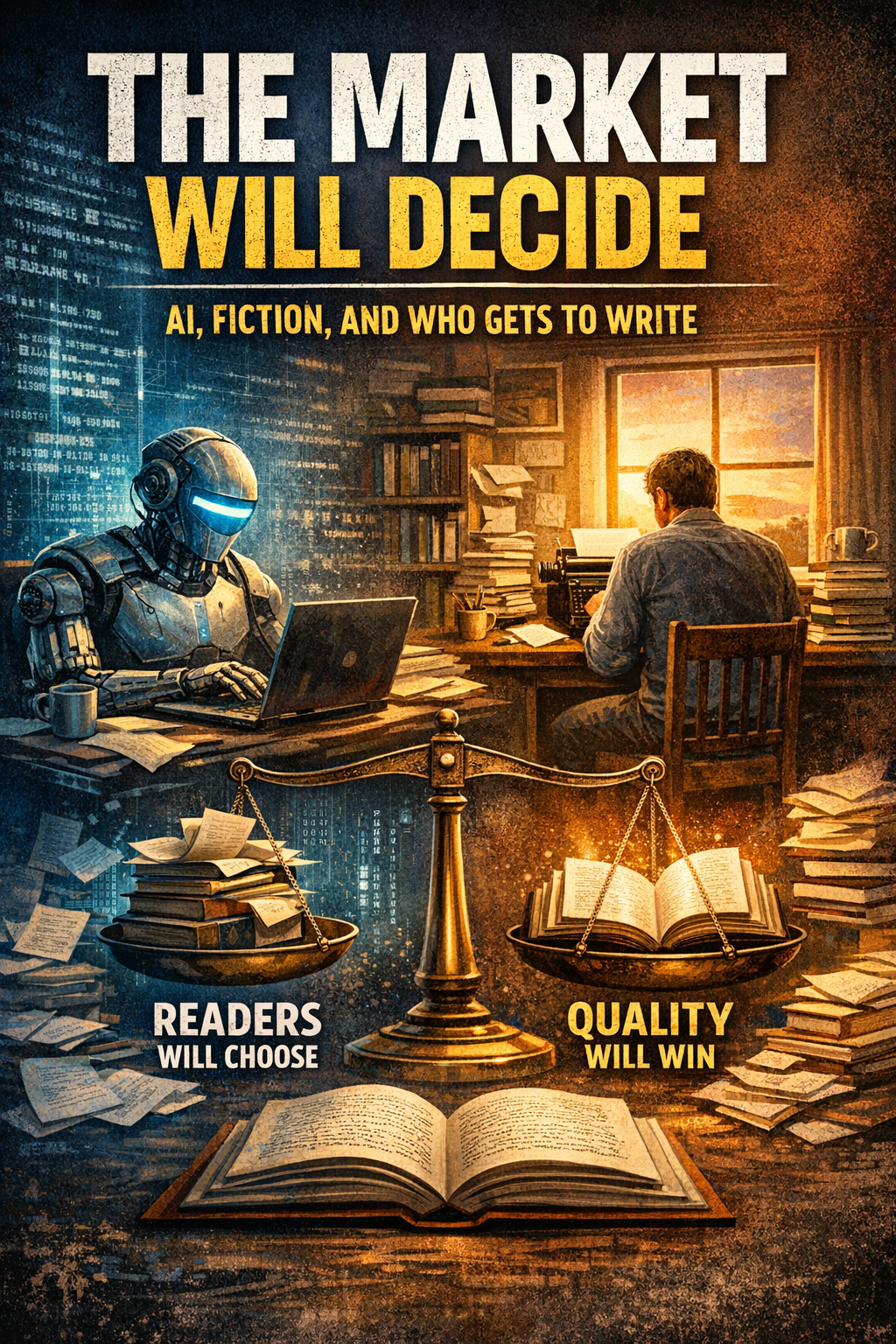
The market and the readers will ultimately decide. They always have. Publishing has never been a pure meritocracy and it has never been free of junk. Long before artificial intelligence showed up, readers were already sorting through ghostwritten books, formula fiction, vanity press disasters, trend-chasing knockoffs, celebrity titles propped up by marketing and a mountain of forgettable self-published work. Most of it disappeared because readers did what readers always do: they separated what was worth their time from what was not. That is why so much of the current panic over AI in fiction feels overheated. I understand the concern. I understand why writers worry about originality, labor, ethics and the value of human craft. But too much of this conversation has turned into a moral panic fueled by stigma, fear and a false confidence that people can reliably tell what was AI-assisted and what was not. They often cannot.
As someone who has taught college students, I have watched AI detectors flag writing as mostly AI when it was not. That experience alone makes me skeptical of the certainty with which some people now accuse others. We are pretending there is a clean line where there often is not. And we are pretending that markets need gatekeepers to protect readers from bad books when readers have been doing that job themselves for generations. AI lowers the barrier to entry. It speeds up parts of the process. It allows more people to draft, revise, brainstorm and publish. That will create more competition and more junk. But that does not mean readers lose. It means the old filters lose some control.
Publishing Was Already Crowded Before AI
One of the strangest things about the AI argument is how often people talk as if publishing used to be some clean system where quality naturally rose to the top. It was never that simple. Publishing has always been crowded. Bookstores have always been full of filler. Amazon was already flooded with weak self-published titles before generative AI entered the picture. Readers have always dealt with overhyped books, derivative books and books that sold because of branding rather than brilliance. None of that began with ChatGPT. So when people say AI will flood the market with low-quality work, the honest answer is: compared to what? The flood was already here. AI may widen it, but it did not invent it.
That matters because it shifts the real question. The issue is not whether more bad books will exist - they already do. The issue is whether readers can still identify what is good. Of course they can. Maybe not instantly, maybe not perfectly, but over time they do. Word of mouth still matters. Reviews still matter. Reader loyalty still matters. Books that connect tend to survive. Books that do not tend to sink. The market is not flawless, but it is still better at sorting quality than ideological scolding is.
The flood was already here before AI arrived. The question was never whether more bad books would exist. They already did. The question is whether readers can still find what is good. They can. They always could.
The Stigma Runs Ahead of the Evidence
There is no point pretending otherwise: AI use in fiction carries a stigma. Some readers view any AI involvement as contamination. Some writers treat even limited use as a kind of artistic fraud. Publishers are increasingly nervous about public blowback. That anxiety is not abstract. In March 2026 Hachette canceled U.S. publication and pulled the U.K. edition of the horror novel Shy Girl after allegations that portions of the book were AI-generated, showing just how combustible this issue has become. But the stigma often runs well ahead of the evidence, and that is where the debate starts to go off the rails.
Many people talk as if AI use can be spotted with confidence from prose alone - repetitive phrasing, generic transitions, flat emotional texture, awkward beats. Fair enough. Those may be clues. But clues are not proof. Plenty of human writing is repetitive. Plenty of human writing is flat. Plenty of weak fiction sounds mechanical without a machine ever touching it. Even Turnitin, one of the best-known detection tools in education, explicitly says false positives are possible and that instructors must use judgment rather than treat a score as proof of misconduct. Academic guidance has repeatedly warned that both software-based and human-based detection can produce false positives and false negatives. Detectors can be wrong. Humans can be wrong. And once accusation becomes social sport, people stop asking whether they actually know anything.
A 2025 report covered by Publishers Weekly found that among fiction authors surveyed, only 42 percent said they use AI at least sometimes. Among those who do use it, 87 percent said it boosts productivity and 60 percent said it improves quality. Only 11 percent of fiction authors using AI said they use it to create publishable text directly - the most common uses were brainstorming, search and finding the right wording. Meanwhile fiction writers who do not use AI were reported to be nearly unanimous in their hostility toward it. That tells us two things: many writers are already using AI in practical and limited ways whether critics like it or not, and the loudest opposition is not just about protecting art. It is also about protecting status, scarcity and professional advantage.
A Lot of the Backlash Is About Fear
Writers are not saints. They are workers. They are professionals. They are also human beings protecting turf. That does not make their concerns fake, but it does mean we should be honest about motive. When people in any trade see a new technology lowering barriers to entry, they worry about being undercut. They worry about being crowded out. They worry that something they spent years mastering is about to be diluted by a faster, cheaper and more scalable process. That fear is understandable. It is also predictable - and it has appeared at every previous technological shift in media and publishing without the sky actually falling.
Some objections are genuinely principled. Some writers simply do not want machine assistance in their creative process, and that is their right. But once that personal preference becomes a demand that the whole field stop evolving, the argument starts to look less like ethics and more like labor panic wrapped in artistic language. The distinction matters because conflating the two produces bad policy, bad accusation and a cultural conversation that is more about protecting incumbents than protecting readers.
What Really Scares People: Lowered Barriers to Entry
This is the part many critics do not want to say out loud. AI makes it easier for more people to attempt a book. That does not mean every attempt will be good. It does mean that someone with imagination, persistence and limited technical polish now has more tools than before. They can brainstorm faster, build outlines faster, test scenes faster, sharpen dialogue, summarize research and revise with less friction. Jane Friedman's current publishing FAQ notes that using AI to research, brainstorm, generate outlines or edit your own work does not affect copyright in the underlying human-written work. That means AI-assisted writing is already within the normal range of activity many working writers are exploring, and the legal world is quietly adjusting to that fact while the cultural argument rages on.
The real threat, from the standpoint of anxious writers, is not that AI will create masterpieces on its own. The real threat is that it will help more beginners become competent faster. Most of those beginners will still write bad books. Some will write mediocre ones. But a few will get better and a few will become genuinely good - and they will do it without waiting for the traditional bottlenecks that used to slow them down. That is what changes the game. Not just more content, but more access to the process of becoming a writer at all.
A boring human-written novel does not become noble because no software touched it. A compelling AI-assisted novel does not become unreadable because the author used help during outlining or revision. Readers may have preferences around process, but their deepest loyalty is still to outcome.
Readers Care About Results More Than Purity Tests
Readers are not all the same. Some will care deeply about AI. Some will avoid any book touched by it. Some will demand labeling and disclosure, and transparency will probably become more common. The Authors Guild has pushed for stronger disclosure of training data and clearer labeling of AI outputs so consumers can make informed choices. A 2025 YouGov collaboration reported that transparency about AI use was strongly preferred by American readers.
But the larger point remains: most readers care first about whether a book is good. Most readers care first about whether a book is good - whether it holds them, moves them and earns the next recommendation. Their deepest loyalty is to outcome, not process. That is why the market matters more than purity policing. Readers are not idiots. They may be fooled by hype for a while, but they generally do not stay loyal to books that feel lifeless, generic or hollow. If AI makes it easier to produce lifeless slop, fine - readers will dump it. If AI helps a sharp and creative writer get to a strong finished product faster, readers may not care nearly as much as the activists on social media do.
My Bottom Line
Publishing was already unequal, already noisy and already full of formula before any of this started. AI did not corrupt a pure system. It entered a messy one. Pretending every accusation of AI use is reliable, treating detectors like literary breathalyzers and confusing personal dislike with actual evidence - none of that protects art. It just produces bad accusations and protects the wrong people.
The argument over AI in fiction is really an argument about who gets to create, who gets to compete and who gets to decide what counts as legitimate work. If we hand that authority to bad detectors, social media mobs or self-appointed cultural referees, we will punish the wrong people and protect the wrong standards. If we let readers judge the actual work, quality still has a chance to rise above the noise. Inferior work existed before AI and it will exist after AI. The difference now is that more people can produce faster, publish faster and compete faster. That is what has many writers rattled. Some of the pushback is principled. Much of it is fear. Fear is understandable. It should not be mistaken for a timeless defense of art.
The reader will sort it out. That is not a perfect system. It is just better than panic.
References
- Authors Guild. (2025, March 19). Authors Guild submits guidance for national AI action plan to protect writers' rights.
- Authors Guild. (2026). Artificial Intelligence. authorsguild.org.
- Friedman, J. (2026, March 24). AI and publishing: FAQ for writers. janefriedman.com.
- Publishers Weekly. (2025, November 5). New report examines writers' attitudes toward AI.
- Turnitin. (2023, March 16). Understanding false positives within our AI detection capabilities.
- Turnitin. (2026, March 6). Using the AI writing report.
- YouGov. (2025, August 6). Do Americans want to read AI books?
- The Guardian. (2026, March 20). Hachette pulls horror novel Shy Girl after suspected AI use.
- The Wall Street Journal. (2026, March 20). Publisher pulls Shy Girl horror novel after AI allegations.
Disclaimer: The views expressed in this post are the personal opinions of the author and are offered for educational, commentary and public discourse purposes only. They do not represent the positions of any institution, employer, organization or affiliated entity. Nothing in this post constitutes legal, financial, medical or professional advice of any kind. References to publications, surveys, legal guidance and current events are based on publicly available sources cited above and are intended to support analysis and argument. Commentary on publishing, technology and cultural subjects reflects the author's independent analysis and is protected expression of opinion. Readers are encouraged to consult primary sources and form their own conclusions.