The post was not brave. It was manipulative. It tried to shame Muslim American men into performative online activism by wrapping guilt, fear and religious language around one political demand. Its core message was simple: if you are not publicly amplifying images and slogans, you are spiritually weak, worldly and ungrateful. That is not moral clarity. That is emotional blackmail. Worse, it pointed Muslim men in the wrong direction. If someone wants to talk seriously about fear, cowardice and moral duty, start with the Islamic Republic of Iran and the network of terrorists, militias and proxies it has armed, financed and trained since the 1979 revolution. Iran remains designated by the United States as a state sponsor of terrorism, and U.S. government reporting continues to document its support for Hezbollah, Hamas, the Houthis and other Iran-aligned militias across the region. That is where the conversation about moral courage should begin.
The Post Was Trying to Shame Men, Not Persuade Them
The writer was not making a careful moral argument. He was trying to corner Muslim men by saying that unless they face extreme personal risk, their silence proves spiritual rot. He invoked religion not to enlighten but to intimidate. He reduced a complicated public, political and professional reality to a crude test of manhood and faith. That is a tell. Serious people persuade. Agitators shame. They do not ask whether a claim is wise, true or strategically sound. They ask whether you are weak enough to refuse them. The premise that Muslim men owe their conscience to a political script is not a religious argument. It is a demand for tribal conformity dressed in religious language, and Muslim men should reject it on exactly those grounds.
If You Want to Condemn Evil, Start With Iran's Record
Since the 1979 revolution, Tehran has built and sustained a regional armed network through the Islamic Revolutionary Guard Corps and the Qods Force. The Wilson Center documents Iran providing arms, training and financial support to militias and political movements across the region. The Council on Foreign Relations describes a long-running Iranian network including Hezbollah, the Houthis and other partners used to project influence and threaten the United States and its allies. The State Department's terrorism reports have consistently identified Iran as a state sponsor of terrorism, and Treasury has repeatedly sanctioned networks tied to the IRGC-Qods Force, Hezbollah and Hamas financing - including a major financial network sanctioned in early 2024 and senior Hamas leaders and financiers targeted in late 2024.
So no, the moral center of this discussion is not whether Muslim men in America liked enough posts on social media. The moral center is whether they are willing to condemn a regime that has spent nearly half a century exporting violence through proxies while hiding behind religion. That is the harder test. That is the one that actually costs something.
Serious people persuade. Agitators shame. They do not ask whether a claim is wise, true or strategically sound. They ask whether you are weak enough to refuse them.
October 7 Was Not Resistance. It Was Terror.
If someone wants Muslim men to show moral seriousness, here is a place to begin: condemn October 7 without hedging, throat-clearing or euphemism. The State Department has described the October 7 attack as one in which more than 1,200 people were murdered and 254 were taken hostage. Those are not the numbers of some vague border clash. That was mass murder and mass kidnapping carried out in a single morning. A UN mission subsequently found reasonable grounds to believe that conflict-related sexual violence - including rape and gang rape - occurred during the October 7 attacks and in their aftermath. A separate UN report warned that misinformation and disbelief around these acts risked silencing victims. A man who can work himself into a fever over public silence on one issue but cannot plainly condemn October 7 is not calling others to courage. He is advertising his own moral inversion.
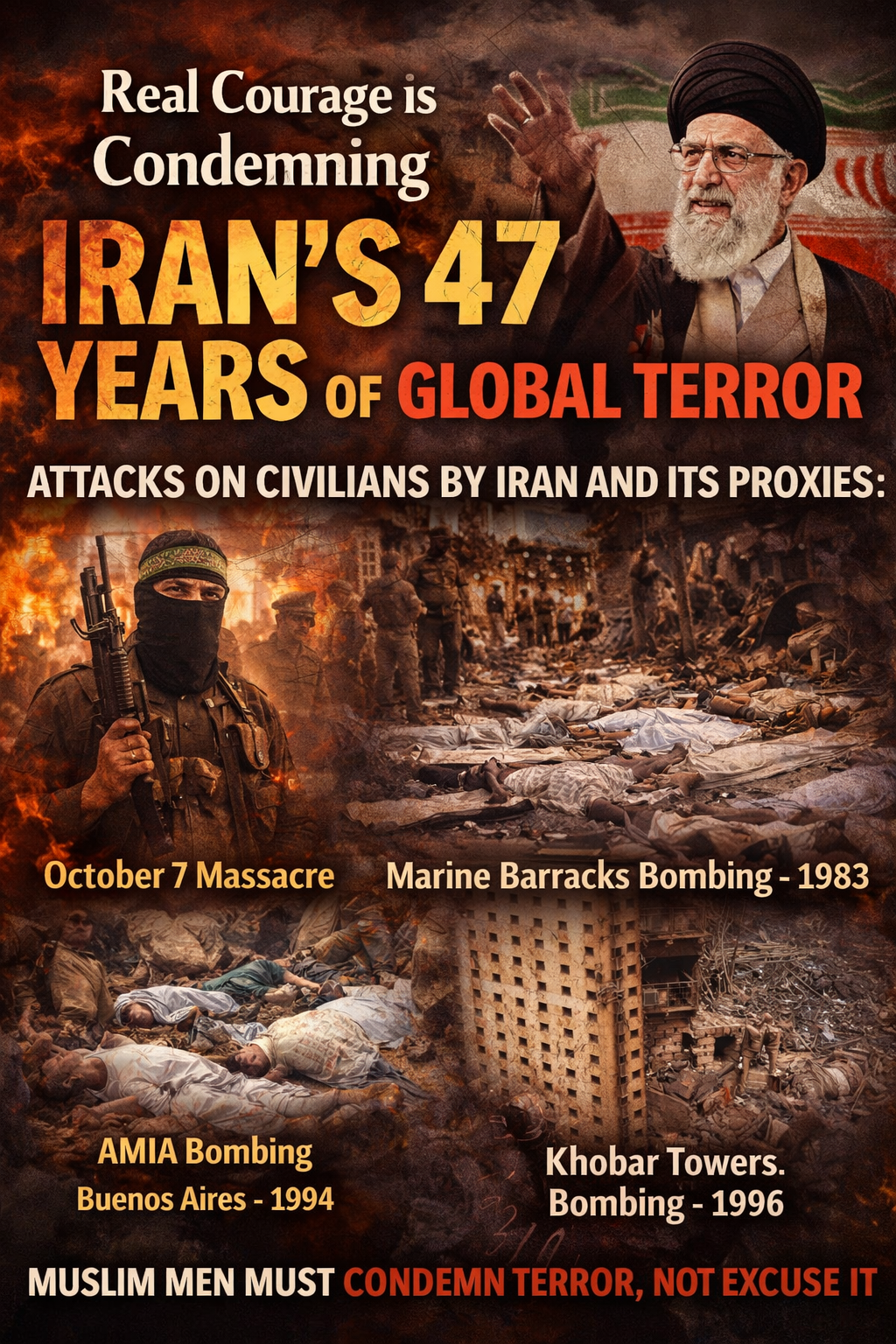
Iran's terror footprint did not start in 2023. Hezbollah, Iran's most notorious proxy, carried out the 1983 Marine barracks bombing in Beirut that killed 241 U.S. service members according to State Department and U.S. military commemoration records. In 1996 a truck bomb at Khobar Towers in Saudi Arabia killed 19 Americans and wounded hundreds more - the FBI announced terrorism charges against members of pro-Iran Saudi Hezbollah for that attack. In 1994 the AMIA bombing in Buenos Aires killed 85 people in the deadliest terrorist attack in Argentine history. The State Department has stated that Iran, as Hezbollah's patron, wanted to attack Argentina. Add to that Iran-backed Houthi financing networks documented by Treasury, the broader web of Iran-aligned militias operating from Lebanon to Iraq to Yemen and the pattern requires no interpretation. It is what it is.
Muslim Men Should Not Be Bullied Into Sectarian Propaganda
There is something insulting in the original post's premise. It treats Muslim American men as if their duty is to prove themselves through public displays that fit one ideological lane. It assumes that if they do not echo a specific emotional script, they are traitors to God. That is nonsense. Muslim men are citizens, fathers, husbands, workers and thinkers. They can grieve civilian deaths. They can oppose war. They can care about Palestinians, Israelis, Iranians, Lebanese and everyone else caught in these conflicts. They can refuse to turn their conscience into a propaganda feed. They do not owe online absolutists a loyalty oath. And they certainly do not owe silence about Iran's role in producing the conditions that have killed so many of the people those absolutists claim to mourn.
Real Courage Means Saying What the Agitators Do Not Want to Hear
Here is what actual moral courage looks like in this context. It means saying Iran's rulers have brutalized their own people while funding violence abroad. It means saying Hezbollah is not noble. Hamas is not noble. The Houthis are not noble. Murdering civilians, kidnapping families, bombing military barracks, targeting Jews in Argentina and terrorizing shipping lanes do not become righteous because someone wraps them in theology or grievance. It means refusing the cheap trick where every demand for moral clarity is directed outward, never inward. The post wants Muslim men to fear being seen as weak for not posting enough. They should fear something else instead: becoming so tribal that they can no longer call evil by its name when the perpetrators claim to act for their side. That is the real spiritual failure. Not silence on social media. Silence about the terror machine operating in the name of the faith.
Condemn the murder of civilians. Condemn rape and hostage-taking. Condemn the use of religion to sanctify terror. Condemn the regimes and proxies that have made a career out of all three. That is not betrayal. That is backbone.
My Bottom Line
The man in that post was not summoning courage. He was summoning conformity. Muslim men do not need to be hectored into social media rituals to prove they have souls. They need the freedom and the honesty to reject blood-soaked movements that hide behind religion. That starts with condemning Iran's 47-year record of terrorism and proxy warfare - not excusing it, minimizing it or changing the subject. Since the 1979 revolution Tehran's regime has built a regional apparatus of coercion and terror that includes support for Hezbollah, Hamas, the Houthis and other aligned militias, documented in detail by U.S. government reports, Treasury sanctions and the body counts left behind at Beirut, Khobar, Buenos Aires and beyond.
Guilt-driven identity politics ruins moral judgment. It trains people to ask not what is true but what they are required to signal. That is how terrorism gets laundered, atrocities get relativized and men get pressured into parroting narratives they would reject if they were thinking clearly. If a man cannot plainly condemn October 7, Hezbollah's long terror record, Khobar Towers, the AMIA bombing and Iran's decades of proxy violence, then he has no business lecturing anyone else about courage.
The better standard is simple. Condemn the murder of civilians. Condemn rape and hostage-taking. Condemn the use of religion to sanctify terror. Condemn the regimes and proxies that have made a career out of all three. That is not betrayal of your community. That is the only kind of moral seriousness worth having.
References
- Council on Foreign Relations. (2026). Iran's Regional Armed Network.
- Federal Bureau of Investigation. (2001, June 21). Terrorism charges brought against 13 members of pro-Iran Saudi Hizballah.
- Office of the Special Representative of the Secretary-General on Sexual Violence in Conflict. (2024, March 4). Mission Report: Official Visit to Israel and the Occupied West Bank. United Nations.
- United Nations. (2024, March 11). Reasonable grounds to believe conflict-related sexual violence occurred during October 7 attacks.
- United Nations Human Rights Council. (2024, June 10). A/HRC/56/CRP.3.
- U.S. Department of State. (2025). Two-year anniversary of October 7th attack.
- U.S. Department of State. (2024). Country Reports on Terrorism 2023.
- U.S. Department of State. (2026). State Sponsors of Terrorism. Bureau of Counterterrorism.
- U.S. Department of State. (2019, July 12). Commemoration of the 25th anniversary of the terrorist bombing of the AMIA in Buenos Aires.
- U.S. Department of State. (2020, October 23). On the anniversary of the Marine barracks terrorist attack.
- U.S. Department of the Treasury. (2021, June 10). Treasury sanctions network financing Houthi aggression and exploiting Yemeni civilians.
- U.S. Department of the Treasury. (2024, January 31). Treasury sanctions Iranian IRGC-QF and Hizballah financial network.
- U.S. Department of the Treasury. (2024, October 7). Treasury targets significant international Hamas fundraising network.
- U.S. Department of the Treasury. (2024, November 19). Treasury targets key Hamas leaders and financiers.
- Wilson Center. (2023, September 12). Iran's Islamist Proxies in the Middle East.
Disclaimer: The views expressed in this post are the personal opinions of the author and are offered for educational, commentary and public discourse purposes only. They do not represent the positions of any institution, employer, organization or affiliated entity. Nothing in this post constitutes legal, financial, medical or professional advice of any kind. References to public figures, institutions, historical events and government reports are based on publicly available sources cited above and are intended to support analysis and argument. Commentary on religious, political and geopolitical subjects reflects the author's independent analysis and is protected expression of opinion. This post critiques a specific rhetorical approach and named terrorist organizations and state actors; it makes no claims about Muslim Americans as a group beyond those explicitly stated. Readers are encouraged to consult primary sources and form their own conclusions.