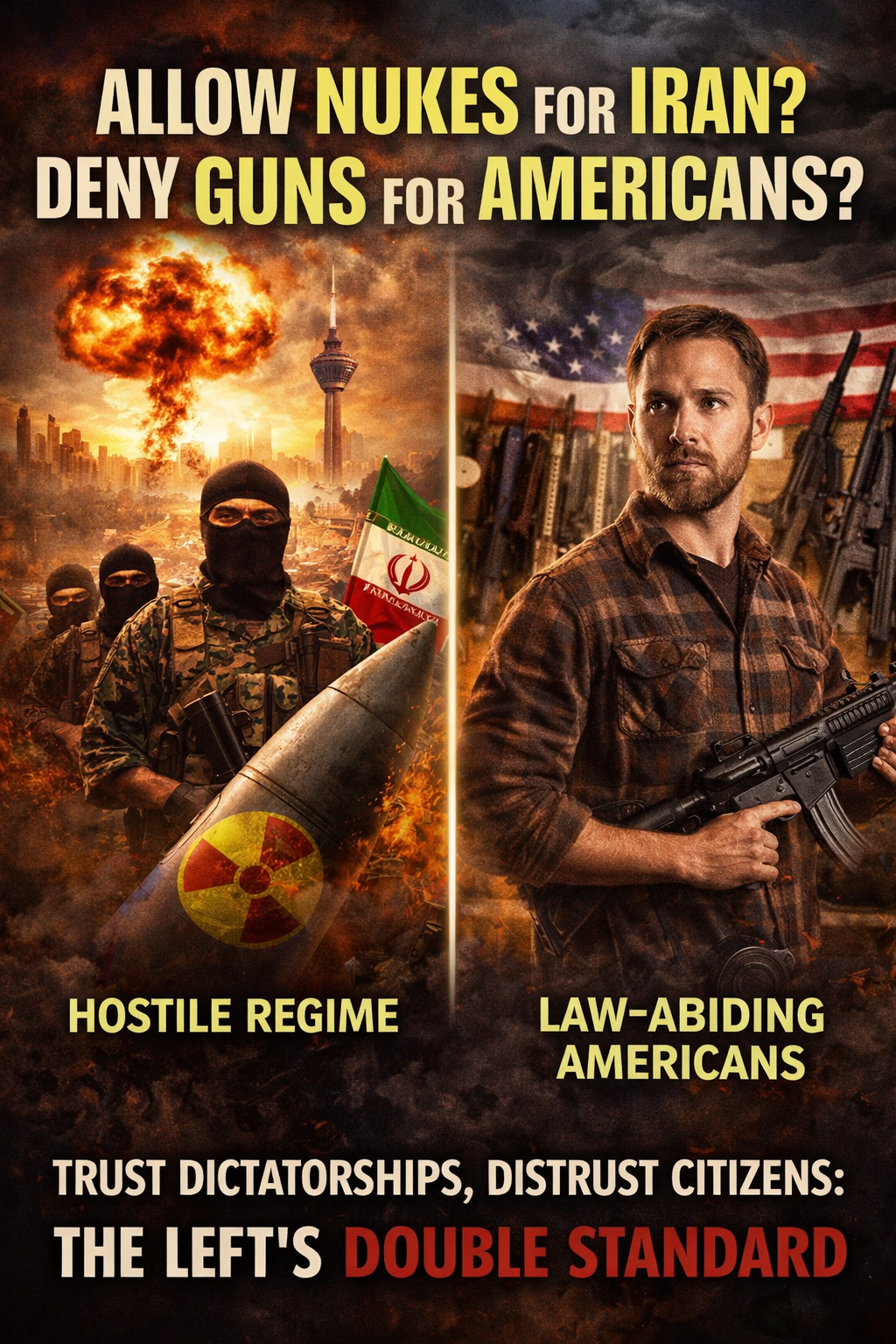
There is a simple point buried inside a lot of the gun control debate, and it deserves to be said plainly. If a person is comfortable with Iran moving toward nuclear capability - or shrugs at the danger - but is deeply offended by law-abiding Americans owning firearms, that is not a coherent worldview. It shows a mindset that fears ordinary citizens more than it fears violent regimes, and that tells you a great deal about where modern progressive politics has ended up. The question at the center of this is straightforward: who is more trustworthy with force - a hostile theocratic state with a documented history of repression, proxy violence and anti-American rhetoric, or an American citizen who passes a background check, follows the law and wants the ability to defend home and family? For a lot of people on the political left, the answer seems upside down.
The Left Fears the Wrong People
Many of the same people who treat the Second Amendment like a historical mistake are strangely evasive when it comes to foreign threats. They can work themselves into a moral panic over a citizen owning a rifle, yet discuss hostile states in the language of nuance, diplomacy and context as though the real danger is American overreaction. The law-abiding gun owner is not building centrifuges in a mountain bunker. He is not funding terror proxies across the Middle East. He is not chanting death to entire nations. He is not jailing dissidents or crushing women's rights or trying to leverage weapons capability into geopolitical blackmail. He is a citizen exercising a constitutional right that exists precisely because free people are not supposed to depend entirely on the state for protection.
Yet somehow the American citizen is the one progressives instinctively distrust. That tells you the issue is not really safety. It is control. The political left is generally comfortable with concentrated power when it is held by governments, bureaucracies or approved international institutions. What makes them uneasy is power in the hands of ordinary people who are outside their management. A rancher in Colorado with a locked gun safe does not fit into any framework they can regulate, credential or approve, and that is the problem they are actually trying to solve.
The American citizen gets suspicion. The hostile regime gets analysis. The citizen gets regulation. The regime gets patience. That is not wisdom. That is moral inversion, and the country is worse for having normalized it.
The Second Amendment Was Never About Hunting
This is another point too many people either miss or deliberately ignore. The right to keep and bear arms was not written into the Constitution so a man could go deer hunting on the weekend. The deeper principle is that a free people retains the means of defense. The founders did not assume government would always be wise, restrained or benevolent. They knew better because they had lived under power. Madison wrote in Federalist No. 46 that the advantage Americans had over other nations was the existence of a well-regulated militia backed by citizens with arms - that a government afraid of an armed citizenry was constrained in ways no parchment barrier alone could achieve. Hamilton made a parallel argument in Federalist No. 29. These were not romantic gestures toward frontier life. They were hard-headed observations about the relationship between armed citizens and accountable government.
The left likes to pretend civilian firearm ownership is an outdated relic from a primitive age. It is not. It is a permanent recognition of human nature and political reality. Governments can fail. Police cannot be everywhere. Civil order can fracture faster than anyone expects. History does not support the fantasy that disarmed populations are safer simply because the state promises to take care of them. The 20th century alone produced enough counterexamples to settle that question permanently for anyone willing to look at it honestly.
In District of Columbia v. Heller (2008), the Supreme Court held that the Second Amendment protects an individual right to possess firearms independent of service in a militia, and that this right includes keeping a handgun at home for self-defense. In McDonald v. City of Chicago (2010), the Court incorporated that right against state and local governments through the Fourteenth Amendment. These are not fringe interpretations. They are the settled constitutional law of the United States, decided by the highest court in the country. Arguments that treat civilian firearm ownership as a policy choice subject to straightforward prohibition are not engaging with the legal reality. They are arguing against a constitutional right that has been affirmed twice at the Supreme Court level within the last two decades.
A Nuclear Iran Is Not Comparable to an Armed Citizen
This should be obvious, but apparently it needs to be said. There is no meaningful moral comparison between a private citizen owning firearms under American law and a hostile regime obtaining nuclear weapons capability. One is an expression of individual liberty under constitutional order. The other is a strategic threat with regional and potentially global consequences. A gun in the hands of a responsible citizen can protect a household. A nuclear weapon in the hands of a radical regime can threaten cities, destabilize alliances, embolden proxies across multiple theaters and raise the probability of catastrophic miscalculation to a level that should alarm anyone paying attention.
Iran's record on this is not ambiguous. The State Department has designated Iran as a state sponsor of terrorism continuously since 1984. The IRGC and its Quds Force have financed and directed Hizballah, Hamas, Palestinian Islamic Jihad, the Houthis in Yemen and Shia militias across Iraq and Syria. Iran's nuclear program has been documented by the IAEA as having pursued military-relevant research in violation of its treaty obligations. This is not the profile of a state that deserves more patience than an American gun owner deserves trust.
Why the Contradiction Exists
This contradiction does not come out of nowhere. It comes from the worldview itself. Modern left-wing politics tends to divide the world into approved and disapproved actors. The citizen who values self-reliance, national sovereignty, traditional rights and armed self-defense is culturally suspect - he represents independence, and independence is hard to manage. By contrast, distant regimes, international institutions and abstract root causes are often treated with more sympathy because they fit a framework in which Western strength is the primary source of global problems.
That framework has produced a consistent pattern: self-defense framed as aggression, borders framed as cruelty, patriotism framed as embarrassment and constitutional rights framed as obstacles to a better-managed society. The person who wants to protect his family is viewed with suspicion. The regime that brutalizes its own people and threatens others is discussed with careful sensitivity about historical grievances. That is not intelligence. That is ideological conditioning producing predictable outcomes, and the people who suffer from those outcomes are ordinary Americans, not the analysts producing the frameworks.
Gun control advocates often cite total firearm death statistics without disaggregating them in ways that matter for policy. According to the CDC, approximately 54,000 Americans died from firearm-related injuries in 2021. Of those, roughly 54 percent were suicides - a mental health and social crisis distinct from criminal violence. Of the remaining deaths, a significant portion involve illegal firearms used in criminal activity, concentrated heavily in a small number of high-crime urban areas. The profile of the law-abiding gun owner - who accounts for approximately 400 million privately held firearms in the United States - does not match the statistical driver of gun violence. Treating the responsible citizen as the policy problem while the actual drivers of violence remain unaddressed is not evidence-based policy. It is displacement activity that happens to align with a political preference for civilian disarmament.
This Is Fundamentally a Trust Question
At bottom, this is a question about trust. Do you trust free citizens, or do you trust centralized power more? Do you trust the constitutional framework that recognizes self-defense as a right, or do you trust the managerial class that always wants one more restriction, one more registry, one more limitation, one more promise that this time safety will come from surrendering a little more freedom? The same people who tell you that citizens should be disarmed also tend to tell you that government experts, foreign policy professionals and international negotiators can manage threats from hostile powers. The record of elite competence on that front is not reassuring. Decades of Iranian nuclear negotiations produced a situation where Iran's breakout time to weapons-grade enrichment is now measured in weeks, not years. Meanwhile the American gun owner has been told repeatedly that his rights are the real problem.
That is why so many Americans have stopped buying the premise. Not because they are unreasonable. Because the evidence does not support it. The promises never end and the demands never stop, and the threats the experts were supposed to manage keep getting worse while the restrictions on citizens keep expanding. At some point that pattern stops looking like policy and starts looking like a project.
My Bottom Line
The argument is not that every critic of gun ownership literally wants Iran armed and America disarmed. The argument is that there is a real moral and political contradiction in a worldview that treats hostile foreign regimes with more patience than it treats its own law-abiding citizens. A free citizen with a firearm is not the same thing as a rogue regime with nuclear ambition. One reflects liberty and self-defense. The other reflects coercion and strategic threat. Nations decline when they lose confidence in their own people - when they distrust responsible citizens, apologize for self-defense and treat founding liberties as outdated inconveniences. That is not a path to safety. It is a path to weakness, and weakness does not preserve peace. It invites pressure, exploitation and the kind of decay that is very hard to reverse once it has set in.
A country that has been trained to fear its own decent citizens more than its enemies has not become more enlightened. It has become more confused. And confusion, at the level of national security, is not an academic problem. It is a dangerous one.
References
- U.S. Constitution, Amendment II.
- Madison, J. (1788). Federalist No. 46: The Influence of the State and Federal Governments Compared. The Federalist Papers.
- Hamilton, A. (1788). Federalist No. 29: Concerning the Militia. The Federalist Papers.
- District of Columbia v. Heller, 554 U.S. 570 (2008).
- McDonald v. City of Chicago, 561 U.S. 742 (2010).
- U.S. Department of State. (2024). State Sponsors of Terrorism. Bureau of Counterterrorism.
- U.S. Department of State. (2023). Country Reports on Terrorism 2022: Iran.
- International Atomic Energy Agency. (2024). Verification and monitoring in the Islamic Republic of Iran in light of United Nations Security Council resolution 2231 (2015). Board of Governors Report.
- Congressional Research Service. (2024). Iran's Nuclear Program: Tehran's Compliance with International Obligations. CRS Report.
- Centers for Disease Control and Prevention. (2023). Firearm Mortality by State. National Center for Health Statistics.
- Klarevas, L., Doerfler, R., & Hemenway, D. (2019). The effect of large-capacity magazine bans on high-fatality mass shootings, 1990-2017. American Journal of Public Health, 109 (12), 1754-1761.
- Kleck, G. (2015). The impact of gun ownership rates on crime rates. Journal of Criminal Justice, 43 (1), 40-48.
- Kopel, D. B. (1995). The Samurai, the Mountie, and the Cowboy: Should America Adopt the Gun Controls of Other Democracies? Prometheus Books.
Disclaimer: The views expressed in this post are the personal opinions of the author and are offered for educational, commentary and public discourse purposes only. They do not represent the positions of any institution, employer, organization or affiliated entity. Nothing in this post constitutes legal, financial, medical or professional advice of any kind. References to legislation, court decisions, government reports and academic studies are based on publicly available sources cited above and are intended to support analysis and argument. Commentary on gun policy, foreign policy and political subjects reflects the author's independent analysis and is protected expression of opinion. Readers are encouraged to consult primary sources and form their own conclusions.