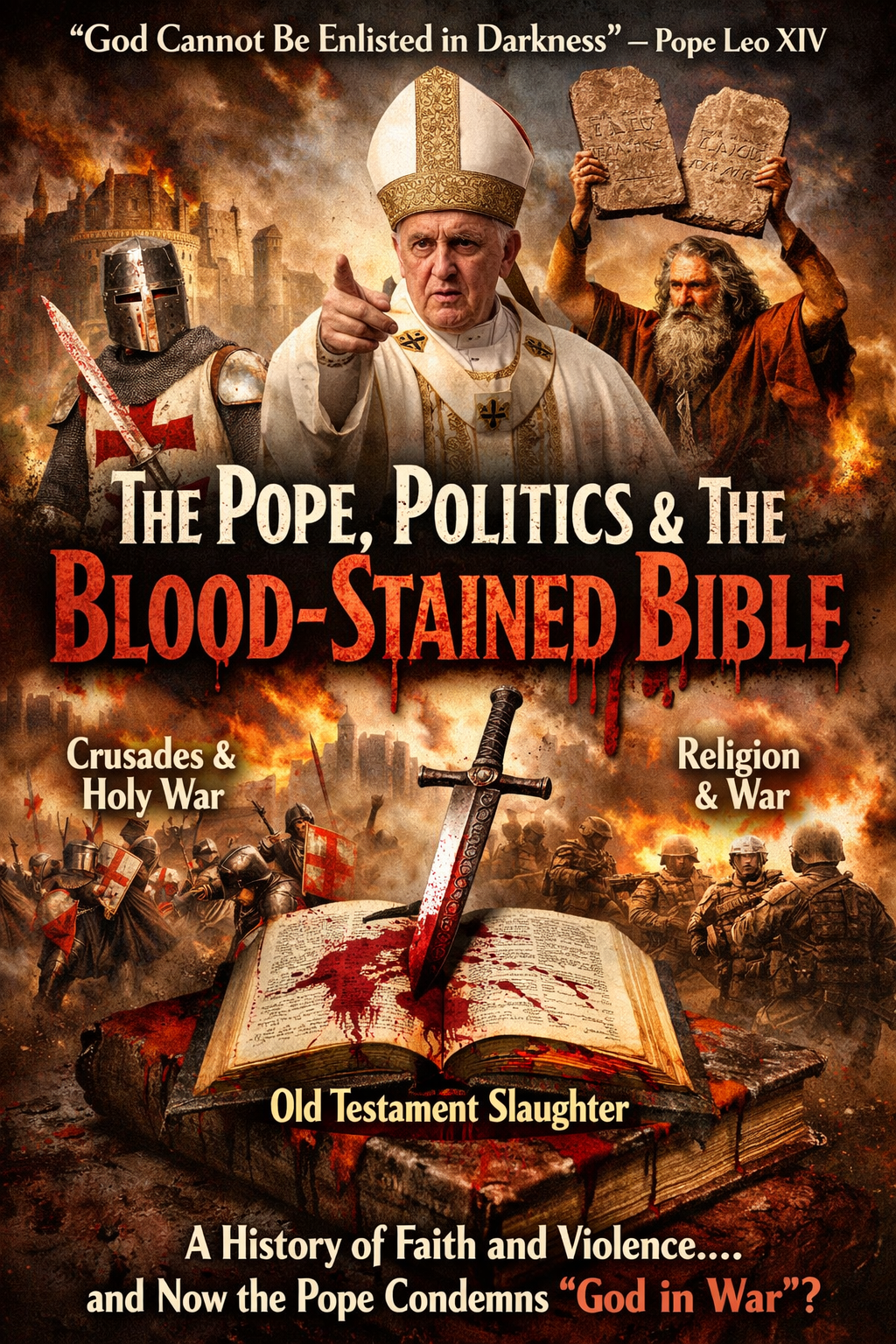
Every so often a pope steps out, says something political in a robe and expects the world to forget the last two thousand years. This week's version came from Pope Leo XIV, who condemned invoking God to justify war and declared that God cannot be enlisted in darkness. That fits the modern PR version of religion - soft voice, polished moral posture, selective memory. It also ignores the bloody record of the institution he leads and the bloody text of the book his church claims as sacred. The pope is free to speak on war. Anyone is. But he does not speak from some spotless mountaintop above politics. The papacy has been political for centuries. It has blessed armies, launched campaigns, backed factions and inserted itself into power struggles across Europe and beyond. The idea that the bishop of Rome is suddenly scandalized by mixing God and war would be funny if history were not so full of corpses.
The Papacy Has Never Been Above Politics
The first thing that needs to be said is the obvious one: the pope is not outside politics. The office itself is political. The papacy is not merely a spiritual pulpit. It has long exercised jurisdiction, governance and influence over states, rulers and public life. That is not a smear. That is basic history. When people act as if a pope speaking on war is a purely spiritual intervention, they are rewriting the record. Popes did not just comment on war from a safe distance. They helped mobilize it. Pope Urban II initiated the First Crusade in 1095. Later popes launched crusades not only in the Holy Land but against heretics and opponents of papal authority. That is not metaphor. That is armed conflict sanctioned and promoted by the papacy.
During Europe's Wars of Religion, papal troops backed Catholic causes in France. The papacy was not some neutral chaplain urging everybody to calm down. It was one of the players. So when a pope rebukes someone for invoking God in war, he may be making a moral argument. Fine. But he is not speaking from innocent ground. He is speaking from an institution that has repeatedly fused theology, statecraft and violence when it suited its interests or convictions. Moral lectures sound different when delivered by a body that helped write the manual on holy conflict.
The First Crusade was not a spontaneous popular movement. It was initiated by Pope Urban II at the Council of Clermont in 1095, with the explicit promise of spiritual reward for those who took up arms. Subsequent crusades were extended to targets including Albigensian heretics in southern France, pagan populations in northern Europe and political opponents of the papacy itself. This means the institution now led by Pope Leo XIV did not merely observe religiously motivated warfare from the sidelines. It organized it, promoted it, granted indulgences for it and directed it against populations that were not always the enemies of Christendom but sometimes enemies of Rome's political authority. Any statement from that institution about God and the choices of death needs to be read against that background.
The Bible Is Not a Pacifist Pamphlet
The second problem is that the pope's framing collides directly with his own scripture. The Bible is not a tidy handbook for modern humanitarian sentiment. It is full of judgment, conquest, slaughter and divine wrath. That is not some fringe reading forced onto the text by angry skeptics. It is sitting right there in black and white. In Joshua, Jericho falls and the population is put to the sword. Ai is destroyed. In 1 Samuel, the Amalekites are marked for total destruction. In Exodus, Pharaoh's army is drowned. In the broader Old Testament narrative, divine judgment is not symbolic self-care language. It is often violent, total and final.
Christians usually answer that by distinguishing descriptive passages from prescriptive conduct, old covenant from new covenant, ancient Israel from the church and temporal judgment from ordinary state violence. Those are real theological distinctions. But they do not erase the plain fact that the biblical God is repeatedly depicted as a God of wrath, judgment and war as well as mercy. The old line about never associating God with death sounds less like a serious reading of scripture and more like a sanitized talking point designed for modern ears. You cannot build your faith on a book in which cities are destroyed under divine command, then act shocked when someone points out that your tradition has always contained a theology of righteous violence.
You can argue that a particular modern war is unjust. You can argue that a politician is abusing religious language. But you do not get to pretend the God of the Bible is some purely therapeutic life coach who never enters history with blood on the ground.
Cherry-Picking Is the Oldest Religious Trick in the Book
That is really the problem here. Not that the pope spoke. Not even that he condemned a war claim. The problem is the selective memory. Religious authorities do this constantly. They quote the parts of scripture that fit the emotional tone of the moment and quietly push the harder parts into the back room. Love your neighbor gets airtime. So does blessed are the peacemakers. Fine. But once you are dealing with the whole Bible, you also inherit Joshua, Judges, Samuel, Revelation and a long trail of divine judgment that no amount of incense can make disappear.
This is why so many people have lost patience with clerical moralizing. The modern religious elite wants the authority of an ancient text without the embarrassment of what that text actually says. They want the grandeur, the symbolism and the public deference. They do not want the awkward questions. Has the pope read his own Bible? Of course he has. The issue is that religious leaders routinely present a curated version of the faith to fit modern politics. When the subject is war, they suddenly talk as if invoking God in conflict is alien to biblical religion. It is not alien to biblical religion. It is one of the oldest themes in biblical religion.
Religion Has Fueled War for a Very Long Time
Religion did not merely coexist with warfare throughout history. It often intensified it, justified it or sanctified it. The Crusades are the most famous example because they are impossible to hide. The First Crusade was initiated by a pope. Later crusades were extended to heretics and political opponents, meaning the papacy was framing military campaigns as spiritually meaningful enterprises against targets it found inconvenient. Then came the Wars of Religion in Europe, where confessional identity and political power were tangled together in devastating ways. Papal support for Catholic causes was part of that picture. Anyone who wants to paint the Vatican as historically detached from factional conflict is asking you to ignore the record.
And before Christians point fingers only outward, the Bible itself records internal religious violence, civil war and divinely sanctioned extermination. So the problem is not just what popes did later. The problem is built into the tradition's own storytelling and moral imagination. The God of scripture is not merely a God of comfort. He is also depicted as a destroyer of cities, armies and peoples judged wicked. That does not prove every modern war claim is valid. It does prove that the pope's lofty language about God never being enlisted in darkness collapses under the weight of his own textual and institutional inheritance.
A politician saying God is on our side can still be reckless, manipulative or flat-out dishonest. History is full of rulers who wrapped ambition in religious language, and that criticism is legitimate. Invoking heaven does not automatically make a war just. But that is precisely why the pope's statement should have been narrower and more honest. He could have said no leader should casually presume divine approval for military action. He could have said the church must resist turning God into a mascot for national power. He could have said moral claims about war require humility because human beings are prone to self-justification. Instead he used language that implies God and violent judgment belong to darkness - as if his own canon and his own institution had not repeatedly said otherwise. That is not humility. That is selective amnesia dressed as moral clarity.
Clergy Want Influence Without Accountability
What really irritates people about these moments is not just hypocrisy. It is the structure of the hypocrisy. Religious leaders want to speak into public life. Fine. Then they should be answered in public life. They want moral influence over politics, war, family, sex, education and culture. Fine. Then their own record is fair game. They do not get to move in and out of the public square whenever it is convenient - prophetic when they approve of the cause, above politics when someone returns fire. If the pope wants to condemn a politician's theology of war, then the pope's theology of war, history of war and institution's role in war are all open for inspection. That is not anti-religious bigotry. That is called accountability. And once that inspection begins, the halo slips fast.
My Bottom Line
The pope can condemn war rhetoric all he wants. What he cannot do is pretend the Catholic Church has clean hands or that the Bible presents a God who never acts through violent judgment. The papacy launched crusades. Popes backed factions. Popes helped sanctify bloodshed. Meanwhile the Bible is packed with scenes of divinely ordered destruction and apocalyptic judgment. The sermon that God cannot be associated with choices of death may play well in a modern headline, but it does not survive contact with either church history or scripture.
If the pope wants to argue that modern leaders should be cautious about claiming divine endorsement, that is a defensible position. But he should make it honestly, without pretending his own tradition is innocent of the very thing he condemns. A faith built on a book of war, judgment and wrath does not get to rebrand itself overnight as though violence entered the room yesterday. And an institution that helped mobilize holy war does not get to lecture the rest of the world as if it just discovered the danger of mixing God with power.
The rebuttal is not that every war is righteous or that every leader who invokes God is right. The rebuttal is that the pope's posture here is historically thin, theologically selective and politically convenient. He knows it. So does the record.
References
- Associated Press. (2026, June 22). Pope expresses deep concern about strikes on Iran.
- Encyclopaedia Britannica. (2026). Crusades.
- Encyclopaedia Britannica. (2026). First Crusade.
- Encyclopaedia Britannica. (2026). History of Europe: The Wars of Religion.
- Encyclopaedia Britannica. (2026). Papacy.
- Encyclopaedia Britannica. (2026). Roman Catholicism: The Crusades.
- The Holy Bible, New King James Version. (1982). Thomas Nelson. Joshua 6:21; Joshua 8:25; Exodus 14:28; Deuteronomy 7:1-2; Deuteronomy 20:16-18; 1 Samuel 15:3; Genesis 15:16; Revelation 19:15, 19:21.
- Vatican. (2025). Leo XIV.
- Vatican News. (2026, January 1). Pope: Start today to build a year of peace.
Disclaimer: The views expressed in this post are the personal opinions of the author and are offered for educational, commentary and public discourse purposes only. They do not represent the positions of any institution, employer, organization or affiliated entity. Nothing in this post constitutes legal, financial, medical or professional advice of any kind. References to public figures, institutions, historical events and religious texts are based on publicly available sources cited above and are intended to support analysis and argument. Commentary on religious and political subjects reflects the author's independent analysis and is protected expression of opinion. Readers are encouraged to consult primary sources and form their own conclusions. Any resemblance to specific individuals or situations beyond those explicitly referenced is coincidental.