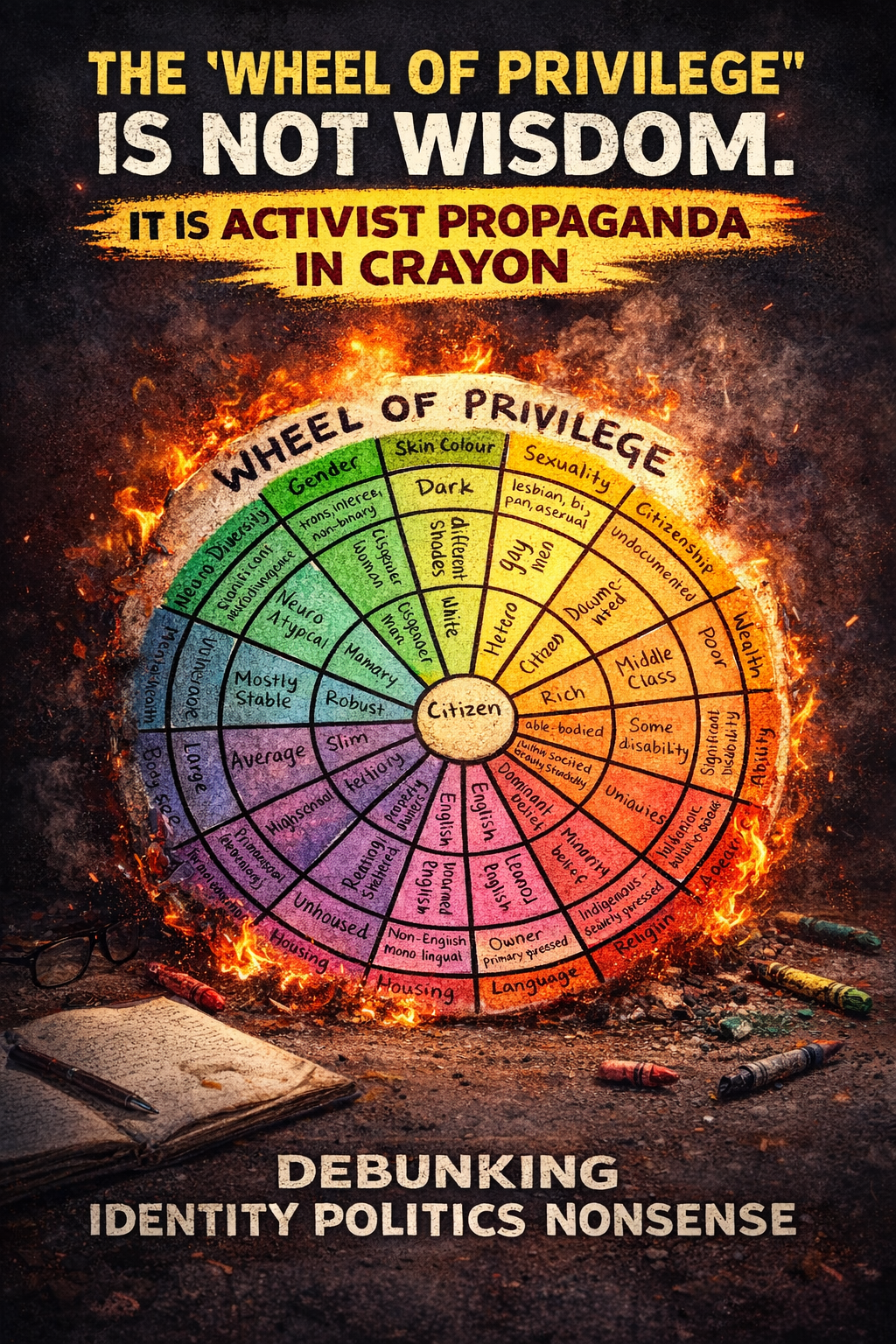
The so-called "Wheel of Privilege" looks clever at first glance. That is how bad ideas usually work. Dress them up in bright colors, divide life into neat little slices and suddenly a childish political worldview starts to look like insight. What this chart is actually doing is taking human complexity and flattening it into a cartoon. It tells people that if you sit near the center of the wheel on enough categories, your life is basically cushioned by invisible power. If you sit farther out on enough categories, your life is supposedly shaped by oppression. It is not a serious model of society. It is a grievance map dressed up as social science.
Before somebody predictably misreads this, let me make the obvious point: people do face hardships. Poverty matters. Disability matters. Family instability matters. Trauma matters. Discrimination exists. Unequal outcomes are real. But that is not what this wheel is actually about. This wheel is about converting every human trait into political ranking. It turns life into a scoreboard and people into demographic bundles. That deserves to be taken apart section by section.
Mental Health
The chart treats "mostly stable" as privilege and "vulnerable" or poor mental health as lack of privilege. On the surface that sounds reasonable - serious mental illness can make life harder. But the wheel treats mental health like a political identity rather than a medical or personal reality. Mental health is not a morality badge. It is not a caste system. It is not something that automatically places you outside the social mainstream in some permanent, politically meaningful way. Many people struggle privately and function at a high level. Many others are emotionally fragile without any diagnosed condition at all. Some people weaponize mental health language to avoid responsibility. Others silently endure crushing anxiety or depression while still showing up to work and taking care of their families.
The wheel does not clarify any of that. It simply says: stable equals privileged, vulnerable equals oppressed. That is shallow. Real life is not.
Neurodiversity
This category does the same trick. It assumes "neurotypical" is socially advantaged while "neuro-atypical" automatically means marginalization. There is a grain of truth wrapped in a mountain of ideology. Some neurological conditions create real barriers. But "neurodiversity" has also become one of those fashionable umbrella terms stretched beyond usefulness - now often including everything from profound disability to mild eccentricity to self-diagnosed internet identity. The result is a framework that cannot distinguish between people who need serious accommodation and people who simply want elevated moral status.
A brilliant engineer with autism may outperform ten supposedly "privileged" people in the workplace. A person with ADHD may struggle in one environment and thrive in another. A highly verbal, educated person claiming "neurodivergence" as identity may have more social power than a blue-collar laborer with no such label. The wheel ignores all of that because it wants labels, not nuance.
Gender
Here the chart gives the game away. "Cisgender man" sits closest to the center, then "cisgender woman," then "trans, intersex, non-binary" farther out. This is not analysis. This is doctrine. First, it smuggles in the assumption that "cisgender" is a neutral, settled category rather than ideological language imposed by activists. Most people do not think of themselves as "cis." They think of themselves as men or women. Second, the chart pretends gender identity itself is the central social fact. It is not. Biology, behavior, family structure, culture, competence and appearance affect life far more than activist jargon does.
The biggest flaw is this: the wheel treats distance from traditional norms as automatic evidence of oppression. Some people who identify outside conventional categories may face ridicule or alienation. Fine. But that does not magically make every such identity more truthful, more insightful or more morally authoritative. A society recognizing biological reality is not oppression. It is reality.
Skin Colour
This section is perhaps the most predictable: white near the center, different shades farther out, dark furthest away. The idea is simple enough to be emotionally satisfying and intellectually worthless. Race can matter. Historical injustice can matter. Bias can matter. But the wheel takes broad historical trends and shoves them onto every individual in the present. That is where the dishonesty starts. A poor white roofer with a bad back, no inheritance and no elite connections is not floating through life on invisible cushions. A wealthy minority executive with degrees, social capital and institutional status is not living the same life as someone from a broken rural town just because the chart assigns them different positions on a diagram.
Race is one variable among many. The wheel wants it to be the master variable because that serves modern political storytelling. Life is messier than that.
The biggest lie in the Wheel of Privilege is not any single slice. It is the assumption underneath all of them: that human life can be understood primarily through identity ranking. That is the rot at the center.
Sexuality
According to the chart, heterosexuality is privileged while being gay, lesbian, bi, pan or asexual places you farther from the center. The wheel confuses non-majority status with oppression status. Yes, same-sex attraction has historically carried social costs in many times and places - that is true. But today, in much of the West, gay identity often brings not just acceptance but institutional endorsement across media, education, HR culture and corporate branding. In elite spaces, dissent from sexual identity ideology is often punished more harshly than the identities themselves.
More importantly, sexuality alone tells you very little about a person's actual life circumstances. Two gay men can inhabit totally different worlds depending on money, family, health, talent and personal choices. The wheel converts one trait into a political shortcut. It is a reduction machine.
Citizenship
This one is especially obnoxious. The chart implies that being a citizen is "privileged" while being undocumented places you farther out - as though national belonging itself were some form of unfair advantage. That is not privilege. That is sovereignty. A country exists to serve its citizens first. If citizenship counts as oppression toward non-citizens then every border, every voting rule and every immigration system becomes morally suspect by definition. That is not social analysis. That is open-border ideology hiding behind a marker.
Being undocumented can create instability. Obviously. But instability caused by entering or remaining in a country unlawfully is not evidence that citizenship is some sinister social asset. A functioning nation has members and non-members. Pretending otherwise is not compassion. It is the dismantling of the concept of a country dressed up as moral sophistication.
Wealth
This is the easiest slice to understand and still one of the most oversimplified. Money matters. Everyone knows it. But the wheel uses wealth as though it were just one more moral chip in the oppression casino, when in reality it often overwhelms most of the other categories on the wheel. A rich person with several "marginalized" identities will typically have more opportunity, insulation and influence than a poor person with several "privileged" ones. That single observation is enough to expose the whole chart as incoherent.
Also absent is the question of how the wealth or poverty arose. Inheritance? Skill? Risk-taking? Divorce? Addiction? Bad policy? Bad luck? Family collapse? The chart does not care. It treats economic condition as static identity rather than dynamic reality shaped by choices, habits and circumstances. That is not analysis. That is a snapshot mistaken for a verdict.
Every section of the wheel shares the same structural defect: it erases agency. The chart is built to tell a story in which outcomes are explained by categories rather than by choices, habits, discipline, character and effort. That is not an accident. Agency ruins the wheel's moral arithmetic. If a person can meaningfully change their situation through work, self-control, honesty, skill-building and better decisions, then the grievance map loses its explanatory power. The wheel survives only as long as people accept that they are products of structures rather than agents in their own lives. That is why it must be contested. Not because real barriers do not exist - they do - but because a framework that systematically denies agency is not a tool for helping people. It is a tool for keeping them stuck.
Ability
The ability section places "able-bodied" near the center and increasing disability farther out. Serious disability can limit mobility, work and independence - nobody needs a rainbow pie chart to know that. The problem is that the chart turns reality into ideology. It invites people to interpret disability as political capital and able-bodied status as social guilt. It also ignores that some disabilities are visible and some are not, some are mild and some are severe, some are overcome and some are not. A person with a manageable limitation may live a stronger and more productive life than a fully able-bodied person who is lazy, addicted or checked out. The wheel wants to erase that possibility because agency ruins its moral arithmetic.
Appearance
This may be the most ridiculous slice. The chart places those "within societal beauty standards" close to the center and those "outside" farther away, as though attractiveness can be graphed like tax brackets. Yes, attractive people can receive advantages - that is part of human nature and has been forever. But the chart pretends beauty standards are simply oppressive social constructions rather than partly rooted in widespread human preference, biology and self-presentation. It also ignores grooming, confidence, fitness, style and self-respect, all of which affect how people are perceived and many of which are at least partly within personal control. Appearance is not a stable oppression category. A person can move from "outside the standard" to highly attractive through discipline and effort alone. That fact breaks the model.
Religion
This section labels "dominant belief" as central and minority or indigenous belief farther out. It confuses being in the majority with enjoying systemic power over everyone else. In some societies, minority faiths absolutely face pressure. In others, majority religions are mocked, regulated or excluded from respectable public life. In modern elite Western culture, traditional Christianity is often treated with more suspicion and hostility than fashionable minority spiritualities. So which one is privileged? The answer depends entirely on where you are and which institution you are examining. The wheel is too crude to notice context because context would destroy its conclusions.
Language
This category puts English near the center and "non-English monolingual" farther out. The chart treats a practical feature of civilization as though it were oppression. A common language is how nations function - how schools teach, how courts operate, how contracts are enforced and how emergency systems save lives. Recognizing the utility of a shared language is not privilege. It is common sense. Yes, people who do not speak the dominant language face barriers. But barriers caused by lack of shared communication are not evidence of bigotry. They are evidence that language matters. A society cannot operate as a Babel of competing tongues and then pretend coherence will emerge from good intentions.
Housing
The housing slice runs from property ownership near the center to unhoused farther out. This section at least touches a real gradient of stability - owning property often does bring security and leverage and being unhoused is obviously severe hardship. But the chart cheats by turning outcomes into identity. A homeowner is not automatically part of some privileged class conspiracy. He may have worked decades for that property, taken risks, made sacrifices and delayed gratification. Someone without stable housing may be the victim of tragedy or of self-destruction or both. The wheel cannot distinguish because it is allergic to cause. It also ignores regional costs, debt, mortgage stress, divorce, medical bankruptcy and local policy failures - in other words, reality - in order to preserve symbolism.
Formal Education
This slice places tertiary education near the center and primary school farther out. In one sense, more education often increases opportunity. But the wheel is wildly behind the times if it thinks formal education automatically maps to social wisdom or stable advantage. Today plenty of degree-holders are indebted, overcredentialed and trained to speak fluent nonsense. Plenty of tradesmen with no elite education make good money, build real things and understand life better than people with three framed certificates and no practical competence. The wheel still treats education as an uncomplicated privilege marker because it was designed by people who worship credentials and have rarely met anyone whose hands build the things they use.
Body Size
This category puts "slim" closer to the center and large farther out. There is a real issue underneath it - heavier people can face stigma. Fine. But this section reveals the wheel's deeper problem: it wants to treat even partially changeable conditions as permanent oppression categories. Body size is affected by genetics, yes, and also by diet, movement, habits, health conditions and culture. That means it is not remotely the same type of category as race or sex, yet the chart jams them together anyway. A large NFL lineman is not socially disadvantaged in the way an unhealthy sedentary person may be. A fit person is not "privileged" in the same sense a trust-fund heir is privileged. Different kinds of advantage are not interchangeable. The wheel keeps pretending they are.
What the Whole Chart Gets Wrong
This framework trains people to ask the wrong questions. Not: Are you competent? Honest? Responsible? Productive? Trustworthy? Self-controlled? Kind? Brave? But instead: Where do you sit on the wheel? How many oppression points do you carry? How much guilt should you inherit from group averages? How much moral authority should you get from your distance from the center? That mindset poisons everything it touches. It poisons education because students learn to sort themselves into categories instead of building character. It poisons workplaces because merit loses ground to demographic storytelling. It poisons politics because argument is replaced by identity hierarchy. And it poisons individuals because they begin seeing themselves not as agents in their own lives but as passive products of structures.
A healthy society should be able to do two things at once: recognize real barriers and insist on personal responsibility. The wheel cannot do that. It is built to deny the second half. It takes partial truths, strips out context, ignores agency, confuses averages with destiny and converts human complexity into political propaganda.
By early adulthood, raw cognitive ability starts to matter more than the social-environment story these charts obsess over. By around age 20, the influence of shared family environment on life outcomes drops sharply, while individual ability, judgment, discipline, choices and effort carry more of the load. That does not mean environment means nothing. It means the claim that adult outcomes are mostly explained by structural identity categories is badly overstated. The research on IQ and life outcomes, the twin studies on heritability, the longitudinal data on cognitive ability and earnings - none of it appears anywhere on the wheel. Why? Because it would destroy the narrative. The wheel is not built to help people understand life. It is built to assign moral positions within a political framework. Those are different projects.
My Bottom Line
The "Wheel of Privilege" is not a serious map of society. It is a therapeutic prop for identity politics. Yes, people start from different places. Yes, some burdens are heavier than others. But no, your life cannot be reduced to a rainbow target where proximity to the center determines how much power, guilt, suffering or truth you possess. Bad frameworks produce bad citizens. When people are taught to interpret life through grievance charts instead of responsibility, competence and reality, they become easier to manipulate and harder to unite.
A country cannot stay healthy if every conversation becomes a contest over who is most oppressed and who must apologize for existing. We need less identity bookkeeping and more honesty about what actually builds stable lives: family, work, discipline, health, language, law, accountability and freedom. Those things do not appear anywhere on the wheel. That tells you everything you need to know about what the wheel is actually for.
Calling a grievance map wisdom does not make it wisdom. It makes the people who distribute it more powerful and the people who believe it less free. That is the point. It always was.
Disclaimer: The views expressed in this post are the personal opinions of the author and are offered for educational, commentary and public discourse purposes only. They do not represent the positions of any institution, employer, organization or affiliated entity. Nothing in this post constitutes legal, financial, medical or professional advice of any kind. The "Wheel of Privilege" image analyzed in this post is attributed within the image to @brenna.quinlan; this post critiques the framework and its ideological premises, not any specific individual. Commentary on political and cultural subjects reflects the author's independent analysis and is protected expression of opinion. Readers are encouraged to consult primary sources and form their own conclusions.