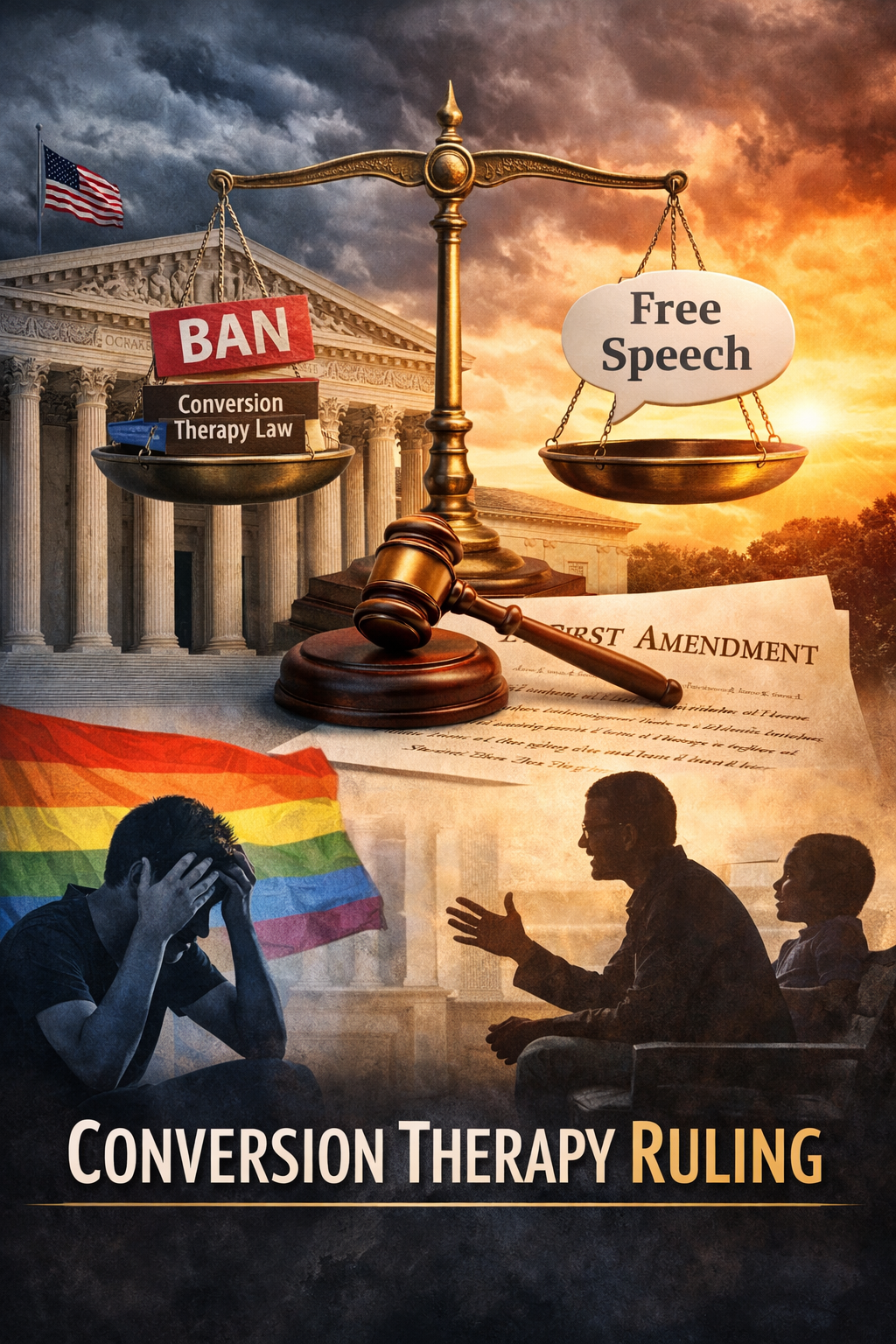
The Supreme Court's March 31, 2026 decision in Chiles v. Salazar will be spun in predictable ways. One side will say the Court blessed conversion therapy. The other will say the Court heroically liberated counselors from state censorship. Neither framing is quite right. What the Court actually did was narrower and more important: it said Colorado cannot regulate pure talk therapy by letting one viewpoint speak while punishing the other. In the Court's view that is not neutral health regulation. It is viewpoint discrimination, and viewpoint discrimination is poison under the First Amendment. That matters whether you like the underlying therapy or hate it. The First Amendment is tested hardest when the speech at issue is unpopular, uncomfortable or wrapped inside a profession people trust. Colorado wrote a law that allowed counselors to affirm a minor's sexual orientation or gender identity while punishing counselors who tried through talk alone to help a minor move in a different direction. The Court said that is the state picking ideological winners and losers. Once government starts doing that, the constitutional problem is not subtle.
What the Court Actually Held
The majority, written by Justice Gorsuch, did not say states are powerless to protect minors. It did not say every form of conversion therapy is constitutionally protected. It did not endorse aversive practices, physical interventions or coercive abuse. The opinion makes clear that the counselor challenging the law claimed to offer only talk therapy and did not seek protection for the methods most people associate with conversion therapy historically. The Court's point was simpler: speech does not stop being speech because the state calls it treatment or professional conduct.
Colorado's statute prohibited licensed professionals from engaging in conversion therapy with minors and defined that term broadly enough to include efforts to change sexual orientation or gender identity. At the same time the law expressly allowed counseling that provided acceptance, support, identity exploration and assistance to a person undergoing gender transition. That asymmetry is what doomed it. Under the Court's reading, Colorado did not ban a method across the board. It banned one side of the conversation while approving the other.
Justice Kagan, joined by Justice Sotomayor, agreed with the majority's logic in a concurrence worth reading carefully. She said the case was straightforward because the state suppressed one side of a debate while aiding the other. She also signaled that a different law - content-based perhaps but viewpoint-neutral - could raise a harder constitutional question. That is practically a roadmap for states that want to try again. Justice Jackson dissented on the ground that Colorado was regulating the practice of medicine and mental health rather than censoring public debate. She warned the majority's approach could complicate states' ability to regulate professional treatment delivered through speech, which is a real concern since counseling is by definition verbal. That dissent is serious. But the majority plainly concluded Colorado had crossed from setting medical standards into prescribing orthodoxy, and the asymmetric text of the statute made that case hard to answer.
Why the Court Got This Right
The state should not be allowed to say that a counselor may speak in favor of affirmation, transition or acceptance but may not speak in favor of celibacy, restraint, identity with one's biological sex or reducing same-sex attraction if that is what a client seeks. That is not neutral regulation. That is the state deciding which moral and psychological destinations are acceptable before the counseling session begins. The First Amendment exists precisely to stop government from turning its favored beliefs into mandatory speech norms for licensed professionals.
The ruling also pushes back against a bad modern habit: relabeling speech as conduct whenever the speech is disfavored. If a therapist's words count as protected speech when they affirm a client, those same words do not become unprotected conduct when they challenge, redirect or question. Colorado wanted to have it both ways. The Court refused. That is a healthy reflex in a free country. There is also a broader principle. Government officials and regulatory boards are poor candidates to become national referees of acceptable therapeutic viewpoints on questions that remain politically explosive, morally contested and psychologically unsettled. The Court recognized this field is in the middle of what it called fierce public debate. Giving the state power to punish one viewpoint and subsidize the opposite in that environment is not caution. It is ideological enforcement dressed as health policy.
The state decided which moral and psychological destinations were acceptable before the counseling session began. The First Amendment exists precisely to stop government from doing that.
What the Lower Courts Now Have to Do
The Supreme Court reversed the Tenth Circuit and remanded for further proceedings consistent with its opinion. The lower courts must now analyze Colorado's law under the much tougher First Amendment framework the majority established rather than the lighter standard previously applied. In practical terms Colorado now faces a steep climb. Viewpoint-based regulations are about as constitutionally suspect as restrictions get. The lower court will have to decide whether Colorado can satisfy the demanding scrutiny that applies to content-based and especially viewpoint-based speech restrictions - typically requiring a compelling interest and a law narrowly tailored to achieve it by the least speech-restrictive means available. Protecting minors is undeniably important. Colorado's problem is not the goal. It is the method.
A law that bans only one direction of counseling while allowing the other is difficult to defend as narrowly tailored. If the state's real concern is coercion, fraud, abuse or demonstrable psychological harm, then it should regulate coercion, fraud, abuse and harm in a viewpoint-neutral way. Once the statute says this message is allowed but that one is forbidden, the constitutional deck turns against the state rapidly.
What Colorado and Other States Need to Do Now
Justice Kagan's concurrence practically drew the roadmap for states that want to try again. If a state wants to protect minors from harmful counseling it needs to write laws that focus on methods, coercion, professional standards, informed consent, fraud or demonstrable abuse without embedding a state-approved viewpoint about sexuality or gender into the statute itself. That means stopping laws written like ideological scorecards. If a state wants to ban electric shocks, humiliation, isolation, forced confessions, threats or coercive protocols it can do that directly and constitutionally. If it wants strict documentation requirements, parental disclosures, waiting periods, complaint procedures or disciplinary standards tied to nonconsensual or deceptive conduct it has a better constitutional chance than if it writes a law that blesses affirmation and criminalizes dissent. That is the lesson of this case. The concurrence says so almost explicitly.
The political impact will be immediate. Colorado's law was one of roughly two dozen similar state statutes and this ruling puts many of them in legal jeopardy if they are drafted the same way. Some states may defend existing laws. Others will rewrite them. Either way the era of calling speech regulation professional conduct and assuming the First Amendment stops at the therapist's office door just took a serious hit.
This case sits at the intersection of free speech, parental rights, youth mental health, professional licensing and the ongoing political fight over sex and gender. The Court sent a clear message that states do not get a free pass to regulate speech because the speaker holds a license. That principle will echo well beyond Colorado. It also signals that the Court is increasingly skeptical of government attempts to enforce ideological conformity in contested fields. That does not mean every regulation is now vulnerable. It means lawmakers will need to be more careful, more precise and less openly partisan in how they draft these statutes. For years many legislators wrote as if constitutional scrutiny would stop at the words public health. This ruling is a reminder that it does not.
My Bottom Line
The Supreme Court did not validate cruelty, coercion or abuse. It did something more fundamental: it reminded Colorado that the government cannot write speech codes for therapists by approving one set of ideas and punishing the other. That is the core merit of the ruling and it holds regardless of how one feels about conversion therapy as a practice.
There will be critics who say the Court endangered vulnerable kids. That concern deserves a real answer, not mockery. But there is another danger too: giving the state power to tell counselors which worldview they may voice on morally disputed questions. Once that machinery exists it never stays neatly confined to one cause. Today it protects one orthodoxy. Tomorrow it may protect another. The First Amendment is supposed to interrupt that cycle before it starts. If states want to protect minors they still can. But they need to regulate harmful methods rather than outlaw disfavored viewpoints. They need to write narrower laws. They need to stop confusing ideological preference with neutral medical regulation. The Court directed exactly that, even without spelling out every future statute line by line. Constitutional rights mean very little if they disappear the moment a debate becomes politically charged. That is precisely when the discipline matters most.
A free society can regulate fraud, coercion, malpractice and abuse. It cannot declare one side of a contested moral debate the only permitted one. The Court was right to say so. The question now is whether states will write better laws or simply keep losing in court.
References
- Colorado General Assembly. (2019). HB19-1129: Prohibit conversion therapy for a minor. leg.colorado.gov.
- Chiles v. Salazar, 607 U.S. ____ (2026).
- Cornell Legal Information Institute. (2026). Chiles v. Salazar. law.cornell.edu.
- Associated Press. (2026, March 31). Supreme Court rules against Colorado ban on "conversion therapy" for LGBTQ+ kids.
- Reuters. (2026, March 31). US Supreme Court rejects Colorado's ban on LGBT "conversion" talk therapy.
Disclaimer: The views expressed in this post are the personal opinions of the author and are offered for educational, commentary and public discourse purposes only. They do not represent the positions of any institution, employer, organization or affiliated entity. Nothing in this post constitutes legal, financial, medical or professional advice of any kind. References to court decisions, legislative history and news reporting are based on publicly available sources cited above. Commentary on legal and constitutional subjects reflects the author's independent analysis and is protected expression of opinion. Readers with legal questions should consult a licensed attorney. Readers are encouraged to consult primary sources and form their own conclusions.