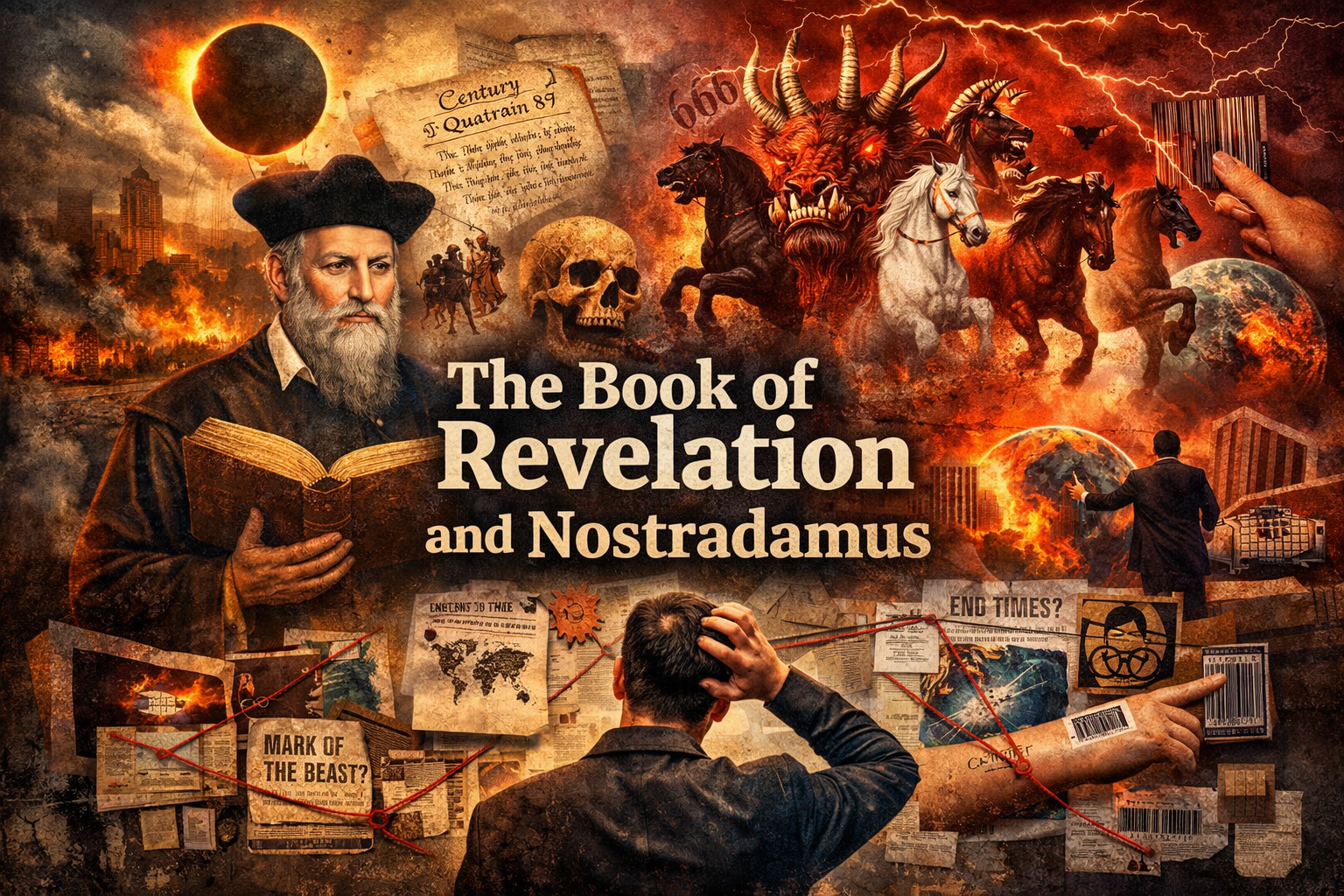
Every generation seems to think it is living in the final act. Wars break out, governments wobble, disease spreads, earthquakes hit, economies shake and suddenly somebody drags Nostradamus off the shelf or opens Revelation like it is tomorrow's newspaper. Then the old game begins: match a few mysterious lines to current events, ignore the misses and declare that prophecy has finally come alive. The problem is not that these texts are mysterious. The problem is that they are so vague, elastic, symbolic and open-ended that they can be bent to fit almost any era. That is why they survive. That is also why they are useless as serious prediction. A prophecy that can predict Rome, Napoleon, Hitler, the Cold War, the European Union, the Iraq War, COVID, artificial intelligence and whatever comes next is not a prophecy. It is a Rorschach test with better marketing. If people want to read Nostradamus or Revelation as literature, mythology, theology or psychological drama, fine. But when they are presented as reliable forecasts of world events, the standard should be higher than poetic fog and selective memory.
Nostradamus: The Patron Saint of After-the-Fact Prediction
Nostradamus gets treated like some kind of cryptic super-analyst of the future. In reality his quatrains are famous for one reason: they are obscure enough to be reinterpreted forever. His writings are loaded with murky symbols, odd phrasing, mixed languages and loose images of fire, blood, kings, war, famine, fear and catastrophe. That is not precision. That is the fortune-cookie model of apocalypse. If you write enough ominous material in broad enough terms, later readers will always find something they think fits. This is not prophecy in any rigorous sense. It is pattern matching after the fact.
That matters because a real prediction should be specific enough that it can fail. It should name names, dates, places or at least tightly defined conditions. Nostradamus usually does not do that in any meaningful way. Instead, interpreters do the heavy lifting. They rummage through history, find a war or assassination or plague and then retrofit the text to the event. The prophecy did not do the work. The reader did. That is why Nostradamus seems to predict everything and nothing at the same time. The appearance of prophetic accuracy is produced entirely by the person reading the text, not by the text itself.
A prophecy that can predict Rome, Napoleon, Hitler, the Cold War, COVID and whatever comes next is not a prophecy. It is a Rorschach test with better marketing.
Revelation: A Symbol Factory Mistaken for a Timeline
The Book of Revelation works much the same way, though with a religious halo around it that makes many people more hesitant to say so out loud. Revelation is a dense symbolic text filled with beasts, horns, bowls of wrath, trumpets, dragons, cosmic battles, seals, blood, stars falling from heaven and the famous number 666. Read it as apocalyptic literature from the ancient world and it is genuinely fascinating. Read it as a coded critique of empire, persecution and political power and there is plenty to discuss. But as a practical predictive document it has the same glaring weakness as Nostradamus: it can be mapped onto nearly any age without strain.
The historical record makes this undeniable. For centuries Christians have claimed Revelation clearly pointed to their own times. The Roman Empire was the beast. Then the papacy was the beast. Then Islam was the beast. Then Napoleon was the beast. Then Hitler was the beast. Then Stalin was the beast. Then the Soviet Union was the beast. Then the United Nations was the beast. Then the European Union was the beast. Then barcodes were the mark of the beast. Then credit cards. Then RFID chips. Then vaccine passports. Then artificial intelligence. The beast, apparently, has excellent rebranding instincts. That constant reshuffling tells you something important. The text is not functioning as a clear prediction. It is functioning as a symbolic container into which each generation pours its current fears.
An elastic prophecy can stretch to fit war, peace before war, famine, inflation, plague, social unrest, political corruption, charismatic leaders, natural disasters, moral decline and religious conflict. That list is not impressive because those things are rare. It is unimpressive because they are common. Human history is saturated with instability, violence, corruption, hunger, disease and delusion. A text that vaguely says bad things are coming will always look smart to somebody. "There will be war, deception, turmoil and suffering" is not prophecy. It is a summary of civilization. These texts remain permanently usable precisely because they are not pinned down enough to be falsified. They cannot age out. The believer can always say "not yet" or "you misunderstood the symbol" or "this next crisis is the real fulfillment." That is not predictive power. That is interpretive escape velocity.
Why Vagueness Feels Deep
People often confuse vagueness with profundity. The less precise a prophecy is, the more room people have to project meaning into it. That is why vague prophecies often feel spooky. They invite participation. The reader becomes co-author. He connects the dots, supplies the missing pieces and experiences the thrill of discovery. It feels like revelation but usually it is just human pattern recognition doing what human pattern recognition always does. We are built to find order even when the order is weak or imagined. We connect unrelated events. We notice hits and forget misses. We remember the prediction that sort of matched and ignore the dozens that went nowhere. That is basic confirmation bias with a religious or mystical costume on it.
A truly impressive prophecy would not need an army of interpreters, podcasts, end-times charts, YouTube thumbnails and paperback books explaining what it really means. It would be plain enough to stand on its own. Instead both Nostradamus and Revelation have produced centuries of interpretive chaos. That should be a clue. The more a prophecy requires explanation, the less it has actually said.
Applicable to Any Time Means Useful in No Time
This is where people get defensive, especially with biblical prophecy. They say that prophecy often has layers, or that God uses symbols, or that it unfolds across ages. That may be so. But the more a prophecy applies to all times equally, the less it tells you about any specific time. A useful prediction narrows possibilities. It does not multiply them. If a prophecy can point to the first century, the medieval world, the Reformation, the French Revolution, World War II, the Cold War and the twenty-first century with equal credibility, then what has it predicted? That human beings will continue being human beings? That empires will abuse power? That violence and corruption will recur? That frightened people will search old texts for current meaning? That is not insight from beyond history. That is history.
Modern prophecy enthusiasts keep insisting that this crisis, this election, this war, this disease outbreak, this technology or this political figure is the final key that unlocks everything. They say it with absolute confidence until the news cycle changes. Then they quietly move the goalposts and find a fresh headline. A forecast that needs constant revision is not a forecast worth trusting.
If the Bible Were Perfect, It Would Not Read Like This
There is a problem here that believers usually do not want to touch. If the Bible is supposed to be immutable, perfect, divinely inspired and preserved as the flawless word of God, then its prophetic material should not read like a fog machine. It should not wander. It should not depend on endless reinterpretation. It should not be so broad that every century can force current events into it and claim victory. That kind of looseness is not what perfection looks like. It is what human writing looks like.
A truly divine communication meant to prepare mankind for future events would be clearer than Revelation. It would be more precise than symbolic beasts, coded numbers, cosmic imagery and language elastic enough to be bent around Rome, the papacy, Napoleon, Hitler, the Cold War, the European Union, modern banking, barcodes, microchips, vaccines and artificial intelligence. At some point that is not prophecy. That is a literary inkblot. The wandering quality of Revelation and the generality of so many biblical prophecies do not strengthen the case for divine authorship. They suggest the text bears the fingerprints of ancient men doing what ancient men always did: writing in symbols, projecting meaning into chaos and speaking with confidence about things they could not possibly know. The more these prophecies have to be rescued by interpreters, revised by theologians and reattached to each new crisis, the less divine they look. If the Bible were truly perfect and immutable it would not need this much explaining, this much apologetics, or this many believers telling us what it really meant after the fact.
The opacity of prophecy is not evidence of heavenly depth. More often than not, it is evidence of human limitation.
The Failure Test Most Believers Avoid
Here is a simple question that usually gets dodged: what would count as failure? What would Nostradamus have to get wrong before people stopped calling him prophetic? What would Revelation's interpreters have to get wrong before people admitted the system does not work? Over the centuries countless end-times predictions tied to biblical prophecy have failed. Dates have passed. Antichrists have come and gone. Marks of the beast have been announced and forgotten. Final empires have collapsed without ending history. Entire prophecy industries have survived being wrong because vagueness gives them cover. When a system cannot fail, it cannot prove itself either.
The standard of proof is always lowered for prophecy and raised for skepticism. The believer gets endless retries. The critic is told he just lacks faith, discernment, context or spiritual sensitivity. Outside religion and mysticism we would call that what it is: an unfalsifiable claim. Unfalsifiable claims are not deep. They are protected. There is a difference.
Prophecy offers order in chaos. It tells frightened people that history is not random, that current suffering fits a script and that their generation matters in a cosmic way. It turns confusion into narrative and anxiety into meaning. That is emotionally powerful. It is also dangerous when taken literally. People primed on vague prophecy start seeing signs everywhere. Every disaster becomes validation. Every rival becomes a beast. Every new technology becomes a mark. Every political setback becomes satanic. Every crisis gets inflated into metaphysical proof. That does not sharpen judgment. It distorts it. Instead of analyzing real causes, real incentives, real institutions and real human stupidity, people slip into prophetic theater. They stop asking what is happening and start asking which ancient symbol this week's headline supposedly fulfills. That is not wisdom. It is escapism with scripture attached.
Revelation's Staying Power Is Literary, Not Predictive
To be fair, Revelation has endured for reasons beyond failed prophecy charts. It is vivid, dramatic, violent, surreal and emotionally powerful. It speaks the language of cosmic struggle. It gives suffering people a story in which evil is judged and history bends toward justice. That has psychological and literary force whether or not one accepts its theology. The same is true of Nostradamus. His staying power is not that he clearly foresaw the future. It is that his murky style creates endless opportunities for reinterpretation. He remains culturally alive because his words are unfinished enough for each generation to finish them in its own image. That may make these texts enduring. It does not make them useful as prophecy.
My Bottom Line
Nostradamus and Revelation have one major thing in common: both are so vague, symbolic and adaptable that they can be made to fit almost any period in history. That is why people keep dragging them into modern events. It is also why they are useless as serious predictive tools. A prophecy worth trusting should be clear enough to test and specific enough to fail. These are not. They survive because interpreters keep rescuing them, updating them and retrofitting them to the fears of the moment.
Vague prophecy trains people to think badly. It encourages confirmation bias, selective memory, emotional reasoning and headline chasing dressed up as insight. It rewards people for making loose connections rather than demanding clear evidence. In religion that can keep bad ideas alive indefinitely. In culture and politics it can turn every crisis into hysteria. If a text can mean everything, it usually means nothing precise at all. I do not regard Nostradamus or Revelation as reliable maps of the future. I regard them as mirrors. People look into them and see whatever their age is already afraid of. That may be psychologically revealing. It is not prophetically impressive.
Human beings do not need more mystical fog. A prophecy that needs constant rescue by interpreters is not speaking from beyond history. It is speaking from inside human limitation - which is where it was written.
References
- The Holy Bible, New Revised Standard Version. (1989). National Council of the Churches of Christ in the United States of America.
- Nostradamus. (1555/2012). Les propheties. CreateSpace Independent Publishing Platform.
- Aune, D. E. (1998). Revelation 1-5. Thomas Nelson.
- Aune, D. E. (1998). Revelation 6-16. Thomas Nelson.
- Aune, D. E. (1998). Revelation 17-22. Thomas Nelson.
- Ehrman, B. D. (2023). Armageddon: What the Bible Really Says About the End. Simon & Schuster.
- Pagels, E. (2012). Revelations: Visions, Prophecy, and Politics in the Book of Revelation. Viking.
- Tetlock, P. E., & Gardner, D. (2015). Superforecasting: The Art and Science of Prediction. Crown.
Disclaimer: The views expressed in this post are the personal opinions of the author and are offered for educational, commentary and public discourse purposes only. They do not represent the positions of any institution, employer, organization or affiliated entity. Nothing in this post constitutes legal, financial, medical or professional advice of any kind. References to religious texts, historical figures and published scholarship are based on publicly available sources cited above. This post expresses skepticism about specific interpretive claims and does not constitute an attack on individual believers or religious communities. Commentary on religious and philosophical subjects reflects the author's independent analysis and is protected expression of opinion. Readers are encouraged to consult primary sources and form their own conclusions.