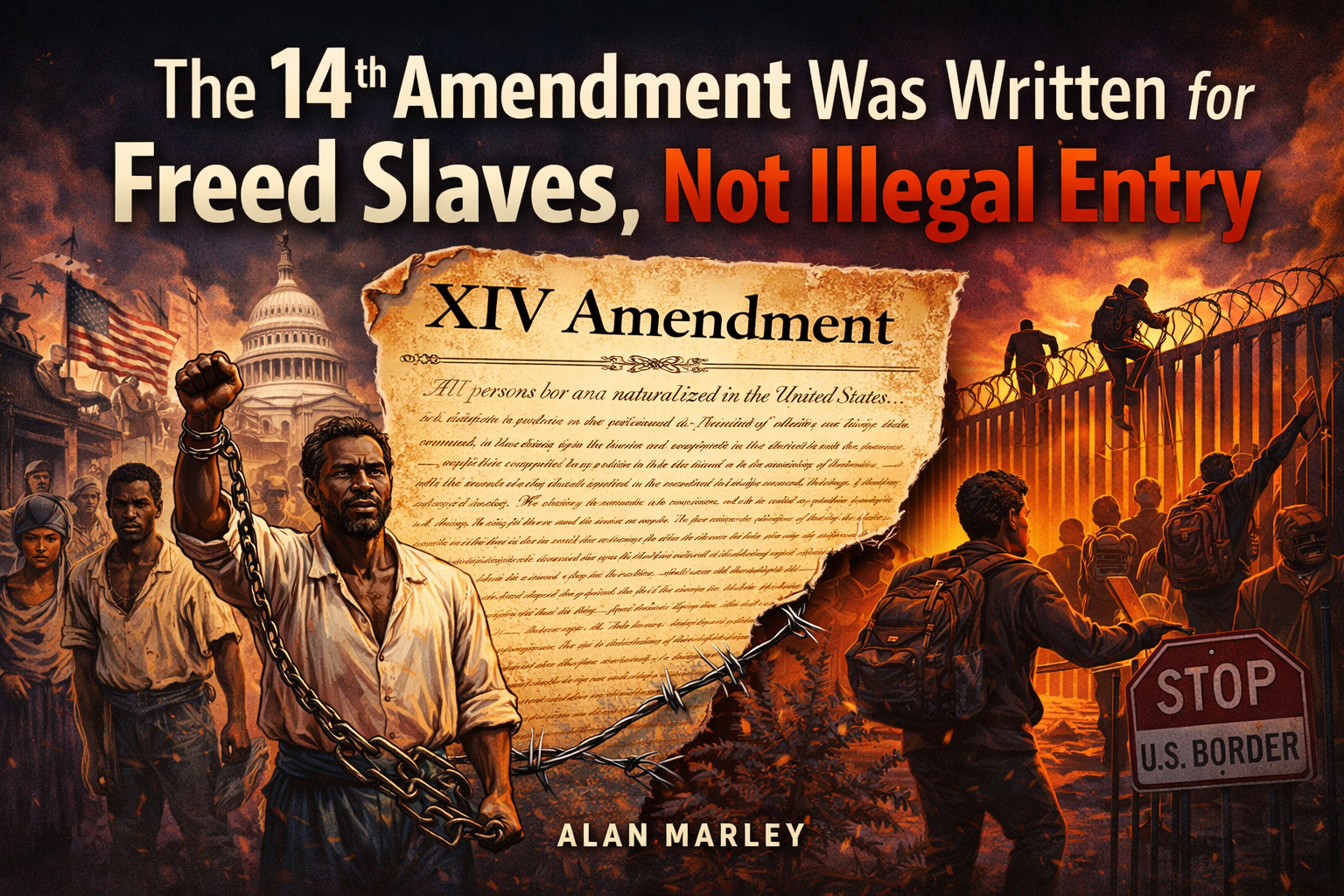
The Fourteenth Amendment did not drop out of the sky. It came out of the wreckage of the Civil War, the abolition of slavery and the urgent need to settle a basic question: would formerly enslaved people and their children be citizens of the United States, or would hostile states keep inventing ways to deny them full membership in the country? That was the problem in front of Congress in 1866.
That history matters because modern arguments about birthright citizenship often pretend the amendment was written for today's immigration fights. It was not. Its immediate purpose was to bury Dred Scott and constitutionally secure citizenship for the people slavery had degraded and the law had excluded. That is the center of gravity of the amendment's origin.
Honesty requires another point too. Current Supreme Court doctrine, especially United States v. Wong Kim Ark in 1898, has long read the Citizenship Clause broadly, extending birthright citizenship to almost everyone born here except narrow categories such as children of diplomats, hostile occupying forces and, at the time, certain tribal Indians. So if we are talking about original purpose, that is one discussion. If we are talking about current doctrine, that is another. Serious people should not blur the two.
What Congress Was Trying to Fix
The Fourteenth Amendment's Citizenship Clause begins with plain language: "All persons born or naturalized in the United States, and subject to the jurisdiction thereof, are citizens." Congress wrote that after emancipation because the country had just lived through a legal and moral disgrace in which Black Americans could be denied citizenship altogether. The amendment was part of the Reconstruction effort to settle that question permanently.
That is why the amendment has to be read in historical context. The political crisis of the moment was not tourism, visa overstays or modern illegal immigration. The crisis was whether the former slave states would continue treating freedmen as a degraded caste outside the real political community. The Fourteenth Amendment was drafted to stop that game.
The basic historical claim is sound: the amendment was written to constitutionalize the citizenship of freed slaves and their children. That was the immediate evil being addressed. Anyone pretending otherwise is skipping the actual historical crisis the amendment was written to solve.
The Original Debate Was About Black Citizenship
The drafting record points in that direction. Senator Jacob Howard, who introduced the citizenship language in the Senate, described it as settling "the great question of citizenship." Senator Lyman Trumbull tied the same project to the Civil Rights Act of 1866, which was designed to protect the civil status of the newly freed population. The amendment was not drafted because Congress in 1866 was worried about anchor babies. That phrase and that controversy belong to a much later era.
The framers of the Fourteenth Amendment were trying to nail down citizenship for a class of people who had lived in America for generations while being denied the ordinary status of Americans. The driving purpose was concrete: bury Dred Scott , constitutionalize emancipation and close off every avenue the former slave states might use to reconstruct a racial caste system by other means.
Where the Modern Argument Comes In
Here is where the issue becomes more complicated. Some modern critics of automatic birthright citizenship argue that while the Fourteenth Amendment was aimed at protecting freed slaves and their children, it was never meant to guarantee citizenship to the children of people who entered or remained in the country unlawfully. That argument leans heavily on the phrase "subject to the jurisdiction thereof," claiming it implies a more complete political allegiance than mere physical presence. Recent federal litigation has revived exactly that originalist argument.
There is a reason that argument appeals to many people. It draws a common-sense distinction between those who were permanently part of the American political community after slavery and those who violated immigration law to get here. From that angle, it is not unreasonable to say the amendment was not written to solve both problems simultaneously. The historical record does not show Congress spending 1866 worrying about illegal aliens and their U.S.-born children. That much is fair.
The Problem for That Argument: Wong Kim Ark
But there is a legal wall in front of that position, and its name is United States v. Wong Kim Ark. In 1898, the Supreme Court held that a child born in San Francisco to Chinese parents who were subjects of the Emperor of China, but lawfully domiciled in the United States, was a U.S. citizen at birth under the Fourteenth Amendment. The Court treated the Citizenship Clause as embracing the broad common-law rule of birthright citizenship, subject to only narrow historic exceptions.
That case is not about illegal immigration in the modern sense. But it is the central precedent that defenders of broad birthright citizenship rely on, because the Court said the clause uses general language and protects those born here unless they fall into recognized exceptions such as children of diplomats or invading armies.
The honest formulation is not that the Fourteenth Amendment obviously excludes children of illegal aliens. The more accurate argument is that original purpose and later doctrine pulled in different directions.
So the honest formulation is not "the Fourteenth Amendment obviously excludes children of illegal aliens and the law already says so." That is too strong. The more accurate argument is this: the original purpose of the amendment was to secure Black citizenship after slavery, while later doctrine expanded the clause more broadly than that original historical problem required. That is a serious position. It is also a more defensible one.
Why "Children of All Parentage Whatever" Does Not End the Debate
Defenders of modern birthright citizenship often point to Senator John Conness's statement that the clause would treat "the children of all parentage whatever" born in California as citizens, including the children of Chinese immigrants. That statement exists and it matters. But even taking it at face value, it does not prove that the amendment was drafted with modern illegal immigration in mind. In 1866, federal immigration law was rudimentary and the main political crisis remained Reconstruction and Black citizenship.
There is evidence that some framers understood the clause broadly. There is also overwhelming evidence that the amendment's driving purpose was to constitutionalize citizenship for freedmen and their descendants. Both things can be true at once. The problem comes when people turn one of those truths into the whole story.
What the Better Reading Is
The Fourteenth Amendment should be read first through the historical evil it was written to cure. That evil was the denial of citizenship to former slaves and their children. That is not a side issue. That is the point. The amendment was a Reconstruction measure aimed at a specific national disgrace.
That does not automatically settle every modern immigration question. But it does mean people are on solid ground when they say the amendment was not written as a future incentive structure for illegal entry. The language was forged in the fight over freedmen, not in a debate about how to treat the children of people who violated twentieth- or twenty-first-century immigration statutes that did not even exist in 1866.
Legally, the broadest version of birthright citizenship still rests on Wong Kim Ark and related doctrine. Historically, the amendment's animating purpose was much narrower and more concrete: secure citizenship for those whom slavery had denied it. That distinction should be front and center in any honest debate.
My Bottom Line
The Fourteenth Amendment was born out of Reconstruction, not modern border politics. Its central purpose was to guarantee citizenship to freed slaves and their children after the legal and moral wreck of slavery. That is the historical core. Current Supreme Court precedent has read the Citizenship Clause more broadly than that immediate purpose, and anyone discussing the issue honestly should admit that.
But that later legal development should not erase the amendment's original context. The people who wrote it were trying to secure Black citizenship, not create a constitutional prize for illegal entry generations later. You can support changing modern birthright citizenship doctrine or oppose changing it. Either way, the history should be told straight.
Why This Matters
Constitutional arguments get sloppy fast when people detach text from history. If you strip the Fourteenth Amendment from Reconstruction, you can make it serve almost any modern narrative you like. But history is supposed to discipline argument, not decorate it.
The amendment was written to settle the status of a people emerging from slavery. That is a serious thing. Treating it as though it were mainly a modern immigration policy memo does violence to the actual history.
References
- U.S. Const. amend. XIV, § 1.
- United States v. Wong Kim Ark , 169 U.S. 649 (1898).
- Elk v. Wilkins , 112 U.S. 94 (1884).
- Memphis v. Greene , 451 U.S. 100 (1981).
- Constitution Annotated. Fourteenth Amendment, Section 1. Library of Congress.
- Congressional Globe, 39th Cong., 1st Sess. 2890–91 (1866).
Disclaimer: The views expressed in this post are the personal opinions of the author and are offered for educational, commentary and public discourse purposes only. They do not represent the positions of any institution, employer, organization or affiliated entity. Nothing in this post constitutes legal, financial, medical or professional advice of any kind. References to public figures, institutions, historical events and current affairs are based on publicly available sources and are intended to support analysis and argument, not to state facts about any individual's character, intent or conduct beyond what the cited sources support. Commentary on religious, political and cultural subjects reflects the author's independent analysis and is protected expression of opinion. Readers are encouraged to consult primary sources and form their own conclusions. Any resemblance to specific individuals or situations beyond those explicitly referenced is coincidental.