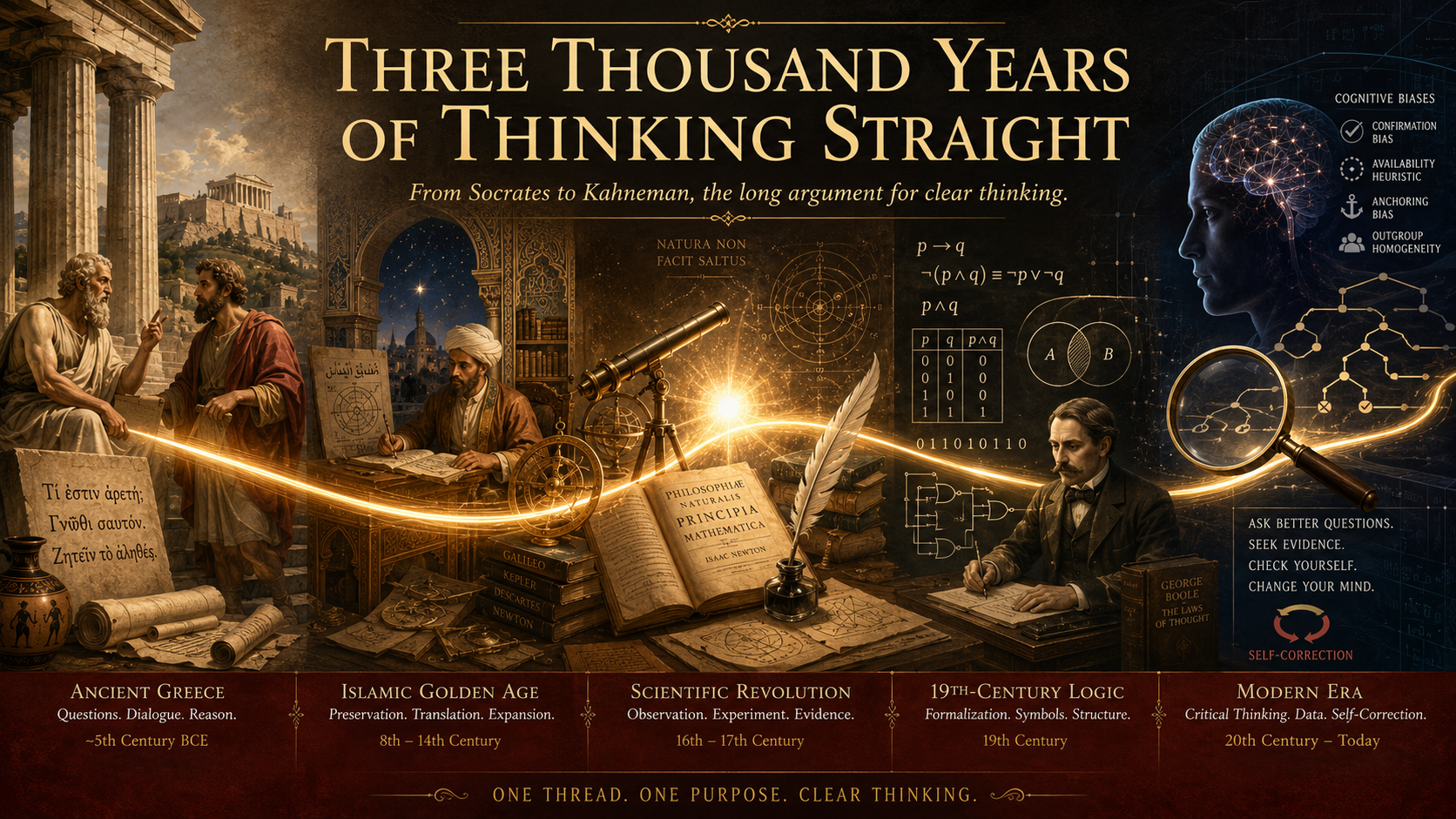
Nobody sat down one afternoon and invented logic. It arrived the way most durable things arrive: slowly, through argument, through failure and through the grinding need to tell a good reason from a bad one. The history of critical thinking is not a straight line. It is a long argument between people who agreed on very little except that careless thinking gets people killed, nations destroyed and truth buried.
That argument began in Greece roughly 2,500 years ago. It has not ended. What follows is a tour of the major stations on that route, from the first men who tried to name the rules of good reasoning to the modern psychologists who discovered how systematically we break them.
The Greeks: Building the Vocabulary
Before logic had a name, it had a method. Socrates, who wrote nothing himself but whose conversations were preserved by Plato, practiced what we now call dialectic. The Socratic method is disarmingly simple: ask a question, receive an answer, probe the answer for inconsistency, force the person to refine or abandon the claim. Repeat until clarity emerges or the conversation partner storms off in frustration. It happened both ways.
What Socrates understood — and what made him dangerous enough to execute — was that most people hold beliefs they have never examined. They know what they think they know. Ask them why and the scaffolding collapses. The examined life Socrates demanded was not a luxury. It was a corrective against the lazy certainty that kills good judgment.
Socrates never claimed to have answers. His power was in questions. The elenchus, his method of cross-examination, was designed to expose contradiction, not to win. That distinction matters. He was not a debater looking for victory. He was a diagnostician looking for error. Most people confuse the two to this day.
Plato systematized some of what Socrates practiced, but it was Aristotle who gave the Western tradition its first formal architecture of reasoning. In the Organon , a collection of six logical treatises, Aristotle laid out the syllogism: a form of deductive argument in which a conclusion follows necessarily from two premises. All men are mortal. Socrates is a man. Therefore Socrates is mortal. The structure is simple. The implications are enormous.
For the first time, someone had isolated the form of an argument from its content. A valid syllogism is valid regardless of what it is about. That insight opened the door to formal logic as a discipline. Aristotle also catalogued the fallacies, the ways arguments go wrong, including equivocation, false dichotomy and the appeal to authority. He named the enemies of clear thinking and gave people tools to recognize them.
Aristotle isolated the form of an argument from its content. That opened the door to everything that followed.
The Stoics, particularly Chrysippus in the third century BCE, extended Aristotle's work into propositional logic, examining the logical relationships between statements rather than the structures of terms within them. If it rains the ground gets wet. It is raining. Therefore the ground is wet. This kind of conditional reasoning became foundational for later developments in mathematics and computer science. The Stoics also made the connection between logic and ethics explicit: living rationally required reasoning well, which required understanding how reasoning works.
The Medieval Period: Logic in Service of Theology
When Greek philosophical texts moved through the Islamic world and eventually back into medieval Europe, they arrived into a context that was largely theological. The great challenge for medieval thinkers was reconciling faith with reason. That tension produced some of the most rigorous logical work in the Western tradition.
Al-Farabi and Ibn Sina (Avicenna) in the Islamic world preserved, translated and extended Aristotelian logic while adding significant refinements of their own. Ibn Rushd (Averroes) wrote commentaries on Aristotle so thorough that European scholars simply called him "the Commentator." Without the Islamic transmission of Greek philosophy, much of the logical tradition would have been lost entirely to the West.
The preservation and development of Greek logic in the Islamic world between roughly the 8th and 13th centuries was not incidental. It was the result of deliberate translation projects, institutional support and serious intellectual engagement. Europe did not rediscover Aristotle. Islamic scholars handed him back, with improvements.
Thomas Aquinas synthesized Aristotelian logic with Christian theology in the 13th century, producing a systematic framework that used deductive argument to defend and clarify doctrine. Whether you accept his conclusions or not, the Summa Theologica is a masterwork of structured argumentation. Aquinas treated objections seriously, stated them fairly and then answered them. That practice alone put him ahead of most modern commentators.
William of Ockham contributed what became known as Ockham's Razor: the principle that entities should not be multiplied beyond necessity. Among competing explanations, prefer the simpler one. It is the most quoted principle in the history of critical thinking and one of the most consistently ignored in practice.
The Scientific Revolution: Logic Meets Evidence
The great shift in the 16th and 17th centuries was not the invention of reason. It was the insistence that reason had to answer to observation. Francis Bacon, writing in the early 1600s, attacked the purely deductive tradition and argued that knowledge must be built inductively from accumulated evidence. His Novum Organum was a direct challenge to Aristotle's Organon. The title was intentional. Bacon was not revising the old logic. He was proposing a replacement.
Bacon also catalogued what he called the Idols: systematic biases that distort human reasoning. The Idol of the Tribe is the tendency to see patterns that are not there. The Idol of the Cave is the distortion that comes from personal background and temperament. The Idol of the Marketplace is the confusion caused by imprecise language. The Idol of the Theatre is the tendency to defer to authority and tradition. These are not merely historical curiosities. Bacon was describing cognitive biases four centuries before cognitive science gave them clinical names.
Bacon catalogued the Idols: systematic biases that distort human reasoning. He was describing cognitive bias four centuries before cognitive science named it.
René Descartes approached the problem differently. Rather than building knowledge from evidence upward, he tried to establish it from indubitable foundations downward. His method of radical doubt — stripping away every belief that could conceivably be false until he arrived at something certain — produced the most famous sentence in the history of philosophy: cogito ergo sum. I think therefore I am. Whatever you make of the conclusion, the method was an exercise in relentless critical interrogation applied to one's own beliefs. That practice remains useful.
John Locke and David Hume pushed the empiricist tradition further, arguing that all genuine knowledge traces back to experience and that reason unmoored from evidence is speculation dressed as certainty. Hume's problem of induction — the observation that no amount of past observations can logically guarantee a future one — is still considered one of the sharpest unresolved problems in the philosophy of knowledge. Just because the sun rose every day for ten thousand years does not prove it will rise tomorrow. That is not comforting. It is honest.
The 19th Century: Formalizing the Machine
George Boole in the 1840s did something that would have seemed peculiar to Aristotle: he turned logic into algebra. In The Laws of Thought, Boole showed that logical operations could be expressed as mathematical equations using only the values 0 and 1. His work was abstract and largely ignored in his lifetime. A century later it became the foundation of digital computing. Every logical operation your phone performs traces back to a Victorian mathematician who wanted to turn thought into arithmetic.
Gottlob Frege formalized predicate logic in the 1870s and 1880s, creating a notation system powerful enough to express mathematical proofs rigorously. Bertrand Russell and Alfred North Whitehead attempted to reduce all of mathematics to logical foundations in Principia Mathematica, a project that took three enormous volumes and ultimately ran into the wall Kurt Gödel built in 1931.
In 1931, Kurt Gödel proved that any sufficiently powerful formal system will contain true statements that cannot be proven within that system and that no such system can prove its own consistency. This was not a failure of logic. It was logic revealing its own boundaries from the inside. It remains one of the most significant intellectual achievements of the 20th century and is still frequently misunderstood by people who invoke it to defend sloppy reasoning.
John Stuart Mill's System of Logic in 1843 established methods for inductive reasoning that remain foundational in scientific methodology. Mill's methods for identifying causes — including the methods of agreement, difference and concomitant variation — are still taught in research design courses. When a modern scientist designs a controlled experiment, they are executing a procedure Mill described in 1843.
The 20th Century: Discovering How Badly We Reason
By the middle of the 20th century, formal logic was highly developed and largely confined to mathematics and philosophy departments. Then something uncomfortable happened. Psychologists started testing whether ordinary people actually reasoned according to any of the principles those departments had spent centuries developing. The results were not flattering.
Peter Wason's selection task, introduced in 1966, demonstrated that most people fail a simple test of conditional logical reasoning even when the problem is clearly stated. The error rate was not marginal. It was overwhelming. Smart, educated people consistently chose the wrong cards. The experiment suggested that human reasoning does not naturally follow the rules of formal logic. We reason by heuristic, by analogy, by social intuition. We reason well when the problem resembles something we have already solved and poorly when it does not.
Daniel Kahneman and Amos Tversky built on that foundation through the 1970s and 1980s, systematically cataloguing the cognitive biases that distort judgment. Anchoring. Availability. Representativeness. Confirmation bias. Overconfidence. Their work, which Kahneman summarized in Thinking, Fast and Slow in 2011, distinguished between two modes of thinking: fast intuitive reasoning that is efficient but error-prone and slow deliberate reasoning that is more reliable but costly in attention and effort.
Kahneman and Tversky did not discover that humans are stupid. They discovered that human reasoning shortcuts are rational under scarcity and dangerous under complexity.
This was not a discovery that humans are stupid. It was a discovery that the shortcuts human cognition relies on are rational adaptations to conditions of limited information and time pressure. They work well in the environments they evolved for. They fail in modern environments that require statistical thinking, long-term planning and the evaluation of evidence for claims that have no direct perceptual equivalent.
Richard Paul and Linda Elder at the Foundation for Critical Thinking spent decades translating this research into practical frameworks for education. Their model of critical thinking — built around elements of reasoning, intellectual standards and intellectual virtues — took the insights of both the formal logic tradition and the cognitive bias literature and turned them into teachable habits. Thinking well is not natural. It is trained.
What Three Thousand Years Adds Up To
The arc from Socrates to Kahneman is not a story of continuous progress. It is a story of recovered ground, lost tools, institutional resistance and occasional breakthroughs. Logic was formalized and then revealed to be insufficient without evidence. Evidence was championed and then shown to be insufficient without an understanding of how evidence gets distorted by the minds evaluating it. The formal rules were built. Then the violations were catalogued. Now the question is whether the violations can be corrected.
Every generation has rediscovered the same core problem: humans are not naturally good at evaluating claims dispassionately. We are tribal, pattern-seeking and motivated to confirm what we already believe. The philosophers named the problem. The scientists measured it. Neither group has solved it. The only known partial remedy is sustained practice in recognizing when those tendencies are operating and slowing down long enough to apply the tools three thousand years of argument produced.
The tools are available. The syllogism still works. Ockham's Razor still cuts. Bacon's Idols are still operating in every argument you read today. Hume's problem of induction still haunts every forecast. Gödel's incompleteness theorems still mark the edges of formal systems. Kahneman's System One is still running in the background of every judgment you make faster than you can stop it.
None of this makes clear thinking easy. It makes clear thinking possible. That is a different claim and an honest one.
The examined life Socrates demanded is still the only one worth defending. Twenty-five hundred years have not changed that. They have just made the argument harder to ignore.
References
Aristotle. Organon. (R. Smith, Trans.). Hackett Publishing.
Bacon, F. (1620). Novum organum. (P. Urbach & J. Gibson, Trans., 1994). Open Court.
Boole, G. (1854). An investigation of the laws of thought. Macmillan.
Descartes, R. (1637). Discourse on method. (D. Weissman, Ed., 1996). Yale University Press.
Gödel, K. (1931). On formally undecidable propositions of Principia Mathematica and related systems. Monatshefte fur Mathematik und Physik, 38, 173–198.
Hume, D. (1748). An enquiry concerning human understanding. (T. Beauchamp, Ed., 1999). Oxford University Press.
Kahneman, D. (2011). Thinking, fast and slow. Farrar, Straus and Giroux.
Mill, J. S. (1843). A system of logic, ratiocinative and inductive. John W. Parker.
Paul, R., & Elder, L. (2006). Critical thinking: Tools for taking charge of your learning and your life (2nd ed.). Pearson Prentice Hall.
Plato. The dialogues of Plato. (B. Jowett, Trans., 1892). Oxford University Press.
Wason, P. C. (1966). Reasoning. In B. Foss (Ed.), New horizons in psychology. Penguin.
Disclaimer: The views expressed in this post are personal opinions offered for educational, commentary and public discourse purposes only. They do not represent the positions of any institution, employer or organization with which the author is affiliated. Nothing in this post constitutes professional legal, financial or medical advice. References to public figures, institutions and events are drawn from publicly available sources cited above and are intended to support analysis and commentary, not to make factual claims about individuals beyond what those sources establish. Political and religious commentary reflects the author's protected opinion. Readers are encouraged to consult primary sources and form their own conclusions. Any resemblance to persons or situations beyond those explicitly referenced is coincidental and unintended.