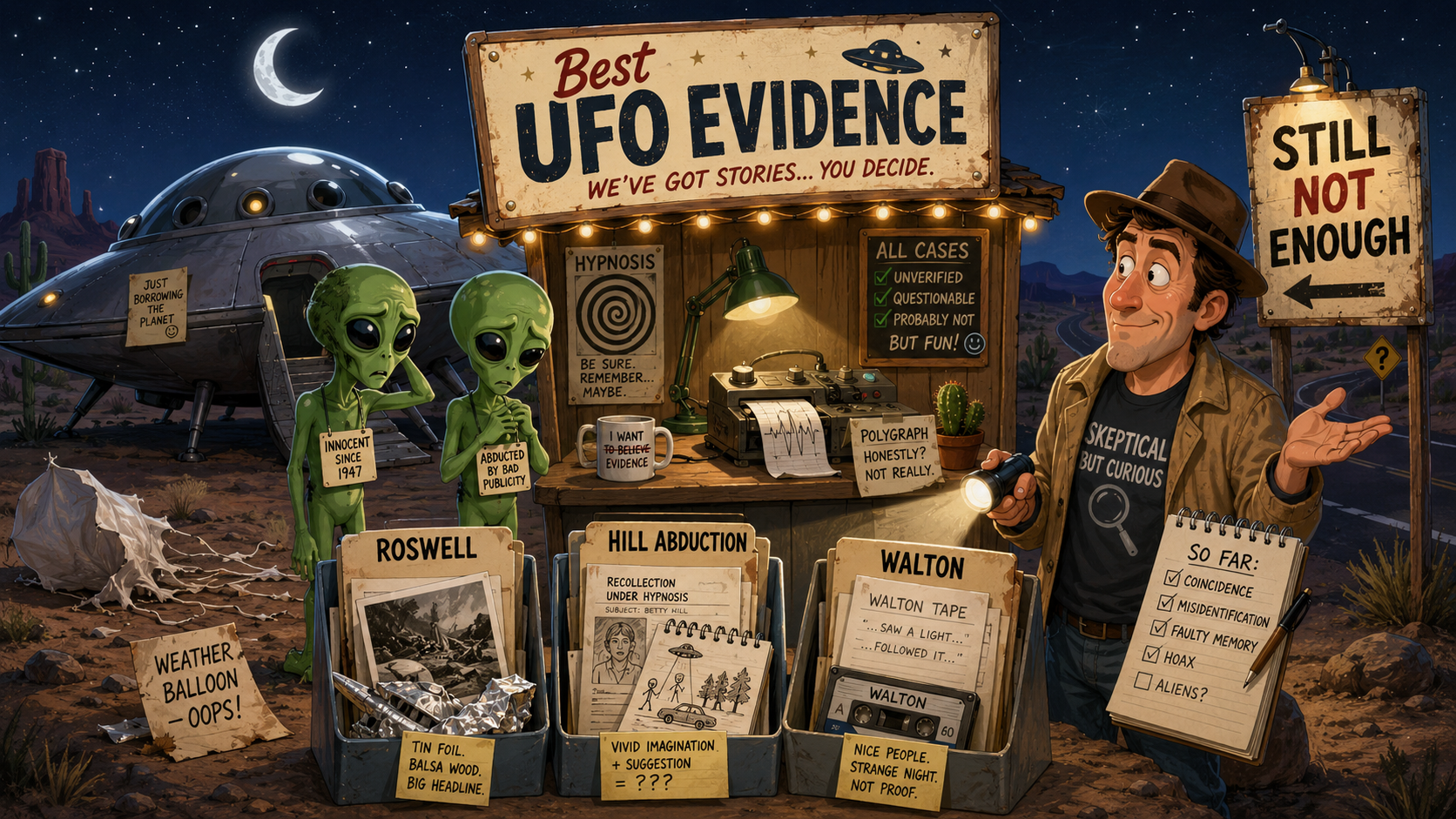
Part one of this series made a simple argument: unidentified does not mean extraterrestrial. The evidence has never risen to the level of the claim. If that argument annoyed you, this one might annoy you more. Because here I am going to give the believers their best cases. The canon. The events that launched a thousand documentaries, filled convention halls and made true believers out of ordinary people. Roswell. Betty and Barney Hill. Travis Walton. These are not fringe stories. These are the flagship cases. The ones believers point to first when someone asks for proof. If the alien hypothesis cannot survive an honest look at these, it cannot survive anything.
It does not survive.
Roswell, 1947: The Crash That Wasn't
In the summer of 1947, something came down on a ranch outside Roswell, New Mexico. Rancher Mac Brazel found wreckage scattered across his property. He reported it to the local sheriff. The Army Air Force sent people out and recovered the debris. On July 8, 1947, the Roswell Army Air Field public information officer issued a press release saying they had recovered a "flying disc." The next day the Army reversed that statement and said it was a weather balloon.
That reversal is the seed of everything. The Army said one thing then said another. To believers, that correction was a cover-up. To anyone thinking carefully, it looks like what it was: a press officer who did not know what he was talking about, corrected by superiors who did.
Project Mogul was a classified program using high-altitude balloon arrays to monitor Soviet nuclear tests by listening for atmospheric shockwaves. The debris Brazel found was almost certainly a Mogul array. The Army did not want to explain Mogul because Mogul was secret. That is a reason to deny the real explanation. It is not a reason to invent an alien one.
The alien mythology around Roswell did not fully take hold until the 1970s and 1980s. The witnesses who described alien bodies did not come forward in 1947. They came forward decades later, in interviews, books and TV appearances. Memory is not a recording. It degrades, shifts and absorbs cultural information over time. By the time most of the alien testimony was collected, Roswell was already a cultural phenomenon. The witnesses had been living inside that story for years.
The Air Force released a comprehensive report in 1994 concluding that the debris was consistent with Project Mogul. A follow-up report in 1997 attributed reports of alien bodies to misremembered test dummies dropped in parachute experiments in the area during the 1950s. Not in 1947. Years later. That gap matters to memory researchers. It does not matter much to believers.
The Roswell case has no verified physical evidence of alien origin. No bodies. No craft. What it has in abundance is mystique, which is a different thing entirely.
The case has attracted people who want it to be true. That wanting is powerful. Powerful enough to turn a classified balloon program into the founding myth of modern UFO culture.
Betty and Barney Hill, 1961: The First Abduction
On the night of September 19, 1961, Betty and Barney Hill were driving home through rural New Hampshire from a vacation in Canada. They reported seeing a strange light in the sky. By their account, they arrived home later than expected and felt disoriented. Betty began having vivid dreams of being taken aboard a craft and examined by humanoid figures. She drew a star map she claimed she saw aboard the ship.
Barney, who was Black, reported severe anxiety and developed an ulcer shortly after. He was already under significant psychological stress related to his work with the NAACP and the social pressures of an interracial marriage in early 1960s America. Both eventually underwent hypnotic regression with a Boston psychiatrist, Dr. Benjamin Simon, who recorded their sessions. Those sessions produced detailed alien abduction narratives that became the foundation of the genre.
Dr. Simon himself did not believe the Hills had been abducted by aliens. He concluded the experience was a shared fantasy, with Betty's vivid dreams influencing Barney's account under hypnosis. This is the conclusion of the treating physician who conducted the sessions and had access to both patients over an extended period.
The scientific consensus on hypnotic regression is not favorable to its use as evidence. The American Psychological Association and the American Medical Association have both cautioned that hypnosis can increase the production of false memories while also increasing the subject's confidence in those memories. A person under hypnosis is suggestible. A therapist who expects to hear about alien abduction is likely to get a narrative that fits that expectation — not because anyone is lying, but because that is how suggestible memory works.
Betty's star map became a point of obsession for believers. In 1969, amateur astronomer Marjorie Fish created a three-dimensional model of nearby stars and argued that Betty's map matched a view from the Zeta Reticuli system. That analysis was contested by other astronomers and has not been accepted as scientifically valid. Pattern-matching in star maps, when you are free to rotate, scale and select which stars to include, is not a rigorous method. You can match almost anything to something.
The Hills were sincere people under real stress. Sincere belief is not evidence of the event believed. It never has been.
Stress-induced sleep disruption, hypnopompic hallucinations and the powerful cognitive effect of shared narrative can produce convincing experiences without any extraterrestrial cause. The honest question is not whether the Hills believed what they said. They did. The question is whether sincere belief constitutes evidence of the event believed. It does not.
Travis Walton, 1975: The Abduction That Passed a Polygraph
On the evening of November 5, 1975, a logging crew in the Apache-Sitgreaves National Forest in Arizona reported that their coworker Travis Walton had been struck by a beam of light from a hovering craft and had vanished. He was missing for five days. When he reappeared, he gave a detailed account of being held aboard a craft and examined by humanoid beings. The crew members passed polygraph examinations. Walton passed a polygraph on his account. The story became the basis for the 1993 film Fire in the Sky. It remains one of the most cited cases in UFO literature.
Polygraphs measure physiological responses to stress, not truth. They are not admissible as evidence in most American courts precisely because they do not reliably distinguish between a liar and an anxious honest person or between a sincere believer in a false story and someone telling the truth. Passing a polygraph while describing an alien abduction proves that you are not panicking while telling the story. It proves nothing about whether the event occurred.
The crew's account also had problems. One crew member, Allen Dalis, failed a polygraph at the time of the original investigation. The original polygraph examiner for the National Enquirer, which had purchased the story rights, concluded that at least one of the witnesses was "definitely lying." That finding received considerably less attention than the polygraph passes.
Walton's story has another layer worth examining. The logging crew was behind on a government contract and faced financial penalties. A dramatic event forcing them off the forest could have provided cover for that failure. This does not prove fabrication. It establishes motive, which is relevant when evaluating any extraordinary claim.
The film version of the story bears little resemblance to what Walton originally described. His original account was not of a terrifying ordeal. It became more terrifying in subsequent retellings and adaptations, in the same direction any story shaped by market forces tends to drift. Scarier sells better than strange but ambiguous.
Passing a polygraph while describing an alien abduction proves you are not panicking while telling the story. Nothing more.
The physical evidence from the Walton case is what it always is in these stories: nothing that survives scientific scrutiny. No craft. No biological trace. No instrument data. No verified physical anomaly that could not be explained by a hoax, a hallucination or a fabricated disappearance.
The Pattern Across All Three
Look at these cases together and the pattern is unmistakable. Each one starts with something genuinely strange or unexplained. A debris field. A disorienting night drive. A missing person. Then the alien explanation is layered on and once it is, everything that follows gets filtered through that frame. Witnesses are interviewed years or decades later, after the alien narrative is already established in culture. Hypnosis is used to recover memories, a technique the scientific community has repeatedly flagged as unreliable. Polygraphs are cited selectively, with the failures buried and the passes promoted. Physical evidence that should exist if the story were true is simply absent and the absence is attributed to government cover-up rather than the more obvious explanation.
In each of these cases, the absence of physical evidence is not treated as evidence against the claim. It is treated as further proof of conspiracy. This is not how any legitimate investigative framework operates. When evidence cannot confirm or falsify a claim, the claim is not scientifically meaningful. It is a belief.
The common thread is not alien contact. It is human psychology applied to unexplained events. Strange things happen. People are frightened or confused. They look for explanations. The explanations available to them come from the culture around them. In 1947, flying saucers had just entered the popular imagination. In 1961, they were all over television and pulp fiction. By 1975, alien abduction was a recognizable cultural script. People who have unexplained experiences reach for the explanations their culture has provided. That is not weakness. That is how minds work. What it is not is evidence of extraterrestrial visitation.
The Evidence Problem Has Not Changed
The believers have had decades with these cases. Documentaries, books, congressional hearings, declassified files and the entire power of the internet applied to finding proof. What has emerged? More stories. More anecdotes. More witnesses who remember things differently than they remembered them before. More photographs that blur on inspection. Not one piece of recovered alien technology. Not one verified biological sample. Not one instrument recording that cannot be explained by something terrestrial. Not one foreign government, independent scientist or international research body that has confirmed extraterrestrial contact using the evidence from any of these cases.
The standard for believing something is not whether you feel it is true. The standard is whether the evidence supports it. The government files that have been released in recent years contain a lot of interesting material about what pilots and sensors detected. They contain very little that moves the needle on the central question. AARO, the Defense Department's current UAP office, has reviewed hundreds of cases and found none that verified extraterrestrial activity. That assessment may be wrong. Institutions have been wrong before. But "the institution may be wrong" is not the same argument as "here is positive evidence that proves the alternative."
Roswell was likely a classified balloon program, not a crashed disc. Betty and Barney Hill were likely experiencing the effects of stress, sleep disruption and hypnotically induced false memory, not alien examination. Travis Walton's disappearance has never been satisfactorily explained, but "not satisfactorily explained" is the beginning of an investigation, not the end of one.
The honest answer to each of these cases is the same answer from Part One: I do not know what happened. Reality is under no obligation to be satisfying. Aliens closes the gap with a satisfying click. That is not how evidence works.
References
Broad, W. J. (1994, September 18). Wreckage in the desert was Soviets' and aliens', U.S. says. The New York Times.
Fuller, J. G. (1966). The interrupted journey: Two lost hours "aboard a flying saucer." Dial Press.
Klass, P. J. (1997). The real Roswell crashed-saucer coverup. Prometheus Books.
McLeod, C. C., Corbisier, B., & Mack, J. E. (1996). A more parsimonious explanation for UFO abduction. Psychological Inquiry, 7 (2), 156–168.
Office of the Secretary of the Air Force. (1994). The Roswell report: Fact versus fiction in the New Mexico desert. U.S. Government Printing Office.
Office of the Secretary of the Air Force. (1997). The Roswell report: Case closed. U.S. Government Printing Office.
Sheaffer, R. (1998). UFO sightings: The evidence. Prometheus Books.
Walton, T. (1978). The Walton experience. Berkley Books.
Disclaimer: The views expressed in this post are personal opinions offered for educational, commentary and public discourse purposes only. They do not represent the positions of any institution, employer or organization with which the author is affiliated. Nothing in this post constitutes professional legal, financial or medical advice. References to public figures, institutions and events are drawn from publicly available sources cited above and are intended to support analysis and commentary, not to make factual claims about individuals beyond what those sources establish. Political and religious commentary reflects the author's protected opinion. Readers are encouraged to consult primary sources and form their own conclusions. Any resemblance to persons or situations beyond those explicitly referenced is coincidental and unintended.